September 25, 2026 · Denver · Aurora · Buying · Selling · Financing
Assumable mortgages in Colorado: when you can take over a seller’s loan, and when you cannot
FHA and VA loans can be assumed with the lender’s and the agency’s approval, at the existing rate and remaining balance. Conventional loans usually cannot. What the official handbooks, the VA circular, and Colorado’s purchase contract actually say — and what still has to be negotiated as equity.
The short answer
In brief: An assumable mortgage transfers a seller's existing loan to the buyer at its remaining principal balance, interest rate and remaining term, but only if the loan documents and the insurer or guarantor allow it and the servicer approves the buyer. It is not a shortcut around qualifying. This guide covers the FHA and VA steps and the equity gap.
An assumable mortgage is not a shortcut around qualifying, and it is not something I can approve as a broker. It is a transfer of an existing loan from the seller to the buyer, at that loan’s remaining principal balance, interest rate, and remaining term, if the loan documents and the insurer or guarantor allow it and if the servicer approves the buyer. HUD’s FHA Single Family Housing Policy Handbook 4000.1, last revised August 12, 2026, and retrieved November 10, 2026, defines the term this way: "Assumption refers to the transfer of an existing mortgage obligation from an existing Borrower to the assuming Borrower."
Most of the assumable first mortgages a Denver or Aurora buyer will actually meet are FHA-insured or VA-guaranteed. A conventional loan usually contains a due-on-sale clause. Federal law, at 12 U.S.C. section 1701j-3(b)(1) (opens in a new tab), the Garn-St. Germain Depository Institutions Act, states: "Notwithstanding any provision of the constitution or laws (including the judicial decisions) of any State to the contrary, a lender may, subject to subsection (c), enter into or enforce a contract containing a due-on-sale clause with respect to a real property loan." Whether a particular conventional note can be assumed, or whether a due-on-sale clause can be enforced, is a question for the lender and, if needed, for an attorney. It is not a casual workaround.
Even when a loan is assumable, two other numbers still have to work. One is the remaining loan balance, which is what the buyer would take over. The other is the purchase price. If the price is higher than the balance, the difference is the seller’s equity, and it has to be paid in the contract — in cash, with a second loan, or some other lawful arrangement — because assuming the existing loan does not, by itself, pay the seller for that equity. HUD’s handbook, quoted later, says the assuming FHA borrower is not required to make a cash investment toward the assumed principal; that is a rule about the FHA loan, not a rule that the seller must give the house away for the remaining balance.
I am a licensed Colorado real estate broker with Call It Closed International Realty. I am not a lender, a loan originator, an attorney, or a tax advisor. I keep a separate assumable-mortgage page for how I work with buyers and sellers who want to look at this path. This article is the official-rule companion to that page. It is not an approval of any assumption and not lending or legal advice.
Disclaimer. This article is general information only. It is not legal, tax, lending, insurance, appraisal, inspection, or financial advice, and reading it does not create a client, agency, or attorney-client relationship. Laws, rates, programs, and figures change. Confirm the official source, and talk with a licensed attorney, tax professional, lender, insurance agent, or inspector before you act. Joshua Wei is a Colorado real estate broker, not an attorney. He is an Associate Broker with Call It Closed International Realty, license FA.100108558. Equal Housing Opportunity.
 Full size (opens in a new tab)
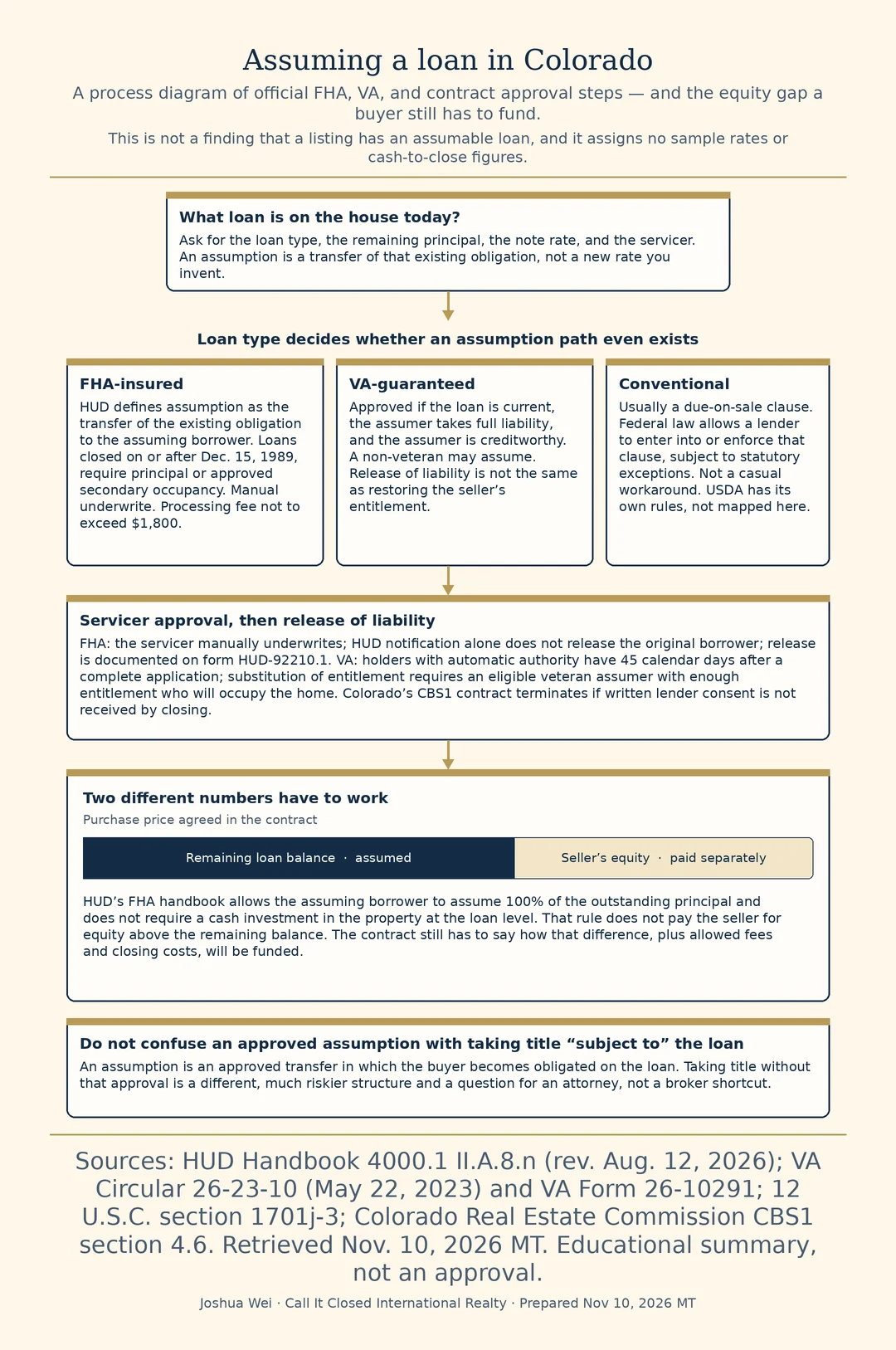
A vertical process diagram, cream background and navy type, of official steps for assuming a mortgage in Colorado. It starts by identifying the existing loan, then splits three loan-type cards: FHA-insured assumptions with a manual underwrite and a processing-fee cap of $1,800; VA-guaranteed assumptions if the loan is current and the assumer is creditworthy, noting that a non-veteran may assume and that release of liability is not the same as restoring entitlement; and conventional loans, which usually have a due-on-sale clause a lender may enforce. A lower box covers servicer approval and release of liability, including VA’s 45-day clock and the Colorado contract’s requirement of written lender consent by closing. A bar diagram shows the remaining loan balance as the assumed portion of the purchase price and the seller’s equity as an amount paid separately. A final card distinguishes an approved assumption from taking title subject to the loan. Sources: HUD Handbook 4000.1, VA Circular 26-23-10, 12 U.S.C. section 1701j-3, and Colorado CBS1 section 4.6, retrieved November 10, 2026 MT.
Sources: HUD Handbook 4000.1, Update 18 (opens in a new tab); VA Circular 26-23-10 (opens in a new tab); 12 U.S.C. section 1701j-3 (govinfo) (opens in a new tab); Colorado Division of Real Estate, broker contracts and forms (opens in a new tab)
Cream background, navy text, gold rules. A vertical process: identify the loan; three loan-type cards; servicer approval and release; a horizontal bar dividing an assumed remaining balance from seller’s equity; a caution against taking title subject to the loan. Footer cites official sources at 28px, prepared November 10, 2026 MT.
The diagram above is a map of the official approval path, not a promise that a given listing has an assumable loan. It starts with the loan type, then the servicer’s credit review, then release of liability and, for a VA loan, substitution of entitlement, and it flags the equity gap between the purchase price and the remaining balance. It assigns no sample rates and no typical cash-to-close figures.
How does Colorado’s purchase contract treat an assumption?
The Commission-approved Contract to Buy and Sell Real Estate (Residential), CBS1, mandatory beginning January 1, 2026, has a dedicated assumption section. I used the official form from the Division of Real Estate contracts and forms page (opens in a new tab), retrieved November 10, 2026. Section 4.6 states: "Buyer agrees to assume and pay an existing loan in the approximate amount of the Assumption Balance set forth in section 4.1. (Price and Terms)." The same section lets the parties fill in a not-to-exceed transfer fee, a not-to-exceed new interest rate, and a not-to-exceed new payment, and it gives the buyer a right to terminate on or before the Closing Date "If the actual principal balance of the existing loan at Closing is less than the Assumption Balance, which causes the amount of cash required from Buyer at Closing to be increased by more than" the filled-in amount, "or if any other terms or provisions of the loan change."
Release of the seller is a checked box, not an automatic result. Section 4.6 states: "Seller Will Will Not be released from liability on said loan." In that quotation, "Will" and "Will Not" are the form’s two checkboxes. If a release is required, "compliance with the requirements for release from liability will be evidenced by delivery on or before Loan Transfer Approval Deadline at Closing of an appropriate letter of commitment from lender." Section 4.6 then states: "This Contract terminates if written consent from Seller’s lender for Buyer’s assumption of Seller’s existing loan is not received by all parties and the Closing Company on or before Closing."
Section 5.4 adds a related clock. If the lender’s approval of a transfer is required, "this Contract is conditional upon Buyer obtaining such approval without change in the terms of such loan, except as set forth in section 4.6. If lender’s approval is not obtained by Loan Transfer Approval Deadline, this Contract will terminate on such deadline." The seller also has a right to terminate on or before Closing, "if Seller is to be released from liability under such existing loan and Buyer does not obtain such compliance as set forth in section 4.6." Those sentences are why an assumption has to be written into the contract with dates, caps, and a release box, and then actually approved, rather than described in an email as "we’ll just take over the loan."
What does FHA require?
HUD Handbook 4000.1, section II.A.8.n, "Assumptions," dated August 19, 2024, in the edition last revised August 12, 2026, is the current FHA rule set I used. Occupancy depends on the original closing date. The handbook states: "If the original Mortgage was closed on or after December 15, 1989, the assuming Borrower must intend to occupy the Property as a Principal Residence or HUD-approved Secondary Residence." If the original mortgage closed before that date, the assuming borrower "may assume the Mortgage as a Principal Residence, HUD-approved Secondary Residence or Investment Property." Investment-property assumptions, where they are allowed, have a maximum loan-to-value of 75 percent; a HUD-approved secondary residence has a maximum of 85 percent.
Approval is not informal. The handbook states that "Assuming Borrowers must be underwritten in accordance with Origination through Post-closing/Endorsement," with a listed set of origination steps that do not apply, and that "The TOTAL Mortgage Scorecard must not be used for assumptions. The DE underwriter must manually underwrite the assumption." The holding or servicing mortgagee is responsible for that review. Notification to HUD "does not formally release the original Borrower from personal liability for the mortgage Note." Release, when it is completed, is documented on form HUD-92210.1, Approval of Purchaser and Release of Seller, "thereby releasing the original owner when they sell by assumption to the assuming Borrower who executes an agreement to assume the Mortgage and to pay the debt."
On cash at the loan level, the handbook states: "The assuming Borrower is not required to make a cash investment in the Property. The assuming Borrower may assume 100 percent of the outstanding principal balance of the Mortgage, subject to the restrictions on LTV ratio for Investment Properties and HUD-approved Secondary Residences." That sentence is about the FHA principal being assumed. It does not cancel the purchase-price-minus-balance equity that the contract still has to address. On fees, the handbook states: "Mortgagees may charge the assuming Borrower a processing fee that is reasonable and customary not to exceed a maximum of $1,800." Other allowable costs may also be charged under the handbook’s separate fee rules. There are also narrow exceptions, including certain transfers by devise or descent, or some divorce transfers, that can be processed without a credit review when the handbook’s conditions are met. Those exceptions are fact-specific. A sale to an unrelated buyer is not one of them.
FHA mortgage insurance does not disappear because the loan changed hands. Whether premiums continue, and on what terms, is a question for the servicer under current FHA rules, not a number I will invent here.
What does VA require?
VA’s rules are in statute and regulation, and they were restated in VA Circular 26-23-10 (opens in a new tab), "VA Assumption Updates," dated May 22, 2023, retrieved November 10, 2026. The circular states: "VA statute and regulations require an assumption be approved if: a. The loan is current, and b. The assumer is contractually obligated to purchase the property and to assume full liability, and c. The assumer is creditworthy under VA’s credit and underwriting standards." The footnote cites 38 U.S.C. section 3714 (opens in a new tab) and 38 C.F.R. sections 36.4303(l) and 36.4340.
A non-veteran can be the assumer. VA Form 26-10291, Assumption Entitlement Acknowledgment, retrieved November 10, 2026, states: "Any qualified purchaser (including a non-Veteran) may assume the remaining balance of your VA-guaranteed loan. The purchaser must meet VA's credit and income underwriting standards and the loan must be current at the time of closing." It also states: "One feature of your Department of Veterans Affairs (VA)-guaranteed loan is that the loan is assumable."
Release of liability and restoration of the seller’s VA entitlement are not the same event. The circular states: "An assumption involves the transfer of ownership and release of liability of a VA-guaranteed loan. An assumption may be processed with or without a substitution of entitlement." Without substitution, "The original Veteran’s entitlement remains encumbered by the loan until the loan is paid in full. The seller would not receive a restoration of entitlement." With substitution, "If the assumer is an eligible Veteran who intends to occupy the property as their home and has sufficient entitlement, they may agree to substitute their entitlement for the seller’s entitlement. The seller would receive a restoration of entitlement." Form 26-10291 states the same point in consumer language: "If the assumption is approved, you will no longer be responsible for the mortgage payment on the VA-guaranteed loan. However, your entitlement will still be tied to the loan unless the assumption includes a SOE." "Enough entitlement," the form states, "means the assumer(s) has at least the same amount of entitlement available as the amount of entitlement originally used to guaranty the loan being assumed."
Timing and fees are also specified. Holders or servicers with automatic authority "shall process and decide assumption applications for loans they hold or service within 45 calendar days of receipt of a complete application." A disapproval may be appealed to VA within 30 calendar days by the seller or the assumer. The circular states: "The holder or servicer may charge an assumption processing fee not to exceed $300 on assumptions processed by holders or servicers with automatic authority, or $250 on assumptions that require VA prior approval." A VA funding fee can also apply unless the assumer is exempt; whether a particular assumer is exempt, and what the current fee is, is a question for the servicer and VA, not a figure I will invent here. A seller who needs the entitlement restored in order to buy another house with a VA loan should not treat an approved assumption as automatically solving that problem.
What about a conventional loan, or taking title "subject to" the mortgage?
A conventional loan is usually a due-on-sale problem, not an FHA- or VA-style assumption path. As already quoted, 12 U.S.C. section 1701j-3(b)(1) allows a lender, subject to subsection (c), to enter into or enforce a due-on-sale clause. Subsection (a)(1) defines that clause as "a contract provision which authorizes a lender, at its option, to declare due and payable sums secured by the lender’s security instrument if all or any part of the property, or an interest therein, securing the real property loan is sold or transferred without the lender’s prior written consent." Subsection (d) lists certain transfers in which a lender may not exercise the option. Whether a given clause, exception, or proposed assumption of a conventional loan is available is a legal and lending question. I cannot waive a due-on-sale clause, and I cannot tell you that a conventional loan is assumable because interest rates have changed.
Taking title "subject to" an existing loan, without an approved assumption, is a different and much riskier structure. The original borrower may remain liable, the lender may have a right to call the loan, and the buyer may have no contract with the servicer. That is not something I can approve or structure as a broker. If someone proposes it, the next conversation belongs with an attorney and, as needed, the servicer.
USDA Rural Development loans have their own transfer and assumption rules. I am not restating those rules here because I did not obtain a complete official USDA handbook excerpt in this research pass. If the loan is USDA, ask a USDA-approved lender or Rural Development, and do not import FHA or VA procedures onto that file.
CHFA down-payment second mortgages are a separate caution. CHFA’s Home Finance CHFA Sellers Guide, retrieved November 10, 2026, states: "CHFA Second Mortgage Loans are not assumable." A buyer looking at a house with a CHFA first mortgage should also ask the participating lender and CHFA Loan Servicing what can, and cannot, be assumed.
What else has to be true for the numbers to work?
The official approval and the purchase contract still have to close on the same facts. The buyer has to be creditworthy under the program rules already quoted. The loan generally has to be current, at least for a VA assumption, as the circular and Form 26-10291 require. The parties have to agree on a purchase price, and on how any equity above the remaining balance will be paid. Title work, a closing company, and, where the contract requires them, an appraisal, insurance, and inspections still exist. The Consumer Financial Protection Bureau has explained, in a TILA-RESPA factsheet (opens in a new tab) on assumptions, that when a transaction is an "assumption" as defined in Regulation Z, 12 C.F.R. section 1026.20(b) — "when a creditor expressly agrees in writing to accept a new consumer as a primary obligor on an existing residential mortgage transaction" — the creditor may have to provide a Loan Estimate and Closing Disclosure based on the remaining obligation. That is a disclosure rule for the creditor, not a substitute for program approval.
Assumptions also take time. VA’s 45-day clock, already quoted, is a servicer deadline after a complete application, not a promise that the contract’s Loan Transfer Approval Deadline can be set casually. FHA’s review is a manual underwrite. If the written consent required by CBS1 section 4.6 does not arrive, the contract terminates on the terms already quoted. None of that is a reason to avoid the tool. It is a reason to treat it as a dated, approved transfer, not as a handshake.
What this article does not do
It does not list homes in Denver or Aurora that currently have assumable loans, and it does not estimate how much interest a buyer would "save." Those figures depend on the actual note rate, the remaining term, the price, and the equity. It does not say that every FHA or VA loan is a good assumption, or that a seller should accept one. It does not interpret a disputed due-on-sale clause, a "subject-to" proposal, or a missing release. I can help you read a listing, a note, and a CBS1 assumption section with the other side’s broker, and I can tell you when the next question belongs with the servicer, a lender, or an attorney.
Frequently asked questions
Are all FHA and VA loans assumable?
FHA’s handbook treats assumption as an FHA program feature, with occupancy and underwriting rules that depend in part on whether the loan closed before or after December 15, 1989. VA’s circular and Form 26-10291 describe assumability as a feature of a VA-guaranteed loan, with credit review and a current-loan requirement. In both cases the servicer still has to approve the assuming borrower, except in the narrow handbook exceptions already noted. Do not skip that review.
Can a buyer who is not a veteran assume a VA loan?
Yes, if the buyer qualifies. Form 26-10291, already quoted, states that any qualified purchaser, including a non-veteran, may assume the remaining balance. The seller’s entitlement, however, remains tied to the loan unless an eligible veteran assumer completes a substitution of entitlement.
If the assumption is approved, is the seller automatically released?
Not by silence. FHA release is documented on form HUD-92210.1, as the handbook states, and HUD notification alone "does not formally release the original Borrower." VA’s circular treats release of liability as part of an approved assumption, and treats substitution of entitlement as a separate question. CBS1 section 4.6 makes release a checkbox and requires a letter of commitment when a release is part of the bargain. Read the form, the servicer’s commitment, and, if needed, an attorney’s advice.
Does assuming a loan mean I do not need cash?
Not usually. HUD’s handbook allows an FHA assuming borrower to assume 100 percent of the outstanding principal and does not require a cash investment in the property at the loan level. If the purchase price is higher than that principal, the difference still has to be paid under the contract. Closing costs and any allowed transfer fee are additional. CBS1 section 4.6 even gives the buyer a termination right if a lower-than-expected remaining balance increases the cash required by more than the filled-in amount.
Can I assume a conventional loan at the seller’s rate?
Usually not as a matter of right. A conventional loan typically includes a due-on-sale clause, and 12 U.S.C. section 1701j-3, already quoted, allows a lender to enter into or enforce such a clause, subject to the statute’s own exceptions. Ask the servicer and, if needed, an attorney. Do not treat a low note rate as proof that the loan is assumable.
Is taking the house "subject to" the existing mortgage the same as an assumption?
No. An assumption, in the sense used by HUD, VA, and Regulation Z, is an approved transfer in which the new borrower becomes obligated on the loan. "Subject to" without that approval is a different structure and a legal question I cannot settle in a blog post.
Related notes
- Buying in Denver or Aurora with a VA loan: funding fee, seller concessions, appraisal, and the contract's VA clause
- CHFA first-time buyer programs in Denver and Aurora: what the 2026 limits and assistance options actually say
Sources and method
FHA assumption rules, including the definition, the December 15, 1989, occupancy line, manual underwriting, release on form HUD-92210.1, the 100 percent principal rule, and the $1,800 fee cap, are from HUD Handbook 4000.1, section II.A.8.n, "Assumptions (08/19/2024)," in the edition last revised August 12, 2026, retrieved November 10, 2026 from HUD’s Handbook 4000.1 publication (opens in a new tab). VA rules are from VA Circular 26-23-10 (opens in a new tab) (May 22, 2023) and from VA Form 26-10291 (opens in a new tab), both retrieved November 10, 2026, and from the statute those documents cite, 38 U.S.C. section 3714 (opens in a new tab). Due-on-sale language is quoted from the official 2023 United States Code text of 12 U.S.C. section 1701j-3 (opens in a new tab) at govinfo. Contract language is from the Colorado Real Estate Commission’s CBS1, Adoption Date August 5, 2025, Mandatory Use Date January 1, 2026, downloaded from the Division of Real Estate contracts and forms page (opens in a new tab) on November 10, 2026. The TILA-RESPA assumption definition is from the CFPB factsheet (opens in a new tab) on whether Loan Estimates and Closing Disclosures are required for assumptions, retrieved November 10, 2026, quoting 12 C.F.R. section 1026.20(b). The CHFA second-mortgage statement is from the Home Finance CHFA Sellers Guide, retrieved November 10, 2026. This is an educational summary of those official documents, not an underwriting decision, not a completed contract, and not legal or lending advice.
This note is general education from a Colorado real estate broker with Call It Closed International Realty. If you want to look at a specific Denver or Aurora house with an existing FHA or VA loan, I can help you read the listing, the contract’s assumption section, and the questions that belong with the servicer.
Disclaimer
This article is general information only. It is not legal, tax, lending, insurance, appraisal, inspection, or financial advice, and it is not a substitute for advice about your situation. Joshua Wei is a Colorado real estate broker, not an attorney. Reading this article does not create a client relationship, an agency relationship, or an attorney-client relationship with Joshua Wei or with Call It Closed International Realty.
Laws, program rules, interest rates, insurance terms, tax figures, and other details change. Examples in this article are hypothetical illustrations unless a source is named for a specific, dated figure. Information in this article is believed accurate as of November 13, 2026 and is not guaranteed. No result is promised, and you should not rely on this article as the last word for your situation.
Before you act, confirm the point with the official source linked or cited in this article, and talk with a licensed professional who can apply the rule to your facts. That may be a licensed attorney, a tax professional, a lender, an insurance agent, a home inspector, or another licensed professional, depending on the question. Links to third-party websites and publications are provided for reference only. They are not an endorsement, and their content can change.
If you already have a brokerage relationship with another broker, this is not a solicitation.
Joshua Wei, Associate Broker, Call It Closed International Realty, Colorado license FA.100108558. Equal Housing Opportunity.