September 24, 2026 · Denver · Aurora · Buying · Financing
CHFA first-time buyer programs in Denver and Aurora: what the 2026 limits and assistance options actually say
Colorado Housing and Finance Authority first mortgages and down-payment assistance have published income and price limits, and they are not limited to first-time buyers in every program. How the 2026 chart and the official Seller’s Guide actually work — and what a participating lender still has to apply to your file.
The short answer
In brief: CHFA, the Colorado Housing and Finance Authority, does not take loan applications itself. A participating lender originates a CHFA first mortgage, and CHFA down payment assistance can only be used when paired with that first mortgage. Not every CHFA purchase program is limited to first-time buyers. Programs have published income limits, and some also have purchase-price limits.
Colorado Housing and Finance Authority, or CHFA, is the state’s housing-finance agency. It does not take your loan application itself. A CHFA participating lender (opens in a new tab) originates a first mortgage under a CHFA program and, if you also use assistance, pairs it with a CHFA down-payment grant or second mortgage. CHFA’s homeownership flyer (07/25.v7) (opens in a new tab), retrieved November 10, 2026, says: "CHFA down payment assistance can only be used when paired with a first mortgage loan under a CHFA program."
Not every CHFA purchase program is limited to first-time buyers. CHFA’s Home Finance CHFA Sellers Guide, retrieved the same day from CHFA’s participating-lender forms page, states that "The CHFA Preferred product is not restricted to First-time Homebuyers" and that "The CHFA SmartStep Program is not restricted to First-time Homebuyers." By contrast, "The CHFA FirstStep Program is restricted to First-time Homebuyers," subject to stated exceptions for a qualified veteran or a purchase in a targeted area. A first-generation program is narrower still. The official CHFA Home Finance Program Income Limits chart, effective November 2, 2026, then applies different income definitions and, on some programs, a purchase-price cap. In Denver, Arapahoe, and Adams Counties, several commonly used programs show a $178,920 qualifying-income limit, and the programs that have a purchase-price limit show $832,750.
Those figures are published limits, not a determination that you qualify. A participating lender has to apply the current chart, the current Seller’s Guide, and the insurer or guarantor rules — FHA, VA, USDA, Fannie Mae, or Freddie Mac — to your household and to the house. This article walks through what those official documents actually say, so you can have a more precise conversation with that lender. It is not a loan offer, not an underwriting decision, and not lending advice.
I am a licensed Colorado real estate broker with Call It Closed International Realty. I am not a lender, a loan originator, an attorney, or a tax advisor. Questions about whether a CHFA program fits your income, credit, or tax situation belong with a participating lender and, for tax questions, with a tax advisor.
Disclaimer. This article is general information only. It is not legal, tax, lending, insurance, appraisal, inspection, or financial advice, and reading it does not create a client, agency, or attorney-client relationship. Laws, rates, programs, and figures change. Confirm the official source, and talk with a licensed attorney, tax professional, lender, insurance agent, or inspector before you act. Joshua Wei is a Colorado real estate broker, not an attorney. He is an Associate Broker with Call It Closed International Realty, license FA.100108558. Equal Housing Opportunity.
 Full size (opens in a new tab)
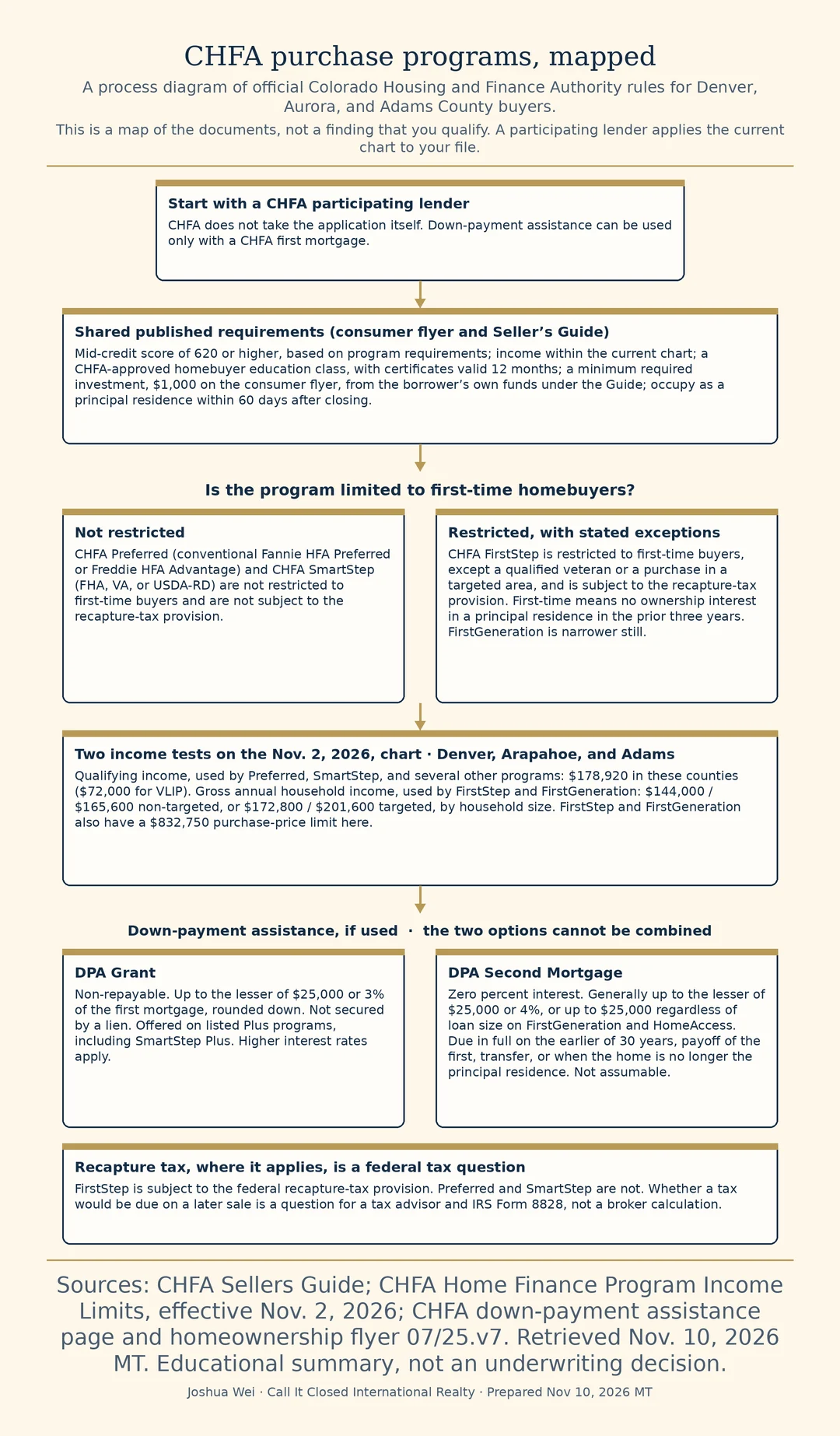
A vertical process diagram, cream background and navy type, mapping official CHFA purchase-program rules for Denver, Aurora, and Adams County buyers. It starts with a CHFA participating lender, then shared requirements (a mid-credit score of 620 or higher based on program rules, income limits, a CHFA-approved education class with a 12-month certificate, a minimum required investment, and occupancy as a principal residence within 60 days). It splits programs that are not restricted to first-time buyers (Preferred and SmartStep, not subject to recapture) from FirstStep, which is restricted with veteran and targeted-area exceptions and is subject to recapture. A box shows two income tests on the November 2, 2026, chart, including a $178,920 qualifying-income limit and FirstStep and FirstGeneration gross-income and $832,750 purchase-price figures for these counties. Two cards compare a down-payment grant (up to the lesser of $25,000 or 3 percent, non-repayable) with a zero-percent second mortgage (generally up to the lesser of $25,000 or 4 percent, due in full on stated events, not assumable). A final box states that recapture tax, where it applies, is a question for a tax advisor and IRS Form 8828. Source: CHFA Sellers Guide, Income Limits effective November 2, 2026, and CHFA consumer pages, retrieved November 10, 2026 MT.
Sources: CHFA, Homeownership (opens in a new tab); CHFA, Down Payment Assistance (opens in a new tab); CHFA, programs, forms, and matrices (Seller’s Guide) (opens in a new tab)
Cream background, navy text, gold rules. A vertical stack of process cards: start with a participating lender; shared requirements; a two-column split of programs not restricted to first-time buyers versus FirstStep and FirstGeneration; a box of November 2, 2026, income and price limits for Denver, Arapahoe, and Adams Counties; two cards comparing a DPA grant and a DPA second mortgage; a recapture-tax caution. Footer cites CHFA official documents retrieved November 10, 2026 MT, with a source label at 28px.
The diagram above is a map of the official CHFA documents, not a shortcut around a lender’s review. It groups the shared borrower requirements, the first-time and first-generation definitions, the two income tests on the November 2, 2026, chart, and the difference between a down-payment grant and a second mortgage. It does not decide which program you should use.
How do I start a CHFA loan?
You start with a participating lender, not with me and not with a CHFA "application" I can submit for you. CHFA’s homeownership page (opens in a new tab), retrieved November 10, 2026, points buyers to that statewide lender list. The consumer homeownership flyer dated 07/25.v7, retrieved the same day, lists these general borrower requirements: "Have a mid-credit score of 620 or higher (based on program requirements)"; "Total borrower(s) income must not exceed CHFA’s income limits"; "All borrowers must attend a CHFA-approved homebuyer education class"; and "Make a minimum required investment of $1,000 toward the purchase of the home". The same flyer notes: "Higher interest rates apply." A mid-credit-score floor that is "based on program requirements" is not a promise that 620 is enough on every file.
The Seller’s Guide adds detail that the flyer summarizes. On education, it states: "CHFA requires all Borrowers and Co-Borrowers, except for permitted refinance loans, to individually complete an online or classroom-based CHFA-approved Homebuyer Education course, provided by a CHFA-approved provider." It also states: "Homebuyer Education Certificates are valid for 12 months. To meet the Homebuyer Education requirement, Borrowers must execute a purchase contract prior to expiration of the Homebuyer Education Certificate." On occupancy, section 201.E states: "All Borrowers must intend to, and must, occupy the Property as their Principal Residence within 60 days after the Closing Date." On the minimum contribution, the Guide states that CHFA "requires the Minimum Borrower Financial Contribution to be from the Borrower’s own funds," with limited gift rules, and that it "cannot come from the proceeds of any subordinate Mortgage Loan, or from any new debt acquired by the Borrower, including credit card debt." The Guide also lists items paid outside of closing — including an earnest-money deposit and a "Home inspection fee, including fees paid for additional inspection services, such as sewer scopes, or structural engineer’s report" — that "may be counted toward the Minimum Borrower Financial Contribution if documented on the Closing Disclosure."
Those are CHFA’s published rules. A participating lender still has to apply the insurer or investor overlays and the current program matrix to the file.
What does "first-time homebuyer" actually mean here?
It is a defined term, not a casual description of someone who feels new to buying. Section 201.B of the Seller’s Guide states: "A First-time Homebuyer is a Borrower who has had no present ownership interest in the Borrower’s principal residence at any time during the three-year period ending on the date the mortgage is executed (i.e., the Mortgage Loan Closing Date)." The same subsection states that first-time programs "may also be available to individuals who are not First-time Homebuyers if for the purchase by a Qualified Veteran (see definition) of such individual’s principal residence in Colorado or for the purchase of the Borrower’s Principal Residence located in a Targeted Area in Colorado."
First-generation is narrower. Section 201.C states: "A First-generation Homebuyer is any Borrower who has never owned a home and whose parents or guardians never owned a home during the homebuyer’s lifetime." It adds: "Borrowers who have lived in the foster care system do not need to be First-generation Homebuyers but must have never owned a home." Whether a particular household meets either definition is a question for the participating lender, not a label I can apply from a blog post.
Which programs are limited to first-time buyers, and which are not?
The Seller’s Guide answers that program by program. CHFA Preferred is a conventional first mortgage — Fannie Mae HFA Preferred or Freddie Mac HFA Advantage — and, as already quoted, "is not restricted to First-time Homebuyers." Preferred Plus is the same first mortgage with a CHFA down-payment second mortgage. Those loans "are not subject to the Recapture Tax Provision."
CHFA SmartStep is a government first mortgage. The Guide states that acceptable loan types "include FHA, FHA 203(k), VA, and USDA-RD purchase loans." SmartStep Plus "includes either the CHFA DPA Grant or CHFA DPA Second Mortgage Loan." As already quoted, SmartStep "is not restricted to First-time Homebuyers" and loans in the program "are not subject to the Recapture Tax Provision."
CHFA FirstStep is the first-time, tax-exempt-bond program. The Guide states: "The CHFA FirstStep Program is restricted to First-time Homebuyers, subject to the following exceptions: purchase by a Qualified Veteran (see definition) of such individual’s Principal Residence in Colorado or purchase of the Borrower’s principal residence located in a Targeted Area in Colorado. Mortgage Loans originated in this Program are subject to the Recapture Tax Provision. This Program has Income and Purchase Price Limits, which are available on the website at chfainfo.com." The first mortgage "must have a 30-year term, a fixed Interest Rate, and be fully amortizing." Acceptable loan types "include FHA 203(b) purchase loans only." FirstStep Plus adds the down-payment second mortgage. The Guide also states: "The CHFA FirstStep Program may not be combined with any Mortgage Credit Certificate (MCC) Program."
CHFA FirstGeneration is limited to first-generation buyers as defined above, with the foster-care exception. CHFA HomeAccess is not a first-time-only label; it is restricted to buyers who, in the Guide’s words, "live with a permanent disability" or who are the custodial parent or legal guardian of an individual living with a permanent disability, with occupancy conditions set out in section 308. Other named programs, including Schools To Home, Section Eight Homeownership, Colorado Champions, and Colorado HFA1, have their own matrices on CHFA’s programs and forms page (opens in a new tab). I am not ranking those programs, and I am not saying which one you should use.
How do the November 2026 income and purchase-price limits work?
They are not one number for every program. The official CHFA Home Finance Program Income Limits chart, effective November 2, 2026, and retrieved November 10, 2026, splits the programs into columns that use different income definitions.
For CHFA Preferred — including the Very Low Income Program, or VLIP — and for SmartStep, HomeAccess, Schools To Home, Section Eight, and Colorado HFA1, the chart uses "Qualifying Income." Footnote 3 of that chart states: "Only the income utilized by the Participating Lender for purposes of credit qualifying the borrower(s) will be required for purposes of determining eligibility under CHFA’s Income Limits." For Denver, Arapahoe, and Adams Counties, the November 2, 2026, chart shows $178,920 in that column for those programs, except VLIP, which shows $72,000. Colorado Champions, in a separate qualifying-income column, shows $196,810 in those same counties.
For FirstStep and FirstGeneration, the chart uses "Gross Annual Income," and it splits 1-to-2-person and 3-or-more-person households, and targeted and non-targeted areas. Footnote 4 states that this figure is "Equal to the current total gross annual income for all loan applicants [i.e., borrower(s) and coborrower(s)], any spouse or civil union partner of any borrower or co-borrower who will reside in the residence, and any other individual who is expected to both live in the residence and to be secondarily liable on the Mortgage Loan. All sources of income for all such individuals must be included." In Denver, Arapahoe, and Adams Counties, the November 2, 2026, chart shows non-targeted limits of $144,000 for a 1-to-2-person household and $165,600 for a 3-or-more-person household, and targeted limits of $172,800 and $201,600, respectively.
Purchase-price limits do not apply to every program. Footnote 1 of the chart, which applies to the qualifying-income programs, states: "No purchase price limits. However, maximum total loan limit (including financed MIP, MI, Funding Fee, or Guarantee Fee, as applicable) may not exceed lower of $832,750 or limit required by loan type." Footnote 2, which applies to FirstStep and FirstGeneration, states: "Purchase price limits apply. However, maximum loan limit may not exceed lower of 1) $832,750 or 2) limit required by loan type, and may never exceed purchase price limits." In Denver, Arapahoe, and Adams Counties, the chart shows a $832,750 purchase-price limit in both the targeted and non-targeted columns. That cap is a program limit, not a statement about October’s metro median or about what any one house is worth.
Jefferson and Boulder Counties are on the same chart and are not identical in every column. If you are buying outside Denver, Aurora, or Adams County, read the row for that county with the lender. Limits change; the chart’s effective date is the date to check, not this article.
How does CHFA down-payment assistance work?
It is optional, it is not automatic, and you cannot stack the two main forms in one transaction. Section 304 of the Seller’s Guide states: "CHFA Down Payment Assistance options may not be combined in a single loan transaction (i.e., a Borrower may not receive both a CHFA DPA Grant and a CHFA Second Mortgage Loan)."
The grant, where it is offered, is described in the Guide as "non-repayable" and as an amount that "may not exceed the lesser of $25,000 or 3 percent of the CHFA First Mortgage Loan’s OPB, rounded down to the nearest dollar," including financed mortgage insurance or funding fees as applicable. It "will not be secured by a lien." The Guide lists the grant on SmartStep Plus and Section Eight Homeownership Plus. CHFA’s consumer down-payment assistance page states the same cap as "Up to the lesser of $25,000 or 3 percent of your first mortgage" and "No repayment required," and it flags that "Higher interest rates apply."
The second mortgage is different. The Guide states that these loans "have a zero percent Interest Rate." For Preferred, SmartStep, Section Eight, FirstStep, Colorado HFA1, and Colorado Champions, the amount "may not exceed" "the lesser of $25,000 or 4 percent of the CHFA First Mortgage Loan’s OPB rounded down to the nearest dollar." For FirstGeneration and HomeAccess, the Guide states: "Maximum of $25,000 regardless of CHFA First Mortgage Loan’s OPB." For Schools To Home, it is "up to 25% of the CHFA First Mortgage Loan’s OPB rounded down to the nearest dollar (including financed MIP)." The consumer page describes the second mortgage as "Up to the lesser of $25,000 or 4 percent of your first mortgage" and states that "individuals living with a permanent disability or first-generation homebuyers can access specific programs offering up to $25,000 regardless of first mortgage amount."
Repayment of the second is deferred, not forgiven. The Guide states: "Payment on the CHFA DPA Second Mortgage Loan is due in full on the earlier of (i) 30 years from the date of the CHFA DPA Second Mortgage Loan; (ii) the date the Promissory Note, secured by the First Deed of Trust encumbering the Property is paid in full, either by voluntary prepayment, acceleration, or foreclosure; (iii) the date the Borrower assigns, transfers, or conveys all or any part of his/her interest in the Property; or (iv) the date the Borrower ceases to occupy the Property as his/her Principal Residence." The consumer page summarizes the same idea as repayment "deferred until certain events, such as payoff of your first mortgage, or the sale or refinance of the home, or the home is no longer your primary residence." The Guide also states: "CHFA Second Mortgage Loans are not assumable."
Neither the grant nor the second mortgage can be used to fund CHFA’s minimum borrower contribution, to pay off debt, to fund escrow repairs, or to cover a gap between the appraised value and the sales price. The exact amount, if any, is determined by the participating lender from the cash needed to close, after that minimum contribution.
What is the recapture tax, and who has to think about it?
It is a federal tax topic, not a CHFA fee I can calculate for you. Section 1100 of the Seller’s Guide states: "The Internal Revenue Code’s recapture tax requirements apply to Borrowers who receive the benefits associated with a Mortgage Loan funded by Tax-exempt Mortgage Revenue Bonds, either through a lower mortgage Interest Rate than what is customarily charged on other Mortgage Loans, or through receipt of a credit against their federal income taxes via a Mortgage Credit Certificate (MCC). Such Borrowers may be subject to recapture of those benefits under certain circumstances as described in this Chapter." FirstStep loans, as already quoted, "are subject to the Recapture Tax Provision." Preferred and SmartStep loans, as already quoted, are not.
The IRS instructions for Form 8828, Recapture of Federal Mortgage Subsidy (opens in a new tab) (Rev. November 2024), retrieved November 10, 2026, state: "Use this form to figure and report the recapture tax on the mortgage subsidy if you sold or otherwise disposed of your federally subsidized home." They define a federal mortgage subsidy as including "A mortgage loan (including a qualified rehabilitation loan) that had a lower interest rate than was usually charged because it was funded from a tax-exempt qualified mortgage bond (QMB) issue" or a mortgage credit certificate used to reduce federal income tax. CHFA’s Guide tells lenders that, when the provision applies, the borrower is advised in an initial affidavit and later receives a Notice of Potential Recapture Tax.
Whether recapture would actually be due on a later sale depends on facts a blog post cannot know, including whether you sell during the period the tax rules cover, whether you sell at a gain, and whether your income is above specified levels. That is a question for a tax advisor, using the IRS form, the CHFA notice, and your own records. It is not a reason, by itself, to choose or avoid a program without that advice, and it is not tax advice from me.
What this article does not do
It does not underwrite your file, lock a rate, or reserve assistance funds. It does not compare today’s CHFA rates with conventional or FHA rates, because those figures move and I am not the lender. It does not say that a first-time buyer must use FirstStep, or that a repeat buyer should use Preferred or SmartStep. It does not interpret a targeted-area map, a disability finding, or a recapture calculation. If you are already under contract, the loan dates in your purchase contract still have to be read with your broker and your lender. Those dates are filled in by the parties on the Commission-approved form; they are not set by CHFA.
Frequently asked questions
Do I have to be a first-time buyer to use CHFA?
No, not for every program. The Seller’s Guide, already quoted, states that Preferred and SmartStep are not restricted to first-time homebuyers. FirstStep is restricted, with the veteran and targeted-area exceptions also quoted above. Ask a participating lender which program, if any, fits your household.
Can I use CHFA assistance with a regular FHA or conventional loan that is not a CHFA first mortgage?
CHFA’s homeownership flyer (07/25.v7) (opens in a new tab), already quoted, says that the assistance "can only be used when paired with a first mortgage loan under a CHFA program."
Is the $25,000 assistance amount guaranteed?
No. The official caps are "up to" figures, and they are the lesser of $25,000 or a stated percentage of the first mortgage, except on the specific FirstGeneration and HomeAccess second-mortgage rule, and on Schools To Home, already quoted. The lender sizes the assistance from the cash needed to close, after CHFA’s minimum contribution. The consumer page also states that higher interest rates apply.
Do I have to pay the second mortgage back each month?
The Guide describes a zero percent second mortgage whose payment "is due in full" on the earlier of the events already quoted, including thirty years, payoff of the first mortgage, a transfer of the property, or the date you cease to occupy it as your principal residence. That is not a monthly amortizing payment under the published terms, and it is not forgiveness. Read the actual loan documents with the lender.
What credit score do I need?
The consumer flyer states a mid-credit score of 620 or higher, "based on program requirements." The Seller’s Guide also uses mid-FICO bands of 620 to 659 and 660 or above for certain debt-to-income overlays. A participating lender has to apply the current matrix and the insurer or investor rules to your file. I cannot tell you that 620 is sufficient.
Will I owe a recapture tax if I use CHFA?
Only some CHFA first mortgages are subject to the federal recapture-tax provision, as the Guide states for FirstStep and not for Preferred or SmartStep. Whether a tax would actually be due later is a question for a tax advisor under the Internal Revenue Code and IRS Form 8828, not a calculation I can make as a broker.
Are these income limits the same in Boulder or Jefferson County?
Not necessarily. The November 2, 2026, chart is organized by county. Denver, Arapahoe, and Adams Counties share the figures quoted above in the columns I cited. Other counties can differ, especially on FirstStep and FirstGeneration household limits and on purchase-price caps. Use the row for the county where the home sits.
Related notes
- Denver's affordable homeownership program: income limits, price caps, and resale rules
- Using gift money for a down payment in Denver or Aurora: what Fannie Mae's guide and the IRS actually say
- Taking over a seller's low-rate loan
Sources and method
Program rules, first-time and first-generation definitions, occupancy, education, minimum-contribution, down-payment assistance, and recapture statements are from the Home Finance CHFA Sellers Guide, retrieved November 10, 2026, from CHFA’s programs, forms, and matrices page (opens in a new tab) as CHFASellersGuide.pdf (opens in a new tab). Quoted language is taken verbatim from that official guide, including sections 201, 304, 305, 306, 307, 308, 108, and 1100. Income and purchase-price figures, and footnotes 1 through 4, are from the official CHFA Home Finance Program Income Limits chart, effective November 2, 2026, retrieved the same day from CHFA (document version 10/26.v24). Consumer-facing grant and second-mortgage summaries, the pairing rule, and the "Higher interest rates apply" statement are from CHFA’s down-payment assistance page (opens in a new tab) and from the CHFA homeownership flyer, 07/25.v7, both retrieved November 10, 2026. Recapture tax as a federal filing topic is from the IRS Instructions for Form 8828 (Rev. November 2024) (opens in a new tab), retrieved November 10, 2026. This is an educational summary of those official documents, not a substitute for a participating lender’s review and not lending or tax advice.
This note is general education from a Colorado real estate broker with Call It Closed International Realty. If you want to look at a specific Denver or Aurora listing against a CHFA program, I can help you think about the house, the contract, and the questions to take to a participating lender. I cannot tell you that you qualify.
Disclaimer
This article is general information only. It is not legal, tax, lending, insurance, appraisal, inspection, or financial advice, and it is not a substitute for advice about your situation. Joshua Wei is a Colorado real estate broker, not an attorney. Reading this article does not create a client relationship, an agency relationship, or an attorney-client relationship with Joshua Wei or with Call It Closed International Realty.
Laws, program rules, interest rates, insurance terms, tax figures, and other details change. Examples in this article are hypothetical illustrations unless a source is named for a specific, dated figure. Information in this article is believed accurate as of November 13, 2026 and is not guaranteed. No result is promised, and you should not rely on this article as the last word for your situation.
Before you act, confirm the point with the official source linked or cited in this article, and talk with a licensed professional who can apply the rule to your facts. That may be a licensed attorney, a tax professional, a lender, an insurance agent, a home inspector, or another licensed professional, depending on the question. Links to third-party websites and publications are provided for reference only. They are not an endorsement, and their content can change.
If you already have a brokerage relationship with another broker, this is not a solicitation.
Joshua Wei, Associate Broker, Call It Closed International Realty, Colorado license FA.100108558. Equal Housing Opportunity.