November 8, 2026 · Denver · Aurora · VA Loans · Buying · Selling
Buying in Denver or Aurora with a VA loan: funding fee, seller concessions, appraisal, and the contract's VA clause
A broker's checklist for VA buyers and the sellers who receive their offers. VA's funding fee chart and exemptions, the 4% seller-concession limit, entitlement and loan limits, the appraisal and minimum property requirements, and the VA language in Colorado's purchase contract.
The short answer
In brief: A VA-backed loan works differently from a conventional loan in three ways that matter in a Denver or Aurora negotiation. The funding fee can be financed into the loan, and some buyers are exempt. VA limits seller's concessions to no more than 4% of the home's reasonable value. Colorado's contract has a VA clause tied to VA's value.
A VA-backed loan works differently from a conventional loan in three ways that matter at the negotiating table:
- The funding fee. It can be financed into the loan, and some buyers are exempt.
- Seller concessions are capped. VA "limit[s] seller’s concessions to no more than 4% of your home’s reasonable value."
- The appraisal ties into the contract. Colorado's purchase contract has a VA clause tied to the value VA establishes.
Your lender decides your rate, fees and approval. This article covers the parts a buyer's or seller's broker works with.
I am a licensed Colorado real estate broker with Call It Closed International Realty. I am not a lender or an attorney.
Disclaimer. This article is general information only. It is not legal, tax, lending, insurance, appraisal, inspection, or financial advice, and reading it does not create a client, agency, or attorney-client relationship. Laws, rates, programs, and figures change. Confirm the official source, and talk with a licensed attorney, tax professional, lender, insurance agent, or inspector before you act. Joshua Wei is a Colorado real estate broker, not an attorney. He is an Associate Broker with Call It Closed International Realty, license FA.100108558. Equal Housing Opportunity.
 Full size (opens in a new tab)
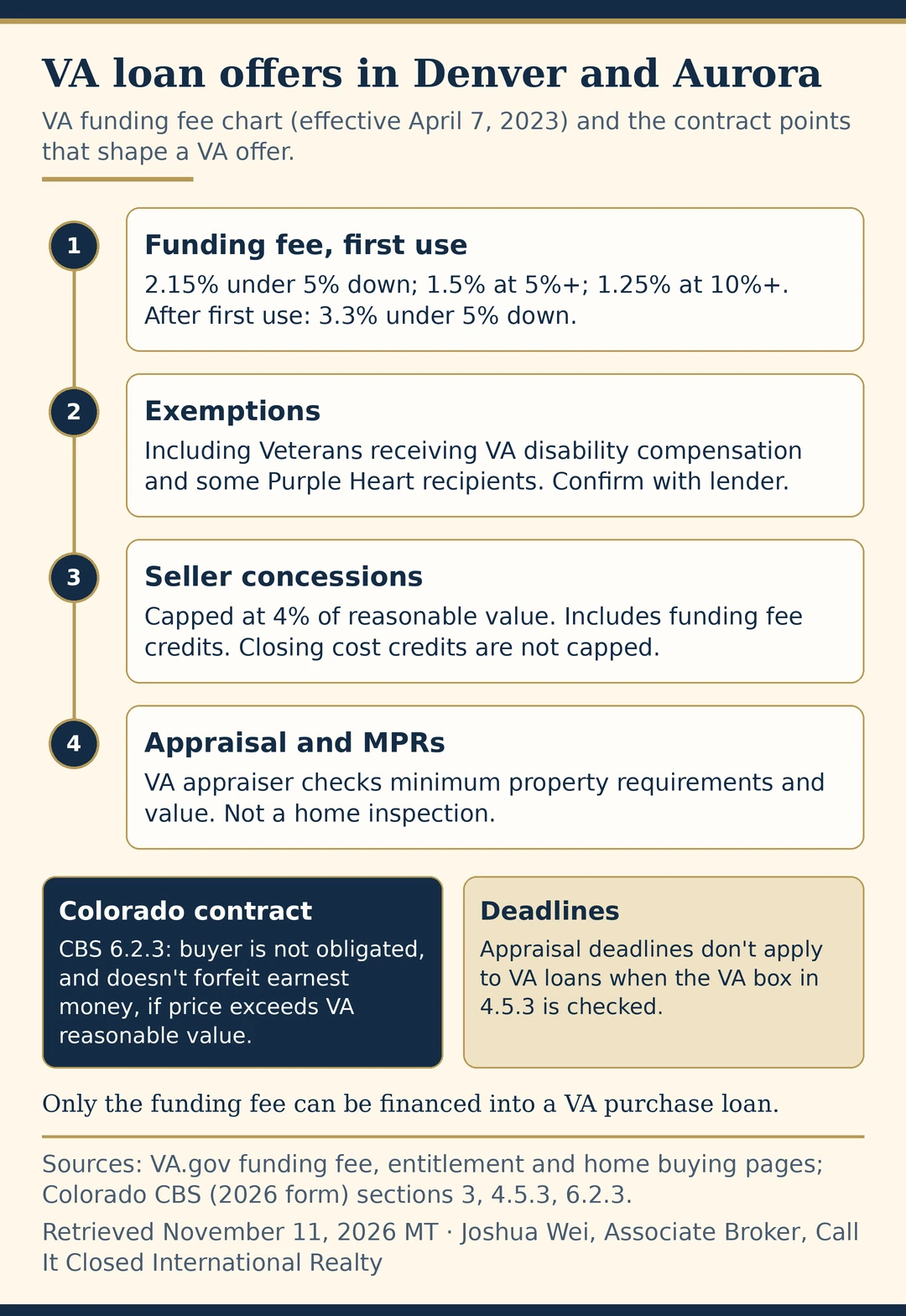
A vertical flow diagram, cream background with navy type and gold accents, titled VA loan offers in Denver and Aurora. Subtitle: VA funding fee chart (effective April 7, 2023) and the contract points that shape a VA offer. 4 numbered steps: 1, Funding fee, first use: 2.15% under 5% down; 1.5% at 5%+; 1.25% at 10%+. After first use: 3.3% under 5% down; 2, Exemptions: Including Veterans receiving VA disability compensation and some Purple Heart recipients. Confirm with lender; 3, Seller concessions: Capped at 4% of reasonable value. Includes funding fee credits. Closing cost credits are not capped; 4, Appraisal and MPRs: VA appraiser checks minimum property requirements and value. Not a home inspection. Two cards: Colorado contract: CBS 6.2.3: buyer is not obligated, and doesn't forfeit earnest money, if price exceeds VA reasonable value; and Deadlines: Appraisal deadlines don't apply to VA loans when the VA box in 4.5.3 is checked. A note says: Only the funding fee can be financed into a VA purchase loan. Sources: VA.gov funding fee, entitlement and home buying pages; Colorado CBS (2026 form) sections 3, 4.5.3, 6.2.3. Retrieved November 11, 2026 MT. Joshua Wei, Associate Broker, Call It Closed International Realty.
Sources: VA funding fee and closing costs (opens in a new tab); VA home buying process (opens in a new tab)
Cream background, navy text, gold rules. Numbered navy circles on a gold spine with white step cards, two branch cards (navy and tan), a note, and a source footer.
The figure above shows VA's funding fee chart for purchase loans and the contract points that affect a VA offer.
What is the VA funding fee, and who pays it?
VA's funding fee and closing costs page (opens in a new tab) calls the fee "a one-time payment that the Veteran, service member, or survivor pays on a VA-backed or VA direct home loan." It's figured as a percentage of the loan amount. The chart has been "Effective April 7, 2023." For purchase loans:
| Down payment | First use | After first use | |---|---|---| | Less than 5% | 2.15% | 3.3% | | 5% or more | 1.5% | 1.5% | | 10% or more | 1.25% | 1.25% |
VA's own worked example: "Let's say you're using a VA-backed loan for the first time, and you're buying a $200,000 home and paying a down payment of $10,000 (5% of the $200,000 loan). You'll pay a VA funding fee of $2,850, or 1.5% of the $190,000 loan amount." It adds: "The funding fee applies only to the loan amount, not the purchase price of the home." VA also notes: "If you used a VA-backed or VA direct home loan to purchase only a manufactured home in the past, you'll still pay the first-time funding fee."
VA lists exemptions. One applies if "You’re receiving VA compensation for a service-connected disability." Another covers an active-duty service member who provides "evidence that you received a Purple Heart" on or before closing. Whether a particular buyer is exempt is a question for the lender.
The full list on VA's page also covers a buyer who is "eligible to receive VA compensation for a service-connected disability, but you're receiving retirement or active-duty pay instead," a surviving spouse "receiving Dependency and Indemnity Compensation (D.I.C.)," and a service member who "has received a proposed or memorandum rating before the loan closing date that says you're eligible to get compensation because of a pre-discharge claim."
Can the fee be refunded later?
VA says: "You may be eligible for a refund of the VA funding fee if you're later awarded VA compensation for a service-connected disability. The effective date of your VA compensation must be retroactive to before the date of your loan closing." But: "If you get a proposed or memorandum rating after your loan closing date, you'll still need to pay the funding fee. You won't be eligible for a refund based on this rating."
Other funding fee rates a buyer or seller may see
VA's chart lists rates for other loan types, including "Loan assumptions 0.5%" and "Interest rate reduction refinancing loans (IRRRL) 0.5%." For VA-backed cash-out refinancing, the rate is 2.15% for first use and 3.3% after first use. A buyer taking over a seller's VA loan should read the related note on assumable mortgages linked below.
The fee can be financed. VA also says that on a purchase loan, "you can finance only the VA funding fee into the loan amount. You must pay all other fees and charges when your loan closes."
How much can a seller contribute?
VA says: "We don’t limit credits for a loan’s closing costs, but we do limit seller’s concessions to no more than 4% of your home’s reasonable value." It defines concessions as "anything of value added to the transaction at no additional cost to the buyer." Examples it gives include "credits for the VA Funding Fee, debt payoff, or prepayment of the buyer’s hazard insurance."
How a particular seller credit is classified under VA's rules is a question for the lender.
VA says where to find the number the 4% is measured against: "You can find your home's reasonable value in the VA Notice of Value that your lender provided to you."
Who pays which closing costs
VA says: "You (the buyer) and the seller can negotiate who will pay closing costs like these," and lists "Commission and fees for your real estate professional," "Loan origination fee," "Loan discount points," "Credit report and any credit balances or judgments," "VA appraisal fee," "Hazard insurance and real estate taxes," "State and local taxes," "Title insurance," and "Recording fee."
On lender fees, VA's buying page says that "Many lenders charge Veterans using VA-backed home loans a 1% flat fee," sometimes called a "loan origination fee," and that "Lenders may also charge you additional fees." It adds: "In some cases, lender fees are negotiable." VA also says: "We don't determine most details of your home loan," and lists the lender's decisions as the "Interest rate," "Discount points," and "Other closing costs."
How Colorado's contract handles concessions
CBS section 4.2 (Seller Concession) has the seller "credit to Buyer $__ (Seller Concession)." The concession "may be used for any Buyer fee, cost, charge or expenditure to the extent the amount is allowed by the Buyer's lender and is included in the Closing Statement or Closing Disclosure at Closing." It adds: "Seller Concession is in addition to any sum Seller has agreed to pay or credit Buyer elsewhere in this Contract." Under section 4.5.1, the buyer "must timely pay Buyer's loan costs, loan discount points, prepaid items and loan origination fees as required by lender," except as section 4.2 permits.
The VA line in section 4.5.3 also says the amount the seller agrees to pay "does not include any compensation to be paid to Buyer's brokerage firm."
The Colorado contract also has a VA-specific line. CBS section 4.5.3 says that if the VA box is checked, the "Seller agrees to pay those closing costs and fees that Buyer is not allowed by law to pay not to exceed $" whatever amount the parties write in.
Is there a loan limit?
VA's entitlement page (opens in a new tab) says that if you have full entitlement, "You don’t have a loan limit (as long as you can afford the loan amount and the property appraisal supports the purchase price of the home)." If you've used entitlement before and haven't had it restored, VA says your remaining entitlement "is based on the county loan limit where you plan to buy or refinance a home." The lender works this out.
VA explains the numbers on the Certificate of Eligibility (COE). Basic entitlement of $36,000 "isn't the amount you can borrow. It's the maximum amount we'll pay your lender if you don't pay them back on a loan that's $144,000 or less. For a loan that's more than $144,000, we guarantee to your lender that we'll pay up to 25% of the loan amount."
For a buyer with entitlement already in use, VA describes the steps: check the "Entitlement Charged" column on the COE, find the county's One-Unit Limit on the FHFA website, multiply it by .25, and subtract the entitlement already used. VA's example: "$900,000 x .25 = $225,000," then "$225,000 - $50,000 = $175,000," and "$175,000 x 4 = $700,000." VA says "Your lender may require you to make a down payment if you don't have enough remaining bonus entitlement for a 25% VA guaranty for the loan amount you want."
Two more points from VA: "The maximum VA loan on an individual property is either the appraised value of the property or the purchase price, whichever is lower." And: "We don't require a minimum credit score, but some lenders do have a requirement."
What does the appraisal check?
VA's home buying process page (opens in a new tab) says "A VA-approved appraiser will also appraise the house to make sure it meets basic property condition requirements (called minimum property requirements, or MPRs), and will provide an opinion of value on the house." It adds: "Please note that an appraisal isn’t the same as an inspection." VA also says: "We strongly recommend that you get an inspection to check for any major defects before you purchase your home."
If the appraisal comes in low, VA lists three options:
- Provide "valid sales data" for a reconsideration.
- Ask the seller to lower the price.
- "Pay the difference between the appraised price and the sales price."
For the first option, VA says: "You can ask your real estate agent to provide the lender with valid sales data showing the property is worth more than its appraised price. The lender will ask the appraiser to reconsider based on this information." For the third: "To do this, you'll need to pay this cost at closing."
Repairs the appraisal calls for
If the appraiser flags a minimum property requirement, the lender may require work before closing. CBS section 6.3 covers "any written requirements, replacements, removals or repairs, including any specified in the Appraisal (Lender Property Requirements)." Unless the parties agree in writing to handle them, the requirements are completed, or the buyer waives them in writing, the contract "terminates on the earlier of three days following Seller's receipt of the Lender Property Requirements, or Closing." Who pays the appraisal is a checkbox in section 6.4: the cost "must be timely paid by" the buyer or the seller.
What does Colorado's contract say?
VA's page says to "Be sure the sales contract includes the “VA escape clause” or “VA option clause.”" In the Commission's residential Contract to Buy and Sell Real Estate (opens in a new tab), section 6.2.3 says the buyer "shall not incur any penalty by forfeiture of Earnest Money or otherwise or be obligated to complete the purchase of the Property described herein, if the Contract Purchase Price or cost exceeds the reasonable value of the Property established by the Department of Veterans Affairs." The buyer may still choose to proceed.
A note under the contract's deadline table says: "If FHA or VA loan boxes are checked in section 4.5.3. (Loan Limitations), the Appraisal deadlines DO NOT apply to FHA insured or VA guaranteed loans." Questions about a specific contract's deadlines are for a Colorado real estate attorney.
The rest of section 6.2.3 says: "The purchaser (Buyer) shall, however, have the privilege and option of proceeding with the consummation of this Contract without regard to the amount of the reasonable value established by the Department of Veterans Affairs."
Before closing
VA says: "Your lender must give you a Closing Disclosure at least 3 business days before closing. Be sure to read it carefully. It includes loan terms, fees, closing costs, and your estimated monthly mortgage payments."
What a seller should check in a VA offer
- Which loan box is checked in section 4.5.3, and the dollar cap the seller agreed to for costs the buyer can't pay.
- The Seller Concession amount in section 4.2, and whether the total stays within VA's 4% concession limit as the lender applies it.
- Who pays the appraisal under section 6.4.
- How section 6.3 works if the appraisal calls for repairs.
- The VA value clause in section 6.2.3.
An invented example
This example is invented; the people and numbers are not real.
A first-time VA buyer in Aurora with full entitlement offers $450,000 with no down payment. Under VA's chart, the funding fee on a first-use purchase with less than 5% down is 2.15% of the loan amount, and the buyer plans to finance it. The seller agrees in section 4.2 to a $6,000 Seller Concession. The VA appraisal comes back at $440,000. Under VA's rule, the loan is capped at the lower of price and appraised value, so the buyer's agent sends sales data for a reconsideration. The appraiser does not change the value. The parties agree to $440,000. On a $440,000 loan, the funding fee is 2.15%, or $9,460, financed into the loan. The buyer could instead have used the section 6.2.3 option to proceed at the original price and pay the difference at closing.
A buyer's checklist
- Get your COE and check basic and remaining entitlement.
- Ask the lender whether you are exempt from the funding fee, and get a Loan Estimate.
- Compare lenders on rate, points and fees.
- Confirm the VA box is checked in section 4.5.3, and agree on the seller's cap.
- Get an inspection; the appraisal is not one.
- Read the Notice of Value when it arrives.
- Read the Closing Disclosure at least three business days before closing.
Frequently asked questions
What's the VA funding fee on a first-time purchase with no down payment?
2.15% of the loan amount, under VA's chart effective April 7, 2023.
Can the seller pay my funding fee?
VA counts a funding fee credit as a seller concession, and concessions are capped at 4% of the home's reasonable value.
Can I roll closing costs into a VA purchase loan?
VA says only the funding fee can be financed into a purchase loan.
Is the VA appraisal a home inspection?
VA says "an appraisal isn’t the same as an inspection" and strongly recommends an inspection.
What if the home appraises below the price?
The Colorado contract's VA clause (section 6.2.3) says the buyer "shall not incur any penalty by forfeiture of Earnest Money" if the price exceeds VA's reasonable value. VA lists a reconsideration, a lower price, or paying the difference as options. How they apply to a specific contract is a question for a Colorado real estate attorney.
Is there a minimum credit score?
VA says it doesn't require one, "but some lenders do have a requirement, so be sure to contact more than one lender to compare."
Can I get a refund of the funding fee?
Possibly, if you are later awarded VA disability compensation with an effective date before your closing, according to VA.
Do appraisal deadlines in the Colorado contract apply to VA loans?
Not when the VA box is checked in section 4.5.3, according to the note under the deadline table.
Related notes
- Denver home prices are holding. Concessions are where the give is.
- Assumable mortgages in Colorado: when you can take over a seller’s loan, and when you cannot
- CHFA first-time buyer programs in Denver and Aurora: what the 2026 limits and assistance options actually say
Sources and method
Official sources, retrieved November 11, 2026, America/Denver:
- U.S. Department of Veterans Affairs, VA funding fee and loan closing costs (opens in a new tab) (page last updated October 5, 2026)
- U.S. Department of Veterans Affairs, VA home loan entitlement and limits (opens in a new tab)
- U.S. Department of Veterans Affairs, VA home buying process (opens in a new tab)
- Colorado Real Estate Commission, Contract to Buy and Sell Real Estate (Residential), for use on and after January 1, 2026 (opens in a new tab): section 3 table note, sections 4.5.3, 6.2.3
Added November 13, 2026: further passages of VA's funding fee page (opens in a new tab) (worked example, full exemption list, refunds, other rates, closing costs, Notice of Value), entitlement page (opens in a new tab) (basic and bonus entitlement, remaining-entitlement steps) and buying page (opens in a new tab) (lender fees, reconsideration of value, Closing Disclosure), and CBS1 sections 4.2, 4.5.1, 4.5.3, 6.2.3, 6.3 and 6.4 (2026 contract PDF (opens in a new tab)).
Quotations are verbatim. The example buyer is invented. The residential contract was not on the Commission's 2027 substantive-changes list. Confirm the current form and VA's current fee chart before you rely on them.
This note is general education from a Colorado real estate broker with Call It Closed International Realty. If you're buying with a VA loan in Denver or Aurora, or weighing a VA offer on your home, I'll help you work through the contract terms with your lender.
Disclaimer
This article is general information only. It is not legal, tax, lending, insurance, appraisal, inspection, or financial advice, and it is not a substitute for advice about your situation. Joshua Wei is a Colorado real estate broker, not an attorney. Reading this article does not create a client relationship, an agency relationship, or an attorney-client relationship with Joshua Wei or with Call It Closed International Realty.
Laws, program rules, interest rates, insurance terms, tax figures, and other details change. Examples in this article are hypothetical illustrations unless a source is named for a specific, dated figure. Information in this article is believed accurate as of November 13, 2026 and is not guaranteed. No result is promised, and you should not rely on this article as the last word for your situation.
Before you act, confirm the point with the official source linked or cited in this article, and talk with a licensed professional who can apply the rule to your facts. That may be a licensed attorney, a tax professional, a lender, an insurance agent, a home inspector, or another licensed professional, depending on the question. Links to third-party websites and publications are provided for reference only. They are not an endorsement, and their content can change.
If you already have a brokerage relationship with another broker, this is not a solicitation.
Joshua Wei, Associate Broker, Call It Closed International Realty, Colorado license FA.100108558. Equal Housing Opportunity.