November 7, 2026 · Aurora · Denver · Buying
Outside the floodplain is not the whole answer: an Aurora homebuyer's water-risk checklist
Read flood maps, drainage clues, property history and insurance as separate evidence before buying in Aurora or Denver. A practical, no-guarantees checklist.
Start with a better question than “Is it in a flood zone?”
A home can look reassuring on a sunny afternoon. The yard is dry, the basement is furnished and the map a buyer saw appears to place the property outside a mapped high-risk area. Those observations are useful, but they do not answer the same question. A flood map, a drainage inspection, a seller's known history and an insurance policy each describe a different part of water risk.
Aurora's emergency-management guidance explains that flooding can involve heavy rainfall, urban runoff, drainage channels, streets and low-lying areas. It is not limited to a home standing immediately beside a river. Colorado's Water Conservation Board also cautions that being outside a mapped high-risk area does not eliminate the possibility of flooding. That is why the stronger buyer question is: what evidence do we have about this particular property, and which important questions are still open? (City of Aurora, Know Your Flood Hazard (opens in a new tab); Colorado Water Conservation Board, Flood Insurance FAQ (opens in a new tab))
This is a practical due-diligence guide for buyers in Aurora, Denver and the surrounding Front Range, not a forecast that a particular home will flood. I am Joshua Wei, a Colorado broker with Call It Closed International Realty. I am not a floodplain engineer, insurance agent, attorney or appraiser. Use qualified professionals and the appropriate public officials for property-specific conclusions. No map excerpt or article can guarantee an outcome for your home.
Disclaimer. This article is general information only. It is not legal, tax, lending, insurance, appraisal, inspection, or financial advice, and reading it does not create a client, agency, or attorney-client relationship. Laws, rates, programs, and figures change. Confirm the official source, and talk with a licensed attorney, tax professional, lender, insurance agent, or inspector before you act. Joshua Wei is a Colorado real estate broker, not an attorney. He is an Associate Broker with Call It Closed International Realty, license FA.100108558. Equal Housing Opportunity.
 Full size (opens in a new tab)
Sources: City of Aurora, Know Your Flood Hazard (opens in a new tab); Colorado Water Conservation Board, Flood Insurance FAQ (opens in a new tab)
Text version of this figure
- Rain, runoff and the shape of a lot
- Joshua Wei
- Call It Closed International Realty
- City of Aurora · CWCB flood insurance FAQ
- Prepared Nov 7, 2026 MT
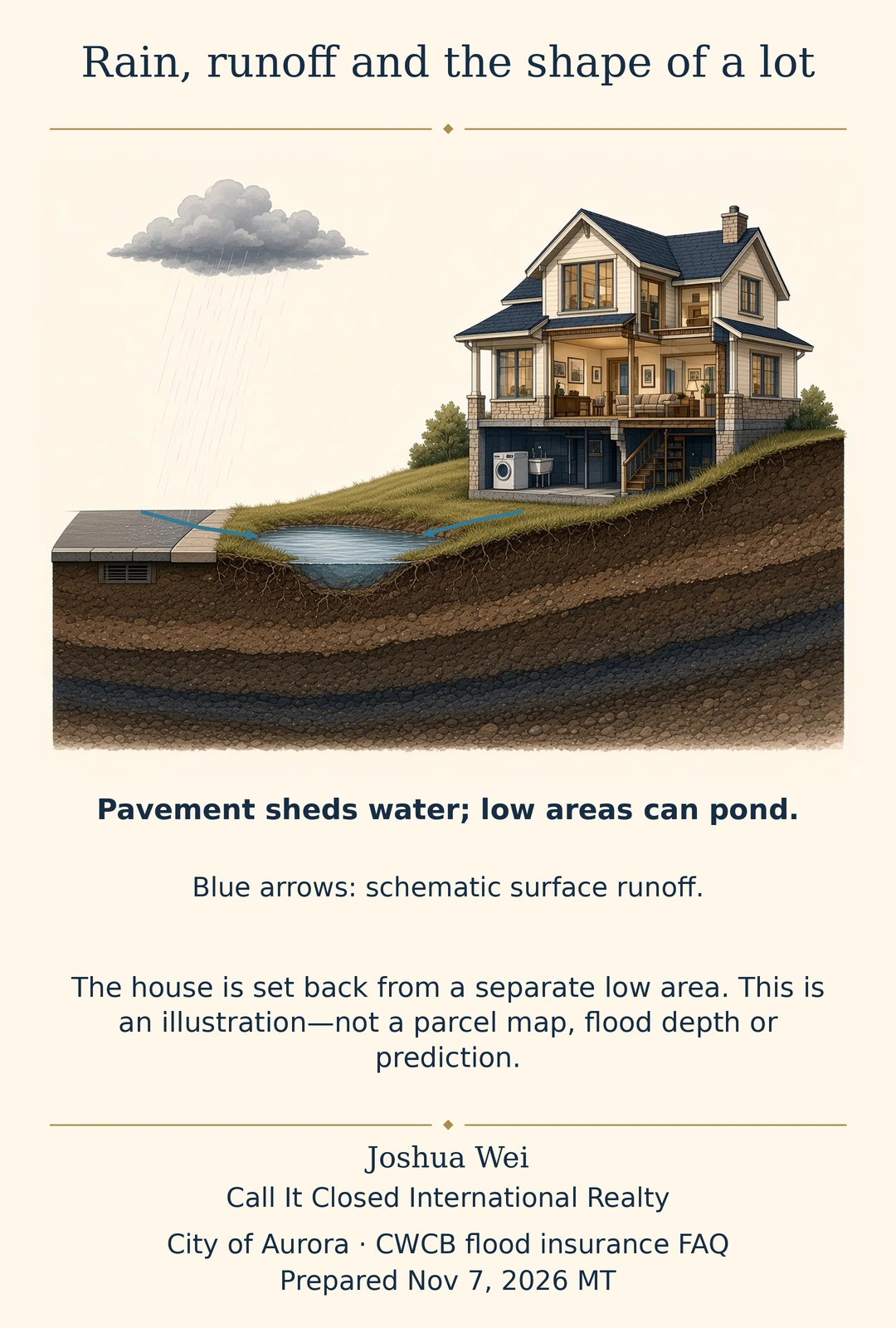
- Pavement sheds water; low areas can pond.
- Blue arrows: schematic surface runoff.
- The house is set back from a separate low area. This is
- an illustration—not a parcel map, flood depth or
- prediction.
Detailed illustrative cutaway lot: rain falls above pavement on the left; a separate shallow depression holds water; a house sits upslope and set back on dry ground to the right. Two blue schematic arrows descend toward the depression along surface paths, not toward the home. No real map, flood depth, property diagnosis or prediction.
Separate the four files you are trying to build
Think of the investigation as four related files: mapping, site conditions, history and insurance. The mapping file identifies the property, the map used and the applicable mapped designation. Site conditions concern what a qualified inspector or specialist can observe and explain. History records what the seller and available documents actually disclose. Insurance concerns which losses an actual policy would cover, its terms and its cost.
A reassuring answer in one file should not silently fill a gap in another. A seller may report no known flooding, but that is not an engineering assessment. A lender may not require flood coverage, but that is not a promise that water cannot enter the building. An insurance quote may be available, but that does not mean the buyer understands the deductible, contents coverage or basement limitations.
Keeping the files separate also makes conversations more productive. Instead of asking your broker to certify that a property is safe, ask who can answer each unresolved question and what document would support the answer. Then fit that work into the actual transaction calendar. The goal is a decision supported by evidence, not a stack of loosely related screenshots that only looks complete.
Match the map to the actual property
Start with the correct address and confirm which parcel and structure you are viewing. A map centered near a street address is a starting point, not proof that you have interpreted the lot boundaries or building location correctly. If the mapped boundary is close to the home, ask the local floodplain administrator or other appropriate official how to understand it. Do not eyeball a narrow separation and turn it into a precise property conclusion.
Record the map source, its status and the date you accessed it. Aurora links public flood-hazard resources, including city and regional mapping tools. The Colorado Division of Real Estate also points consumers toward official flood-map resources in its floodplain guidance. The National Flood Insurance Program's FloodSmart (opens in a new tab) page, retrieved November 10, 2026, tells readers: "Look up your address in the Flood Map Service Center to learn if you live, work or travel in areas that are at higher risk for flooding." The official FEMA Flood Map Service Center (opens in a new tab) is that lookup. Use those official pathways rather than treating a listing website's summary as the final authority. (City of Aurora, Know Your Flood Hazard (opens in a new tab); Colorado Division of Real Estate, Floods and Floodplains in Colorado (opens in a new tab))
If you encounter an effective map, a proposed revision or preliminary information, keep those labels attached. Ask the relevant public office which map applies to your question and whether another process is pending. This guide does not determine a property's designation or resolve a boundary dispute. No address was searched for this article, and none of the examples should be read as an assessment of a particular Denver or Aurora home.
Understand what “100-year” actually means
Aurora explains that a so-called 100-year flood has a one-percent chance of being equaled or exceeded in any given year. It does not mean a flood can happen only once in a century or that a recent event starts a protective countdown. That distinction matters when someone dismisses a risk because the neighborhood already had a bad storm. The terminology describes a probability framework, not a schedule. City of Aurora, Know Your Flood Hazard (opens in a new tab)
Do not convert that explanation into a custom lifetime probability for a house without the right information and assumptions. This article does not calculate cumulative odds for your ownership period, predict climate changes or assign a probability to areas outside a mapped boundary. A general definition is useful; a precise-looking calculation detached from the actual property would create false confidence.
Likewise, avoid describing an unmapped or lower-risk area as a no-risk zone. Maps answer defined hazard questions using the applicable mapping process. They do not promise that every way water might reach a house has been modeled or ruled out. Understanding the vocabulary helps you ask better questions, but it does not replace the site, history and policy portions of the investigation.
Look beyond rivers to drainage and runoff
Aurora's guidance describes heavy rainfall and urban conditions that can concentrate runoff. Pavement and other impervious surfaces, blocked drainage and low-lying streets can matter even when a buyer's attention is focused on a named waterway. The city also discusses flooding related to channels, ditches and canals. These are reasons to ask about how water moves around the property, not to diagnose the cause from an online photograph. City of Aurora, Know Your Flood Hazard (opens in a new tab)
During an ordinary inspection, ask the inspector to identify visible concerns within the scope of that inspection and explain where a specialist may be needed. Look for an explanation of grading, drainage routes and any observed signs of moisture rather than a casual assurance that everything drains away. A broker can help coordinate questions, but should not substitute a sales opinion for an engineering evaluation.
Do not perform your own storm experiment, enter moving water or visit a hazardous drainage area to see what happens in a heavy rain. Existing records, safe observations and qualified professional assessment are the appropriate tools. If there is an active hazard, follow local emergency guidance. Due diligence is not a reason to expose yourself or someone else to dangerous conditions.
A dry basement is an observation, not the full history
A finished basement may look dry at the showing and still leave questions worth asking. Fresh paint, replaced flooring or a dehumidifier does not prove a past flood, and it does not prove that there has never been one. Avoid making a diagnosis from appearances. Ask what is known, request the available documents and let an appropriately qualified professional assess any visible concern.
Where a seller identifies prior water entry or repairs, distinguish the event, the reported cause, the work performed and any subsequent observations. An invoice may establish that a contractor did specific work without establishing that every possible cause was corrected. A photograph may show damage without explaining whether it resulted from surface water, a plumbing issue or another source.
This is also a reason not to label all basement water as flood damage. The classification matters for the investigation and potentially for insurance, but a buyer should not make it up to fit a preferred narrative. Ask the relevant professional what is supported by the evidence and what remains unknown. Preserve that distinction when deciding whether further investigation, a proposal or a contractual discussion is needed.
Ask about history without demanding a guarantee
Ask the seller about known water events and obtain the disclosures and available supporting records through the proper transaction process. If the seller does not know the answer, record that uncertainty. “No known history reported” is a different statement from “the property has never experienced water intrusion.” Neither the broker nor the buyer should expand a limited response into a guarantee.
Useful supporting documents may include repair invoices, drainage evaluations, permits or insurance-related records the seller can appropriately supply. The existence and availability of those documents will vary; do not promise every buyer a complete public claims file. Keep personal information protected and request only material relevant to the transaction. A missing record can remain a question rather than become an unsupported accusation.
Use current approved transaction forms with your broker and obtain counsel for disputes about disclosure obligations or legal remedies. The Division of Real Estate's floodplain article is useful background, but it was published in 2021. I am not treating its old form line numbers as current instructions or reproducing them here. An educational source can guide questions without replacing today's documents or professional advice. Colorado Division of Real Estate, Floods and Floodplains in Colorado (opens in a new tab)
Homeowners insurance and flood insurance are not interchangeable
The National Flood Insurance Program's consumer site, FloodSmart (opens in a new tab), retrieved November 10, 2026, states: "Most homeowners insurance does not cover flood damage." A buyer who hears that a house is insurable still needs to know what policy is being discussed and which losses it actually covers. Do not assume that a general homeowners quote includes protection against every kind of water entering the home. The Colorado Water Conservation Board, Flood Insurance FAQ (opens in a new tab) is additional state guidance on the same point.
Ask a licensed insurance professional to explain the relevant coverages, exclusions and definitions for the proposed policies. Surface flooding, sewer backup, plumbing leaks and wind-driven rain should not be casually grouped together as if a single promise covers them all. The policy language and facts of a loss matter. This article does not classify a future claim or promise that an endorsement will pay it.
Request the explanation while you still have time to make decisions, not after the closing when the first premium notice arrives. Tell the agent the property, intended occupancy and relevant facts accurately. Compare written proposals on their actual terms rather than choosing the smallest premium from two policies that insure different things. Price is meaningful only when the buyer understands what is being bought.
Ask specifically about the basement and your belongings
A finished basement can be a major part of a buyer's living plan, but the insurance treatment may not match the buyer's mental picture. CWCB warns about limitations affecting basement coverage under the National Flood Insurance Program, including finished surfaces and personal belongings. That is a concrete reason to ask questions before assuming the entire finished lower level is protected. Colorado Water Conservation Board, Flood Insurance FAQ (opens in a new tab)
Ask the insurance professional to explain building coverage, contents coverage, applicable deductibles and any location-specific limitations in the actual proposal. If you plan to place valuable items downstairs or use the space as an office, describe that plan rather than assume a generic quote accounts for it. Ask what examples can clarify the policy, while recognizing that an example is not a guarantee about a future claim.
Do not use this article as a substitute for reading the policy or deciding which possessions belong where. A real estate broker can identify the question and help coordinate timing. The licensed insurance professional should explain the proposed coverage, and the buyer should decide whether the remaining uninsured exposure fits the ownership plan. That conversation is more useful than treating a finished basement as either automatically covered or automatically uninsurable.
A lender's requirement is not your entire risk decision
Some buyers first encounter flood insurance when a lender requests it. Others hear that it is not required and conclude that further investigation is unnecessary. CWCB notes that a lender can require flood coverage even outside the mandatory high-risk zones. More broadly, a lender's requirement and an owner's personal decision about protection are different questions. Colorado Water Conservation Board, Flood Insurance FAQ (opens in a new tab)
Ask the lender what determination is being used, what coverage evidence is required for the loan and when it must be supplied. Ask the insurance professional what options are available and what those options cover. If the two conversations seem inconsistent, resolve the specific point instead of assuming one provider has certified the home against every form of water damage.
This article does not tell a buyer to purchase a particular policy or promise eligibility. NFIP availability depends on participation requirements, and private options and underwriting may differ. A lender's approval is also not an engineering opinion about drainage. Treat financing, coverage and physical investigation as connected tasks with their own standards rather than interchangeable endorsements of a property.
Put insurance timing on the transaction calendar
Do not wait until the last available day to ask when coverage can begin. The National Flood Insurance Program's page How to buy flood insurance (opens in a new tab), retrieved November 10, 2026, answers the question “Is there a waiting period for my coverage to begin?” as follows: "Your flood insurance coverage will go into effect 30 days after your date of purchase." It continues: "There are four exceptions to this rule:" "There is no wait if you buy flood insurance while making, increasing, extending or renewing a mortgage." "There is no wait if you change your flood insurance coverage while renewing your policy." "There is a one-day wait if your property is in a newly-designated high-risk flood zone and you buy a policy within 12 months of the update." "There is a one-day waiting period if a flood is caused or worsened by a wildfire on federal land and you buy a policy within 60 days of the wildfire containment date." Because the applicable timing depends on the circumstances, ask a licensed insurance professional to explain the effective date for your actual purchase. Do not assume every policy starts immediately or that every transaction has the same delay. The Colorado Water Conservation Board, Flood Insurance FAQ (opens in a new tab) also discusses waiting periods and exceptions.
Coordinate that answer with your lender and broker. A quote, an application and an effective policy are different milestones. Ask what is needed to bind coverage, what proof the lender requires and whether any open issue could affect closing. Keep the written confirmation rather than rely on a general statement that insurance has been handled.
If the timing or terms do not fit the transaction, raise that issue before the relevant contractual dates. This guide does not create an extension or tell either party what concession must be offered. It identifies a dependency that buyers can investigate early. An otherwise organized inspection process can still leave an important gap if insurance questions are postponed until the final paperwork.
Make the ownership budget specific instead of hypothetical
Use actual written insurance proposals and any property-specific professional estimates when considering ownership costs. I am not supplying a universal flood premium, a drainage-repair allowance or an expected annual loss. Those would be misleading substitutes for the property's facts, the available policy and the work actually proposed.
If a specialist recommends drainage work, ask for the scope, intended purpose, limitations and any permits or approvals that may be needed. Do not assume a repair on private property resolves a public drainage issue, or that public infrastructure work can be requested and completed on the buyer's preferred schedule. Identify the responsible party and appropriate public contact rather than assign responsibility from a map alone.
CWCB also cautions against treating disaster assistance as a substitute for insurance. Assistance is not guaranteed compensation for every loss and may depend on declarations, eligibility and program terms. A buyer should not build a budget around the hope that a future event will trigger aid. Evaluate the proposed insurance and remaining exposure on their own terms. Colorado Water Conservation Board, Flood Insurance FAQ (opens in a new tab)
Keep each professional question answerable
A concise request is often more effective than a broad demand for reassurance. Give the floodplain office the correct property identification and ask which map applies. Give the inspector the observed concern and ask whether it is within the inspection scope. Give the insurance professional the proposed use of the home and ask how the quoted coverage treats that situation. These requests do not guarantee an answer in your preferred timeframe, but they make it easier to identify the right next step without asking one person to certify matters outside their expertise.
Close the loop on unanswered questions
Before you reach a decision point, write down what each file actually supports. You may have a confirmed map designation, an inspection that recommends further evaluation, a seller's limited history and an insurance quote with exclusions. That is more honest and useful than compressing everything into “no issue found.” Identify the unanswered item, the person qualified to answer it and the time needed to obtain the answer.
Keep the supporting records for ownership. Map access dates, professional reports, repair documentation and policy explanations may be useful when maintaining the property or discussing it with future advisers. They do not freeze conditions forever, so treat later changes and new information as reasons to revisit the relevant file rather than assume the original transaction settled every future question.
For an Aurora or Denver buyer, the strongest conclusion is not that every home is equally risky or that a map is useless. It is that the map is one tool in a broader investigation. Match it to the right property, understand the site and known history, and obtain a clear explanation of actual coverage. That process helps you make an informed decision without mistaking a dry showing, a lender's requirement or a reassuring phrase for a guarantee.
Sources
- National Flood Insurance Program, FloodSmart home page, retrieved November 10, 2026, including the sentence that most homeowners insurance does not cover flood damage, and the link to the Flood Map Service Center. FloodSmart (opens in a new tab); FEMA Flood Map Service Center (opens in a new tab)
- National Flood Insurance Program, How to buy flood insurance, retrieved November 10, 2026, for the official waiting-period question and exceptions. How to buy flood insurance (opens in a new tab)
- City of Aurora, Know Your Flood Hazard, living public guidance accessed November 7, 2026, and reopened November 10, 2026. Know Your Flood Hazard (opens in a new tab)
- Colorado Water Conservation Board, Flood Insurance FAQ, living guidance accessed November 7, 2026. Flood Insurance FAQ (opens in a new tab)
- Colorado Division of Real Estate, Floods and Floodplains in Colorado, April 28, 2021, accessed November 7, 2026. Floods and Floodplains in Colorado (opens in a new tab)
Related reading
October 2026 Denver metro prices and concessions is negotiation context only. Property-tax and metro-district questions and radon testing when you buy or sell are separate investigations.
Disclaimer
This article is general information only. It is not legal, tax, lending, insurance, appraisal, inspection, or financial advice, and it is not a substitute for advice about your situation. Joshua Wei is a Colorado real estate broker, not an attorney. Reading this article does not create a client relationship, an agency relationship, or an attorney-client relationship with Joshua Wei or with Call It Closed International Realty.
Laws, program rules, interest rates, insurance terms, tax figures, and other details change. Examples in this article are hypothetical illustrations unless a source is named for a specific, dated figure. Information in this article is believed accurate as of November 7, 2026, including the corrections in this November 10, 2026 refresh, and is not guaranteed. No result is promised, and you should not rely on this article as the last word for your situation.
Before you act, confirm the point with the official source linked or cited in this article, and talk with a licensed professional who can apply the rule to your facts. That may be a licensed attorney, a tax professional, a lender, an insurance agent, a home inspector, or another licensed professional, depending on the question. Links to third-party websites and publications are provided for reference only. They are not an endorsement, and their content can change.
If you already have a brokerage relationship with another broker, this is not a solicitation.
Joshua Wei, Associate Broker, Call It Closed International Realty, Colorado license FA.100108558. Equal Housing Opportunity.