November 7, 2026 · Aurora · Denver · Buying
Buying in Aurora? Check the parcel’s tax story before trusting the payment.
A practical Denver-area buyer’s guide to property-tax years, assessed values, metro district disclosures and escrow estimates—without guessing your future bill.
The payment estimate needs an evidence file
Before you decide that a house fits your monthly budget, ask a less exciting question than whether you like the kitchen: what property-tax information went into the payment estimate? A listing can show a perfectly accurate historical tax amount that does not answer your question about owning the completed home next year. A lender can provide an estimate that is useful for shopping without having the final information that determines a future bill. The problem is not that every estimate is wrong. It is that the word “taxes” can hide different years, values and assumptions.
This matters when buying in Aurora, Denver or another Front Range community, especially when a metropolitan district is part of the property's tax picture. You need to identify the actual parcel, understand what the current bill describes, and separate the district's authority from the levy being collected. You also need to know how the lender has translated those inputs into an escrow estimate. A ZIP code and a purchase price do not establish all of those facts.
There is a timely reason to revisit the subject. Colorado's HB25-1219 changed metropolitan-district disclosure requirements. The Division of Real Estate's HB25-1219 summary (opens in a new tab) identifies August 6, 2025 as the act's effective date. The official 2026 text of Colorado Revised Statutes section 38-35.7-110 (2) (opens in a new tab), printed pages 1082–1084 of the Title 38 PDF, retrieved November 10, 2026, states: "On and after January 1, 2022, an owner of residential real property that is located within the boundaries of a metropolitan district organized on or after January 1, 2000, that sells the property, concurrently with or prior to the execution of a contract to sell the property, shall provide to the purchaser of the property:" the documents and statements listed in that subsection. This is an existing change to investigate in a current transaction, not a new law announced this week. Ask your broker and qualified counsel about its application to your sale. The signed House Bill 25-1219 (opens in a new tab) session law is the 2025 act that put the current wording in place. (Colorado Division of Real Estate, HB25-1219 summary (opens in a new tab); signed HB25-1219 (opens in a new tab))
I am a Colorado real estate broker with Call It Closed International Realty, not an attorney or appraiser. This guide is general transaction education, not tax advice, a legal opinion, a valuation or a loan quote. Its purpose is to make your questions and source documents more precise before you commit to a payment you have not fully investigated.
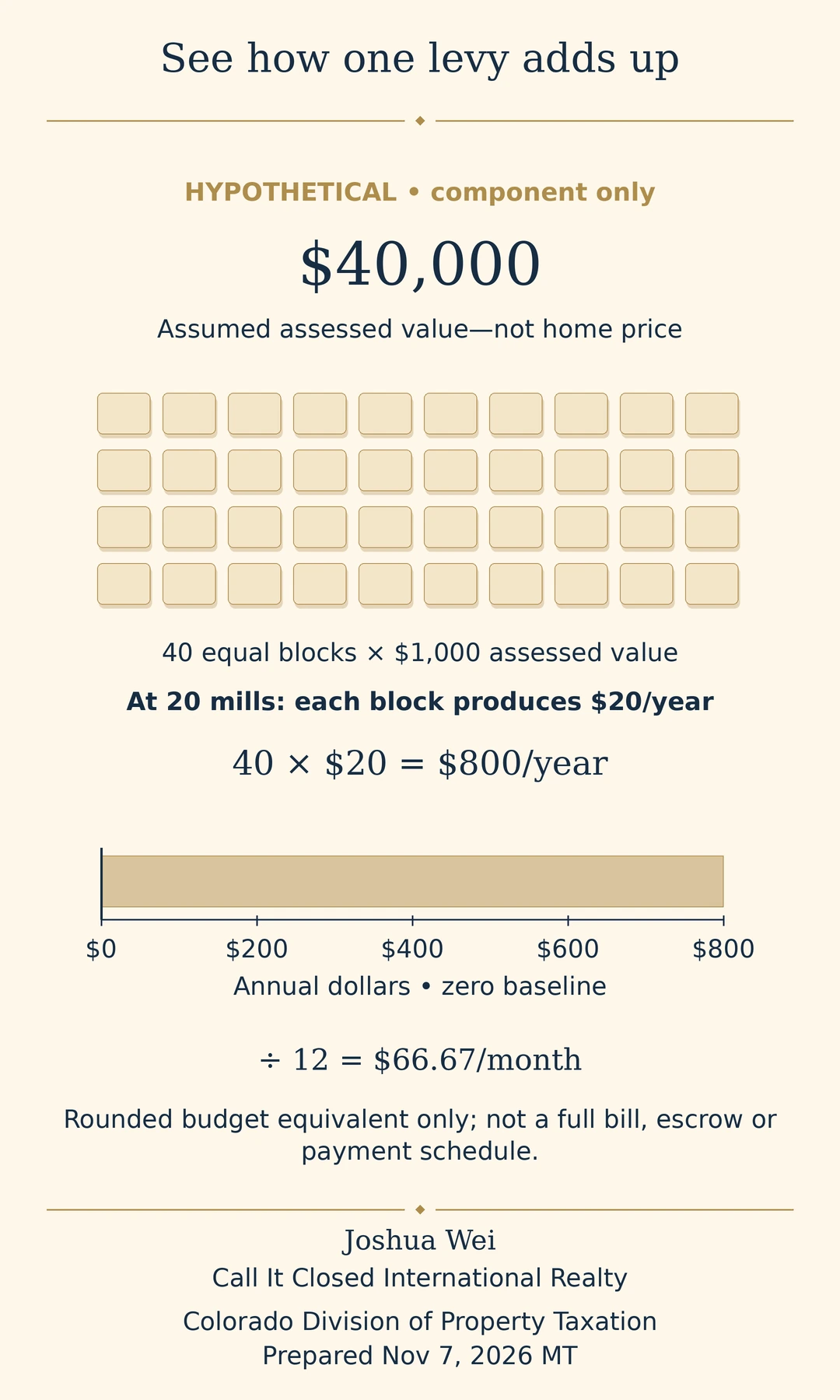
The chart below is a hypothetical single levy component. It uses an assumed assessed value of $40,000 and an assumed levy of 20 mills. It is not a full tax bill, a parcel estimate, or an escrow quote, and it excludes other levies, fees, and insurance. The same invented example is worked through later in this note.
Disclaimer. This article is general information only. It is not legal, tax, lending, insurance, appraisal, inspection, or financial advice, and reading it does not create a client, agency, or attorney-client relationship. Laws, rates, programs, and figures change. Confirm the official source, and talk with a licensed attorney, tax professional, lender, insurance agent, or inspector before you act. Joshua Wei is a Colorado real estate broker, not an attorney. He is an Associate Broker with Call It Closed International Realty, license FA.100108558. Equal Housing Opportunity.
 Full size (opens in a new tab)
Sources: Colorado Division of Property Taxation (opens in a new tab)
Text version of this figure
- See how one levy adds up
- Joshua Wei
- Call It Closed International Realty
- Colorado Division of Property Taxation
- Prepared Nov 7, 2026 MT
- HYPOTHETICAL • component only
- $40,000
- Assumed assessed value—not home price
- 40 equal blocks × $1,000 assessed value
- At 20 mills: each block produces $20/year
- 40 × $20 = $800/year
- $0
- $200
- $400
- $600
- $800
- Annual dollars • zero baseline
- ÷ 12 = $66.67/month
- Rounded budget equivalent only; not a full bill, escrow or
- payment schedule.
Hypothetical, not actual parcel data. Forty identically sized blocks each represent $1,000 of assumed assessed value, totaling $40,000; at an assumed 20 mills, each produces $20 yearly, totaling $800. A zero-based annual-dollar bar runs from $0 to $800 with $200 ticks; dividing annual amount by twelve gives $66.67 monthly rounded for budgeting, not payment timing or total tax/escrow.
Start with a parcel, not a neighborhood reputation
Write down the property's street address, county and parcel identifier before comparing tax figures. Check that the assessor and tax records describe the same property you are considering. If it is new construction, ask whether the record refers to the finished residence, the lot before construction or a larger parcel before changes. Do not assume that a familiar subdivision name or mailing address resolves the record match.
This is also why a ZIP newsletter cannot responsibly turn one home's tax information into a bill estimate for every reader in that ZIP. Taxing boundaries and property characteristics are not the same thing as postal boundaries. A useful regional article can teach you how to investigate the tax picture. It cannot replace a parcel-specific search and verified estimate. I would not describe a whole ZIP as “low tax” or “high tax” based on a listing I happened to see.
Ask for the underlying documents rather than a cropped screenshot of an amount. The full record can show the tax year, property classification, value information and taxing entities that explain the number. If the record and listing disagree, preserve both and ask which period and parcel each uses. Do not quietly select the smaller amount because it makes the payment look more attractive.
Separate the assessor's job from the tax bill
Colorado's Division of Property Taxation explains that the county assessor discovers, lists, classifies and values property under state law. The taxing authorities determine their tax rates within the applicable rules. Those are related jobs, but they are not the same job. A valuation notice is not a promise about the final tax amount, and a change in a tax bill is not automatically evidence that the assessor changed the property's value. Colorado Division of Property Taxation (opens in a new tab)
The state explains the ingredients as property classification, actual value, assessment rate, assessed value and tax rate. When comparing documents, identify which ingredient each number represents. The asking price is not the assessed value. The assessor's actual value is not the amount of tax due. A mill levy is a tax rate, not an annual dollar bill. Using the right label prevents errors before any calculation begins.
For a particular transaction, ask the assessor or another qualified professional to explain the applicable value and assessment treatment, then have the lender explain the estimate it used. You do not have to become a property-tax specialist to request that explanation. You do need to recognize when a payment worksheet has skipped from purchase price to an annual tax number without documenting the steps.
Why one assessment-rate shortcut can mislead
The state's current property-tax guide says residential property has separate assessment rates for local-government and school-district calculations beginning in 2025. That is a warning against taking an old internet formula with a single residential percentage and applying it indiscriminately to every levy. The distinction belongs in the explanation even when you are not calculating a bill yourself. Colorado Division of Property Taxation (opens in a new tab)
Ask whether the estimate separates the relevant school and local-government components and uses the correct tax-year inputs. Also ask whether any applicable adjustments or property-specific treatment have been considered. This guide deliberately does not turn the state's displayed assessment rates into a universal calculator for every buyer. Tax years and individual circumstances matter, and the appropriate county record is a better starting point than a reusable screenshot.
A good estimate should be reproducible by the person preparing it. Ask for the source of the assessed amounts, the levy information, the year being estimated and the explanation of anything still provisional. If those inputs are not final, label the result as provisional. A precise-looking dollar amount is not the same thing as a precisely supported estimate.
Read the tax year and collection year out loud
The state guide says property-tax bills reflect taxes for the preceding year. That simple distinction can create confusion when a buyer asks about “this year's taxes.” Does the speaker mean the tax year printed on the bill, the calendar year in which the bill is paid, or the period after the buyer closes? Put both the tax year and collection year beside every amount in your comparison. Colorado Division of Property Taxation (opens in a new tab)
A historical bill is evidence of the historical obligation it describes. It is not a guarantee that the same amount will apply through your ownership. Even when the house has not changed, the inputs to the calculation can change. If the house is newly completed, there may be an additional reason to investigate whether the older record reflects the current property. Do not describe that possibility as a certainty that every new home will have a particular tax increase.
When you send information to the lender, include the entire document and the year labels. Ask which period is used in the monthly estimate and whether a different amount is being used for the closing deposit or tax proration. Those can be different calculations. The goal is to reconcile them, not to force every line on every document to display the same number.
Colorado property tax bills reflect the taxes for the year before, so the bill for the year you close is paid the next year. At closing, the seller usually gives the buyer a credit for the seller's share of that year's taxes, and the buyer pays the full bill when it comes due. The standard Colorado purchase contract lets the parties choose what that credit is based on: the taxes for the calendar year before closing, or the most recent mill levy and the most recent assessed or actual value. On a newly built home, last year's bill may cover only the land or a partly built house, so a credit based on that bill can be much smaller than the taxes you will actually owe. The contract also says that, unless its Additional Provisions say otherwise, these prorations are final. Ask your broker, the title company, and your lender which option your contract uses before you sign.
What a metropolitan district adds to the investigation
Aurora describes metropolitan districts as independent units of government that provide services within their boundaries. The city explains that districts can issue tax-exempt bonds to finance infrastructure and impose property taxes to repay those bonds. It also identifies the service plan as a governing document describing a district's purpose, powers, responsibilities and financial details. City of Aurora, metropolitan districts (opens in a new tab)
That makes district research different from asking whether an HOA exists. Do not treat the district's tax levy as interchangeable with association dues or assume the absence of an HOA means there is no district obligation. Ask which entities appear on the property's records, what each charge funds, and whether there are fees outside the tax bill. Keep those questions distinct even if the same community name appears on several documents.
A district is not, by its existence alone, proof of a bad purchase. It is a source of financial and governance information to understand. Public infrastructure has costs, and different properties and communities organize those costs differently. The buyer's task is to evaluate the documented obligations and services in the actual property decision, not to accept either a blanket sales pitch or a blanket warning about every district.
Current levy, authorized maximum and debt are different facts
Ask for the current levy and its period, then ask for the service-plan limits and any relevant amendments. A maximum permitted levy and a levy currently imposed answer different questions. A statement about what the district may do should not be presented as the amount it is doing today. Conversely, today's amount should not be advertised as a permanent ceiling without reviewing the governing documents and applicable rules.
Separate debt-service and operating components where the documents distinguish them. A quoted cap on one component does not automatically establish a cap on all property taxes or all costs of living in the district. Aurora's public page describes protections in its model service plan, but that is not a substitute for reading the particular district's approved plan and amendments. I am not assigning a universal cap or payoff date to every Aurora property. City of Aurora, metropolitan districts (opens in a new tab)
Similarly, authorized debt is not necessarily outstanding debt, and outstanding debt is not necessarily an immediate personal invoice for an individual buyer. Those distinctions call for an explanation from the district and qualified advisers. If a marketing handout compresses them into a single reassuring sentence, ask for the underlying document and a written explanation of what it actually means for the property.
What the disclosure change does—and does not—settle
Section 4 of the signed HB25-1219 act addresses residential property within metropolitan districts organized on or after January 1, 2000. It changes the disclosure framework that had focused on newly constructed residences and requires a warning that the district's exercise of debt, levy or fee authority may increase residents' costs. It also modifies the tax-estimate language to require a dollar amount. The official consolidated 2026 statute confirms the expanded scope and the dollar-estimate requirement. The estimate concerns collection during the sale year and uses the purchase price, residential assessment rate and levies in effect at the sale. These are reasons to request a substantive disclosure, not just a general acknowledgment that a district exists. (signed HB25-1219 (opens in a new tab); 2026 Colorado Revised Statutes, section 38-35.7-110 (opens in a new tab))
The official sentence of Colorado Revised Statutes section 38-35.7-110 (2) (opens in a new tab) quoted above places that duty "concurrently with or prior to the execution of a contract to sell the property." If you are preparing to sign, ask your broker and counsel whether the appropriate disclosures have been obtained and whether they address the property and district involved. Do not assume this article determines compliance for a transaction. It does not decide remedies, interpret a disputed contract or create a termination right.
The requirement for an estimate does not turn the estimate into a guarantee of future taxes. Ask which year, valuation basis and levy inputs support it. Keep the district estimate separate from the total tax picture, because other taxing entities can affect the property too. A document can be useful and still need explanation. The benefit of disclosure is the chance to investigate before a decision, not a reason to stop asking questions.
A small hypothetical shows why labels matter
Consider a purely invented district-component example, not a real parcel, current assessment rate or prediction. Assume the applicable assessed value for that component is $40,000 and the district levy is 20 mills. A mill is one dollar per thousand dollars of assessed value. For this illustrative component, $40,000 multiplied by 20 divided by 1,000 equals $800 per year. Spread evenly across twelve months for budgeting, that is about $66.67 per month. (Colorado Division of Property Taxation (opens in a new tab); calculation E1)
The example does not calculate the property's total taxes. It excludes school levies, other local levies, any distinct assessed bases, adjustments, fees and insurance. It also does not calculate the lender's actual escrow deposit or monthly collection. Its only purpose is to show why a mill figure needs an assessed-value base and why a district-only dollar estimate should not be mistaken for the whole annual bill.
Do not multiply the same levy directly by a home's full purchase price and call that its tax. Do not add a district amount again if it is already included in a verified total. Both mistakes can distort affordability in opposite directions. A clear worksheet labels each component, explains whether it is included in the total, and leaves unresolved items visible rather than hiding them in a rounded payment.
Escrow is a collection mechanism, not tax-rate protection
The Consumer Financial Protection Bureau, in What is an escrow or impound account? (opens in a new tab), retrieved November 10, 2026, states: "An escrow account, sometimes called an impound account depending on where you live, is set up by your mortgage lender to pay certain property-related expenses." It continues: "The money that goes into the account comes from a portion of your monthly mortgage payment." And: "Your mortgage servicer will manage the escrow account and pay these bills on your behalf." On changes, the same page states: "Your property taxes and insurance premiums can change from year to year. Your escrow payment—and with it, your total monthly payment will change accordingly."
For a buyer, the practical question is what the lender expects to collect and why. Ask whether the tax estimate reflects the property information you supplied, what remains provisional and how the initial escrow funding is calculated. A loan with fixed principal-and-interest payments does not make every other housing expense fixed. Keep the loan payment terms separate from the estimated taxes and insurance in your personal budget.
If the loan does not use escrow, the tax obligation does not disappear. The same CFPB page states: "If your loan doesn’t include an escrow account, you will have to plan to pay these large expenses yourself." Neither arrangement gives this article enough information to recommend a particular loan or cash reserve. Ask a licensed lender and a tax advisor about the options using your actual transaction, documents and finances.
Compare houses on equivalent information
When comparing homes in Denver, Aurora or elsewhere along the Front Range, use the same categories for each: verified parcel, historical tax-year bill, current value information, identified taxing entities, documented district information and lender estimate. A side-by-side comparison is only useful if you know which entries are historical, current or projected. Otherwise the cheaper-looking home may simply have the older input.
Add separately payable fees and association dues without counting anything twice. Record what services they cover, but do not assume services with the same name have the same scope. Keep insurance and utilities in the broader ownership budget as well. Those items matter to affordability, but they are not evidence about the tax levy itself. Separating them makes the comparison easier to explain.
Then list the unanswered questions. Who can confirm the district boundary? Which office can explain the tax-year classification? Who prepared the estimate? Is an updated levy or valuation still pending? A home does not become unsuitable simply because an answer is pending, but you should know how much uncertainty you are accepting and when you need the answer under your actual contract.
Sellers can make the tax story easier to follow
A seller can prepare a useful tax file without promising what the next owner's bill will be. Provide complete, correctly labeled current and historical documents, identify the parcel and district, and route questions to the appropriate sources. If a newer document supersedes an older one, make that clear. Do not leave a buyer to discover that a payment advertisement and a disclosure refer to different periods.
For a property affected by metropolitan-district disclosure requirements, work with the listing broker and qualified counsel to obtain and review what applies. Avoid claiming that a generic web link or a signed acknowledgment settles every requirement. The document's content, its applicability and the transaction's timing all matter. This article is not a checklist that certifies statutory compliance.
Clear information is not a guarantee of price, speed or loan approval. It is a way to reduce avoidable confusion. A buyer can evaluate a known tax picture more intelligently than a bundle of unlabeled estimates, even when the correct information leads them to decide the property is not right for their budget.
The next step is a better question, not a prediction
Before you rely on a payment estimate, ask: “Which parcel, tax year, assessed-value basis and levies support this tax number, and what could still change?” If a metropolitan district is involved, ask for its applicable disclosure and the explanation of current versus authorized obligations. Then ask the lender to reconcile those inputs with the loan worksheet and escrow assumptions.
I can help organize the property documents and buying or selling questions with you. The assessor, district, lender and qualified legal or tax advisers should resolve matters within their respective responsibilities. A dated regional article can help you know what to ask; it cannot replace their parcel-specific answers. That is the useful way to put local research to work without pretending a market headline or a ZIP code can predict your future bill.
Sources
- Colorado Division of Real Estate, HB25-1219 summary: signed May 29, 2025; effective August 6, 2025. HB25-1219 summary (opens in a new tab)
- Colorado General Assembly, enacted HB25-1219, Chapter 290, section 4. Signed act (opens in a new tab)
- Official consolidated Colorado Revised Statutes 2026, Title 38, section 38-35.7-110, retrieved November 10, 2026, printed pages 1082–1084. CRS 2026 Title 38 PDF (opens in a new tab). Official release index: 2026 CRS titles download (opens in a new tab)
- Colorado Division of Property Taxation, Understanding Property Taxes in Colorado, living page including the 2026 assessment chart, accessed November 7, 2026. Understanding property taxes in Colorado (opens in a new tab)
- City of Aurora, Metropolitan Districts, living guidance accessed November 7, 2026. Metropolitan districts (opens in a new tab)
- Consumer Financial Protection Bureau, What is an escrow or impound account?, living guidance accessed November 7, 2026. What is an escrow or impound account? (opens in a new tab)
Added November 19, 2026, after an expert review, and checked that day: Colorado Real Estate Commission, Contract to Buy and Sell Real Estate (Residential), CBS1, Mandatory Use Date January 1, 2026, sections 16.1.1 and 16.1.4 (opens in a new tab).
Related reading
October 2026 Denver metro prices and concessions explains a different set of figures. It is not evidence about tax law. Radon testing when you buy or sell and flood maps, drainage, and insurance are separate questions. How this site labels market sources is on the market methodology page.
Disclaimer
This article is general information only. It is not legal, tax, lending, insurance, appraisal, inspection, or financial advice, and it is not a substitute for advice about your situation. Joshua Wei is a Colorado real estate broker, not an attorney. Reading this article does not create a client relationship, an agency relationship, or an attorney-client relationship with Joshua Wei or with Call It Closed International Realty.
Laws, program rules, interest rates, insurance terms, tax figures, and other details change. Examples in this article are hypothetical illustrations unless a source is named for a specific, dated figure. Information in this article is believed accurate as of November 19, 2026, including the corrections in this November 10, 2026 refresh, and is not guaranteed. No result is promised, and you should not rely on this article as the last word for your situation.
Before you act, confirm the point with the official source linked or cited in this article, and talk with a licensed professional who can apply the rule to your facts. That may be a licensed attorney, a tax professional, a lender, an insurance agent, a home inspector, or another licensed professional, depending on the question. Links to third-party websites and publications are provided for reference only. They are not an endorsement, and their content can change.
If you already have a brokerage relationship with another broker, this is not a solicitation.
Joshua Wei, Associate Broker, Call It Closed International Realty, Colorado license FA.100108558. Equal Housing Opportunity.