November 7, 2026 · Denver · Aurora · Buying
Buying a Denver or Aurora home? Make radon testing a plan, not a checkbox.
How to organize radon records, testing, mitigation questions and follow-up when buying or selling a Colorado home—without guessing from the neighborhood.
A result is useful only when you understand the test
When you tour a home in Denver or Aurora, a radon system in the basement may look like a question already answered. So may a seller's old report with a reassuring result. Both can be useful information, but neither explains the home's current conditions by itself. The productive question is not simply whether the property has ever been tested. It is what was measured, under which conditions, what happened afterward and what you need to verify before your decision.
Colorado's Department of Public Health and Environment encourages buyers to test during the inspection process using a licensed radon measurement professional. Its January 5, 2026 public advisory also encourages homeowners to test regardless of their neighbors' results because levels can vary from home to home. That is a practical reason to investigate the particular home, not assign a result to an entire ZIP code or neighborhood. (Colorado Department of Public Health and Environment, testing and mitigating your home for radon (opens in a new tab); Colorado Department of Public Health and Environment, January 5, 2026 advisory (opens in a new tab))
A good transaction plan connects the records, the measurement, any recommended work and the follow-up. It does not turn a health question into a frightening headline or promise that a home is permanently risk-free. I am a Colorado real estate broker with Call It Closed International Realty, not an environmental scientist, physician, attorney or appraiser. This guide is general home-buying education; qualified radon professionals and your own advisers should interpret your property's results and options.
Disclaimer. This article is general information only. It is not legal, tax, lending, insurance, appraisal, inspection, or financial advice, and reading it does not create a client, agency, or attorney-client relationship. Laws, rates, programs, and figures change. Confirm the official source, and talk with a licensed attorney, tax professional, lender, insurance agent, or inspector before you act. Joshua Wei is a Colorado real estate broker, not an attorney. He is an Associate Broker with Call It Closed International Realty, license FA.100108558. Equal Housing Opportunity.
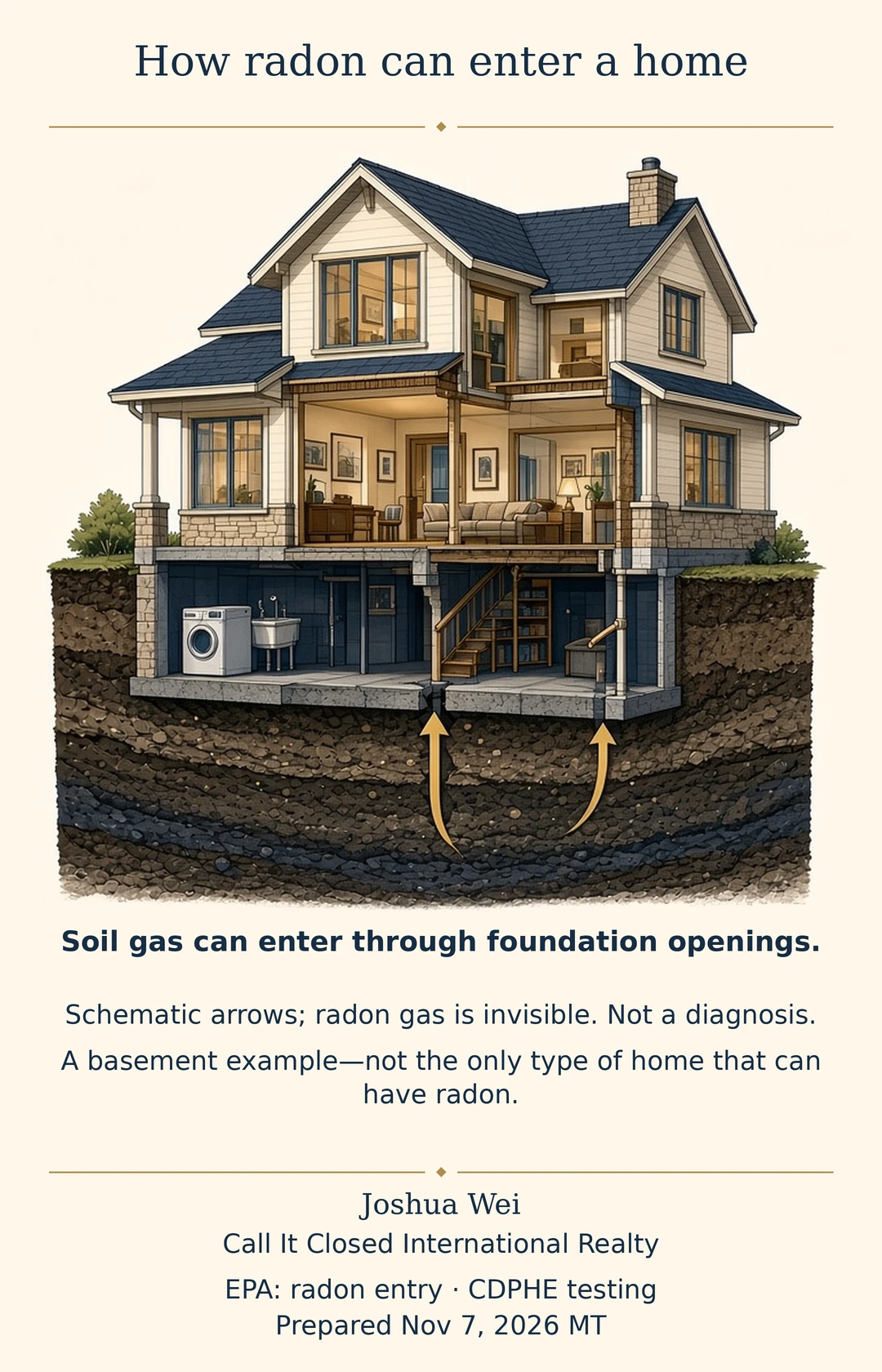 Full size (opens in a new tab)
Sources: EPA, how radon enters a home (opens in a new tab); Colorado Department of Public Health and Environment, testing your home for radon (opens in a new tab); Colorado Department of Public Health and Environment, January 5, 2026 advisory (opens in a new tab)
Text version of this figure
- How radon can enter a home
- Joshua Wei
- Call It Closed International Realty
- EPA: radon entry · CDPHE testing
- Prepared Nov 7, 2026 MT
- Soil gas can enter through foundation openings.
- Schematic arrows; radon gas is invisible. Not a diagnosis.
- A basement example—not the only type of home that can
- have radon.
Actual approved detailed house cutaway, enlarged with all soil arrows retained. Two schematic arrows rise from layered soil toward visible slab/foundation joints. Radon itself is invisible; drawing is not a diagnosis. Homes without basements can have radon too.
Why this belongs early in the buying conversation
Testing needs coordination. A measurement professional needs appropriate access, the occupants need instructions, and the test needs the conditions and duration required by its method. If you wait until the last moment to ask who is ordering the test, you may have a schedule problem before anyone has answered the radon question. A rushed or disturbed measurement is not improved by a fast closing calendar.
Before signing, ask your broker how radon investigation fits the inspection and other dates in the actual contract. Ask who will arrange access and how the report will reach the buyer. Do not assume a general inspection automatically includes a radon measurement, that every inspector performs one, or that a provider can accommodate your preferred dates. Confirm the scope instead of relying on a familiar service label.
This article does not prescribe a legal inspection deadline or create a right to demand particular work from the seller. It explains an information workflow. The contract and the parties' negotiated terms control the transaction; a licensed professional should control the measurement protocol. Keeping those responsibilities distinct helps prevent a test result from becoming entangled with an avoidable scheduling misunderstanding.
Start by requesting the existing record
Ask for available prior test reports, information about any mitigation system, installation and service records, and any follow-up measurements. Read the full report rather than a photograph of its final number. The address, date, device or method, location, duration and notes about conditions can help explain what the result represents. If an attachment is missing, mark it as missing rather than infer a favorable history.
A report from a previous owner or earlier year can provide context. It does not automatically describe the conditions during your current transaction. Ask whether the home's use or configuration has changed since the test and let the measurement professional explain whether a new measurement is appropriate. Do not assume that a report is invalid simply because it is older, or that it is sufficient simply because it looks official.
Keep known facts separate from the seller's recollection and your own interpretation. “A system was installed” is not the same statement as “this report measured the home after installation.” “No report supplied” is not the same as “the home has no radon.” This kind of careful labeling is useful to both buyers and sellers because it avoids turning a gap in the file into a claim nobody can support.
A neighborhood result cannot substitute for your home
Radon is not something a buyer can reliably evaluate by how a home smells or how recently its basement was painted. CDPHE describes it as a naturally occurring radioactive gas without color, odor or taste. The agency's recommendation to test regardless of a neighbor's result follows from the fact that levels differ between homes. A ZIP-wide observation is not an indoor measurement at a particular address. Colorado Department of Public Health and Environment, January 5, 2026 advisory (opens in a new tab)
For the same reason, I would not rank Denver or Aurora neighborhoods as radon-safe based on a newsletter graphic. A regional article can explain the testing process. It cannot diagnose a home from a map, a listing description or another property's report. A seller's long occupancy without a known complaint is not a measurement either.
This does not mean buyers should assume every home has the same result. It means the uncertainty has a practical investigative step. Ask for a properly conducted test and an explanation of what it shows. That is more useful than either dismissing the issue because a nearby house tested low or escalating it into a prediction that a particular property must need expensive work.
Match the test to the decision you are making
CDPHE distinguishes short-term measurements from long-term measurements. Its testing page describes short-term tests lasting 48 to 120 hours, while long-term tests run from 91 days to a year under normal living conditions. The agency explains that longer measurements offer a more representative picture over time because concentrations can fluctuate. These are different tools, not interchangeable labels for the same evidence. Colorado Department of Public Health and Environment, testing and mitigating your home for radon (opens in a new tab)
In a purchase, the available calendar may make a short-term measurement the practical investigation. Ask the licensed provider which method is appropriate and what its limitations are. Do not advertise a short result as a complete description of a lifetime of exposure, and do not dismiss it merely because it does not span every season. The professional's job is to explain how the result fits the decision and what follow-up is warranted.
For an owner with more time, longer-term measurement may address a different question about the home over normal use. A buyer and seller can understand that distinction without trying to force a lengthy study into an incompatible transaction schedule. The sensible approach is to preserve the method and duration in your notes and avoid comparing two numbers as if they were collected in identical circumstances when they were not.
Conditions and placement are part of the result
The state testing guidance includes closed-building instructions and emphasizes following the device's directions. For its short-term instructions, it describes closing exterior windows and doors before the test and maintaining the required conditions throughout it, while allowing normal entry and exit. Your licensed provider should tell the occupants exactly what the selected method requires. This article is not a replacement protocol or permission to improvise one. Colorado Department of Public Health and Environment, testing and mitigating your home for radon (opens in a new tab)
Ask who will communicate those instructions to everyone with access. A test can be affected by people who do not know it is underway: a household member, visiting contractor or someone preparing the home for a showing. The practical solution is coordination and documentation, not accusations. If conditions were disturbed, report that fact to the provider and let the provider explain the consequence for validity and any retesting.
Placement matters too. CDPHE distinguishes testing for ordinary owner use from testing in a real estate transaction, where the lowest area that could become living space can be relevant. An unfinished basement is not automatically irrelevant because nobody currently sleeps there. Let the measurement professional determine suitable placement rather than hide the device in a convenient corner or ask it to produce a preferred result. Colorado Department of Public Health and Environment, testing and mitigating your home for radon (opens in a new tab)
Read the action level without turning it into a guarantee
CDPHE's January 2026 advisory identifies the EPA action level as 4.0 picocuries per liter, usually written pCi/L. The primary EPA page What is EPA's Action Level for Radon and What Does it Mean? (opens in a new tab), retrieved November 10, 2026, states: "The EPA recommends homes be fixed if the radon level is 4 pCi/L (picocuries per liter) (150 becquerels per meter cubed (Bq/m³)) or more." It continues: "Because there is no known safe level of exposure to radon, the EPA also recommends that Americans consider fixing their home for radon levels between 2 pCi/L and 4 pCi/L (75 - 150 Bq/m³)." That unit and threshold should stay attached to the discussion. A bare number copied into a text message can be misunderstood if the reader does not know the unit, test type or location. Have the professional interpret the actual report rather than treating a screenshot as a complete conclusion. Colorado Department of Public Health and Environment, January 5, 2026 advisory (opens in a new tab)
An action level is not a promise that a result below it means no risk or that a single measurement settles every future condition. Nor should a reading be turned into a medical prediction about anyone who has lived in the home. The appropriate transaction conversation is about measurement quality, recommended response and verification. Medical questions belong with a qualified health professional, not a broker's forecast.
If the result is near a decision threshold, ask what the provider recommends and why. Do not round it to the more convenient side, average incompatible results on your own or select whichever test supports the negotiation you want. Preserving the original report and obtaining a clear explanation creates a much stronger basis for a decision than arguing over an unlabeled decimal.
If mitigation is recommended, request a defined scope
When elevated levels are identified, CDPHE recommends working toward mitigation and describes systems that reduce radon by controlling its entry or diluting indoor air. The state identifies sub-slab or, for some crawl spaces, sub-membrane depressurization as common approaches. Selecting the appropriate design is a professional task, not a decision this article can make from a home's age or exterior photograph. Colorado Department of Public Health and Environment, testing and mitigating your home for radon (opens in a new tab)
Ask the provider what work is proposed, where equipment will be located, how the system will operate and what post-installation verification is included. Request a written scope, provider qualifications and a clear account of which work is and is not covered. A generic allowance and a fully specified installation proposal answer different questions. Compare actual proposals rather than relying on a statewide price anecdote.
I am deliberately not quoting a universal mitigation cost. A number on an informational website is not a bid for your home, and access or design issues can change the work. Get a property-specific proposal and understand it before negotiating who performs or funds the work. This protects the buyer from treating a small credit as a completed remedy and protects the seller from agreeing to an undefined obligation.
An installed system needs a verification story
A pipe, fan or label can tell you that equipment is present. It does not by itself show the current indoor concentration, confirm that the equipment is operating as designed or document what happened after installation. Ask for the installation record and any subsequent measurement, then have a qualified professional explain the appropriate check for the current transaction. Do not treat visual presence as a substitute for performance information.
CDPHE's January 2026 advisory recommends that homeowners who already have mitigation systems retest every two years. That is a maintenance-oriented recommendation from the agency, not a warranty interval or a statement that no earlier check could be appropriate. If records are missing or the home has changed, ask the professional what additional investigation makes sense. Colorado Department of Public Health and Environment, January 5, 2026 advisory (opens in a new tab)
The follow-up plan should be understandable to the person who will live in the home. Ask what the owner should monitor, what service instructions should be retained and whom to contact with a concern. Equipment documentation should travel with the property file. It is much easier to maintain a system when the next owner knows what it is supposed to do and has the right instructions instead of relying on a memory of the installation conversation.
Keep the negotiation separate from the technical answer
The measurement professional explains the result and recommended work. The buyer and seller decide what terms they are willing to negotiate under their contract. Those are connected conversations, but they should not be collapsed into a statement that every reading requires the same credit or that one party is automatically entitled to a particular outcome.
If work is negotiated before closing, specify the agreed scope, access, timing, completion documentation and verification expectations through the proper transaction documents. If the parties discuss a buyer-managed solution after closing, understand that money and completed work are not the same thing. Ask your broker and qualified advisers to explain the practical and contractual implications rather than assume an informal message resolves them.
Do not let an unresolved technical issue disappear behind a scheduled closing. An appointment on the calendar does not prove a system is complete, and an invoice does not necessarily include a follow-up test. Track each milestone by what it establishes. If something remains open, discuss the available options before the relevant contract dates rather than invent a promise that the missing answer will be favorable.
Sellers can prepare without claiming a clean bill of health
A seller can make the process clearer by collecting the records that actually exist, identifying the system and providing the available information through the proper disclosure process. Label test dates and locations accurately. If a document describes the home before a system was installed, do not present it as the after-installation result. If you do not have a record, say so instead of reconstructing one from memory.
Give the buyer's testing provider reasonable, agreed access and ensure the occupants receive the instructions. That is not an admission of a problem; it is part of obtaining useful information. Avoid adjusting the home to influence a result or treating ordinary professional questions as evidence that the buyer is acting in bad faith. A reliable test serves both sides better than a disputed one.
This guide does not certify compliance with Colorado's disclosure laws or reproduce a mandatory form. Use the current approved documents with your broker and obtain legal advice for questions about duties, omissions or disputed facts. Clear records help the transaction, but they do not replace the actual disclosure process or professional judgment.
Questions to ask before you book a provider
Before reserving a test, ask the provider to explain the service you are buying in plain language. Will the person performing the measurement be appropriately licensed? What method will be used, what report will you receive and when will it be available? If you also need advice about an existing system, ask whether that evaluation is included or requires a separate appointment. Do not infer that every service is bundled into a single booking.
Give the provider the transaction dates without asking for a shortcut around the measurement requirements. Ask how access problems or disturbed conditions would be handled, including any additional appointment or charge. You are trying to understand the process before an exception occurs, not demand a guaranteed result. If a provider cannot explain the scope clearly, resolve that question before relying on the appointment as a completed investigation.
When several people are coordinating the purchase, identify who receives the report and who is responsible for bringing an unanswered recommendation back into the transaction discussion. The provider should not have to guess which party is tracking the inspection calendar. At the same time, avoid circulating personal or property documents more widely than necessary. Keep the original report accessible to the appropriate parties, and use a concise task list for coordination: test arranged, report received, questions answered, any agreed work documented and follow-up resolved. That list records progress without replacing professional interpretation or changing a contract deadline.
Build a small handoff file for ownership
At the end of the transaction, the useful file contains the original reports, any provider explanations, the agreed work and completion evidence, system instructions and the follow-up plan. Keep it with the home's records so the next testing or service decision has a starting point. Do not rely on a disappearing message thread as the only record of what was measured or installed.
An owner can use that file to ask informed questions without pretending to diagnose the equipment personally. If a later result differs, compare the test circumstances and consult a qualified provider. Do not assume a difference proves anyone acted improperly or that a previous test was necessarily wrong. Conditions and measurement windows matter; interpretation is better grounded in the complete record.
For buyers in Denver, Aurora and elsewhere along the Front Range, the main lesson is straightforward: make radon investigation a plan with a responsible provider, a usable report and a defined follow-up. For sellers, make the known history easier to understand. A listing headline cannot answer the indoor-air question, but a properly organized investigation can give you a much more useful basis for your next decision.
Sources
- U.S. Environmental Protection Agency, What is EPA's Action Level for Radon and What Does it Mean?, retrieved November 10, 2026. EPA action-level page (opens in a new tab)
- Colorado Department of Public Health and Environment, Testing and mitigating your home for radon, living guidance accessed November 7, 2026, and reopened November 10, 2026. Testing and mitigating your home for radon (opens in a new tab)
- Colorado Department of Public Health and Environment, January 5, 2026 advisory, accessed November 7, 2026. Half of Colorado homes have elevated radon levels (opens in a new tab)
Related reading
October 2026 Denver metro prices and concessions is negotiation context, not a health authority. Property-tax and metro-district questions and flood maps, drainage, and insurance are different files.
Disclaimer
This article is general information only. It is not legal, tax, lending, insurance, appraisal, inspection, or financial advice, and it is not a substitute for advice about your situation. Joshua Wei is a Colorado real estate broker, not an attorney. Reading this article does not create a client relationship, an agency relationship, or an attorney-client relationship with Joshua Wei or with Call It Closed International Realty.
Laws, program rules, interest rates, insurance terms, tax figures, and other details change. Examples in this article are hypothetical illustrations unless a source is named for a specific, dated figure. Information in this article is believed accurate as of November 7, 2026, including the corrections in this November 10, 2026 refresh, and is not guaranteed. No result is promised, and you should not rely on this article as the last word for your situation.
Before you act, confirm the point with the official source linked or cited in this article, and talk with a licensed professional who can apply the rule to your facts. That may be a licensed attorney, a tax professional, a lender, an insurance agent, a home inspector, or another licensed professional, depending on the question. Links to third-party websites and publications are provided for reference only. They are not an endorsement, and their content can change.
If you already have a brokerage relationship with another broker, this is not a solicitation.
Joshua Wei, Associate Broker, Call It Closed International Realty, Colorado license FA.100108558. Equal Housing Opportunity.