November 7, 2026 · Denver · First-Time Buyers · Affordable Housing · Buying
Denver's affordable homeownership program: income limits, price caps, and resale rules
How Denver's income-restricted for-sale homes work. HOST's income and asset limits, the 2026 maximum initial sale prices, the covenant and resale cap, the no-cash and one-home rules, and how pre-qualification fits into a purchase.
The short answer
In brief: Denver offers income-restricted homes for sale below market prices through its Department of Housing Stability, HOST. HOST's Affordable Home Ownership page sets a minimum household income of 50% of Area Median Income and a maximum of 80% to 120%, depending on the home's address, plus an asset test. Price caps and resale restrictions come with these homes.
Denver has income-restricted homes for sale below market prices, run by the Department of Housing Stability (HOST). HOST's Affordable Home Ownership page (opens in a new tab) gives the two main eligibility tests:
- Income: a minimum of "50% of the Area Median Income based on household size" and a maximum of "80%-120% of the Area Median Income based on household size (limit is based on address of affordable home)."
- Assets: "Your personal assets cannot be more than 1.5 times the maximum initial sales price of the affordable home."
HOST's program overview (opens in a new tab) says each home has "an affordable covenant recorded on it that specifies how many years the home will stay in the affordable program." While the covenant is in effect, HOST calculates the resale price.
I am a licensed Colorado real estate broker with Call It Closed International Realty. I am not a lender or an attorney.
Disclaimer. This article is general information only. It is not legal, tax, lending, insurance, appraisal, inspection, or financial advice, and reading it does not create a client, agency, or attorney-client relationship. Laws, rates, programs, and figures change. Confirm the official source, and talk with a licensed attorney, tax professional, lender, insurance agent, or inspector before you act. Joshua Wei is a Colorado real estate broker, not an attorney. He is an Associate Broker with Call It Closed International Realty, license FA.100108558. Equal Housing Opportunity.
 Full size (opens in a new tab)
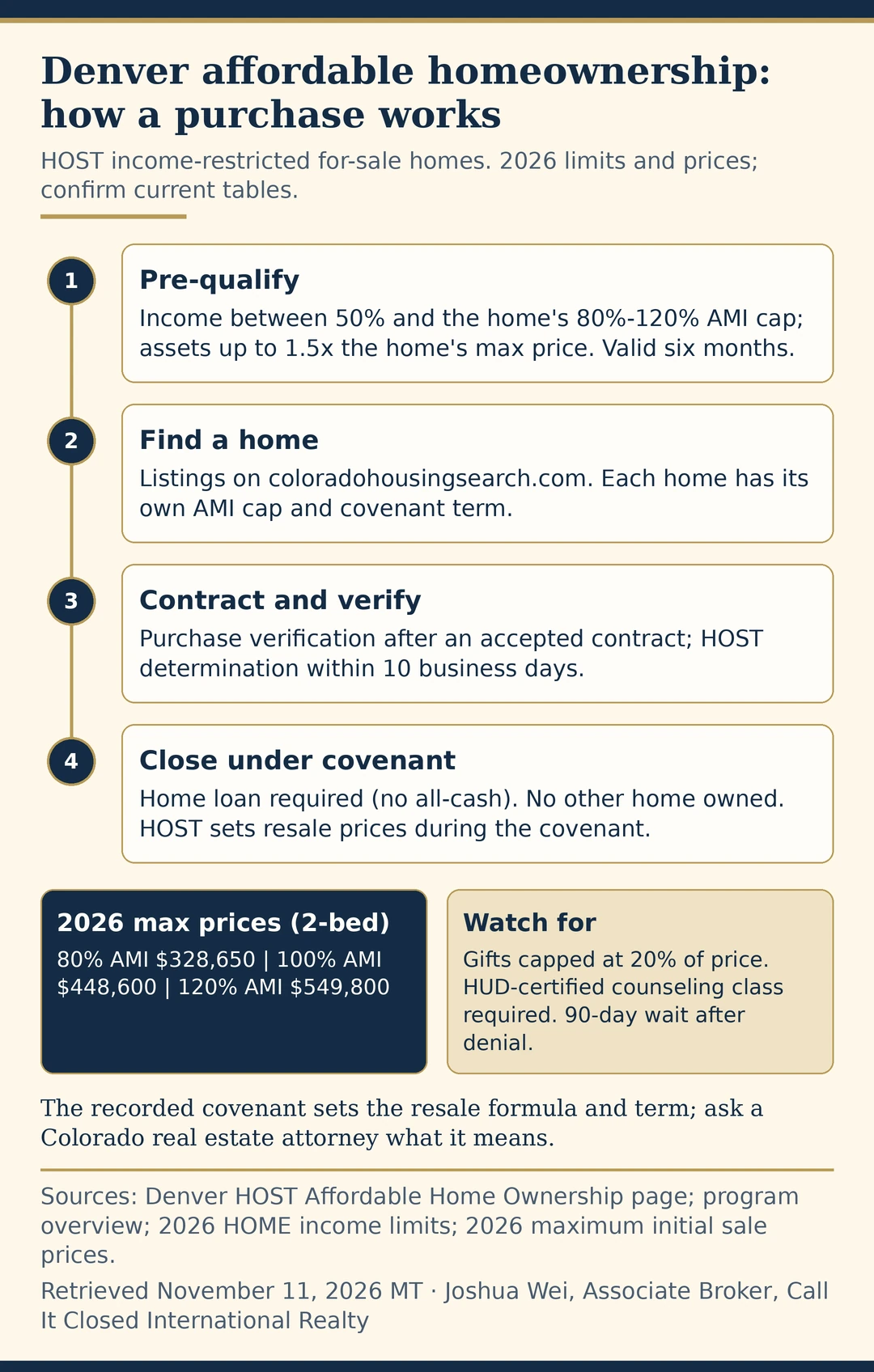
A vertical flow diagram, cream background with navy type and gold accents, titled Denver affordable homeownership: how a purchase works. Subtitle: HOST income-restricted for-sale homes. 2026 limits and prices; confirm current tables. 4 numbered steps: 1, Pre-qualify: Income between 50% and the home's 80%-120% AMI cap; assets up to 1.5x the home's max price. Valid six months; 2, Find a home: Listings on coloradohousingsearch.com. Each home has its own AMI cap and covenant term; 3, Contract and verify: Purchase verification after an accepted contract; HOST determination within 10 business days; 4, Close under covenant: Home loan required (no all-cash). No other home owned. HOST sets resale prices during the covenant. Two cards: 2026 max prices (2-bed): 80% AMI $328,650 | 100% AMI $448,600 | 120% AMI $549,800; and Watch for: Gifts capped at 20% of price. HUD-certified counseling class required. 90-day wait after denial. A note says: The recorded covenant sets the resale formula and term; ask a Colorado real estate attorney what it means. Sources: Denver HOST Affordable Home Ownership page; program overview; 2026 HOME income limits; 2026 maximum initial sale prices. Retrieved November 11, 2026 MT. Joshua Wei, Associate Broker, Call It Closed International Realty.
Sources: Denver HOST Affordable Home Ownership (opens in a new tab)
Cream background, navy text, gold rules. Numbered navy circles on a gold spine with white step cards, two branch cards (navy and tan), a note, and a source footer.
The figure above shows a purchase in order: pre-qualify, find a home, get under contract, verify, and close under the covenant.
Where do these homes come from?
HOST's overview says that when the city funds developers, "the exchange is for a specified number of homes to become affordable homes." It adds that the "Mandatory Housing Ordinance" passed in 2022 "requires all developers and builders who build in the City to provide a set number of homes in their development as affordable homes."
To find listings, HOST points buyers to coloradohousingsearch.com.
What are the income limits?
HOST uses the 2026 HOME income limits (opens in a new tab) ("Effective: June 1, 2026") for all affordable properties. A few rows from that table:
| Area median income | 1 person | 2 people | 4 people | |---|---|---|---| | 50% (program minimum) | $50,400 | $57,600 | $72,000 | | 80% | $74,800 | $85,450 | $106,800 | | 100% | $100,800 | $115,200 | $144,000 | | 120% | $120,950 | $138,250 | $172,800 |
HOST's program rules (opens in a new tab) (the 2024 Inclusionary Housing Ordinance Rules and Regulations, which HOST's page links as the "Affordable Homeownership program Rules and Regulations") set a different range for homes created under that ordinance. They say: "To be income eligible to purchase at initial sale, the household must demonstrate that the total household income is at or above fifty (50%) of the AMI, for household size, and is at or below eighty percent (80%) of AMI, for household size, or no more than ninety-five percent (95%) of AMI, for household size, if the MPDU is in a High Cost Structure." (MPDU is the rules' term for an affordable unit.) The HOST page gives a maximum of "80%-120%" based on the home's address. I am not resolving the difference; the covenant on a specific home and HOST decide which limit applies.
For a resale of a home whose initial limit was 80% of AMI, the rules set a rising schedule by years of ownership at resale: 80% of AMI for 0 to 3 years, 90% for 3 to 6 years, 100% for 6 to 15 years, and "No Restriction" after 15 years. The rules also say: "Household income will be calculated at the highest anticipated income over the next twelve (12) months." They exclude "college funds and IRS recognized institutional retirement funds" from the income calculation.
Each home's covenant sets its own maximum. HOST's overview says to count everyone "living in home more than 50% of the time – no matter what age." The table is dated effective June 1, 2026; HOST can confirm whether a newer one applies.
What do the homes cost?
HOST publishes 2026 maximum initial sale prices (opens in a new tab) by AMI level and bedroom count. Some examples:
- 80% of AMI: 1-bedroom $285,700; 2-bedroom $328,650; 3-bedroom $371,350
- 100% of AMI: 1-bedroom $392,450; 2-bedroom $448,600; 3-bedroom $504,700
- 120% of AMI: 1-bedroom $482,450; 2-bedroom $549,800; 3-bedroom $617,200
The asset limit is tied to the home's price. On a home capped at $328,650, for example, 1.5 times the price is $492,975.
The rules describe how HOST sets these prices: "Maximum affordable price will be based on 30% of an eligible household's gross household income." The assumptions include "A maximum down payment of 5.0%" and "Current Year AMI thresholds adjusted for household size published by HUD." The rules also say that, except in agreements or covenants approved before July 31, 2007, "transfer fees shall never be charged for transfer of an MPDU."
What rules come with the home?
HOST's overview lists several:
- "Applicant cannot own another home at time of closing or at any time while owning the affordable home."
- "The program does not allow for all cash buyers. Must have a home loan."
- On resale, the home "will increase in value, but not as much as a home on the open market."
- After the affordable period ends, part or all of the proceeds from the first sale go back to the city for affordable housing.
Living in the home
The program rules say: "Purchasers of MPDUs are required to occupy the purchased MPDU within thirty (30) days of closing on the unit and may not own any other residential property during their ownership of the MPDU. Owners of MPDUs are required to occupy those units as their primary residence."
There is a narrow exception. "At the sole discretion of the Director, a temporary occupancy exception for owners of for-sale MPDUs may be allowed." It "would allow such owner(s) of an MPDU unit to lease the MPDU for no more than six months in duration for a total of no more than a two year period." Listed reasons include a "Job or military transfer more than sixty (60) miles from Denver City and County limits," "Change in household size," and "Foreclosure prevention." The rent is capped so "the owner will not profit from an occupancy exception," and "all subleasing" is prohibited.
How the resale price is figured
For homes created after June 1, 2010, the rules start with the prior purchase price. "For each year from the date that the selling Owner acquired the MPDU multiply the selling Owner's Prior Purchase Price by the percentage change over the prior year in the Standard and Poor's Case/Shiller Index up to a maximum increase for any given year of three and a half percent (3.5%)." The yearly increases are "not compounded from year to year," and "In years where the Standard and Poor's Case/Shiller Index decreases, there shall be no adjustment to decrease the Prior Purchase Price of the MPDU."
Added to that are HOST-approved "Eligible Capital Improvements" and the seller's sale commission, up to "the maximum allowable sales commission published by HOST on an annual basis." Homes created before May 31, 2010 use a different, appraisal-based shared-appreciation formula. The rules add: "It is anticipated that market conditions may, from time to time, cause a MPDU to be sold for less than the maximum allowable resale price."
HOST's Maximum Resale Price Request (opens in a new tab) form says your home does not have a "market" value while the covenant is in effect. It adds: "There is no guarantee that the property can be sold at the Maximum Resale Price." It also says: "It may take up to 10 business days for us to process completed Price Requests."
Refinancing
The rules say: "Owners of MPDUs may not refinance an MPDU for more than the Maximum Allowable Resale Price." The price request form warns: "Do not refinance your Affordable Home for an amount in excess of the Maximum Sale Price issued by our office." It adds: "The city will not waive the Maximum Resale Price or buyer income requirements at the point of a future sale, regardless of the amount owed on the home."
After the covenant ends
Under the rules, an owner planning "the first sale of an MPDU within ten (10) years after the end of the control period shall provide 30 days notice to HOST." HOST then has 30 days to give notice of "the City's intent to purchase and maintain the property as affordable housing." If the City does not intend to buy, "the owner may proceed to sell the MPDU." On that first sale, the owner pays the City half of the "final gain," as the rules define it. The covenant on a particular home controls how this applies.
Each home's terms are in its recorded covenant. What a covenant's resale formula and term mean for a buyer is a question for a Colorado real estate attorney.
How does the application fit a purchase timeline?
HOST says: "Pre-qualification is valid for six (6) months from the dated determination letter." Once you have an accepted contract, you complete the purchase verification.
The overview says completed applications get a determination "within 10 business days." How that fits loan and closing deadlines is a question for the lender.
Other rules from HOST's page:
- "Denied applications and cancelled applications will need to wait 90 days before re-applying."
- "Financial gifts are restricted to 20% of the purchase price of the affordable home."
- "Applicants are required to complete a HUD Certified Homebuyer Counseling Class." HOST lists free class providers.
What the application asks for
HOST's page lists the documents, including "A copy of the signed purchase contract for the affordable home you wish to purchase," a "Completed loan application form from the lender (form 1003)," and a Verification of Employment form "for each employed household member." It also asks for "Two months of the most recent consecutive paystubs," bank statements for "all bank accounts held by each household member," and federal tax return transcripts for the last two years. On transcripts it notes: "Federal Tax Return Transcripts are different from Tax Returns."
For gifts, the page says "Gift funds must be received by the buyer before closing on the affordable home." It adds that the gift letter must state "that no repayment is required and that the gift funds will be used solely for the purchase of a Denver affordable home."
What happens at closing
HOST's closing instructions to title companies (opens in a new tab) say: "At least two business days prior to closing, provide a copy of the draft Seller's and Buyer's Settlement Statements to affordablehousing@denvergov.org." The title company receives an Income & Price Certification Form and is told: "Do not proceed with closing until you have received this certification." The covenant "must be recorded prior to any other documents including Deeds and loan documents," and the buyer signs a Memorandum of Acceptance, which is notarized and recorded. The letter also notes: "Closing can not occur until buyer(s) have been income verified by the City and County of Denver."
The same letter says the City "strongly recommends" listing the covenant in the title commitment's requirements, citing "the potential ramifications of non-compliance with the Covenant-particularly voidable title."
An invented example
This example is invented; the household, the home and the numbers are not real.
A two-person household earns $80,000 a year. On the 2026 HOME table, that is between the 50% row ($57,600) and the 80% row ($85,450) for two people. They get a pre-qualification letter from HOST, valid for six months. They find a 2-bedroom condo with an 80% AMI covenant and a price of $328,650, at the 2026 maximum for that level. Their assets must not exceed $492,975. Their lender issues a loan application, and they send HOST the signed contract for purchase verification, then receive a determination within the stated 10 business days. Before closing, the title company sends the draft settlement statements to HOST and waits for the certification. At closing, the covenant is already recorded, and they sign the Memorandum of Acceptance.
A buyer's checklist
- Check your income against the HOME table and the limit for the specific home's address.
- Pre-qualify with HOST and note the six-month expiration.
- Read the covenant for the term, the resale formula and the occupancy rules, with an attorney if you want legal advice.
- Line up a lender; cash purchases are not allowed.
- Plan for the counseling class and any gift letter.
- Build HOST's review into your contract deadlines.
- Before any refinance, get a maximum resale price from HOST.
Frequently asked questions
Can I pay cash for a Denver affordable home?
HOST says "The program does not allow for all cash buyers. Must have a home loan."
Can I keep a home I already own?
HOST's overview says: "Applicant cannot own another home at time of closing or at any time while owning the affordable home."
What income counts?
HOST's page says "All employed household members’ income, ages 18 and older, must be within certain income limits."
Do retirement accounts count toward the asset limit?
HOST says "We no longer require any statements for IRS recognized retirement accounts." Ask HOST how those accounts are treated for the asset test.
How long is a pre-qualification good for?
Six months from the dated determination letter.
Can I rent out the home?
The program rules require owners to occupy the home as a primary residence. A temporary leasing exception is at the Director's "sole discretion" and limited to listed hardships.
Can I refinance?
Not "for more than the Maximum Allowable Resale Price," under the rules. Ask HOST for a refinance price first.
Do improvements I make count at resale?
The rules add the costs of "Eligible Capital Improvements that have been approved by HOST." HOST's price request form asks for "copies of paid invoices, receipts, and description of work" and says: "All capital improvements must remain attached to the property." Ask HOST which improvements qualify before you start work.
How does HOST decide what my primary residence is?
The rules say the factors include "business pursuits, employment, income sources, residence for income or other tax purposes, age, marital status, residence of parents, spouse and children, if any, location of personal or real property, billing addresses, and motor vehicle registration."
Does the commission I pay when I sell come back to me?
The resale formula adds "the amount of the sale commission paid by the Owner; provided that such amount does not exceed the maximum allowable sales commission published by HOST on an annual basis." For a refinance price, the rules say "HOST shall not include the broker commission."
Is this the same as down payment assistance?
HOST's page lists down payment programs like metroDPA and CHAC separately from the affordable homes. HOST can explain how they differ.
Related notes
- CHFA first-time buyer programs in Denver and Aurora: what the 2026 limits and assistance options actually say
- Still have a Colorado first-time home buyer savings account? What to know before you buy in 2027
- Using gift money for a down payment in Denver or Aurora: what Fannie Mae's guide and the IRS actually say
Sources and method
Official sources, retrieved November 11, 2026, America/Denver:
- Denver HOST, Affordable Home Ownership (opens in a new tab)
- Denver HOST, Affordable Homeownership Program overview (rev. 01.22.25) (opens in a new tab)
- Denver HOST, 2026 HOME Income Limits (effective June 1, 2026) (opens in a new tab)
- Denver HOST, 2026 Maximum Initial Sale Prices (opens in a new tab)
Added November 13, 2026: further passages of HOST's Affordable Home Ownership page (opens in a new tab) (documents, gifts); the program's 2024 Rules and Regulations (opens in a new tab) (income eligibility, resale schedule, pricing, occupancy, resale price, refinance, final payment); HOST's closing instructions (opens in a new tab); and the Maximum Resale Price Request (opens in a new tab) form.
Quotations and figures are verbatim. The household in the example is invented. The $492,975 example is my own arithmetic. Limits and prices change, so confirm the current tables with HOST (affordablehousing@denvergov.org).
This note is general education from a Colorado real estate broker with Call It Closed International Realty. If you're considering an income-restricted home in Denver, I'll help you line up HOST's timeline with your contract deadlines.
Disclaimer
This article is general information only. It is not legal, tax, lending, insurance, appraisal, inspection, or financial advice, and it is not a substitute for advice about your situation. Joshua Wei is a Colorado real estate broker, not an attorney. Reading this article does not create a client relationship, an agency relationship, or an attorney-client relationship with Joshua Wei or with Call It Closed International Realty.
Laws, program rules, interest rates, insurance terms, tax figures, and other details change. Examples in this article are hypothetical illustrations unless a source is named for a specific, dated figure. Information in this article is believed accurate as of November 13, 2026 and is not guaranteed. No result is promised, and you should not rely on this article as the last word for your situation.
Before you act, confirm the point with the official source linked or cited in this article, and talk with a licensed professional who can apply the rule to your facts. That may be a licensed attorney, a tax professional, a lender, an insurance agent, a home inspector, or another licensed professional, depending on the question. Links to third-party websites and publications are provided for reference only. They are not an endorsement, and their content can change.
If you already have a brokerage relationship with another broker, this is not a solicitation.
Joshua Wei, Associate Broker, Call It Closed International Realty, Colorado license FA.100108558. Equal Housing Opportunity.