October 5, 2026 · Denver · Aurora · Buying · Financing
Using gift money for a down payment in Denver or Aurora: what Fannie Mae's guide and the IRS actually say
When family helps with a down payment, lenders and the IRS each have rules. What Fannie Mae Selling Guide B3-4.3-04 requires (donors, gift letters, transfers), and what the IRS says about the $19,000 annual exclusion and who pays gift tax.
The short answer
In brief: Two sets of rules apply to a gifted down payment. For conventional loans sold to Fannie Mae, the Selling Guide lets a borrower use a personal gift from an acceptable donor toward the down payment, closing costs or reserves, subject to minimum borrower contribution requirements. The IRS gift tax question is separate, and the donor is generally responsible.
When family helps with a down payment, two sets of rules apply, and they answer different questions.
The lender's question: can you use the money? For conventional loans sold to Fannie Mae, the Selling Guide, B3-4.3-04, Personal Gifts (opens in a new tab) says: "A borrower of a mortgage loan secured by a principal residence or second home may use funds received as a personal gift from an acceptable donor. Gift funds may fund all or part of the down payment, closing costs, or financial reserves subject to the minimum borrower contribution requirements below. Gifts are not allowed on an investment property."
The tax question: does anyone owe gift tax? The IRS Frequently Asked Questions on Gift Taxes (opens in a new tab) says: "The donor is generally responsible for paying the gift tax." Among gifts that are generally not taxable gifts, it lists "Gifts that are not more than the annual exclusion for the calendar year." The IRS What's new – Estate and gift tax (opens in a new tab) page lists the annual exclusion per donee for 2026 as $19,000.
Loan questions are for your lender, ideally before money moves. Gift tax questions are for the donor's own tax advisor.
I am a licensed Colorado real estate broker with Call It Closed International Realty. I am not a lender or loan officer, and I am not giving tax advice.
Disclaimer. This article is general information only. It is not legal, tax, lending, insurance, appraisal, inspection, or financial advice, and reading it does not create a client, agency, or attorney-client relationship. Laws, rates, programs, and figures change. Confirm the official source, and talk with a licensed attorney, tax professional, lender, insurance agent, or inspector before you act. Joshua Wei is a Colorado real estate broker, not an attorney. He is an Associate Broker with Call It Closed International Realty, license FA.100108558. Equal Housing Opportunity.
 Full size (opens in a new tab)
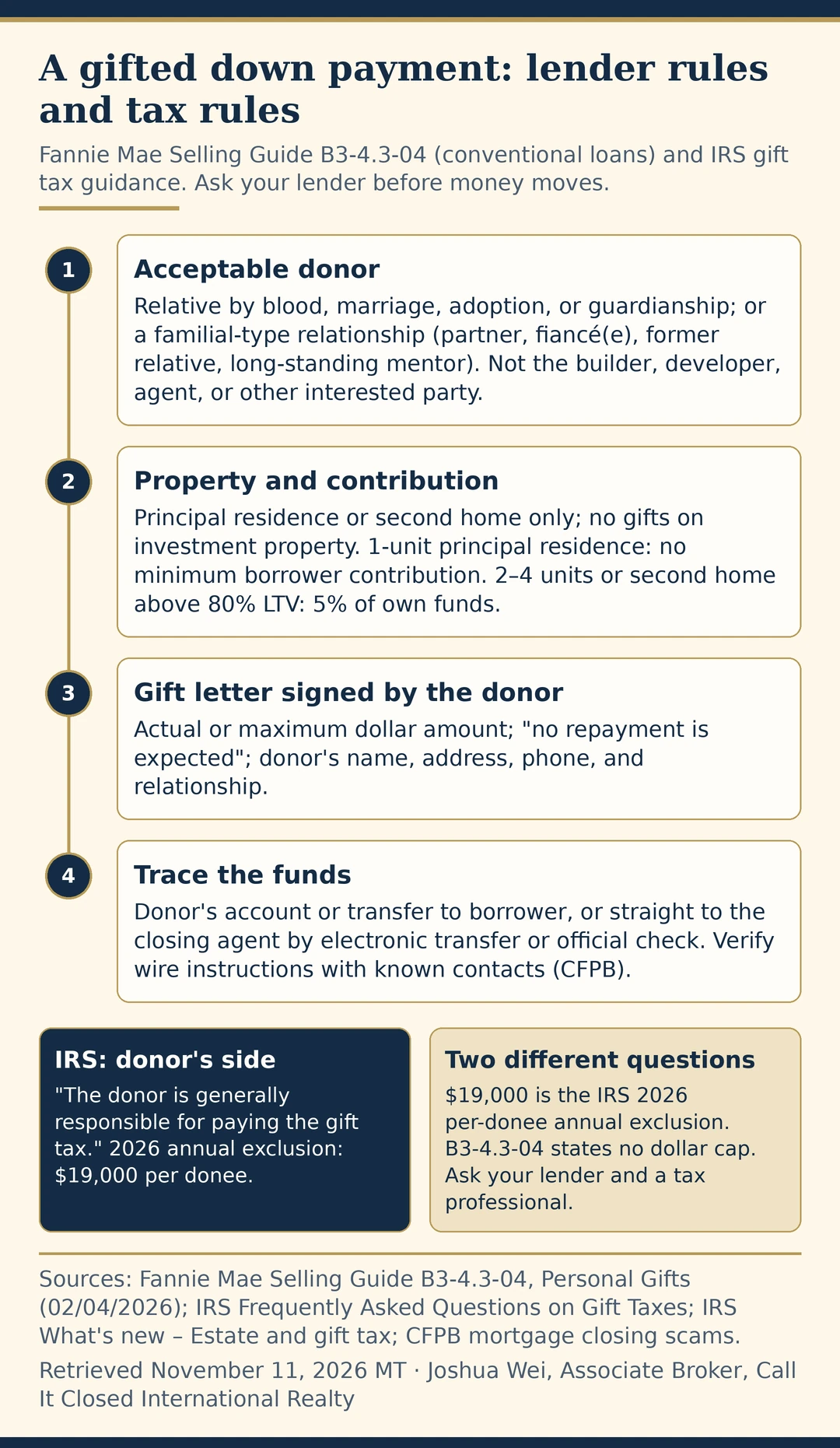
A vertical flow diagram, cream background with navy type and gold accents, titled A gifted down payment: lender rules and tax rules, with the subtitle Fannie Mae Selling Guide B3-4.3-04 for conventional loans and IRS gift tax guidance, ask your lender before money moves. Four numbered steps: 1, acceptable donor, meaning a relative by blood, marriage, adoption, or guardianship, or a familial-type relationship such as a partner, fiancé or fiancée, former relative, or long-standing mentor, and not the builder, developer, agent, or another interested party; 2, property and contribution, principal residence or second home only with no gifts on investment property, no minimum borrower contribution for a one-unit principal residence, and 5 percent of own funds for two to four units or a second home above 80 percent loan-to-value; 3, a gift letter signed by the donor with the actual or maximum dollar amount, the statement that no repayment is expected, and the donor's name, address, phone, and relationship; 4, trace the funds, through the donor's account or a transfer to the borrower, or straight to the closing agent by electronic transfer or official check, and verify wire instructions with known contacts per the CFPB. Two lower cards: IRS donor's side, the donor is generally responsible for paying the gift tax, and the 2026 annual exclusion is 19,000 dollars per donee; and not a lending limit, since the 19,000 dollar figure is the IRS per-donee annual exclusion, not a lender cap, and donors should ask their own tax professional. Sources: Fannie Mae Selling Guide, IRS, and CFPB. Retrieved November 11, 2026 MT.
Sources: Fannie Mae Selling Guide B3-4.3-04 (opens in a new tab); IRS Frequently Asked Questions on Gift Taxes (opens in a new tab); IRS What's new – Estate and gift tax (opens in a new tab)
Cream background, navy text, gold rules. Four numbered steps on a gold spine, two side-by-side cards, and a 28px source footer.
The diagram above walks through a gifted down payment on a Fannie Mae conventional loan: who can give, the gift letter, how funds move, and the separate IRS gift tax question. It summarizes official sources and is not lending or tax advice.
Who can give gift money for a conventional loan?
Fannie Mae's B3-4.3-04 says a gift can come from:
- "a relative, defined as the borrower's spouse, child, or other dependent, or by any other individual who is related to the borrower by blood, marriage, adoption, or legal guardianship; or"
- "a non-relative that shares a familial relationship with the borrower defined as a domestic partner (or relative of the domestic partner), individual engaged to marry the borrower, former relative, or an individual with a long-standing familial-like or mentorship relationship with the borrower."
It also sets a limit: "The donor may not be, or have any affiliation with, the builder, the developer, the real estate agent, or any other interested party to the transaction." There is one carve-out: "Gift funds from the seller who is also an acceptable donor and not affiliated with any other interested party to the transaction are allowed."
Help from a seller that is not a gift, such as a closing-cost credit, follows different rules.
This article covers Fannie Mae's conventional guideline in detail and FHA's handbook in brief, below. VA, CHFA, and other programs publish their own requirements, so ask your lender which rules apply to your loan.
Do I need to put in any of my own money?
It depends on the property and the loan-to-value ratio. Fannie Mae's minimum borrower contribution table says that at 80% LTV or less, for a one- to four-unit principal residence or a second home, "A minimum borrower contribution from the borrower's own funds is not required. All funds needed to complete the transaction can come from a gift."
Above 80%, it says the same thing for a "One-unit principal residence." For a "Two- to four-unit principal residence" or "Second home," "The borrower must make a 5% minimum borrower contribution from their own funds."
A footnote adds that if the donor "has lived with the borrower for the last 12 months, the gift is considered the borrower's own funds and may be used to satisfy the minimum borrower contribution requirement as long as both individuals will use the home being purchased as their principal residence."
When a gift from a donor who lives with the borrower is pooled with the borrower's funds to make up the minimum cash down payment on a manually underwritten loan, B3-4.3-04 says the file must also include "A certification from the donor stating that they have lived with the borrower for the past 12 months and will continue to do so in the new residence," plus "Documents that demonstrate a history of borrower and donor shared residency." It adds: "The donor's address must be the same as the borrower's address."
What goes in a gift letter?
Fannie Mae states: "Gifts must be evidenced by a letter signed by the donor, called a gift letter." The guide says the gift letter must:
- "specify the actual or the maximum dollar amount of the gift;"
- "include the donor's statement that no repayment is expected; and"
- "indicate the donor's name, address, telephone number, and relationship to the borrower."
The letter must include "the donor's statement that no repayment is expected." If repayment is expected, ask your lender how the funds must be handled.
How should the money move?
The lender has to trace it. Under B3-4.3-04, "The lender must verify that sufficient funds to cover the gift are either in the donor's account (such as a checking, savings or investment account, or trust or estate account owned by the donor) or have been transferred to the borrower's account." Acceptable documentation includes:
- "a copy of the donor's check and the borrower's deposit slip,"
- "evidence of the electronic transfer of funds from the donor's account to the borrower's account or to the closing agent;"
- "a settlement statement showing receipt of the donor's check."
If funds go straight to closing, "the lender must document that the donor gave the closing agent the gift funds in the form of an electronic transfer, certified check, a cashier's check, or other official check."
Practical points from the real estate side:
- Ask the lender before the donor sends anything. Their documentation checklist decides what works.
- Verify wire instructions. The CFPB's mortgage closing scams (opens in a new tab) guidance says: "Never follow instructions contained in an email. Verify the closing instructions, including the account name and number, with your trusted representatives either in person or by using the phone number you previously agreed to." That applies to a donor wiring money too.
- Keep records. Both the donor's and your statements may be requested.
What if a relative is selling me the house?
A family sale can use a gift of equity instead of cash. Fannie Mae's B3-4.3-05, Gifts of Equity (opens in a new tab), says a "gift of equity" "refers to a gift provided by the seller of a property to the buyer. The gift represents a portion of the seller's equity in the property, and is transferred to the buyer as a credit in the transaction."
Under that section, a gift of equity "is permitted for principal residence and second home purchase transactions; can be used to fund all or part of the down payment and closing costs (including prepaid items); and cannot be used towards financial reserves." The same donor and minimum contribution rules apply. And: "When a gift of equity is provided by an acceptable donor, the donor is not considered to be an interested party and the gift of equity is not subject to Fannie Mae's interested party contribution requirements." The loan file needs "a signed gift letter" and "the settlement statement listing the gift of equity."
In a Colorado contract, the credit would be written into the purchase contract and shown on the closing statement. How to write it is a question for your lender and a Colorado real estate attorney. The tax effect for the seller, and the buyer's basis in the home, are questions for each party's tax advisor; the basis rule is discussed below.
What about grants and down payment assistance?
Money from a program isn't a personal gift under Fannie Mae's guide. B3-4.3-06, Grants and Lender Contributions (opens in a new tab), covers "funds donated from acceptable entities," which it calls "a grant." It says grants "must be funded by one of the following entities, provided they are not the property seller or other interested party in the transaction": an eligible "Community Seconds provider" or "a lender." It also says: "Down payment assistance may not be funded in any way through the first lien mortgage, such as through premium pricing."
For a one-unit principal residence, its table says "A minimum borrower contribution from the borrower's own funds is not required. All funds needed to complete the transaction can come from a grant." Which programs qualify, including CHFA's, is a question for the program and your lender.
How do FHA's gift rules compare?
HUD's Single Family Housing Policy Handbook 4000.1 (opens in a new tab) has its own list. Under "Gifts (Personal and Equity)," it says: "Gifts refer to the contributions of cash or equity with no expectation of repayment." Its acceptable sources are "the Borrower's Family Member," "the Borrower's employer or labor union," "a close friend with a clearly defined and documented interest in the Borrower," "a charitable organization," and "a governmental agency or public Entity that has a program providing homeownership assistance."
Three FHA points differ from the Fannie Mae text above:
- Cash on hand. "Cash on Hand is not an acceptable source of donor gift funds."
- Both signatures. "The Mortgagee must obtain a gift letter signed and dated by the donor and Borrower."
- Gifts of equity. "Only Family Members may provide equity credit as a gift on Property being sold to other Family Members."
The handbook also covers a donor who borrows the money: "the Mortgagee must have the donor provide written evidence that the funds were borrowed from an acceptable source, not from a party to the transaction."
The PDF's page footers show "Last Revised: 08/14/2019" and say to "Refer to the online version of SF Handbook 4000.1 for specific sections' effective dates." FHA rules for your loan come from your FHA lender.
What does the IRS say about gift tax?
The IRS defines a gift as "Any transfer to an individual, either directly or indirectly, where full consideration (measured in money or money's worth) is not received in return." It also says: "The general rule is that any gift is a taxable gift. However, there are many exceptions to this rule."
On the annual exclusion, the IRS FAQ explains: "The annual exclusion applies to gifts to each donee. In other words, if you give each of your children $19,000 in 2026, the annual exclusion applies to each gift." The What's new page lists "$19,000" for 2026.
Two more IRS points:
- "The donor is generally responsible for paying the gift tax."
- For the person receiving the gift, the FAQ says: "Making a gift or leaving your estate to your heirs does not ordinarily affect your federal income tax."
For a married couple giving together, the IRS FAQ (opens in a new tab) says: "Each spouse is entitled to the annual exclusion amount on the gift," and its table lists "$19,000" per donee from one spouse and "$38,000" from two spouses for 2026. For "gift splitting," it points to the Form 709 instructions.
The FAQ also lists gifts that are "Generally" not taxable, including "Tuition or medical expenses you pay for someone (the educational and medical exclusions)" and "Gifts to your spouse."
The IRS FAQ's basis rule for a gift of property is: "The general rule is that your basis in the property is the same as the basis of the donor." That rule describes a pure gift of property, not a sale in which part of the price is forgiven. A gift of equity is usually both a sale and a gift, because the buyer pays something and receives the rest as a gift. The part-sale, part-gift basis rule is in Treasury Regulation 1.1015-4, which says: "Where a transfer of property is in part a sale and in part a gift, the unadjusted basis of the property in the hands of the transferee is the sum of— (1) Whichever of the following is the greater: (i) The amount paid by the transferee for the property, or (ii) The transferor's adjusted basis for the property at the time of the transfer, and (2) The amount of increase, if any, in basis authorized by section 1015(d) for gift tax paid (see section 1.1015-5)." The same regulation says: "For determining loss, the unadjusted basis of the property in the hands of the transferee shall not be greater than the fair market value of the property at the time of such transfer." The number depends on what was paid, the seller's adjusted basis, later gift tax, and, for a later loss, the fair market value at the time of the transfer. A tax advisor should compute basis before anyone treats the donor's basis as the buyer's basis.
A gift above the annual exclusion can require a Form 709 even if no gift tax is due, because the extra amount is counted against the lifetime exclusion. The current IRS Instructions for Form 709 (for gifts made during calendar year 2025; as of November 17, 2026, instructions titled for calendar year 2026 gifts were not yet posted) say that a U.S. citizen or resident "must file a gift tax return (whether or not any tax is ultimately due)" in the situations they list, including if you gave gifts to someone "totaling more than $19,000 (other than to your spouse)." The What's new page lists the same $19,000 annual exclusion per donee for 2026, and notes that the basic exclusion amount was increased "to $15,000,000 for calendar year 2026." Whether a particular gift needs a Form 709 filing, how married donors handle a gift, and how the lifetime exclusion applies are questions for the donor's tax advisor.
Related: Note on Denver home prices and seller concessions (opens in a new tab).
A checklist for buyers and donors
- Buyer: ask the lender which program's gift rules apply and get its gift letter form.
- Buyer: confirm whether the donor is an acceptable donor under that program.
- Donor: keep the bank statement that shows the funds and the withdrawal.
- Donor: use an electronic transfer or official check, as the lender directs, and confirm wire instructions by phone at a known number.
- Seller giving equity: put the gift of equity in the purchase contract and make sure it appears on the settlement statement.
- Donor: ask a tax advisor whether a Form 709 filing is needed, including when no gift tax is due.
A hypothetical
This example is invented. A buyer is purchasing a one-unit Aurora condo as her principal residence with a 95 percent LTV conventional loan. Her parents plan to give her $15,000. Before anyone moves money, her lender sends its gift letter form, and her parents fill in the amount, their contact details, their relationship to her, and the statement that no repayment is expected. Because the loan is above 80 percent LTV on a one-unit principal residence, Fannie Mae's table shows no minimum contribution from her own funds. Her parents wire the money to the title company after confirming the wire instructions by calling a number they looked up independently. On the tax side, $15,000 from her parents together is under the $38,000 two-spouse figure the IRS lists for 2026. Whether they have any filing obligation is a question for their tax advisor.
Frequently asked questions
Can my parents give me my whole down payment?
For a one-unit principal residence, B3-4.3-04 lists no minimum borrower contribution. Ask your lender what applies to your loan.
Can a friend give me money?
Fannie Mae allows "an individual with a long-standing familial-like or mentorship relationship with the borrower." The lender decides whether that is documented.
Can I use gift money on a rental property?
Not under B3-4.3-04: "Gifts are not allowed on an investment property."
Does the gift have to be in my account before closing?
B3-4.3-04 describes verifying funds in the donor's account, a transfer to the borrower, or a transfer to the closing agent. Ask your lender for its checklist.
Can my parents give me equity instead of cash if I'm buying their house?
Under Fannie Mae's B3-4.3-05, a gift of equity from an acceptable donor can fund "all or part of the down payment and closing costs." FHA's handbook says "Only Family Members may provide equity credit as a gift on Property being sold to other Family Members." The buyer's basis in a gift-of-equity purchase is a tax question, not a loan-guide question; see the gift tax section above.
Is an FHA gift letter different?
HUD's handbook requires a gift letter "signed and dated by the donor and Borrower."
Do I pay tax on a gift I receive?
The IRS says the donor is generally responsible for gift tax. Ask a tax professional about your situation.
Is $19,000 the most someone can give me?
The IRS lists $19,000 as the 2026 annual exclusion per donee, a gift tax figure. B3-4.3-04 doesn't state a dollar cap on gifts. Ask your lender about the loan and the donor's tax professional about gift tax reporting.
Related notes
- CHFA first-time buyer programs in Denver and Aurora: what the 2026 limits and assistance options actually say
- Why you can't bring a personal check to closing: Colorado's good funds law for Denver and Aurora buyers and sellers
- Wire fraud at closing: how Denver and Aurora buyers can protect their down payment
Sources and method
Official sources, retrieved November 11 and 13, 2026, and rechecked November 17, 2026, America/Denver: Fannie Mae Selling Guide B3-4.3-04, Personal Gifts (opens in a new tab) (dated 02/04/2026 on the page), B3-4.3-05, Gifts of Equity (opens in a new tab) and B3-4.3-06, Grants and Lender Contributions (opens in a new tab); HUD Single Family Housing Policy Handbook 4000.1 (opens in a new tab) (PDF, sections "Gifts (Personal and Equity)"); IRS Frequently Asked Questions on Gift Taxes (opens in a new tab) and What's new – Estate and gift tax (opens in a new tab) (page last reviewed November 3, 2026); IRS Instructions for Form 709 (opens in a new tab) (2025 instructions, for gifts made during calendar year 2025; 2026 instructions were not posted as of November 17, 2026); Treasury Regulation 1.1015-4, 26 CFR 1.1015-4 (opens in a new tab) (eCFR text retrieved November 17, 2026); CFPB, Mortgage closing scams: how to protect yourself and your closing funds (opens in a new tab). Quotations are verbatim. VA and CHFA gift rules are not summarized. The hypothetical is invented.
This note is general education from a Colorado real estate broker with Call It Closed International Realty. If family is helping you buy in Denver or Aurora, I can help you build the lender's gift timeline into your contract dates.
Disclaimer
This article is general information only. It is not legal, tax, lending, insurance, appraisal, inspection, or financial advice, and it is not a substitute for advice about your situation. Joshua Wei is a Colorado real estate broker, not an attorney. Reading this article does not create a client relationship, an agency relationship, or an attorney-client relationship with Joshua Wei or with Call It Closed International Realty.
Laws, program rules, interest rates, insurance terms, tax figures, and other details change. Examples in this article are hypothetical illustrations unless a source is named for a specific, dated figure. Information in this article is believed accurate as of November 17, 2026 and is not guaranteed. No result is promised, and you should not rely on this article as the last word for your situation.
Before you act, confirm the point with the official source linked or cited in this article, and talk with a licensed professional who can apply the rule to your facts. That may be a licensed attorney, a tax professional, a lender, an insurance agent, a home inspector, or another licensed professional, depending on the question. Links to third-party websites and publications are provided for reference only. They are not an endorsement, and their content can change.
If you already have a brokerage relationship with another broker, this is not a solicitation.
Joshua Wei, Associate Broker, Call It Closed International Realty, Colorado license FA.100108558. Equal Housing Opportunity.