September 30, 2026 · Denver · Aurora · Buying · Selling
Who pays the buyer's agent in Colorado? How the 2026 forms handle buyer brokerage compensation in Denver and Aurora
Colorado's Exclusive Right-to-Buy Listing Contract and the 2026 purchase contract spell out who pays a buyer's brokerage firm and how. What the official forms say about negotiable fees, seller-paid compensation, the buyer's backstop obligation, and how lenders treat seller credits.
The short answer
In brief: In Colorado, a buyer's brokerage firm can be paid by the seller, the seller's brokerage firm, the buyer, or a combination, as set out in the written agreements. The Exclusive Right-to-Buy Listing Contract states that brokerage compensation is not set by law and is fully negotiable, and section 29 of the purchase contract has a line for each payer.
In Colorado, a buyer's brokerage firm can be paid by the seller, by the seller's brokerage firm, by the buyer, or by some combination, and the official forms make you write down which. The Colorado Real Estate Commission's Exclusive Right-to-Buy Listing Contract, form BC60, posted on the Division of Real Estate's contracts and forms page (opens in a new tab), puts the most important sentence in capital letters on its first page: "COMPENSATION CHARGED BY BROKERAGE FIRMS IS NOT SET BY LAW AND IS FULLY NEGOTIABLE."
The 2026 Contract to Buy and Sell Real Estate (Residential), on the same page, then has a dedicated Section 29, "BUYER'S BROKERAGE FIRM COMPENSATION," with three lines: an amount paid "by Seller," an amount paid "by Buyer pursuant to a separate agreement between Buyer and Buyer's brokerage firm," and an amount paid "by a separate agreement between Buyer's brokerage firm and Seller's brokerage firm."
The answer to "who pays?" is in the written agreements. This article walks through where those words live, what a buyer agrees to when signing a buyer listing contract, and what sellers are being asked to decide in an offer.
I am a licensed Colorado real estate broker with Call It Closed International Realty, so I have a direct interest in this topic, and you should read it with that in mind. I am not an attorney, a lender, or a tax advisor. Nothing here is a recommendation on what anyone should pay.
Disclaimer. This article is general information only. It is not legal, tax, lending, insurance, appraisal, inspection, or financial advice, and reading it does not create a client, agency, or attorney-client relationship. Laws, rates, programs, and figures change. Confirm the official source, and talk with a licensed attorney, tax professional, lender, insurance agent, or inspector before you act. Joshua Wei is a Colorado real estate broker, not an attorney. He is an Associate Broker with Call It Closed International Realty, license FA.100108558. Equal Housing Opportunity.
 Full size (opens in a new tab)
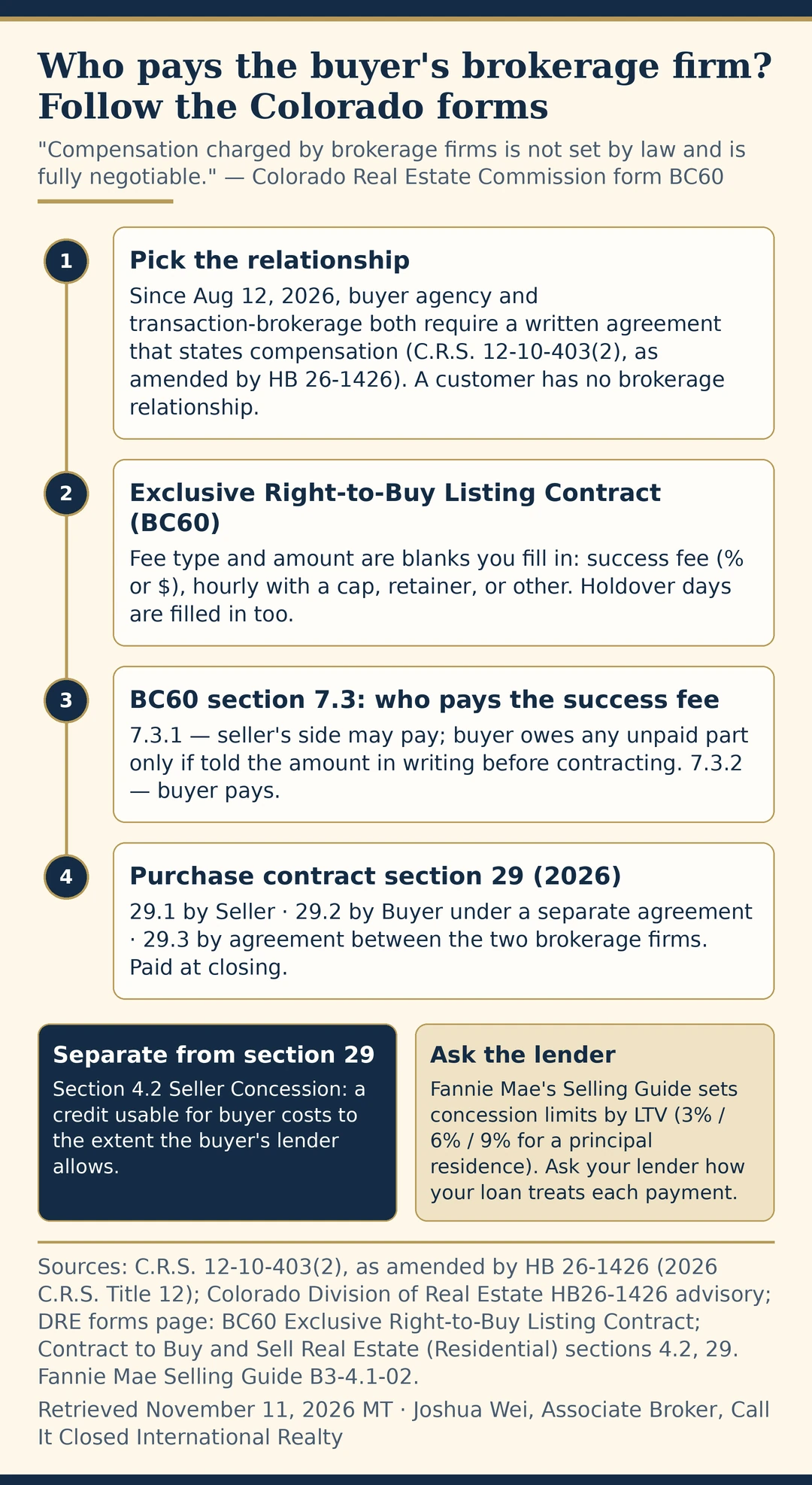
A vertical flow diagram, cream background with navy type and gold accents, titled Who pays the buyer's brokerage firm? Follow the Colorado forms, with the quotation that compensation charged by brokerage firms is not set by law and is fully negotiable, from Colorado Real Estate Commission form BC60. Four numbered steps: 1, pick the relationship, where since August 12, 2026, buyer agency and transaction-brokerage both require a written agreement that states compensation, under C.R.S. 12-10-403(2) as amended by HB 26-1426, and a customer has no brokerage relationship; 2, the Exclusive Right-to-Buy Listing Contract BC60, where fee type and amount are blanks filled in, such as a success fee as a percentage or dollar amount, an hourly fee with a cap, a retainer, or other, plus holdover days; 3, BC60 section 7.3 on who pays the success fee, where under 7.3.1 the seller's side may pay and the buyer owes any unpaid part only if told the amount in writing before contracting, and under 7.3.2 the buyer pays; 4, purchase contract section 29 of 2026, with 29.1 by seller, 29.2 by buyer under a separate agreement, and 29.3 by agreement between the two brokerage firms, paid at closing. Two lower cards: separate from section 29, the section 4.2 seller concession is a credit usable for buyer costs to the extent the buyer's lender allows; and ask the lender, since Fannie Mae caps financing concessions by loan-to-value ratio at 3, 6, or 9 percent for a principal residence, with exceptions for customary seller-paid costs. Sources: C.R.S. 12-10-403(2) as amended by HB 26-1426, the Colorado Division of Real Estate HB26-1426 advisory and forms, and Fannie Mae Selling Guide B3-4.1-02. Retrieved November 11, 2026 MT.
Sources: C.R.S. 12-10-403(2), 2026 C.R.S. Title 12 (as amended by HB 26-1426) (opens in a new tab); Colorado Division of Real Estate, HB26-1426 broker advisory (opens in a new tab); Colorado Division of Real Estate, contracts and forms (BC60; CBS1) (opens in a new tab); Fannie Mae Selling Guide B3-4.1-02, Interested Party Contributions (opens in a new tab)
Cream background, navy text, gold rules. Four numbered steps on a gold spine, two side-by-side cards on seller concessions and lender limits, and a 28px source footer.
The diagram above shows the two documents and the three payment lines in the 2026 purchase contract. It describes the official forms; it does not suggest any fee.
What kinds of relationships can a buyer have with a broker?
The Commission's Brokerage Disclosure to Buyer, also on the DRE forms page, opens with: "DIFFERENT BROKERAGE RELATIONSHIPS ARE AVAILABLE WHICH INCLUDE SELLER AGENCY, BUYER AGENCY OR TRANSACTION-BROKERAGE." Its definitions:
- A buyer's agent "works solely on behalf of the buyer to promote the interests of the buyer with the utmost good faith, loyalty and fidelity," and "A separate written buyer agency agreement is required which sets forth the duties and obligations of the broker and the buyer."
- A transaction-broker "assists the buyer or seller or both throughout a real estate transaction ... without being an agent or advocate for any of the parties." That form (BDB24) predates a 2026 law change and still says no written agreement is needed for transaction-brokerage. That part is no longer accurate; see the next section.
- A customer "is a party to a real estate transaction with whom the broker has no brokerage relationship."
Colorado now requires a written agreement for both relationships
Since August 12, 2026, C.R.S. 12-10-403(2) (opens in a new tab), as amended by HB 26-1426, says: "A broker shall establish either a transaction-broker or a single-agency relationship through a written agreement between the broker and the party or parties to be represented by the broker. Such written agreement must specify and conspicuously disclose the amount or rate of any compensation to be paid to the broker, and the broker shall complete such written agreement before performing any activities described in section 12-10-201 (6)(a)."
The Division of Real Estate's broker advisory (opens in a new tab) puts it plainly: "For a transaction-broker relationship, NO written agreement was required." It continues, "That foundation in Colorado real estate practice is NO MORE." The Division's HB26-1426 summary (opens in a new tab) says the law "now requires that a written agreement is required for both agency relationships and transaction-broker relationships."
The advisory also says "the Buyer's Broker's Compensation Agreement located at the end of the Broker's Disclosure to Buyer is not sufficient to establish a brokerage relationship," and "Only a Listing Contract is sufficient to establish a relationship in writing and to comply with HB26-1426." For buyers, the Commission form is the Exclusive Right-to-Buy Listing Contract (BC60). The advisory adds that "Licensed duties do not include showings, holding open houses, or completing Comparative Market Analyses."
The Commission has adopted updated forms for use on and after January 1, 2027. The 2027 Definitions of Working Relationships (opens in a new tab) (adoption date August 4, 2026) says: "A separate written agreement is required to establish a transaction-broker relationship ..." The DRE forms page also posts updated 2027 versions of the Brokerage Disclosure to Buyer and BC60. If this article is read after December 31, 2026, check BC60 against the 2027 form.
What does each relationship owe the buyer under state law?
The statute spells out the duties, and they differ.
Buyer's agent. Under C.R.S. 12-10-405(1) (opens in a new tab), "A broker engaged by a buyer or tenant to act as a buyer's or tenant's agent shall be a limited agent with the following duties and obligations," including "To perform the terms of the written agreement made with the buyer or tenant" and "To promote the interests of the buyer or tenant with the utmost good faith, loyalty, and fidelity." The listed duties include "Seeking a price and terms that are acceptable to the buyer or tenant," "Disclosing to the buyer or tenant adverse material facts actually known by the broker," and "Counseling the buyer or tenant as to any material benefits or risks of a transaction that are actually known by the broker."
Transaction-broker. Under C.R.S. 12-10-407(1) (opens in a new tab), "A broker engaged as a transaction-broker is not an agent for either party." The duties in section 12-10-407(2) include "To exercise reasonable skill and care as a transaction-broker," "Keeping the parties fully informed regarding the transaction," and "Assisting the parties in complying with the terms and conditions of any contract including closing the transaction." Section 12-10-407(3) adds that a transaction-broker "shall not disclose" without written consent of all parties "That a buyer or tenant is willing to pay more than the purchase price or lease rate offered for the property."
The fee terms sit in the written agreement either way. The relationship decides whose interests the broker is promoting.
What does the Exclusive Right-to-Buy Listing Contract say about pay?
BC60 shows an adoption date of October 7, 2025, and a mandatory use date of January 1, 2026. Section 1 calls it an "exclusive, irrevocable contract" and states: "Brokerage Firm will receive compensation as set forth in this Buyer Listing Contract."
Section 7 offers several ways to structure the fee, each with blanks to fill in:
- Success fee. "A fee equal to _% of the purchase price, or $_." The form says the success fee "is earned by Brokerage Firm upon the Purchase of Property and is due and payable upon closing of the transaction." If a deal fails "as a result of the seller's default with no fault on the part of Buyer, the Success Fee will be waived." If it fails because of the buyer's default, "the Success Fee will not be waived."
- Hourly fee, "up to a maximum total fee" that the parties fill in.
- Retainer fee, described as "nonrefundable," with a box for whether it "Will" or "Will Not be credited against other fees."
- Other compensation, a blank line.
Section 7.3 then answers "Who Will Pay Brokerage Firm's Success Fee" with two choices.
Section 7.3.1, "Seller's Brokerage Firm or Seller May Pay. Buyer IS Obligated to Pay." Under this option, the broker "is authorized and instructed to request payment of Brokerage Firm's Success Fee from one or both of the following: (1) the seller's brokerage firm, or (2) seller." Then the key sentence: "Buyer is obligated to pay any portion of the Success Fee which is not paid by the seller's brokerage firm or seller, but only if Broker discloses to Buyer the amount Buyer must pay, in writing and prior to Buyer entering into a contract with the seller."
Section 7.3.2, "Buyer Will Pay." "Buyer is obligated to pay Brokerage Firm's Success Fee." Under this option the firm "is NOT entitled to receive additional compensation, bonuses or incentives from seller's brokerage firm, seller or any other source unless agreed to by Buyer in writing."
If neither box is checked, the form says, "section 7.3.1 (Seller's Brokerage Firm or Seller May Pay. Buyer IS Obligated to Pay) will apply."
Two more provisions are worth reading slowly:
- No surprise extra pay. Section 7 says: "Unless approved by Buyer, in writing, Brokerage Firm is not entitled to receive additional compensation, bonuses, and incentives paid by seller's brokerage firm or seller." Section 8 adds that the broker and firm will not "accept compensation from any other person or entity in connection with the Property without the written consent of Buyer."
- Holdover period. Section 7.4 says the success fee can also apply to a property contracted for within a number of "calendar days after the Listing Period expires," if the broker negotiated on it and submitted it in writing during the listing period. The parties fill in the number of days and check boxes that control how this works if the buyer later signs with another firm.
How does the 2026 purchase contract handle it?
Section 29 of the Contract to Buy and Sell Real Estate (Residential) states that the buyer's brokerage firm's compensation "will be paid, at Closing, as follows," and lists:
- 29.1: "_% of the Purchase Price or $_ by Seller. Buyer's brokerage firm is an intended third party beneficiary under this provision only. The amount paid by Seller under this provision is in addition to any other amounts Seller is paying on behalf of Buyer elsewhere in this Contract."
- 29.2: "_% of the Purchase Price or $_ by Buyer pursuant to a separate agreement between Buyer and Buyer's brokerage firm. This amount may be modified between Buyer and Buyer's brokerage firm outside of this Contract."
- 29.3: "_% of the Purchase Price or $_ by a separate agreement between Buyer's brokerage firm and Seller's brokerage firm."
Section 29.1 is the line where an offer states compensation to be paid by the seller. The contract has a separate seller concession in Section 4.2, which the contract describes as a credit that "may be used for any Buyer fee, cost, charge or expenditure to the extent the amount is allowed by the Buyer's lender."
BC60 Section 7.3.1 addresses what a buyer owes if the seller's side pays less. How your signed buyer agreement and a specific offer fit together is a question for a Colorado real estate attorney.
The contract also has a "Broker's Acknowledgments and Compensation Disclosure" at the end, and it says: "This Broker's Acknowledgments and Compensation Disclosure is for disclosure purposes only and does NOT create any claim for compensation."
Do lenders care how compensation and credits are paid?
They can. Section 4.2 of the purchase contract already ties seller concessions to what "is allowed by the Buyer's lender." As one official example, Fannie Mae's Selling Guide B3-4.1-02, Interested Party Contributions (opens in a new tab) lists "the property seller" and "the real estate agent or broker" as interested parties, and caps "financing concessions" for a principal residence at 3% when the loan-to-value ratio is greater than 90%, 6% from 75.01% to 90%, and 9% at 75% or less. The same section states: "Typical fees and/or closing costs paid by a seller in accordance with local custom, known as common and customary fees or costs, are not subject to Fannie Mae maximum financing concessions."
The federal housing agencies addressed seller-paid buyer broker fees in 2024, after the National Association of REALTORS® settlement was announced:
- FHA. HUD's March 27, 2024 statement (opens in a new tab) and FHA INFO 2024-12 (opens in a new tab) say: "Under existing FHA policy, if sellers continue to pay buyer-side real estate agent commissions and fees as a matter of state or local law or local custom, and if the commissions and fees are reasonable in amount, existing policy would not treat those payments as interested party contributions provided all other requirements are met." (The FHA INFO version reads "as a manner of state and local law or custom.")
- Fannie Mae. Its April 15, 2024 Selling Notice (opens in a new tab) says: "If a seller or seller's real estate agent continues to pay the buyer's real estate agent commission in accordance with local common and customary practices, these amounts are not required to be counted towards the IPC limits for the transaction."
Both statements are from 2024 and both say the agency will keep monitoring. HUD says it "will closely monitor the real estate marketplace for changes resulting from the settlement." Ask your lender whether the guidance still applies to your loan program and how your own Section 29 line will be treated.
How a seller's or buyer's payment of buyer brokerage compensation is treated for a loan is a question for your lender.
A hypothetical
These numbers are invented. A buyer signs BC60 with a success fee of 2.5 percent and leaves Section 7.3.1 checked. She makes an offer on a $500,000 Aurora house with Section 29.1 filled in at 2 percent by the seller. The gap is 0.5 percent, or $2,500. Under Section 7.3.1, she is obligated to pay it "but only if Broker discloses to Buyer the amount Buyer must pay, in writing and prior to Buyer entering into a contract with the seller." So the written disclosure has to come before she signs the offer. What her signed form means if that doesn't happen is a question for a Colorado real estate attorney. Her lender decides whether her share can be paid from a Section 4.2 seller concession. If the seller's side does not cover it, plan to pay your share in cash at closing. Your lender will usually count it when checking that you have enough funds to close. VA loans have their own rule. VA's Circular 26-24-14 lets a veteran pay reasonable and customary buyer-broker charges for now, but those charges cannot be added to the loan amount, and the lender must count them when deciding whether the veteran has enough cash to close. VA says the circular stays in place until it is rescinded, so ask your lender for the current rule before you sign a buyer agreement.
Questions buyers and sellers can raise before signing
For buyers:
- Which relationship is this: buyer agency, transaction-brokerage, or customer?
- Have I signed a written agreement that states compensation before my broker begins licensed representation work?
- If it is an Exclusive Right-to-Buy Listing Contract, which fee type, what amount, and which box in Section 7.3 is checked?
- How long is the listing period, and how many holdover days?
- Is a retainer credited against the success fee?
- Will my broker tell me in writing, before I sign a purchase contract, what I would owe if the seller pays less?
For sellers:
- In each offer, what is in Section 29.1, and what is in the Section 4.2 seller concession?
- What does your listing agreement say about compensation your brokerage firm may offer to a buyer's brokerage firm? The Commission's Exclusive Right-to-Sell Listing Contract is on the same DRE forms page.
Related: Denver prices and seller concessions (opens in a new tab).
Frequently asked questions
Is there a standard commission in Colorado?
The Commission's form says: "COMPENSATION CHARGED BY BROKERAGE FIRMS IS NOT SET BY LAW AND IS FULLY NEGOTIABLE."
Can a seller still pay the buyer's agent?
The 2026 purchase contract's Section 29.1 provides a line for an amount paid "by Seller."
If the seller pays less than my agreement, do I owe the rest?
Under BC60 Section 7.3.1, the buyer is obligated to pay the unpaid portion "but only if Broker discloses to Buyer the amount Buyer must pay, in writing and prior to Buyer entering into a contract with the seller." Under 7.3.2, the buyer pays the success fee. For what your own signed form means, ask a Colorado real estate attorney.
Do I need a written agreement to work with a broker?
Yes, for either buyer agency or transaction-brokerage, since August 12, 2026, under C.R.S. 12-10-403(2) as amended by HB 26-1426. The written agreement must "specify and conspicuously disclose the amount or rate of any compensation to be paid to the broker," and the broker must complete it "before performing any activities described in section 12-10-201 (6)(a)." The Division's advisory notes that showings and open houses are not licensed duties.
Can my broker take a bonus from the seller without telling me?
BC60 says the firm is not entitled to additional compensation, bonuses, or incentives from the seller's side "Unless approved by Buyer, in writing."
Is a transaction-broker my advocate?
No. C.R.S. 12-10-407(1) says "A broker engaged as a transaction-broker is not an agent for either party."
Does a seller credit count against lender limits?
Fannie Mae's Selling Guide sets financing concession limits by loan-to-value ratio, with exceptions it describes for common and customary seller-paid costs. How your loan program treats each payment is a question for your lender.
Related notes
- Colorado purchase contract deadlines, in plain English
- Closing costs in Denver and Aurora: what is set by law, what is negotiated, and what to read on the forms
- Denver home prices are holding. Concessions are where the give is.
Sources and method
Official sources, retrieved November 11 and 13, 2026, America/Denver: Colorado Division of Real Estate contracts and forms page (opens in a new tab), including Exclusive Right-to-Buy Listing Contract BC60 (opens in a new tab) (adopted October 7, 2025; mandatory January 1, 2026), Sections 1, 7, 7.3, 7.4, and 8; Contract to Buy and Sell Real Estate (Residential) (opens in a new tab) for use on and after January 1, 2026, Sections 4.2 and 29 and the Broker's Acknowledgments and Compensation Disclosure; and Brokerage Disclosure to Buyer (BDB24) (opens in a new tab); C.R.S. 12-10-403(2) (opens in a new tab) (2026 C.R.S., Title 12, amended by HB 26-1426, effective August 12, 2026); the Division's HB26-1426 broker advisory (opens in a new tab) and HB26-1426 summary (opens in a new tab); the 2027 Definitions of Working Relationships (opens in a new tab); C.R.S. 12-10-405 and 12-10-407 (opens in a new tab); HUD's March 27, 2024 FHA statement (opens in a new tab) and FHA INFO 2024-12 (opens in a new tab); Fannie Mae's April 15, 2024 Selling Notice (opens in a new tab); and Fannie Mae Selling Guide B3-4.1-02 (opens in a new tab). Blanks in the forms are shown as "___". Quotations are verbatim. No fee amount, average, or market-wide compensation figure is stated; the hypothetical's numbers are invented.
This note is general education from a Colorado real estate broker with Call It Closed International Realty. If you are buying or selling in Denver or Aurora, I am glad to walk you through these forms line by line before you sign them.
Added November 19, 2026, after an expert review, and checked that day: U.S. Department of Veterans Affairs, Circulars, 2021 to present (Circular 26-24-14, valid until rescinded) (opens in a new tab); U.S. Department of Veterans Affairs, 2026 Report to Congress on the VA Home Loan Program (opens in a new tab); U.S. Department of Veterans Affairs, State Fees and Charges Deviations (current as of February 17, 2026) (opens in a new tab).
Disclaimer
This article is general information only. It is not legal, tax, lending, insurance, appraisal, inspection, or financial advice, and it is not a substitute for advice about your situation. Joshua Wei is a Colorado real estate broker, not an attorney. Reading this article does not create a client relationship, an agency relationship, or an attorney-client relationship with Joshua Wei or with Call It Closed International Realty.
Laws, program rules, interest rates, insurance terms, tax figures, and other details change. Examples in this article are hypothetical illustrations unless a source is named for a specific, dated figure. Information in this article is believed accurate as of November 19, 2026 and is not guaranteed. No result is promised, and you should not rely on this article as the last word for your situation.
Before you act, confirm the point with the official source linked or cited in this article, and talk with a licensed professional who can apply the rule to your facts. That may be a licensed attorney, a tax professional, a lender, an insurance agent, a home inspector, or another licensed professional, depending on the question. Links to third-party websites and publications are provided for reference only. They are not an endorsement, and their content can change.
If you already have a brokerage relationship with another broker, this is not a solicitation.
Joshua Wei, Associate Broker, Call It Closed International Realty, Colorado license FA.100108558. Equal Housing Opportunity.