September 21, 2026 · Denver · Aurora · Buying · Selling
Closing costs in Denver and Aurora: what is set by law, what is negotiated, and what to read on the forms
Colorado’s documentary fee and Denver and Arapahoe recording charges are published amounts. Who pays title insurance, closing fees, and many association charges is decided in the contract. How to read those figures without relying on a made-up “typical” percentage.
The short answer
In brief: Closing costs in Denver and Aurora are not one number or a reliable percentage of the price. Colorado's documentary fee and the Denver and Arapahoe County recording fees are published amounts. Title insurance, closing services and many association charges are allocated in the purchase contract, and a lender itemizes loan costs on the Loan Estimate and Closing Disclosure.
“Closing costs” is not one number, and it is not a reliable percentage of the price. Some charges in a Denver or Aurora closing are set by statute or by a clerk’s published fee schedule. Many of the larger ones are allocated by checkboxes in the purchase contract. If you are borrowing, the lender has to give you a Loan Estimate and, later, a Closing Disclosure, which are the documents that itemize the loan-related figures. None of those sources is a quote I can invent for your house.
Two amounts can be checked against official schedules today. Colorado’s documentary fee is set by section 39-13-102 of the official 2026 Colorado Revised Statutes (opens in a new tab), retrieved November 10, 2026. Subsection (2)(b) states: "When the total consideration paid by the purchaser, inclusive of the amount of any lien or encumbrance against the real property granted or conveyed and all charges and expenses required to be paid for the making of such grant or conveyance exceeds five hundred dollars, the documentary fee payable shall be computed at the rate of one cent for each one hundred dollars, or major fraction thereof, of such consideration." That is the same rate the Denver and Arapahoe County clerk pages state as $0.10 per $1,000. On that formula, a $500,000 consideration produces a $50 fee, and a $600,000 consideration produces a $60 fee. Those examples are my arithmetic on the statute, not typical total closing costs. They are also not your fee until the consideration in your conveyance is known.
Recording is charged per document. The City and County of Denver and Arapahoe County both list $43 per document on the clerk pages opened for this note on November 10, 2026. A financed purchase often records more than one document, for example a deed and a deed of trust. Do not assume a two-document total without looking at your file.
Everything else — the owner’s title policy, the closing-services fee, the appraisal, many association charges, tax prorations, prepaid interest, and escrow deposits — depends on the contract, the lender, the title company, the association, and the calendar. This note shows where each of those items is decided and which document to read. It does not add them up into a fake “average Denver closing.”
I am a licensed Colorado real estate broker with Call It Closed International Realty. I am not an attorney, an appraiser, or a tax advisor for your transaction. Title premiums are set by insurers who file their rates; I cannot quote “the” Colorado title price. Loan figures belong to your lender. Tax withholding questions belong to your tax advisor.
Disclaimer. This article is general information only. It is not legal, tax, lending, insurance, appraisal, inspection, or financial advice, and reading it does not create a client, agency, or attorney-client relationship. Laws, rates, programs, and figures change. Confirm the official source, and talk with a licensed attorney, tax professional, lender, insurance agent, or inspector before you act. Joshua Wei is a Colorado real estate broker, not an attorney. He is an Associate Broker with Call It Closed International Realty, license FA.100108558. Equal Housing Opportunity.
 Full size (opens in a new tab)
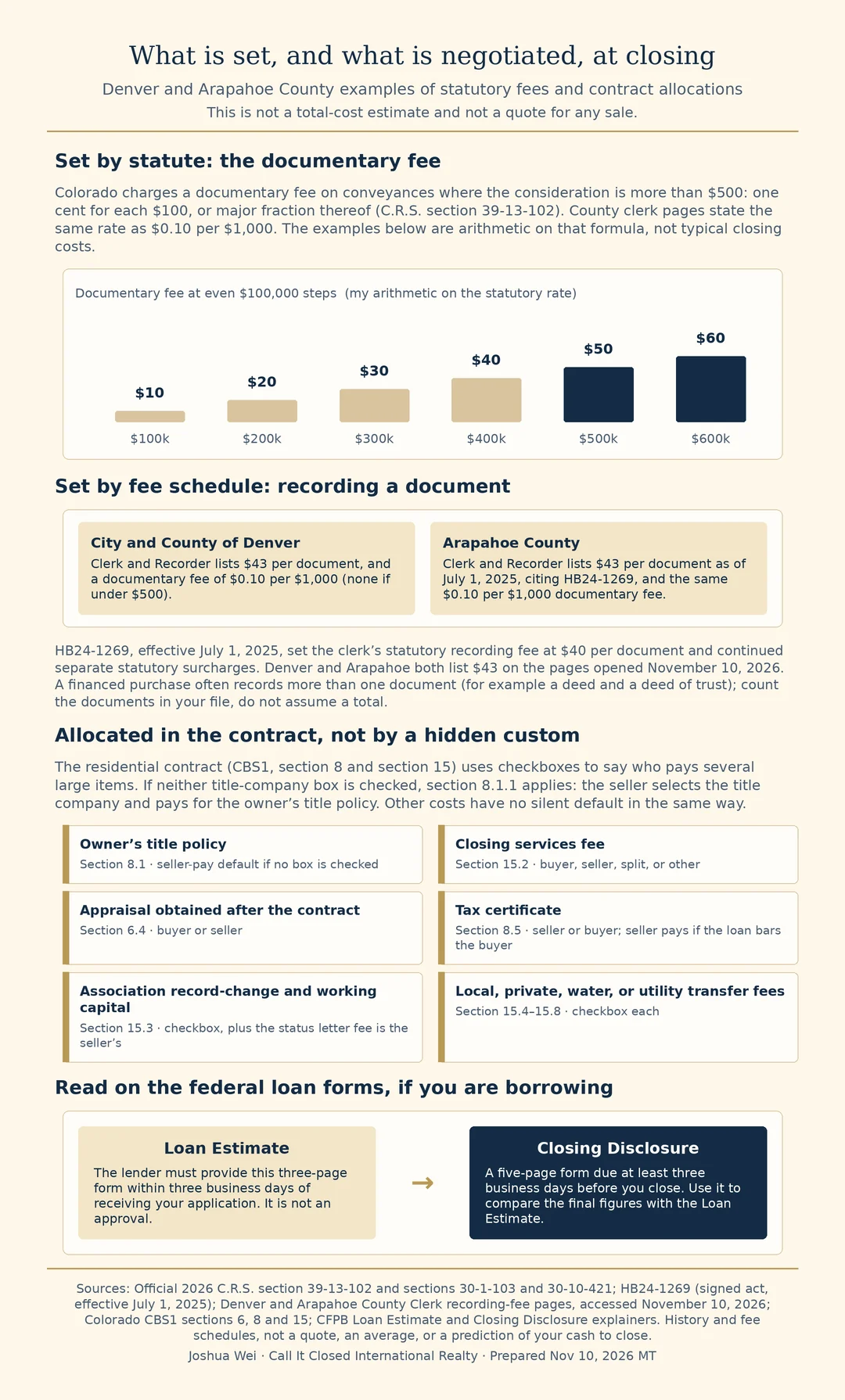
Infographic on a cream background with navy and gold type. A zero-based bar chart shows the Colorado documentary fee at even $100,000 steps from $10 at $100,000 to $60 at $600,000, computed from the statutory rate of one cent per $100. Two county cards report a $43 per-document recording fee in Denver and Arapahoe County as of November 10, 2026. A grid lists contract-allocated items such as the owner’s title policy, closing services, appraisal, tax certificate, and association fees. A final panel contrasts the federal Loan Estimate, due within three business days of application, with the Closing Disclosure, due at least three business days before closing. The graphic is not a total-cost estimate. Prepared November 10, 2026 MT.
Sources: Official 2026 Colorado Revised Statutes section 39-13-102 (OLLS CRS PDF) (opens in a new tab); Official 2026 Colorado Revised Statutes sections 30-1-103 and 30-10-421 (OLLS CRS PDF) (opens in a new tab); Denver Clerk and Recorder, recording fees (opens in a new tab); Arapahoe County Clerk and Recorder, recording fees (opens in a new tab); CFPB, What is a Loan Estimate? (opens in a new tab); CFPB, What is a Closing Disclosure? (opens in a new tab)
Cream background, navy and tan bars on a zero-based documentary-fee chart, two county cards, a six-cell grid of contract checkbox items, and a Loan Estimate to Closing Disclosure panel. Footer cites the statute, HB24-1269, clerk pages, CBS1, and CFPB explainers.
The figure above separates published statutory and clerk fees, the costs the 2026 residential contract allocates with checkboxes, and the two federal loan forms. It is a map of sources, not an estimate of cash to close.
Start with the two forms that itemize a loan, if you are borrowing
The Consumer Financial Protection Bureau explains the two standard forms most buyers will see. Its explainer What is a Loan Estimate? (opens in a new tab), retrieved November 10, 2026, states: "A Loan Estimate is a three-page form that you receive after applying for a mortgage." It continues: "The lender must provide you a Loan Estimate within three business days of receiving your application." And: "The form provides you with important information, including the estimated interest rate, monthly payment, and total closing costs for the loan." The same page says: "All lenders are required to use the same standard Loan Estimate form." And: "When you receive a Loan Estimate, the lender has not yet approved or denied your loan application."
Its explainer What is a Closing Disclosure? (opens in a new tab), last reviewed May 2, 2023, and retrieved November 10, 2026, states: "A Closing Disclosure is a five-page form that provides final details about the mortgage loan you have selected. It includes the loan terms, your projected monthly payments, and how much you will pay in fees and other costs to get your mortgage (closing costs)." It continues: "The lender is required to give you the Closing Disclosure at least three business days before you close on the mortgage loan. This three-day window allows you time to compare your final terms and costs to those estimated in the Loan Estimate that you previously received from the lender. The three days also gives you time to ask your lender any questions before you go to the closing table." The same page notes: "You won't receive a Closing Disclosure if you're applying for a reverse mortgage." It continues that a HELOC, and some other loan types, also use different disclosures.
The residential purchase contract points to the same Loan Estimate timing in section 4.5.4: if the buyer is applying for a residential loan, the lender generally must provide a Loan Estimate within three days after the buyer completes a loan application. That contract sentence is a reminder, not a substitute for the federal rule or for your actual forms.
Cash buyers will not receive those two mortgage forms. They still have a closing statement from the closing company, a deed to record, a documentary fee, title work, and any prorations the contract requires. The absence of a loan does not mean the absence of closing costs.
Cash to close is also not the same thing as closing costs. The cash a buyer must bring can include the remainder of the down payment, prorations, and prepaid items. A seller’s net sheet deducts payoffs, commissions, and the seller’s share of costs from the price. Both numbers move when a figure on the statement changes. Ask the closing company to walk through the current draft, and keep the labels straight.
Which Colorado fees are published in advance?
The documentary fee is a formula, not a local transfer tax
Section 39-13-102 imposes a documentary fee on a person offering for recording a deed or instrument that conveys title to Colorado real property. If the total consideration, including liens, charges, and expenses required for the conveyance, is $500 or less, no documentary fee is payable. If it exceeds $500, the fee is computed at one cent for each one hundred dollars, or major fraction thereof, of that consideration. The fee is payable to the county clerk and recorder, and it is in addition to the recording fee.
Denver’s recording page states the same idea as $0.10 per $1,000, with no documentary fee assessed on consideration under $500. Arapahoe County’s page says $0.10 per $1,000 consideration on documents granting or conveying title. Those clerk restatements match the statute’s rate. The amount still depends on the consideration used for the fee, which the statute defines. I am not assigning a consideration to your deed.
Colorado does not, in the sources opened for this note, impose a statewide real-estate transfer tax on top of that documentary fee. The purchase contract nevertheless has a “Local Transfer Tax” checkbox in section 15.4, because some Colorado localities charge one. The Denver and Arapahoe clerk pages I opened list the documentary fee, not a separate local transfer tax, on their recording-fee schedules. That is not a survey of every municipality in the metro area. If a local transfer tax applies to the property, it should appear in the contract and on the closing statement. Ask the closing company to confirm for the actual location.
Recording is a per-document charge
House Bill 24-1269, the signed act, takes effect July 1, 2025, and applies to documents filed or recorded on or after that date. The official 2026 Colorado Revised Statutes, retrieved November 10, 2026, confirm the result. Section 30-1-103 (1) (opens in a new tab) states that, "For filing or recording each document for which a fee is not specifically provided, except tax schedules and claims against the county, for which no fee is allowed, in cities and counties and in counties of every class, the fee is forty dollars for each document; except that no fee is allowed for filing or recording a certificate of death, a verification of death document, or a certified copy thereof." Section 30-10-421 (1)(b) (opens in a new tab) states: "Beginning July 1, 2004, and through December 31, 2029, the county clerk and recorder shall collect a surcharge of one dollar for each document received for recording or filing in the clerk and recorder's office. The surcharge is in addition to any other fees permitted by statute." Subsection (1)(c) continues a separate surcharge imposed by the electronic recording technology board, also in addition to other fees permitted by statute. The signed House Bill 24-1269 (opens in a new tab) session law is the 2024 act that put the forty-dollar document fee in place effective July 1, 2025.
That is why a published clerk fee can be higher than the forty-dollar statutory component. Arapahoe County’s recording-fee page, opened November 10, 2026, says that per HB-24-1269, recording fees increased to a flat fee of $43 as of July 1, 2025, and it lists $43 for letter- or legal-size documents. Denver’s recording page lists $43 per document. I am reporting those published amounts as of that access date, not a promise that a future surcharge change cannot move them. E-recording service charges, if any, are separate and appear on the title company’s invoice.
Count the documents. A typical financed purchase often records a deed and a deed of trust; an unfinanced purchase may record only the deed, or additional instruments if the file requires them. Two times $43 is not a rule. It is arithmetic after you know the document count.
Who pays the large, negotiated items?
The Commission’s residential contract, CBS1, does not hide these allocations in custom. It asks the parties to check boxes.
The owner’s title policy has a form default
Section 8.1 offers two choices. If the first box is checked, the seller selects the title company and furnishes the owner’s title insurance policy at the seller’s expense. If the second is checked, the buyer selects the company and pays for the owner’s policy. If neither box is checked, section 8.1.2 of CBS1, retrieved November 10, 2026 from the Division of Real Estate contracts and forms page (opens in a new tab), states: "If neither box in section 8.1.1. or section 8.1.2. is checked, section 8.1.1. applies." Section 8.1.1 is the seller-selects-and-pays choice. That is a default in the printed form, not a market survey of what “everyone in Denver does,” and not a rule that the parties cannot change by checking the other box.
Owner’s extended coverage, if the parties want it, has its own premium-allocation checkbox in section 8.1.3. A lender’s title policy, when there is a loan, is a separate product. I am not quoting a premium for either one. The Colorado Division of Insurance regulates title insurers and requires rate and fee filings, as described on its title insurance for industry (opens in a new tab) page. Insurers file their own rates; Colorado does not publish a single statewide price list that I can reprint as “the” charge. Ask for a written quote from the company named in your contract, and ask what the quote does and does not include. A title or closing-cost question about your file belongs with that company, and a coverage question belongs with a licensed insurance professional.
Closing services, appraisals, and the tax certificate are checkbox items
Section 15.1 says the buyer and seller must pay, in Good Funds, their respective closing costs and all other items required to be paid at closing, except as the contract otherwise provides. If the buyer’s loan type in section 4.5.3 prohibits the buyer from paying a fee in that section, the seller pays it.
The closing-services fee itself is section 15.2: buyer, seller, one-half each, or other. The cost of an appraisal obtained after the contract date is section 6.4: buyer or seller. The tax certificate is section 8.5: seller or buyer, except that if the buyer’s loan prohibits the buyer from paying for it, the seller pays.
None of those lines has a dollar amount printed on the form. The amount comes from the title company, the appraiser, or the tax-certificate provider. The contract decides who pays it.
Association charges are split into several lines
At least fourteen days before closing, the seller agrees to request a current association status letter, if one applies. Under section 15.3.1, any fee for issuing that letter must be paid by the seller. A record-change fee, reserves or working capital due at closing, and other fees listed on the status letter each have their own buyer-seller-split-or-N/A boxes. Section 16.2 then addresses how regular assessments are prorated and who is obligated for a special assessment assessed before the closing date, with a further rule for special assessments that fund improvements already installed as of the buyer’s signature.
Those are reasons to read the status letter against the contract, not to guess a “typical HOA transfer fee.” A companion condo due-diligence note is about the building file behind those charges.
Credits, commissions, and withholdings are not “fees” in the same sense
Section 4.2 allows a seller concession, a credit the buyer may use for allowable fees, costs, and prepaid items to the extent the buyer’s lender permits, and in addition to any other sum the seller has agreed to pay. Lender limits still apply. I described how concessions have been showing up in the metro data in the Denver prices and concessions note. A credit changes who effectively bears a cost; it does not make the cost disappear from the statement.
Brokerage compensation is a separately negotiated amount, addressed for the buyer’s brokerage firm in section 29 of the current form and, on the listing side, in the listing contract. It can be the largest number on a seller’s statement. It is not a government fee, and this article does not quote a rate.
Section 15.9.1 of CBS1, FIRPTA, states: "The Internal Revenue Service (IRS) may require a substantial portion of the Seller’s proceeds be withheld after Closing when Seller is a foreign person." The same subsection states: "Seller should inquire with Seller’s tax advisor to determine if withholding applies or if an exemption exists." Section 15.9.2 states: "The Colorado Department of Revenue may require a portion of the Seller’s proceeds be withheld after Closing when Seller will not be a Colorado resident after Closing, if not otherwise exempt." Talk with a tax advisor about withholding. This is not tax advice, and I am not determining anyone’s status. Those sentences are quoted from CBS1, retrieved November 10, 2026 from the Division of Real Estate contracts and forms page (opens in a new tab).
What is prorated, and what is prepaid?
Section 16.1 prorates, to the closing date, personal-property taxes if any, special-taxing-district assessments if any, and general real-estate taxes for the year of closing, based on one of the methods the parties check: taxes for the calendar year immediately preceding closing, or the most recent mill levy and most recent assessed or actual valuation, adjusted by any applicable qualifying seniors or disabled-veteran exemption, or another method they write in. Rents, water and sewer, and other items listed there are also prorated. Unless additional provisions say otherwise, those prorations are final.
A proration is a division of an already identified bill, not a prediction of next year’s tax. The property-tax and metro-district checklist explains why a historical bill, a mill levy, and a lender’s escrow estimate are different facts. If the loan uses an escrow or impound account, the Consumer Financial Protection Bureau explains that the servicer collects a portion of the monthly payment to pay covered bills, and that the escrow payment can change when taxes or insurance change. An escrow deposit at closing is often several months of those bills. The amount belongs on the Loan Estimate and the Closing Disclosure, not in a rule of thumb in this article.
Prepaid interest, a first insurance premium, and similar items are likewise loan- and calendar-specific. A mid-month closing does not have the same prepaid-interest figure as a closing on the first of the month. Your lender’s forms are the source.
Section 4.4.1 of CBS1 states: "All amounts payable by the parties at Closing, including any loan proceeds, Cash at Closing and closing costs, must be in funds that comply with all applicable Colorado laws, including wire transfers, certified check, teller’s check, cashier’s check, and real-time or instant payment (Good Funds)." Colorado Revised Statutes section 38-35-125 (opens in a new tab), in the official 2026 statutes retrieved November 10, 2026, addresses disbursement of closing and settlement funds and states that ""Available for immediate withdrawal as a matter of right" includes funds transferred by any of the following means:" "A wire transfer made through a funds-transfer service operated by the federal reserve or the Clearing House Payments Company;" "A certified check, cashier's check, teller's check, or any other instrument as defined by federal regulation CC, 12 CFR 229.10 (c); and" "A real-time or an instant payment made through a funds-transfer service operated by the federal reserve or the Clearing House Payments Company's real-time payments system." Ask the closing company which of those it will accept, and when, before the day of closing.
How should a buyer or a seller use this without inventing a total?
A useful worksheet has three columns: the item, who pays it under the current contract and loan, and the source of the dollar amount. Published fees — the documentary fee formula and the clerk’s per-document charge — can be computed or looked up once the consideration and the document list are known. Contract-allocated items need a quote from the company that will issue the invoice. Loan-related items need the Loan Estimate first and the Closing Disclosure later, with a line-by-line comparison in the three-day window. Unresolved items should stay visible, not be replaced with a percentage.
Sellers can prepare the same way: know what the listing and the purchase contract say about the owner’s title policy, closing services, concessions, association letters, and prorations, and ask the closing company for a draft net sheet that uses those terms. A cleaner file does not set the price. It keeps a surprise fee from appearing for the first time the day before closing.
If you want help lining the contract boxes up with a draft statement, I will do that with you. I will not invent a total, and I will not pretend a metro median price tells you your title premium or your escrow deposit.
Frequently asked questions
How much are closing costs in Denver or Aurora?
There is no single official total, and this article does not invent a percentage of the price. Some fees are published, including Colorado’s documentary fee and the $43 per-document recording charges listed by Denver and Arapahoe County as of November 10, 2026. Title premiums, lender fees, prepaid items, and escrow deposits vary by the contract, the insurer, the loan, and the calendar. Use the Loan Estimate, the Closing Disclosure, and the closing company’s statement.
What is Colorado’s documentary fee on a $500,000 home?
If the consideration used for the fee is $500,000, the rate quoted above from section 39-13-102 — one cent per $100 — produces a $50 documentary fee, by my arithmetic. The actual fee follows the consideration on the conveyance, which the statute defines. It is in addition to the recording fee.
Does Colorado have a real-estate transfer tax?
The statewide instrument described in the sources for this note is the documentary fee in section 39-13-102, not a separate statewide transfer tax. Some Colorado localities do charge a local transfer tax, which is why the contract has a checkbox for one. Confirm with the closing company for the property’s location.
Who pays for owner’s title insurance in Colorado?
The residential contract decides. If neither box in section 8.1 is checked, the seller selects the title company and pays for the owner’s policy. The parties may check the buyer-pay box instead. Ask for a written premium quote; insurers file their own rates.
When do I get the Closing Disclosure?
The Consumer Financial Protection Bureau, in the Closing Disclosure explainer quoted above, says: "The lender is required to give you the Closing Disclosure at least three business days before you close on the mortgage loan." Some loan types use different forms.
Are recording fees $40 or $43?
HB24-1269 set the clerk’s statutory fee at $40 per document effective July 1, 2025, and continued separate statutory surcharges. Denver and Arapahoe County both list $43 per document on the pages opened November 10, 2026. Use the clerk’s current schedule and the actual number of documents.
Related notes
- The TD-1000 and Colorado's documentary fee: two closing items Denver and Aurora buyers ask about
- Why you can't bring a personal check to closing: Colorado's good funds law for Denver and Aurora buyers and sellers
Sources and method
The documentary fee is from Colorado Revised Statutes section 39-13-102 (opens in a new tab) in the official 2026 Colorado Revised Statutes, downloaded November 10, 2026 from the Office of Legislative Legal Services host linked at the 2026 CRS titles index (opens in a new tab). The same rate is restated on the Denver (opens in a new tab) and Arapahoe County (opens in a new tab) clerk recording-fee pages accessed the same day. Recording-fee law is from that official 2026 text of Colorado Revised Statutes sections 30-1-103 and 30-10-421 (opens in a new tab), and from the signed House Bill 24-1269 (opens in a new tab) act, which states that it takes effect July 1, 2025, and applies to documents filed or recorded on or after that date. The $43 figures are the clerk-page amounts, not a restated statutory surcharge breakdown I did not recompute line by line. Good Funds language is from CBS1 section 4.4.1 and from Colorado Revised Statutes section 38-35-125 (opens in a new tab). Contract allocations are from CBS1, the Contract to Buy and Sell Real Estate (Residential), Adoption Date August 5, 2025, Mandatory Use Date January 1, 2026, sections 4, 6.4, 8, 15, 16, and 29. Loan-form timing and definitions are from the Consumer Financial Protection Bureau’s explainers What is a Loan Estimate? (opens in a new tab) and What is a Closing Disclosure? (opens in a new tab) (the latter last reviewed May 2, 2023; both accessed November 10, 2026), and from the Bureau’s escrow-account explainer already cited in the property-tax note. Title-rate regulation is described generally from the Colorado Division of Insurance’s title insurance for industry (opens in a new tab) page; no insurer’s premium table is reprinted here as a market average.
This note is general education from a Colorado real estate broker with Call It Closed International Realty. It is not a quote, a loan estimate, tax advice, or legal advice. If you are approaching a closing, I will go through the contract boxes and the draft statement with you, and I will tell you which remaining figures have to come from the lender, the title company, or a tax advisor.
Disclaimer
This article is general information only. It is not legal, tax, lending, insurance, appraisal, inspection, or financial advice, and it is not a substitute for advice about your situation. Joshua Wei is a Colorado real estate broker, not an attorney. Reading this article does not create a client relationship, an agency relationship, or an attorney-client relationship with Joshua Wei or with Call It Closed International Realty.
Laws, program rules, interest rates, insurance terms, tax figures, and other details change. Examples in this article are hypothetical illustrations unless a source is named for a specific, dated figure. Information in this article is believed accurate as of November 13, 2026 and is not guaranteed. No result is promised, and you should not rely on this article as the last word for your situation.
Before you act, confirm the point with the official source linked or cited in this article, and talk with a licensed professional who can apply the rule to your facts. That may be a licensed attorney, a tax professional, a lender, an insurance agent, a home inspector, or another licensed professional, depending on the question. Links to third-party websites and publications are provided for reference only. They are not an endorsement, and their content can change.
If you already have a brokerage relationship with another broker, this is not a solicitation.
Joshua Wei, Associate Broker, Call It Closed International Realty, Colorado license FA.100108558. Equal Housing Opportunity.