September 20, 2026 · Denver · Aurora · Buying · Selling
Colorado purchase contract deadlines, in plain English
The Commission-approved residential contract names dozens of deadlines, but the parties fill in the dates. How time is counted, what the main clocks do, and what a missed deadline can mean — without inventing a typical timeline.
The short answer
In brief: Colorado's 2026 residential purchase contract, CBS1, lists more than forty dates and deadlines in section 3, but the buyer and seller write in the actual dates, so no article can give you a standard inspection or closing period. Section 20 says time is of the essence, and a deadline without a time of day expires at 11:59 p.m. Mountain Time.
Colorado’s standard residential purchase contract is a schedule of named events, not a calendar with the days already filled in. The form used on and after January 1, 2026 — the Colorado Real Estate Commission’s Contract to Buy and Sell Real Estate (Residential), often called CBS1 — lists more than forty dates and deadlines in section 3. Inspection, title, the loan, the appraisal, association documents, and closing each have their own clocks. The parties write the actual dates into the contract. A blog post cannot tell you that “inspection is ten days” or that “closing is thirty days,” because those numbers are negotiated for each transaction.
What the form does tell you is how those clocks run, and what happens if one is missed. Section 20 of CBS1, retrieved November 10, 2026 from the Division of Real Estate contracts and forms page (opens in a new tab), states: "Time is of the essence for all dates and deadlines in this Contract. This means that all dates and deadlines are strict and absolute." Section 3.3.1 states: "As used in this Contract, the term “day” means the entire day ending at 11:59 p.m., United States Mountain Time (Standard or Daylight Savings, as applicable)." The same subsection adds: "If Time of Day Deadline is left blank or “N/A” the deadlines will expire at 11:59 p.m., United States Mountain Time." On weekends and holidays, section 3.3.3 states: "Should neither box be checked, the deadline will not be extended." On a blank deadline, section 3.2 states: "If any deadline in section 3.1. (Dates and Deadlines) is left blank or completed with “N/A”, or the word “Deleted,” such deadline is not applicable and the corresponding provision containing the deadline is deleted."
This note walks through those rules, groups the named events in the order a Denver or Aurora buyer or seller usually meets them, and flags a few places where the form treats two similar-looking deadlines as different legal paths. It is a summary of a Commission-approved form, not a completed contract, not a recommendation of any set of dates, and not legal advice about your transaction.
I am a licensed Colorado real estate broker with Call It Closed International Realty. I am not an attorney, an appraiser, or a tax advisor for your sale or purchase. If you have legal questions about a deadline, an amendment, or a notice, ask a Colorado attorney. Read your own contract with your broker. The printed form states, at the top: "THIS FORM HAS IMPORTANT LEGAL CONSEQUENCES AND THE PARTIES SHOULD CONSULT LEGAL AND TAX OR OTHER COUNSEL BEFORE SIGNING." Section 19, Recommendation of Legal and Tax Counsel, adds: "By signing this Contract, Buyer and Seller acknowledge that their respective broker has advised that this Contract has important legal consequences and has recommended: (1) legal examination of title; (2) consultation with legal and tax or other counsel before signing this Contract as this Contract may have important legal and tax implications; (3) to consult with their own attorney if Water Rights, Mineral Rights or Leased Items are included or excluded in the sale; and (4) to consult with legal counsel if there are other matters in this transaction for which legal counsel should be engaged and consulted." It continues: "Such consultations must be done timely as this Contract has strict time limits, including deadlines, that must be complied with." Those sentences are quoted from CBS1, retrieved November 10, 2026.
Disclaimer. This article is general information only. It is not legal, tax, lending, insurance, appraisal, inspection, or financial advice, and reading it does not create a client, agency, or attorney-client relationship. Laws, rates, programs, and figures change. Confirm the official source, and talk with a licensed attorney, tax professional, lender, insurance agent, or inspector before you act. Joshua Wei is a Colorado real estate broker, not an attorney. He is an Associate Broker with Call It Closed International Realty, license FA.100108558. Equal Housing Opportunity.
 Full size (opens in a new tab)
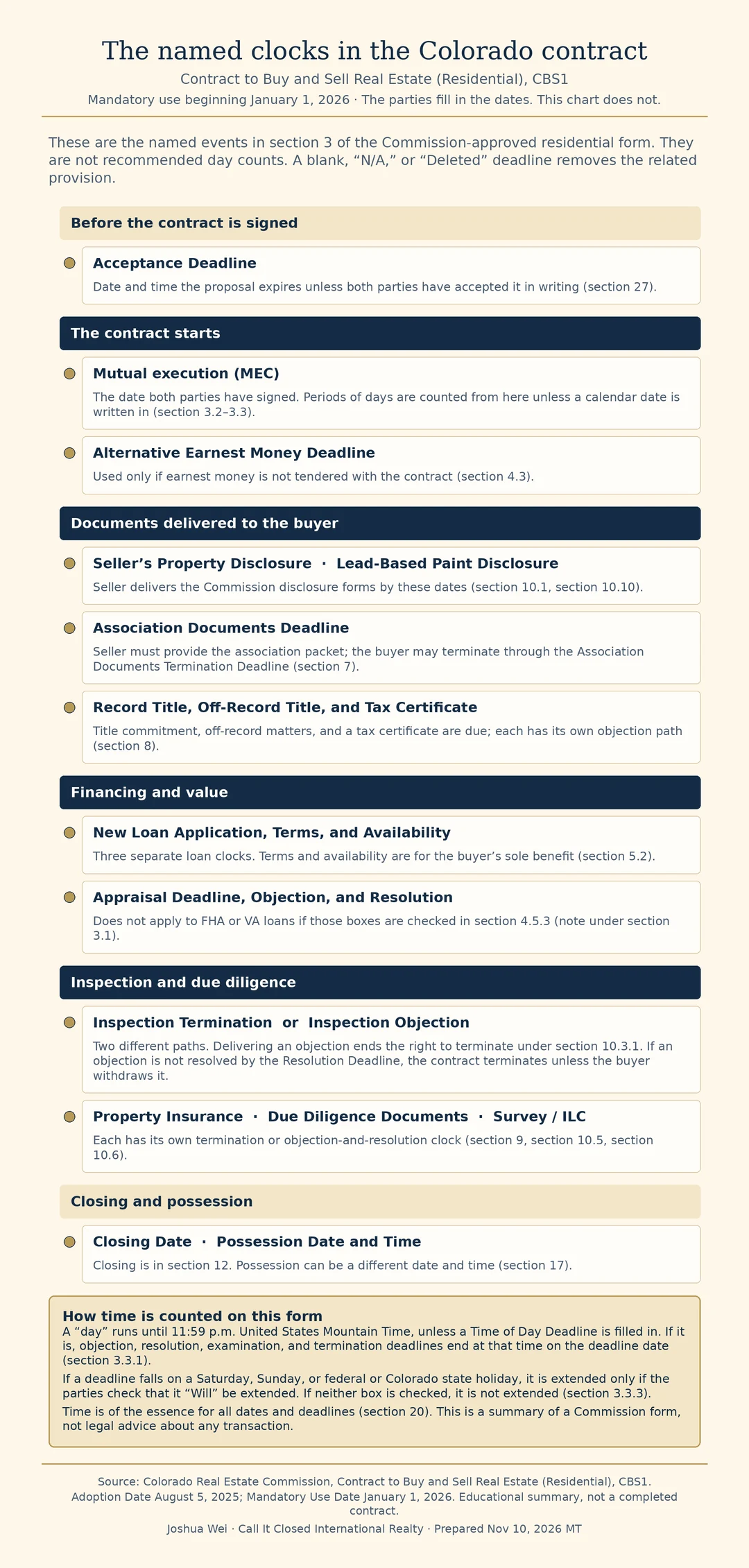
A vertical process diagram, cream background and navy type, of the named deadlines in Colorado’s Contract to Buy and Sell Real Estate (Residential), CBS1, mandatory beginning January 1, 2026. Groups run from Acceptance Deadline, then mutual execution and earnest money, then seller disclosures, association documents, and title, then loan and appraisal, then inspection termination or inspection objection, then closing and possession. A bottom box explains that a day ends at 11:59 p.m. Mountain Time unless a Time of Day Deadline is filled in, and that a weekend or holiday deadline is not automatically extended. The diagram assigns no day counts. Source: Colorado Real Estate Commission CBS1, prepared November 10, 2026 MT.
Sources: Colorado Division of Real Estate, broker contracts and forms (opens in a new tab)
Cream background, navy text, gold rules and ticks. A vertical stack of labeled groups — Before the contract is signed; The contract starts; Documents delivered to the buyer; Financing and value; Inspection and due diligence; Closing and possession — each with short cards naming the CBS1 clocks. A cream box at the bottom states how a day, the Time of Day Deadline, and the weekend-holiday checkbox work. Footer cites CBS1, Adoption Date August 5, 2025, Mandatory Use Date January 1, 2026.
The diagram above is a map of the named events in section 3 of CBS1, the residential form adopted August 5, 2025, and required for use beginning January 1, 2026. It does not assign day counts. The boxes describe what the form calls each clock, not how many days you should allow.
Which form is this, and which one is yours?
The official 2026 text of Colorado Revised Statutes section 12-10-403 (4)(c) (opens in a new tab), retrieved November 10, 2026, states: "A broker shall use a commission-approved form when such a form exists and is appropriate for the transaction." The same section also defines other “standard forms” a broker may use in limited situations, including a form drafted by a licensed Colorado attorney. The Division of Real Estate publishes the current Commission forms on its contracts and forms page (opens in a new tab). The residential contract is one of several. There are separate forms for income-residential property, commercial property, land, and a residential contract that addresses the Colorado Foreclosure Protection Act. This article is about the residential form only.
The copy I used is the Commission’s clean CBS1 PDF: “CBS1 Contract to Buy and Sell Real Estate (Residential),” Adoption Date August 5, 2025, Mandatory Use Date January 1, 2026. The header of the form states that it has important legal consequences and that the parties should consult legal and tax or other counsel before signing. Your transaction may also include addenda, additional provisions in section 30, or a later written amendment. Those writings can change how a deadline works. If they do, they control over this summary.
How does the form count time?
Mutual execution is the starting line for many periods
Section 3.2 of CBS1 states: "The abbreviation “MEC” (mutual execution of this Contract) means the date upon which both parties have signed this Contract." Section 3.3.2 states: "In computing a period of days (e.g., three days after MEC), when the ending date is not specified, the first day is excluded and the last day is included." Many of the dates in section 3 are not written as “days after MEC” at all. They are specific calendar dates the parties fill in. Either way, you need to know which date the contract actually uses.
Acceptance is earlier than MEC. The Acceptance Deadline Date and Time, items 42 and 43 in the section 3 table, come from section 27: the proposal expires unless it is accepted in writing by both Buyer and Seller on or before that deadline. A contract that was never accepted has no later inspection or loan clocks to worry about.
A day has a closing time
Section 3.3.1 of CBS1, already quoted above, defines a day as ending at 11:59 p.m., United States Mountain Time, and states the Time of Day Deadline exception as follows: "Except however, if a Time of Day Deadline is specified in section 3.1. (Dates and Deadlines), all Objection Deadlines, Resolution Deadlines, Examination Deadlines and Termination Deadlines will end on the specified deadline date at the time of day specified in the Time of Day Deadline, United States Mountain Time."
That matters in practice because a notice has to be received by the other party, not merely sent, by the deadline. Section 24.1 of CBS1, Right to Terminate, states: "If a party has a right to terminate as provided in this Contract (Right to Terminate), the termination is effective upon the other party’s receipt of a written notice to terminate (Notice to Terminate), provided such written notice was received on or before the applicable deadline specified in this Contract. If the Notice to Terminate is not received on or before the specified deadline, the party with the Right to Terminate accepts the specified matter, document or condition as satisfactory and waives the Right to Terminate under such provision. Any Notice to Terminate delivered after the applicable deadline specified in the Contract is ineffective and does not terminate this Contract."
Weekends and holidays are not automatically extended
Section 3.3.3 of CBS1 states: "If any deadline falls on a Saturday, Sunday or federal or Colorado state holiday (Holiday), such deadline Will Will Not be extended to the next day that is not a Saturday, Sunday or Holiday. Should neither box be checked, the deadline will not be extended." In that quotation, "Will" and "Will Not" are the form’s two checkboxes. That default surprises people who assume every legal deadline rolls to Monday. On this form, it does so only if the parties check the box that says it will.
A blank deadline is not a flexible deadline
Section 3.2 of CBS1, already quoted above, is blunt about a blank deadline. A missing date is not an invitation to invent one later. It can mean the related objection or termination right is not in the contract at all. Check the table before you assume a right exists.
What are the main groups of deadlines?
The section 3 table organizes the named events in clusters: Title, Owners’ Association, Seller’s Disclosures, Loan and Credit, Appraisal, Survey, Inspection and Due Diligence, and Closing and Possession. The order in the table is not always the order the dates will fall in your contract. Title objections can run alongside the inspection. Loan dates can sit close to the appraisal dates. The useful habit is to read the whole table against the calendar once the dates are filled in, and to know which provision a given date belongs to.
Earnest money has its own clock
Under section 4.3, the earnest money must be tendered by the buyer with the contract unless the parties agree to an Alternative Earnest Money Deadline. That alternative date is item 2 in the section 3 table. If the money is not paid, honored, or tendered when due, section 20 treats that as a default question, with remedies that depend on which boxes were checked. Do not treat a delayed earnest-money date as informal. If one is used, it is a contract deadline.
If the buyer has a Right to Terminate and timely terminates, sections 4.3.2 and 24.2 provide for the return of earnest money, subject to limited surviving provisions. If there is a dispute, section 23 and counsel, not this article, address who keeps a deposit.
Seller disclosures and association documents come early for a reason
The Seller’s Property Disclosure Deadline and the Lead-Based Paint Disclosure Deadline are the seller’s clocks to deliver Commission disclosure forms. Section 10.1 requires the most current applicable Seller’s Property Disclosure, completed to the seller’s actual knowledge and current as of that deadline. Section 10.2 separately requires written disclosure of adverse material facts actually known to the seller, including facts discovered after the contract date, and gives the buyer a right to terminate based on a new disclosure on the earlier of Closing or five days after receipt.
If the property is in a common interest community, section 7 applies. The seller must provide the Association Documents, at the seller’s expense, on or before the Association Documents Deadline. The list is specific: governing documents, certain minutes, a list of insurance policies, assessments, the association’s recent financial documents including any reserve study, and certain construction-defect notices. The buyer then has a Right to Terminate, in the buyer’s sole subjective discretion, on or before the Association Documents Termination Deadline, based on any unsatisfactory provision in those documents. If the documents arrive after the delivery deadline, the buyer has until ten days after receipt — or until Closing, if that comes first — to terminate. If the seller does not receive a timely Notice to Terminate, the buyer accepts the documents as satisfactory and waives that termination right.
That packet is the starting point for a condo or townhome review; a companion due-diligence note walks through the file itself. The deadline is not the same thing as a complete understanding of the building.
Title is a delivery date, an objection date, and a resolution date
Record title, off-record title, and the tax certificate each have a delivery or disclosure deadline and an objection deadline. There is also a Title Resolution Deadline. Under section 8.7, the buyer may object in writing or may terminate, in the buyer’s sole subjective discretion, based on title matters. If the buyer objects and the parties have not agreed to a written settlement by the Title Resolution Deadline, the contract terminates unless the buyer withdraws the objection in writing by then. If title documents or a tax certificate arrive late, the form gives the buyer a measured extra period, generally ten days after receipt or until Closing if earlier, and in some cases extends the resolution deadline.
Section 8.4 is the form’s printed warning about special taxing and metropolitan districts, and it tells buyers to investigate through the county treasurer, the certificate of taxes due, and the county. How a mill levy becomes a dollar estimate is in the property-tax checklist. A companion note separates metro districts from HOAs.
Section 8.1 also decides who selects the title company and who pays for the owner’s title policy. If neither box is checked, section 8.1.2 of CBS1 states: "If neither box in section 8.1.1. or section 8.1.2. is checked, section 8.1.1. applies." Under section 8.1.1, the seller selects the title insurance company and furnishes the owner’s policy at the seller’s expense. That allocation, and the other closing-cost checkboxes, are discussed in a companion closing-costs note.
The loan has three clocks, and they are not interchangeable
If the buyer is obtaining a new loan, section 5.1 requires a verifiable application, when the lender requires one, by the New Loan Application Deadline, and reasonable efforts to obtain the loan. Section 5.2 then splits the remaining loan condition into two different rights, both for the buyer’s benefit.
New Loan Terms, section 5.2.1, is the buyer’s right to terminate on or before the New Loan Terms Deadline if the proposed loan’s payments, interest rate, conditions, costs, or other terms are not satisfactory, in the buyer’s sole subjective discretion.
New Loan Availability, section 5.2.2, is a different question: whether the buyer is satisfied with the availability of the new loan based on the lender’s review and underwriting of the application. The buyer may terminate on or before the New Loan Availability Deadline if that availability is not satisfactory. Section 5.2.2 of CBS1 states: "Buyer does not have a Right to Terminate based on the New Loan Availability if the termination is based on the New Loan Terms, Appraised Value (defined below), the Lender Property Requirements (defined below), Insurability (section 10.5. below) or the Conditional Upon Sale of Property (section 10.7. below)." In capital letters, the same subsection adds: "IF SELLER IS NOT IN DEFAULT AND DOES NOT TIMELY RECEIVE BUYER’S WRITTEN NOTICE TO TERMINATE, BUYER’S EARNEST MONEY WILL BE NONREFUNDABLE, except as otherwise provided in this Contract (e.g., Appraisal, Title, Survey)."
Those sentences are why the three loan dates should not be collapsed into one informal “loan contingency.” The form distinguishes an application, the terms, and availability, and it states a consequence for missing the availability notice. Your own dates, boxes, and any additional provisions still have to be read with your broker and, for legal questions, with an attorney.
Seller or private financing, assumptions, and the seller’s review of the buyer’s credit, if those boxes apply, have their own deadlines in the same cluster.
Appraisal dates do not apply to every loan type
The Appraisal Deadline, Appraisal Objection Deadline, and Appraisal Resolution Deadline are items 22 through 24. A note under the section 3 table says that if FHA or VA loan boxes are checked in section 4.5.3, the appraisal deadlines do not apply to FHA-insured or VA-guaranteed loans. Those loan programs have their own appraisal and amenability rules in section 6. Do not import a conventional appraisal-objection date into an FHA or VA contract without reading that note and section 6.
For other loans, section 6 sets out the appraisal condition, an objection-and-resolution structure, and a separate rule for lender-required repairs. The cost of an appraisal obtained after the contract date is paid by the buyer or the seller, according to the checkbox in section 6.4.
Inspection termination and inspection objection are different paths
This is the place where two deadlines that sound similar are not interchangeable. Section 10.3 gives the buyer, acting in good faith, the right to inspections of the property, inclusions, and leased items, at the buyer’s expense. If the physical condition, services, or certain off-property effects are unsatisfactory, in the buyer’s sole subjective discretion, the buyer may do one of the following.
On or before the Inspection Termination Deadline, section 10.3.1 of CBS1 allows the buyer to "notify Seller in writing, pursuant to section 24.1., that this Contract is terminated due to any unsatisfactory condition, provided the Buyer did not previously deliver an Inspection Objection." The same subsection states: "Buyer’s Right to Terminate under this provision expires upon delivery of an Inspection Objection to Seller pursuant to section 10.3.2."
On or before the Inspection Objection Deadline, the buyer may instead deliver a written description of any unsatisfactory condition that the buyer requires the seller to correct. If that objection is received in time and the parties have not agreed in writing to a settlement by the Inspection Resolution Deadline, the contract terminates on that resolution deadline unless the seller has received the buyer’s written withdrawal of the objection. The parties may also mutually terminate sooner by executing an earnest-money release.
In plain language: one path ends the contract by a termination notice. The other path asks the seller to correct something, and if that request is not resolved in writing by the resolution date, the contract dies unless the buyer takes the request back. Sending the objection is a choice that, under section 10.3.1, ends the termination right in that subsection. The dates for those two paths can be different. They should be read together, not treated as duplicates.
Related clocks in the same cluster include the Property Insurance Termination Deadline (section 10.5), the Due Diligence Documents delivery, objection, and resolution dates (section 10.6), a Conditional Sale Deadline if the buyer must sell another property, and the Lead-Based Paint Termination Deadline. A new improvement location certificate or survey, if the parties require one, has its own delivery, objection, and resolution dates in section 9.
Closing and possession can be different moments
The Closing Date is a section 12 deadline. The Possession Date and Possession Time are section 17 items and may be later than closing if the parties agree, including through a post-closing occupancy agreement. Holiday calendars, lender conditions, and title work all bear on whether a chosen closing date is realistic. That is a planning discussion with the lender and the closing company, not a default in the form. A winter closing that crosses holiday closures is one example; I discussed the seasonal side of that timing in the winter-selling note.
What does a missed deadline actually do?
It depends on which deadline, and on whether the party still had a right that had to be exercised by then. Section 24.1, quoted above, is the general rule for a Right to Terminate. Several objection-and-resolution structures work differently: an unresolved objection can cause the contract to terminate on the resolution date unless the objection is withdrawn. Some delivery failures give the receiving party extra time. Section 20 addresses default when a payment is not made when due or an obligation is not performed timely.
Those are different machines. The wrong lesson is “every missed date kills the contract” or “every missed date can be fixed with an email after the fact.” The right lesson is to identify the provision, the notice that provision requires, and whether receipt by the other party has to occur by a stated time. Brokers can help you track the calendar. They cannot, and I cannot, give you a legal opinion about a missed date in a dispute.
Section 25 of CBS1 states: "No subsequent modification of any of the terms of this Contract is valid, binding upon the parties, or enforceable unless made in writing and signed by the parties." An oral plan to "extend inspection" is not an extension. If you need more time, the extension needs to be documented before the deadline passes.
What this article does not do
It does not recommend a set of dates. It does not interpret a disputed notice, an additional provision, or an amendment, and it does not cover every item in the section 3 table. Water rights, mineral rights, third-party rights to purchase, and several financing variants have their own clocks when they apply. Sellers can still make the clocks usable by having the property disclosure, association packet, and title and district materials ready on time. The Loan Estimate and Closing Disclosure have federal timing rules of their own, explained by the Consumer Financial Protection Bureau in What is a Loan Estimate? (opens in a new tab) and What is a Closing Disclosure? (opens in a new tab), and discussed in the companion closing-costs note.
Frequently asked questions
How many days is the inspection period in a Colorado contract?
The form does not set a number of days. The Inspection Termination Deadline, Inspection Objection Deadline, and Inspection Resolution Deadline are dates the parties fill in, or they are deleted if left blank or marked “N/A.” Any “typical” number you hear is a custom or a habit, not a rule of the form.
Does a deadline that falls on a Saturday automatically move to Monday?
Not on this form, unless the parties check the box in section 3.3.3 that says the deadline “Will” be extended. If neither box is checked, the deadline is not extended.
What time of day is a Colorado contract deadline?
11:59 p.m. United States Mountain Time, unless a Time of Day Deadline is filled in. If one is filled in, objection, resolution, examination, and termination deadlines end at that time on the deadline date.
What is MEC?
MEC means mutual execution of the contract: the date both parties have signed. Periods of days measured from MEC exclude the first day and include the last day.
What happens if a buyer misses a termination deadline?
Under section 24.1, quoted above, a Notice to Terminate that is not received by the specified deadline does not terminate the contract, and the right is waived. Other provisions, including loan-availability language in section 5.2.2 and unresolved-objection structures, can have additional consequences. Read the specific section with your broker and, for legal questions, with an attorney.
If I object to inspection items, can I still terminate under the inspection termination deadline?
Section 10.3.1, quoted above, says the buyer’s right to terminate under that provision expires upon delivery of an Inspection Objection. The objection then follows the resolution path in section 10.3.3. That is one reason the two dates should be read together before a notice is sent.
Do the appraisal deadlines apply to FHA or VA loans?
The note under the section 3 table says that if the FHA or VA boxes are checked in section 4.5.3, the appraisal deadlines do not apply to FHA-insured or VA-guaranteed loans. Section 6 contains the FHA and VA appraisal provisions that do apply.
Is this the contract for every Colorado property?
No. This article describes the residential CBS1 form. Income-residential, commercial, land, and foreclosure-protection variants are separate Commission forms. Additional provisions and addenda can also change a residential contract.
Related notes
- Earnest money in Colorado: who holds it, when you get it back, and what happens in a dispute
- Reading your title commitment: what Denver and Aurora buyers should check before the title objection deadline
- Shop homeowners insurance before your deadline: Colorado's insurability right and the Division of Insurance's buyer guide for Denver and Aurora
Sources and method
The contract language summarized here is from the Colorado Real Estate Commission’s Contract to Buy and Sell Real Estate (Residential), CBS1, Adoption Date August 5, 2025, Mandatory Use Date January 1, 2026, downloaded from the Division of Real Estate’s contracts and forms page (opens in a new tab) on November 10, 2026. The fillable official PDF (SHA-256 4ad3a3694c8a6ab91712cb6bd35980e33fd11aebb9991ac047b3a6f78c4fd2c9) matches the PDF already verified against the clean text in an earlier reviewed package; the clean PDF was also opened and extracted for this article. Quoted contract language in this article is taken verbatim from that official form, retrieved November 10, 2026, including sections 3.2, 3.3, 5.2.2, 8.1.2, 10.3.1, 19, 20, 24.1, and 25. Other sections are cited by number and should be read on the form itself. The requirement to use a Commission-approved form when one exists and is appropriate is from Colorado Revised Statutes section 12-10-403 (4)(c) (opens in a new tab), official 2026 Colorado Revised Statutes, downloaded from the Office of Legislative Legal Services host linked at the 2026 CRS titles index (opens in a new tab) on November 10, 2026. This is an educational summary of a printed form and a statute, not a substitute for the form, not an interpretation of any completed contract, and not legal advice.
This note is general education from a Colorado real estate broker with Call It Closed International Realty. It is not legal advice, tax advice, an appraisal, or a recommendation of dates for your transaction. If you are negotiating or already under contract, I will go through the actual section 3 dates in your contract with you, and I will tell you when a question belongs with an attorney.
Disclaimer
This article is general information only. It is not legal, tax, lending, insurance, appraisal, inspection, or financial advice, and it is not a substitute for advice about your situation. Joshua Wei is a Colorado real estate broker, not an attorney. Reading this article does not create a client relationship, an agency relationship, or an attorney-client relationship with Joshua Wei or with Call It Closed International Realty.
Laws, program rules, interest rates, insurance terms, tax figures, and other details change. Examples in this article are hypothetical illustrations unless a source is named for a specific, dated figure. Information in this article is believed accurate as of November 13, 2026 and is not guaranteed. No result is promised, and you should not rely on this article as the last word for your situation.
Before you act, confirm the point with the official source linked or cited in this article, and talk with a licensed professional who can apply the rule to your facts. That may be a licensed attorney, a tax professional, a lender, an insurance agent, a home inspector, or another licensed professional, depending on the question. Links to third-party websites and publications are provided for reference only. They are not an endorsement, and their content can change.
If you already have a brokerage relationship with another broker, this is not a solicitation.
Joshua Wei, Associate Broker, Call It Closed International Realty, Colorado license FA.100108558. Equal Housing Opportunity.