September 8, 2026 · Colorado · Homeownership · Legal · Equity
Colorado's homestead exemption: what it protects, and why it isn't a property tax break
Colorado's homestead exemption (C.R.S. 38-41-201) protects up to $250,000 or $350,000 of home equity from certain creditors. What the statute says about who qualifies, occupancy, sale proceeds, and why it is different from the senior property tax exemption.
The short answer
In brief: Colorado's homestead exemption protects a home from creditors rather than lowering property taxes. Under Colorado Revised Statutes section 38-41-201(1), every homestead in the state is exempt from execution and attachment arising from any debt, contract or civil obligation, up to $250,000 if the homestead is occupied as a home by an owner, with other amounts set out in the statute.
The Colorado homestead exemption in C.R.S. title 38, part 41 (opens in a new tab) addresses execution and attachment by creditors.
Under section 38-41-201(1), "Every homestead in the state is exempt from execution and attachment arising from any debt, contract, or civil obligation," up to:
- "The sum of two hundred fifty thousand dollars if the homestead is occupied as a home by an owner or an owner's family"
- "The sum of three hundred fifty thousand dollars if the homestead is occupied as a home by an owner who is elderly or disabled, an owner's spouse who is elderly or disabled, or an owner's dependent who is elderly or disabled"
This is a Colorado statute. It does not, by itself, stop a federal tax lien. Questions about IRS collection belong with a tax professional or a tax attorney.
The statute measures the amount in actual cash value "in excess of any liens or encumbrances on the homesteaded property in existence at the time of any levy of execution." Colorado's senior and veteran property tax exemptions are in title 39. How either applies to a household is a question for a Colorado attorney or, for property tax, the county assessor.
I am a licensed Colorado real estate broker with Call It Closed International Realty. I am not an attorney or a tax advisor.
Disclaimer. This article is general information only. It is not legal, tax, lending, insurance, appraisal, inspection, or financial advice, and reading it does not create a client, agency, or attorney-client relationship. Laws, rates, programs, and figures change. Confirm the official source, and talk with a licensed attorney, tax professional, lender, insurance agent, or inspector before you act. Joshua Wei is a Colorado real estate broker, not an attorney. He is an Associate Broker with Call It Closed International Realty, license FA.100108558. Equal Housing Opportunity.
 Full size (opens in a new tab)
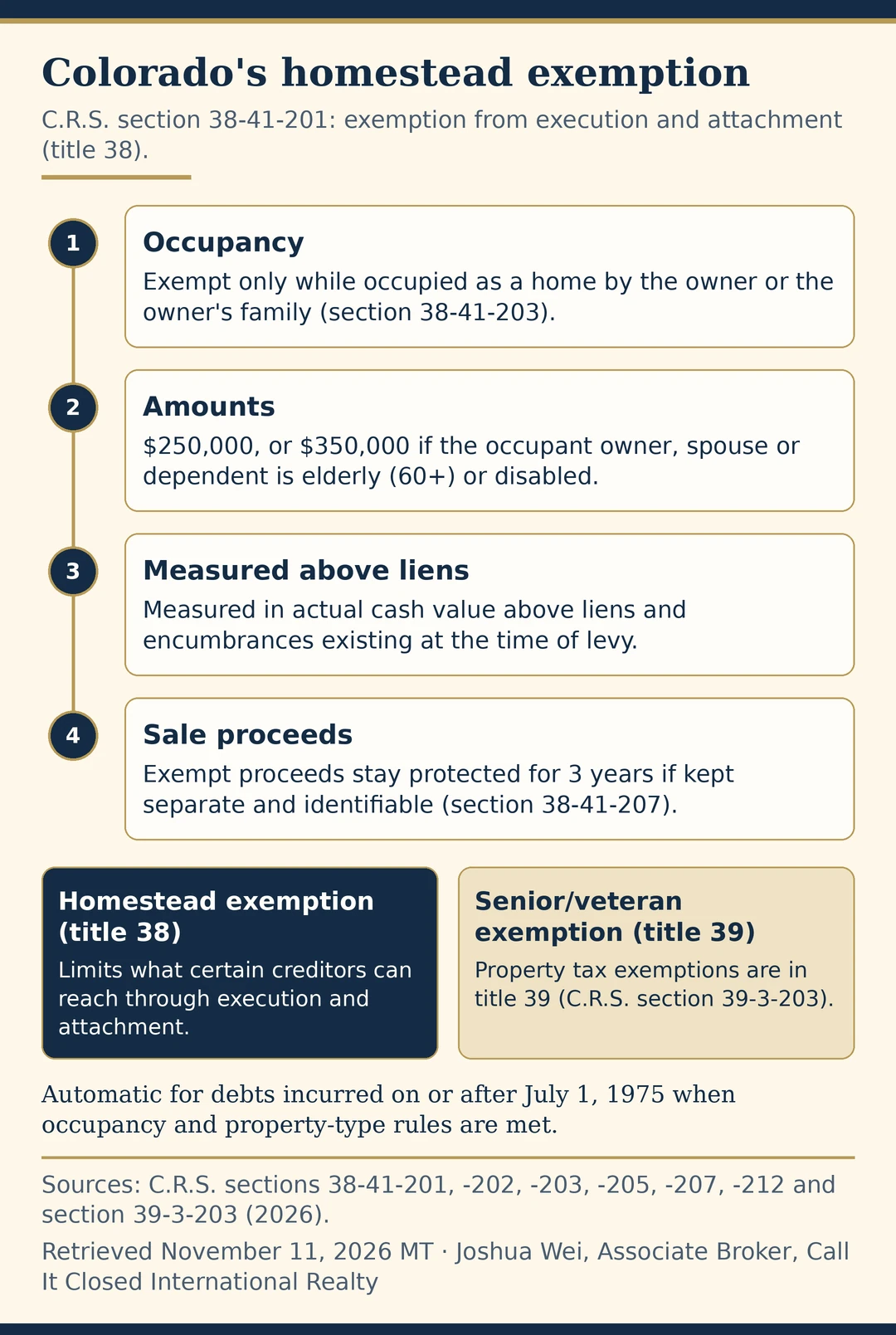
A vertical flow diagram, cream background with navy type and gold accents, titled Colorado's homestead exemption. Subtitle: Colorado Revised Statutes section 38-41-201: exemption from execution and attachment (title 38). 4 numbered steps: 1, Occupancy: Exempt only while occupied as a home by the owner or the owner's family (section 38-41-203); 2, Amounts: $250,000, or $350,000 if the occupant owner, spouse or dependent is elderly (60+) or disabled; 3, Measured above liens: Measured in actual cash value above liens and encumbrances existing at the time of levy; 4, Sale proceeds: Exempt proceeds stay protected for 3 years if kept separate and identifiable (section 38-41-207). Two cards: Homestead exemption (title 38): Limits what certain creditors can reach through execution and attachment; and Senior/veteran exemption (title 39): Property tax exemptions are in title 39 (Colorado Revised Statutes section 39-3-203). A note says: Automatic for debts incurred on or after July 1, 1975 when occupancy and property-type rules are met. Sources: Colorado Revised Statutes sections 38-41-201, -202, -203, -205, -207, -212 and section 39-3-203 (2026). Retrieved November 11, 2026 MT. Joshua Wei, Associate Broker, Call It Closed International Realty.
Sources: C.R.S. title 38 (2026) (opens in a new tab)
Cream background, navy text, gold rules. Numbered navy circles on a gold spine with white step cards, two branch cards (navy and tan), a note, and a source footer.
The figure above summarizes the two exemption amounts, the occupancy rule and the sale-proceeds provision.
What "execution and attachment" means here
The exemption is about collection. A creditor that wins a money judgment can ask the sheriff to levy on, and sell, a debtor's property. The homestead exemption limits what a creditor can take from a home in that process. It doesn't erase the debt, and it doesn't stop a lender from foreclosing its own deed of trust. The phrase in section 38-41-201(1) is that the exemption applies to value "in excess of any liens or encumbrances on the homesteaded property in existence at the time of any levy of execution." Existing mortgages come off the top first.
The current text of section 38-41-201 comes from SB 22-086, effective April 7, 2022. That bill also added section 38-41-201.7, which broadened the kinds of homes that qualify.
Who counts as elderly or disabled?
Section 38-41-201(2)(b) says "'Elderly' means sixty years of age or older." "Disabled" is defined in (2)(a) as having a physical or mental impairment that "substantially precludes the person from engaging in a useful occupation as a homemaker, a wage earner, or a self-employed person." The full definition starts with "a physical or mental impairment that is disabling and that, because of other factors such as age, training, experience, or social setting," has that effect.
The higher $350,000 figure applies if the elderly or disabled person is the owner, "an owner's spouse," or "an owner's dependent." A younger owner living with an elderly or disabled dependent may fall under (1)(b). How the dependent test applies to a particular household is a question for a Colorado attorney.
Does the statute require a filing?
Section 38-41-202(1) says the exemptions "shall be deemed created and may be claimed if the occupancy requirement of section 38-41-203 and the requirement of section 38-41-205 relating to the type of property which may be homesteaded are met."
A recorded statement is required only for debts incurred "prior to July 1, 1975." For those older debts, section 38-41-202(2)(a) says the owner had to record "an instrument in writing describing such property, setting forth the nature and source of the owner's interest therein, and stating that the owner is homesteading such property." For debts incurred since then, nothing needs to be recorded. If an owner or spouse does choose to record a homestead statement, Colorado's homestead law, C.R.S. 38-41-202(4), says both spouses must then sign to transfer or mortgage the property. Check the recorded documents before listing or closing.
What does the statute say about occupancy?
Section 38-41-203 says the property "shall only be exempt as provided in this part 2 while occupied as a home by the owner thereof or his family."
Under section 38-41-205, a homestead may be "A dwelling," "A house and lot or lots, including manufactured homes, mobile homes, trailers, and trailer coaches," or "A farm consisting of any number of acres."
The occupancy rule is the main reason a rental or a second home doesn't qualify. The protection follows the home the owner or family lives in.
What counts as a "dwelling"
Section 38-41-201.7(1) defines "dwelling" as "conventional housing and personal property that is actually used as a residence." Its list includes vehicles and trailers, "A vessel," "A camper coach," "Mounted equipment," "A railway car," "A shipping or cargo container or shed," "A yurt," and "A tiny home, whether movable on wheels or stationary on a foundation." The test is actual use as a residence.
Manufactured homes
Section 38-41-201.6(1) says a titled or registered manufactured home "is a homestead and is entitled to the same exemption as enumerated in section 38-41-201, except for any loans, debts, or obligations incurred prior to January 1, 1983." The legislative declaration in section 38-41-201.5 says "mobile homes are dwellings which should be accorded a status equivalent to conventional homes." Our note on manufactured home titles in Colorado covers how those homes are titled.
What a creditor has to do first
The statute sets steps before a judgment creditor can sell a homestead. Under section 38-41-206(1), the creditor must file with the county clerk and recorder and the sheriff an affidavit showing:
- "A description of the homesteaded property and the name of the claimant of the homestead exemption"
- "The fair market value of said property"
- "That the fair market value of said property less any prior liens or encumbrances thereon exceeds the amount of the homestead exemption fixed in section 38-41-201 for which the claimant qualifies"
- "That no previous execution arising out of the same judgment has been levied upon said property"
The creditor must also file "The affidavit of a professionally qualified independent appraiser" with the same value information.
The 70% floor
Section 38-41-206(2) protects against a low sale. "If the amount offered at the sale of the homesteaded property does not exceed seventy percent of the fair market value shown in the affidavit of the independent appraiser," then "all proceedings to sell said property shall terminate." The person who started the proceedings pays the costs, and "the title of the owner to said property shall not be impaired or affected."
A judgment creditor who bids can't just credit its judgment. Under (3), it "shall be required to pay in cash to the sheriff or other proper officer making the sale an amount sufficient to pay the exemption plus the proper costs and expenses."
Who gets paid, in order
Section 38-41-206(4) sets the order for sale proceeds:
- "First, to the discharge of all prior liens and encumbrances, if any, on said property"
- "Second, to the homestead claimant in the amount of the homestead exemption for which he qualifies"
- "Third, to the sheriff or other proper officer making the sale in an amount sufficient to pay the proper costs and expenses of the sale"
- "Fourth, to the satisfaction of the judgment"
Two hypotheticals
These are invented numbers, to show how the statute's arithmetic works.
Equity under the exemption. A 45-year-old owner lives in an Aurora home worth $600,000, with a $380,000 mortgage. Equity is $220,000, which is less than the $250,000 in section 38-41-201(1)(a). A judgment creditor couldn't truthfully swear, under section 38-41-206(1)(a)(III), that value less prior liens exceeds the exemption. Without that affidavit, section 38-41-206(1) doesn't let the creditor proceed against the home.
Equity over the exemption. A different owner, also under sixty and not disabled, lives in a Denver home worth $700,000 with a $300,000 mortgage, so equity is $400,000. A creditor with a judgment could file the affidavits. At a sale, a bid of $490,000 or less wouldn't exceed seventy percent of $700,000, so proceedings would end under (2). If a sale went through at a higher price, the mortgage would be paid first, then $250,000 to the owner, then the sale costs, then the judgment.
Real cases turn on the appraisal, the debts and any waivers in the loan documents. A Colorado attorney should look at the actual facts.
What does the statute say about sale proceeds?
Section 38-41-207(1) says proceeds from the exempt amount "are exempt from execution or attachment for a period of three years after receipt if the person entitled to the exemption keeps the exempted proceeds separate and apart from other money so that the proceeds may be always identified."
If the proceeds buy a new home, "the same homestead exemption to which the owner was entitled on the property sold carries over to the new property." That carryover "is not valid against a person entitled to a vendor's lien or the holder of a purchase money mortgage against the new property."
The three-year rule in section 38-41-207(1) covers three kinds of proceeds: from a sale by the owner, from a sheriff's sale under section 38-41-206 "paid to the owner of the property or person entitled to the homestead," and "proceeds from insurance covering destruction of homestead property held for use in restoring or replacing the homestead property."
Insurance after a loss
Section 38-41-209 says that when homestead improvements are insured and a loss occurs, "such insurance proceeds to the amount of the exemption shall be exempt in the same manner as provided for a sale of the homesteaded property." After a fire or hail loss, keeping the insurance money separate matters for the same reason sale proceeds do.
For sellers moving to a new home
A seller who is under financial pressure and plans to buy again has a practical step in the statute: keep the exempt proceeds "separate and apart from other money so that the proceeds may be always identified." Mixing them with everyday funds can make the protection harder to show. Timing a sale around a dispute with a creditor is a question for a Colorado attorney before listing.
What about mortgages and deeds of trust?
The exemption covers value "in excess of any liens or encumbrances on the homesteaded property in existence at the time of any levy of execution." Section 38-41-212 addresses foreclosure sales under a mortgage or deed of trust "which contains a waiver of homestead rights." How this applies to specific loan documents is a question for a Colorado attorney.
Section 38-41-212(1) says a purchaser at a foreclosure sale under a deed of trust "which contains a waiver of homestead rights" takes the property "free of any homestead rights and without compliance with the requirements of section 38-41-206." Under (2), if the instrument does not contain a waiver, a purchase at that kind of sale "shall be subject to such homestead rights." Tax sales under article 11 of title 39 are carved out of (2). Whether a given deed of trust contains a waiver is something to read in the recorded document or ask an attorney about.
When an owner dies
Section 38-41-204 says that when a person "dies seized of a homestead leaving a surviving spouse or minor children, such surviving spouse or minor children are entitled to the homestead exemption." Without a surviving spouse or minor children, "the homestead shall be liable for the debts of the deceased."
For joint tenants, section 38-41-208(1) says the homestead continues for a surviving spouse who was a joint tenant. Under (2), if the joint tenants aren't spouses or a parent and minor child, the decedent's "homestead shall cease and terminate, and the property shall be held by the surviving tenants free of any homestead interest." Section 38-41-211 adds that the exemption is "in addition to and not in lieu of the exempt property and family allowances to a surviving spouse and minor and dependent children of a decedent."
Buyers under a contract for deed
Section 38-41-210 says "owner of the property" and "householder" include "a person holding any equity under a contract of sale or other agreement whereby such person is holding possession of the property." The same section says "the rights of the vendor or seller in such contract or other agreement shall always be superior."
Bankruptcy uses Colorado's list
Colorado has opted out of the federal bankruptcy exemption list. Under Colorado Revised Statutes section 13-54-107 (opens in a new tab), "The exemptions provided in section 522 (d) of the federal bankruptcy code of 1978, title 11 of the United States Code, as amended, are denied to residents of this state." Exemptions "shall be limited to those exemptions expressly provided by the statutes of this state." Federal bankruptcy law has its own rules that can affect a homestead claim. Those rules aren't covered here, and a bankruptcy attorney is the person to ask.
How is this different from the senior property tax exemption?
The homestead exemption is in title 38. The senior and disabled veteran property tax exemptions are in title 39 (see Colorado Revised Statutes section 39-3-203 (opens in a new tab)).
The two laws answer different questions. The homestead exemption limits what a judgment creditor can take. The senior exemption reduces property tax. Under section 39-3-203(1), for the years the statute lists, "fifty percent of the first two hundred thousand dollars of actual value of residential real property that as of the assessment date is owner-occupied and is used as the primary residence of the owner-occupier shall be exempt from taxation" if the owner meets the age and ownership conditions and files an application. Subsection (1)(a)(I) requires that the owner be "sixty-five years of age or older as of the assessment date" and have "owned and occupied such residential real property as his or her primary residence for the ten years preceding the assessment date."
The age thresholds are different (sixty for the homestead's "elderly," sixty-five for the tax exemption), and only the tax exemption needs an application. Under section 39-3-203(1)(b), "Under no circumstances shall an exemption be allowed for property taxes assessed during any property tax year prior to the year in which an owner-occupier first files an exemption application." Current filing rules and any later amendments are for the county assessor.
Frequently asked questions
How much equity does Colorado protect?
Section 38-41-201(1) lists "The sum of two hundred fifty thousand dollars," or "three hundred fifty thousand dollars" when the occupant owner, spouse or dependent is elderly or disabled.
The $250,000 or $350,000 figure is set for each homestead. The statute does not give each owner or each spouse a separate amount for the same home. How the amount applies to a married couple or to other co-owners is a question for a Colorado attorney.
What age counts as elderly?
Sixty or older under section 38-41-201(2)(b).
Is it automatic?
For debts incurred on or after July 1, 1975, the statute says the exemption is deemed created when the occupancy and property-type requirements are met.
Does a rental property qualify?
The exemption applies "while occupied as a home by the owner thereof or his family."
Are sale proceeds protected?
Section 38-41-207(1) says they are exempt "for a period of three years after receipt" if kept "separate and apart from other money."
Can a creditor force a sale of my home in Colorado?
Only through the steps in section 38-41-206, including an independent appraiser's affidavit that equity exceeds the exemption. A sale stops if the bid doesn't exceed seventy percent of the appraised value.
Does the homestead exemption apply to a tiny home or RV I live in?
Section 38-41-201.7 includes "A tiny home" and vehicles in its definition of "dwelling" when "actually used as a residence."
Does my mortgage lender have to respect the exemption?
The exemption is measured after existing liens. A foreclosure under a deed of trust that waives homestead rights is governed by section 38-41-212(1).
Is it the same as a property tax exemption?
Property tax exemptions are in title 39, a separate part of the statutes. The county assessor handles property tax exemption questions.
Related notes
- Joint tenants or tenants in common? How co-buyers take title to a Colorado home
- Colorado beneficiary deeds: what a transfer-on-death deed does, and doesn't do, for a Denver or Aurora home
- Special warranty, general warranty, or quitclaim? Colorado deed types for Denver and Aurora buyers, explained
Sources and method
Official sources, retrieved November 11 and 13, 2026, America/Denver:
- C.R.S. title 38 (2026) (opens in a new tab): sections 38-41-201, -201.5, -201.6, -201.7, -202 to -212
- C.R.S. title 13 (2026) (opens in a new tab): section 13-54-107
- C.R.S. title 39 (2026) (opens in a new tab): section 39-3-203(1), cited to show how the property tax exemption differs
Federal bankruptcy rules weren't reviewed beyond Colorado's opt-out statute. Case law can affect how the statute applies; court annotations printed with the statutes weren't relied on. The hypotheticals use invented numbers.
This note is general education from a Colorado real estate broker with Call It Closed International Realty. For creditor, bankruptcy, or estate questions, talk with a Colorado attorney.
Added November 19, 2026, after an expert review, and checked that day: 26 U.S.C. 6321, Lien for taxes (Cornell Legal Information Institute) (opens in a new tab).
Disclaimer
This article is general information only. It is not legal, tax, lending, insurance, appraisal, inspection, or financial advice, and it is not a substitute for advice about your situation. Joshua Wei is a Colorado real estate broker, not an attorney. Reading this article does not create a client relationship, an agency relationship, or an attorney-client relationship with Joshua Wei or with Call It Closed International Realty.
Laws, program rules, interest rates, insurance terms, tax figures, and other details change. Examples in this article are hypothetical illustrations unless a source is named for a specific, dated figure. Information in this article is believed accurate as of November 19, 2026 and is not guaranteed. No result is promised, and you should not rely on this article as the last word for your situation.
Before you act, confirm the point with the official source linked or cited in this article, and talk with a licensed professional who can apply the rule to your facts. That may be a licensed attorney, a tax professional, a lender, an insurance agent, a home inspector, or another licensed professional, depending on the question. Links to third-party websites and publications are provided for reference only. They are not an endorsement, and their content can change.
If you already have a brokerage relationship with another broker, this is not a solicitation.
Joshua Wei, Associate Broker, Call It Closed International Realty, Colorado license FA.100108558. Equal Housing Opportunity.