October 2, 2026 · Denver · Aurora · Selling · Homeownership
Colorado beneficiary deeds: what a transfer-on-death deed does, and doesn't do, for a Denver or Aurora home
Colorado lets an owner record a beneficiary deed so a home passes at death. What C.R.S. 15-15-401 to 415 says about recording, revoking, mortgages, joint tenancy, Medicaid, and selling an inherited home, quoted from the statute.
The short answer
In brief: A Colorado beneficiary deed, sometimes called a transfer-on-death deed, names who receives a home at the owner's death. Under C.R.S. 15-15-402, it must be recorded before the owner's death and takes effect only at death, subject to mortgages and other liens. A beneficiary records proof of death before selling. Ask a Colorado attorney about your situation.
Colorado law lets a homeowner name who receives the home at death by recording a beneficiary deed, sometimes called a transfer-on-death deed. The statute, C.R.S. 15-15-402(1) (opens in a new tab) (Title 15, Article 15, Part 4), says title "may be transferred on the death of the owner by recording, prior to the owner's death, a beneficiary deed signed by the owner of such interest, as grantor, designating a grantee-beneficiary of the interest. The transfer by a beneficiary deed shall be effective only upon the death of the owner."
Three provisions of the statute and its form:
- It must be recorded before death. The statutory form says: "CAUTION: THIS DEED MUST BE RECORDED PRIOR TO THE DEATH OF THE GRANTOR IN ORDER TO BE EFFECTIVE."
- During the owner's lifetime. "the grantee-beneficiary shall have no right, title, or interest in or to the property."
- Existing liens. The beneficiary takes title "subject to all conveyances, encumbrances, assignments, contracts, mortgages, liens, and other interests, affecting title to the property."
Whether a beneficiary deed fits a family's plan is an estate-planning decision for a Colorado attorney. This article explains what the statute says, so you can ask better questions.
I am a licensed Colorado real estate broker with Call It Closed International Realty. I am not an attorney, and nothing here is estate-planning or legal advice. I am not giving tax advice.
Disclaimer. This article is general information only. It is not legal, tax, lending, insurance, appraisal, inspection, or financial advice, and reading it does not create a client, agency, or attorney-client relationship. Laws, rates, programs, and figures change. Confirm the official source, and talk with a licensed attorney, tax professional, lender, insurance agent, or inspector before you act. Joshua Wei is a Colorado real estate broker, not an attorney. He is an Associate Broker with Call It Closed International Realty, license FA.100108558. Equal Housing Opportunity.
 Full size (opens in a new tab)
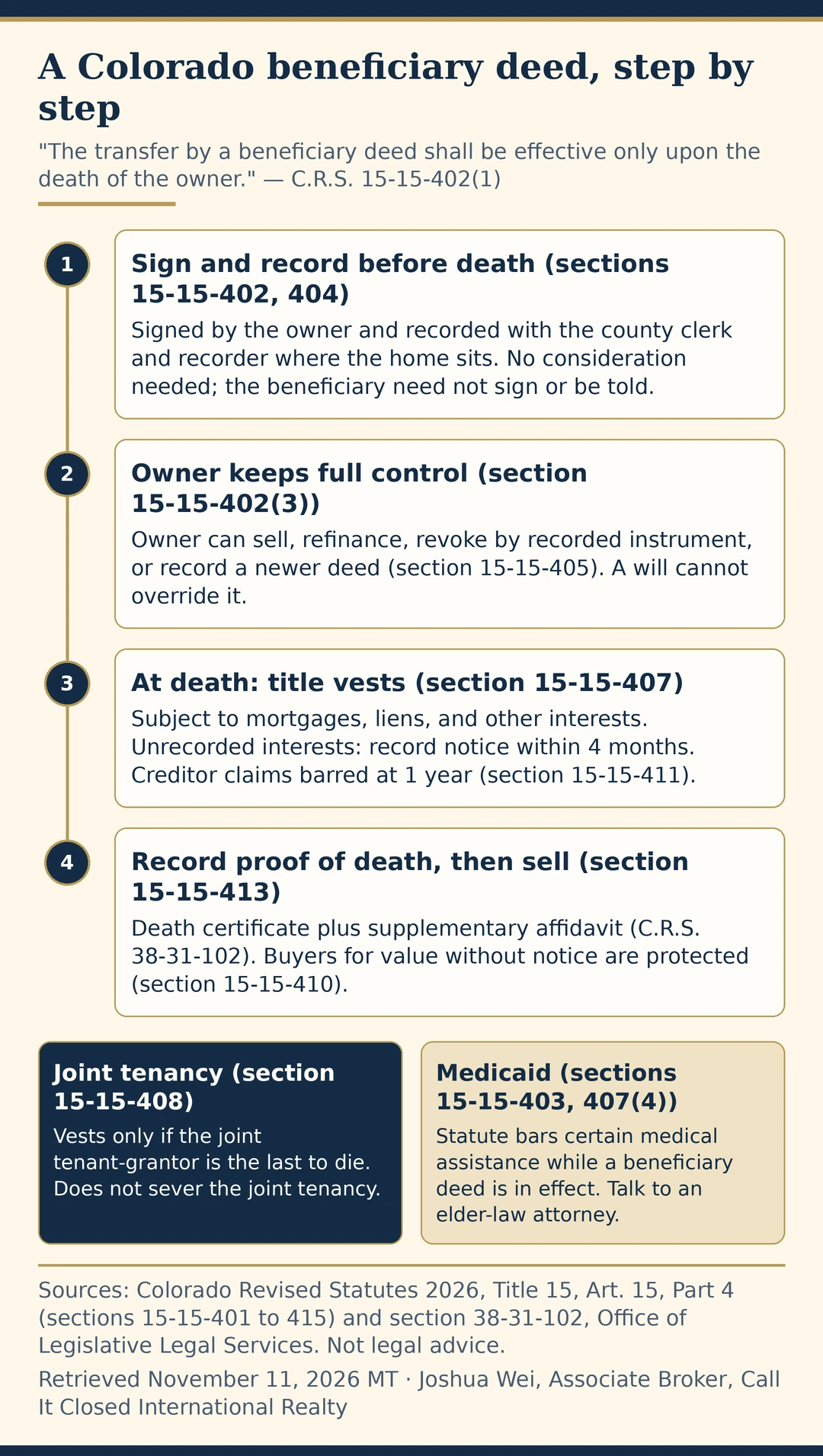
A vertical flow diagram, cream background with navy type and gold accents, titled A Colorado beneficiary deed, step by step, with the quotation that the transfer by a beneficiary deed shall be effective only upon the death of the owner, from C.R.S. 15-15-402(1). Four numbered steps: 1, sign and record before death under sections 15-15-402 and 404, signed by the owner and recorded with the county clerk and recorder where the home sits, with no consideration needed and no need for the beneficiary to sign or be told; 2, the owner keeps full control under section 15-15-402(3) and can sell, refinance, revoke by a recorded instrument, or record a newer deed under section 15-15-405, and a will cannot override it; 3, at death title vests under section 15-15-407, subject to mortgages, liens, and other interests, with unrecorded interests needing notice recorded within 4 months and creditor claims barred at 1 year under section 15-15-411; 4, record proof of death and then sell under section 15-15-413, using a death certificate plus a supplementary affidavit under C.R.S. 38-31-102, with buyers for value without notice protected under section 15-15-410. Two lower cards: joint tenancy under section 15-15-408, which vests only if the joint tenant-grantor is the last to die and does not sever the joint tenancy; and Medicaid under sections 15-15-403 and 407(4), where the statute bars certain medical assistance while a beneficiary deed is in effect, so talk to an elder-law attorney. Sources: Colorado Revised Statutes 2026, Office of Legislative Legal Services. Not legal advice. Retrieved November 11, 2026 MT.
Sources: Colorado Revised Statutes 2026, Title 15 (PDF), Office of Legislative Legal Services (opens in a new tab); Colorado Revised Statutes 2026, Title 38 (PDF) (opens in a new tab)
Cream background, navy text, gold rules. Four numbered steps on a gold spine, two side-by-side cards, and a 28px source footer.
The diagram above follows a Colorado beneficiary deed from signing and recording through the owner's lifetime to the transfer at death and a later sale. Each step cites the statute section it comes from.
What is a beneficiary deed under Colorado law?
C.R.S. 15-15-401(1) (opens in a new tab) defines it as "a deed, subject to revocation by the owner, which conveys an interest in real property and which contains language that the conveyance is to be effective upon the death of the owner."
Under C.R.S. 15-15-404(1), the deed must use the words "conveys on death" or "transfers on death," or otherwise indicate that the transfer takes effect at death, and it must be recorded "prior to the death of the owner in the office of the clerk and recorder in the county where the real property is located." For a Denver home that is the Denver Clerk and Recorder. For Aurora, it depends on whether the property is in Arapahoe, Adams, or Douglas County, which the tax bill or county assessor record will show.
The statute includes a sample form. It contains these warnings in capital letters: "THIS BENEFICIARY DEED IS REVOCABLE. IT DOES NOT TRANSFER ANY OWNERSHIP UNTIL THE DEATH OF THE GRANTOR." and "WARNING: EXECUTION OF THIS BENEFICIARY DEED MAY NOT AVOID PROBATE."
Two more statutory points:
- "A beneficiary deed need not be supported by consideration." (15-15-402(1))
- The beneficiary does not have to sign or even be told. "The joinder, signature, consent, or agreement of, or notice to, a grantee-beneficiary of a beneficiary deed prior to the death of the grantor shall not be required." (15-15-402(2))
A court annotation printed with section 15-15-401 notes: "'Owner' of property and grantor of deed must be a natural person and not an entity." If the home is held in a trust or an LLC, that is a direct question for an attorney.
What else is on the statutory form?
The sample form in C.R.S. 15-15-404(1) (opens in a new tab) has more than the two warnings. Next to the beneficiary's address it says: "(Note to Assessor and Treasurer: This address is for identification purposes only, all notices and tax statements should continue to be sent to grantor.)" The owner keeps getting the tax bill.
It has an "(Optional)" line for a "successor grantee-beneficiary" if the first one "fails to survive grantor." And it carries a third and fourth warning. One says the deed "REVOKES ALL PRIOR BENEFICIARY DEEDS BY THIS GRANTOR FOR THIS REAL PROPERTY EVEN IF THIS BENEFICIARY DEED FAILS TO CONVEY ALL OF THE GRANTOR'S INTEREST IN THIS REAL PROPERTY." The other begins "WARNING: EXECUTION OF THIS BENEFICIARY DEED MAY DISQUALIFY THE GRANTOR FROM BEING DETERMINED ELIGIBLE FOR, OR FROM" receiving Medicaid under title 25.5, as discussed below.
The form is "substantially the following form," in the statute's words. The statute says "may be in substantially the following form," so the sample shows what the deed is expected to contain.
Signing formalities. Section 15-15-406 says "A beneficiary deed or revocation of a beneficiary deed shall be subject to the requirements of section 38-35-109 (2), C.R.S., and may be acknowledged in accordance with section 38-35-101, C.R.S." Ask the attorney who prepares the deed, or the county clerk and recorder, what the recording office requires.
It is not a will. Section 15-15-412 states: "A beneficiary deed shall not be construed to be a testamentary disposition and shall not be invalidated due to nonconformity with the provisions of the code governing wills." So the wills code's formal requirements don't decide its validity, and as noted below, a will can't undo it.
When the statute applies. Under section 15-15-415, "The provisions of this part 4 shall apply to beneficiary deeds executed by owners who die on or after August 4, 2004."
Can the owner still sell, refinance, or change their mind?
Yes, under the statute. C.R.S. 15-15-402(3) says the owner "shall retain the full power and authority with respect to the property without the joinder, signature, consent, or agreement of, or notice to," the beneficiary "for any purpose."
Changing or revoking it is also done by recording:
- Revocation. Under 15-15-405(1), "An owner may revoke a beneficiary deed by executing an instrument that describes the real property affected, that revokes the deed, and that is recorded prior to the death of the owner."
- A newer deed replaces the old one. Under 15-15-405(2), "A subsequent beneficiary deed revokes all prior grantee-beneficiary designations by the owner for the described real property in their entirety."
- A will cannot override it. Under 15-15-405(4), a compliant beneficiary deed "may not be revoked, altered, or amended by the provisions of the will of the owner."
What a lifetime sale means for a recorded beneficiary deed, and what the title company will require, are questions for a Colorado attorney and the title company.
What happens to the mortgage and other liens?
The beneficiary inherits the home as it stands. C.R.S. 15-15-407(2) says the beneficiary takes title "at the death of the owner subject to all conveyances, encumbrances, assignments, contracts, mortgages, liens, and other interests," whether "created before or after the recording of the beneficiary deed."
The statute also sets deadlines for others with claims:
- Unrecorded interests. Under 15-15-407(3)(a), a person with an unrecorded interest "shall record evidence or a notice of the interest in the property not later than four months after the death of the owner."
- Creditors. Under 15-15-411(1)(a), "A claim by a creditor of the owner is forever barred at one year after the owner's death."
- Heirs and others. Under 15-15-411(1)(b), other claimants, heirs, and devisees are barred at the earlier of "Three years after the owner's death" or "One year after the time of recording the proof of death of the owner."
Section 15-15-407(2) goes further than recorded liens. It lists "any executory contract of sale, option to purchase, lease, license, easement, mortgage, deed of trust, or other lien," and adds: "The grantee-beneficiary also takes title subject to any interest in the property of which the grantee-beneficiary has either actual or constructive notice." A tenant's lease, for example, is on that list.
The four-month rule has consequences. Under section 15-15-407(3)(b), "Failure to record evidence or notice of interest in the property described in subsection (2) of this section within four months after the death of the owner shall forever bar the person from asserting an interest in the property as against all persons who do not have notice of the interest." The annotation printed with that section in the official C.R.S. summarizes a 2022 appellate decision, Argo v. Hemphill, 2022 COA 104: the section "unambiguously provides that a grantee-beneficiary takes title to the property subject to interests that are recorded or that the grantee-beneficiary has notice of prior to decedent's death or within four months after decedent's death."
Section 15-15-410 also addresses the beneficiary's obligations to the estate. A sale or loan by the beneficiary "shall not relieve the grantee-beneficiary of the obligation to the personal representative of the deceased owner's estate under section 15-15-103." What that obligation means for a particular estate is a legal question. Section 15-15-103, the section it cross-references, says "a transferee of a nonprobate transfer is subject to liability to any probate estate of the decedent for allowed claims against the decedent's probate estate and statutory allowances to the decedent's spouse and children to the extent the estate is insufficient to satisfy those claims and allowances." It caps that: "The liability of a nonprobate transferee may not exceed the value of nonprobate transfers received or controlled by that transferee." In plain terms, if the probate estate can't pay its allowed claims, a beneficiary who received the house may be asked to cover the shortfall, up to the value received. A probate attorney can explain how that works in a specific estate.
What about joint tenancy and Medicaid?
Joint tenants. Under C.R.S. 15-15-408(1) (opens in a new tab), a joint tenant may use a beneficiary deed, but "title to the interest shall vest in the designated grantee-beneficiary only if the joint tenant-grantor is the last to die of all of the joint tenants of such interest." The same section says "A beneficiary deed shall not sever a joint tenancy."
Medicaid. C.R.S. 15-15-403 is titled "Medicaid eligibility exclusion." It states: "No person who is an applicant for or recipient of medical assistance for which it would be permissible for the department of health care policy and financing to assert a claim pursuant to section 25.5-4-301 or 25.5-4-302, C.R.S., shall be entitled to such medical assistance if the person has in effect a beneficiary deed." Section 15-15-407(4) adds that the beneficiary's interest "shall be subject to any claim of the department of health care policy and financing for recovery of medical assistance payments pursuant to section 25.5-4-301 or 25.5-4-302, C.R.S." Anyone receiving or planning for long-term care should talk with an elder-law attorney before recording one.
How does a beneficiary sell the home later?
First, the death has to be put on record. C.R.S. 15-15-413 (opens in a new tab) says proof of death "shall be established in the same manner as for proving the death of a joint tenant." C.R.S. 38-31-102(1) allows a death certificate, "together with a supplementary affidavit," to be recorded with the county clerk and recorder, and says those documents "may also be used to provide proof of the death of a life tenant, the owner under a beneficiary deed, or any other person whose record interest in real property terminates upon the death of such person to the same extent as a joint tenant as provided in this section."
The affidavit has required contents. Section 38-31-102(1) says the affidavit must be "properly sworn to or" "affirmed by a person of legal age having personal knowledge of the facts, must include the legal description of the real property and a statement that the person referred to in the certificate is the same person who is named in a specific recorded deed or similar instrument." Once recorded, the death certificate and affidavit "must be accepted in all courts of the state of Colorado as prima facie proof of the death." The title company handling a later sale will have its own requirements on top of that.
A beneficiary can also decline. Under 15-15-414, "A grantee-beneficiary may refuse to accept all or any part of the real property interest described in a beneficiary deed."
For buyers, the statute gives some protection. Under 15-15-410(1), a purchaser or lender who acquires the property "for value and without notice" from a grantee-beneficiary "shall take title free of rights of an interested person in the deceased owner's estate," subject to the claims described in 15-15-407(2). A title company will decide what it requires before insuring a sale.
On tax basis, the IRS explains in Publication 551, Basis of Assets (opens in a new tab) (Inherited Property) that "Generally, the basis of property inherited from a decedent is one of the following," starting with "The FMV of the property at the date of the individual's death." How that applies to a particular inherited home is a question for a tax advisor.
Related: Aurora property tax and metro district checklist (opens in a new tab).
Two hypotheticals
These examples are invented.
A widowed owner names two children. An Aurora owner records a beneficiary deed naming her son and daughter, with no successor line. Her son dies before she does. Under section 15-15-407(5), "The provisions of any anti-lapse statute shall not apply to beneficiary deeds," and the son's share is "proportionately added to" the daughter's. The son's children don't take his share under the deed. If the owner wanted them to, that is a drafting question for her attorney while she is alive.
A beneficiary sells the house. A Denver owner dies with a recorded beneficiary deed naming his niece and a mortgage still on the house. The niece records the death certificate and supplementary affidavit under section 38-31-102. She takes title subject to the mortgage under section 15-15-407(2). She lists the house, and the title company sets its requirements before insuring the buyer. The mortgage payoff comes out of the sale proceeds at closing.
Two practical points. The mortgage does not stop at death. Someone needs to keep making the payments while the paperwork and the sale happen, or late fees and foreclosure can follow. Also, federal law generally does not let a lender call the whole loan due just because a home passed to a relative when the borrower died. A beneficiary who is not a relative should ask the loan servicer and an attorney how that rule applies. Contact the servicer early, tell them about the death, and ask what they need from you.
Checklists
For an owner considering a beneficiary deed:
- Confirm how title is held now (sole owner, joint tenants, trust or LLC) on the recorded vesting deed.
- Decide on a successor beneficiary line with your attorney.
- If you receive or may need Medicaid long-term care, see an elder-law attorney first.
- Record before death in the county where the property sits, and keep a copy of the recorded deed.
For a beneficiary planning to sell:
- Get a certified death certificate.
- Ask the title company what it needs: the supplementary affidavit under section 38-31-102, and anything else.
- Get a mortgage payoff statement and check for other liens.
- Ask a probate attorney about the estate's claims under sections 15-15-103 and 15-15-410, and a tax advisor about basis.
Frequently asked questions
Does a beneficiary deed avoid probate?
The statutory form itself warns: "WARNING: EXECUTION OF THIS BENEFICIARY DEED MAY NOT AVOID PROBATE." Ask an attorney about your situation.
Does the beneficiary have to sign?
No. Section 15-15-402(2) says their "joinder, signature, consent, or agreement of, or notice to" is not required before the owner's death.
Can I change the beneficiary later?
The statute provides for a recorded revocation or a later beneficiary deed. Under 15-15-405(3), the most recently executed deed or revocation recorded before death controls "regardless of the order of recording."
Does it come with a warranty of title?
Under 15-15-404(2), unless the owner says otherwise, it "shall not be deemed to contain any warranties of title and shall have the same force and effect as a conveyance made using a bargain and sale deed."
If the beneficiary dies first, what happens?
The form allows an optional successor beneficiary. If one of several beneficiaries dies first and the deed says nothing, 15-15-407(5) says that share is "proportionately added to, and pass as a part of, the shares of the surviving grantee-beneficiaries."
Will the tax bills go to the beneficiary while the owner is alive?
No. The statutory form's note says "all notices and tax statements should continue to be sent to grantor."
Does the beneficiary have to pay the owner's debts?
Section 15-15-103 makes a nonprobate transferee liable to the estate for allowed claims "to the extent the estate is insufficient," capped at "the value of nonprobate transfers received." Ask a probate attorney.
Can a real estate broker prepare a beneficiary deed?
Drafting a beneficiary deed is legal work; ask a Colorado attorney. A real estate broker can help with listing, buying or selling the home.
Related notes
- Special warranty, general warranty, or quitclaim? Colorado deed types for Denver and Aurora buyers, explained
- Joint tenants or tenants in common? How co-buyers take title to a Colorado home
- Reading your title commitment: what Denver and Aurora buyers should check before the title objection deadline
Sources and method
Official sources, retrieved November 11 and 13, 2026, America/Denver: Colorado Revised Statutes 2026, Title 15, Article 15, Part 4 (sections 15-15-401 to 15-15-415) and section 15-15-103, and Title 38, section 38-31-102, from the Office of Legislative Legal Services 2026 C.R.S. download page (opens in a new tab) (Title 15 PDF (opens in a new tab); Title 38 PDF (opens in a new tab)); and IRS Publication 551, Basis of Assets (opens in a new tab). Quotations are verbatim. A court annotation is quoted only as printed in the official C.R.S. volume. This article does not summarize case law beyond the one printed annotation, recording fees, or estate tax rules. The hypotheticals are invented.
This note is general education from a Colorado real estate broker with Call It Closed International Realty. If you are selling or buying a Denver or Aurora home that involves a beneficiary deed, I can help coordinate the real estate side with your attorney and title company.
Added November 19, 2026, after an expert review, and checked that day: 12 U.S.C. 1701j-3, Preemption of due-on-sale prohibitions (Cornell Legal Information Institute) (opens in a new tab).
Disclaimer
This article is general information only. It is not legal, tax, lending, insurance, appraisal, inspection, or financial advice, and it is not a substitute for advice about your situation. Joshua Wei is a Colorado real estate broker, not an attorney. Reading this article does not create a client relationship, an agency relationship, or an attorney-client relationship with Joshua Wei or with Call It Closed International Realty.
Laws, program rules, interest rates, insurance terms, tax figures, and other details change. Examples in this article are hypothetical illustrations unless a source is named for a specific, dated figure. Information in this article is believed accurate as of November 19, 2026 and is not guaranteed. No result is promised, and you should not rely on this article as the last word for your situation.
Before you act, confirm the point with the official source linked or cited in this article, and talk with a licensed professional who can apply the rule to your facts. That may be a licensed attorney, a tax professional, a lender, an insurance agent, a home inspector, or another licensed professional, depending on the question. Links to third-party websites and publications are provided for reference only. They are not an endorsement, and their content can change.
If you already have a brokerage relationship with another broker, this is not a solicitation.
Joshua Wei, Associate Broker, Call It Closed International Realty, Colorado license FA.100108558. Equal Housing Opportunity.