November 11, 2026 · Colorado · Buying · Title · Co-Buyers
Joint tenants or tenants in common? How co-buyers take title to a Colorado home
Colorado's purchase contract asks co-buyers to choose how they'll hold title. What C.R.S. 38-31-101 says about joint tenancy, the default of tenancy in common, survivorship, unequal shares, severance, and why tenancy by the entirety isn't available. Plus the questions to bring to an attorney before you sign.
The short answer
In brief: When two or more people buy a Colorado home together, section 2.1 of the state's residential purchase contract asks how they will take title: as joint tenants, tenants in common, or other. Colorado law addresses what happens when an owner dies; under C.R.S. 38-31-101(6)(c), in a joint tenancy the deceased joint tenant's interest is terminated. Ask an attorney which fits.
When two or more people buy a Colorado home together, the contract asks how they'll take title. Section 2.1 of the Commission's residential Contract to Buy and Sell Real Estate (opens in a new tab) says the buyer "will take title to the Property described below as" Joint Tenants, Tenants In Common, or Other.
The statute addresses what happens when an owner dies. Under C.R.S. 38-31-101(6)(c), in a joint tenancy, "Upon the death of a joint tenant, the deceased joint tenant's interest is terminated," and the surviving owners continue to hold the property. A tenant in common's share works differently. It does not pass automatically to the other owners. It becomes part of the deceased owner's estate and passes under that owner's will or a beneficiary deed. If there is neither, Colorado's probate code says property not disposed of by will or otherwise passes to the owner's heirs. That can mean the surviving owner ends up sharing the home with the other owner's family, and the estate may need to go through probate. A Colorado attorney can explain how this would work for you.
Under C.R.S. 38-31-101(1) and (4), a conveyance to two or more people is a tenancy in common unless the deed declares a joint tenancy. Which form fits a particular household is a question for a Colorado real estate attorney, and tax effects are a question for a tax advisor.
I am a licensed Colorado real estate broker with Call It Closed International Realty. I am not an attorney.
Disclaimer. This article is general information only. It is not legal, tax, lending, insurance, appraisal, inspection, or financial advice, and reading it does not create a client, agency, or attorney-client relationship. Laws, rates, programs, and figures change. Confirm the official source, and talk with a licensed attorney, tax professional, lender, insurance agent, or inspector before you act. Joshua Wei is a Colorado real estate broker, not an attorney. He is an Associate Broker with Call It Closed International Realty, license FA.100108558. Equal Housing Opportunity.
 Full size (opens in a new tab)
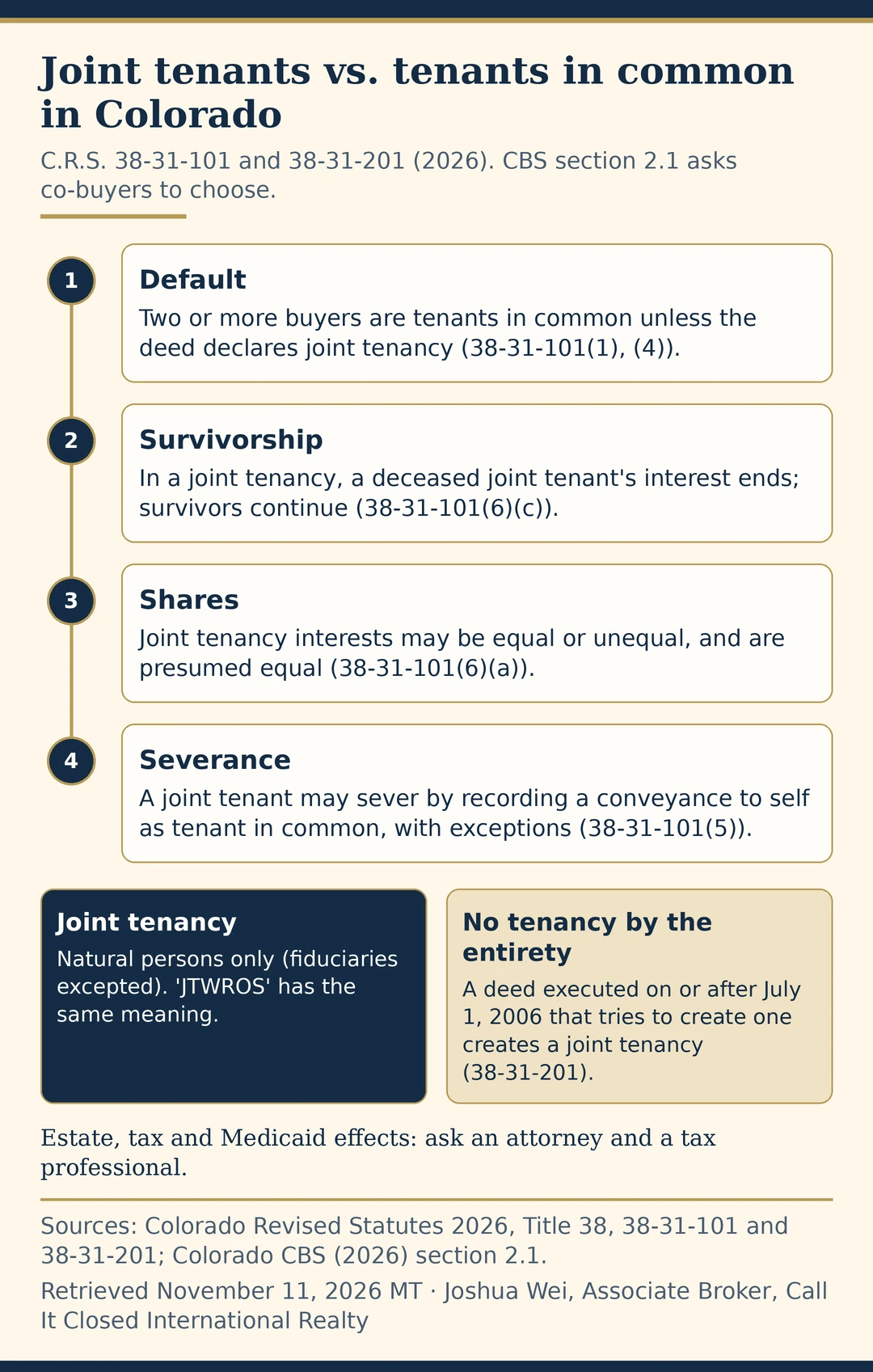
A vertical flow diagram, cream background with navy type and gold accents, titled Joint tenants vs. tenants in common in Colorado. Subtitle: C.R.S. 38-31-101 and 38-31-201 (2026). CBS section 2.1 asks co-buyers to choose. 4 numbered steps: 1, Default: Two or more buyers are tenants in common unless the deed declares joint tenancy (38-31-101(1), (4)); 2, Survivorship: In a joint tenancy, a deceased joint tenant's interest ends; survivors continue (38-31-101(6)(c)); 3, Shares: Joint tenancy interests may be equal or unequal, and are presumed equal (38-31-101(6)(a)); 4, Severance: A joint tenant may sever by recording a conveyance to self as tenant in common, with exceptions (38-31-101(5)). Two cards: Joint tenancy: Natural persons only (fiduciaries excepted). 'JTWROS' has the same meaning; and No tenancy by the entirety: A deed executed on or after July 1, 2006 that tries to create one creates a joint tenancy (38-31-201). A note says: Estate, tax and Medicaid effects: ask an attorney and a tax professional. Sources: Colorado Revised Statutes 2026, Title 38, 38-31-101 and 38-31-201; Colorado CBS (2026) section 2.1. Retrieved November 11, 2026 MT. Joshua Wei, Associate Broker, Call It Closed International Realty.
Sources: C.R.S. 2026 Title 38 (opens in a new tab)
Cream background, navy text, gold rules. Numbered navy circles on a gold spine with white step cards, two branch cards (navy and tan), a note, and a source footer.
The figure above compares the two main ways to hold title, citing the statute for each point.
What's the default if the deed doesn't say?
C.R.S. 38-31-101(1) in the 2026 Colorado Revised Statutes (opens in a new tab) says no conveyance to two or more people creates a joint tenancy "unless, in the instrument conveying the real property or in the will devising the real property, it is declared that the real property is conveyed or devised in joint tenancy or to such natural persons as joint tenants."
The statute also says "JTWROS" and "as joint tenants with right of survivorship" mean the same thing as "in joint tenancy."
Subsection (4) gives the default: a conveyance that doesn't create a joint tenancy "shall be a conveyance or devise in tenancy in common or to tenants in common."
Subsection (1) also says: "Any grantor in any such instrument of conveyance may also be one of the grantees therein." In other words, the statute contemplates a current owner signing a deed that names that same owner as one of the grantees. Whether a deed like that suits a particular situation is a question for a Colorado real estate attorney.
The four unities
Subsection (1.5) keeps an older rule in place. It says "The doctrine of the four unities of time, title, interest, and possession is continued as part of the law of this state," subject to the other subsections. It defines that doctrine as "the common law doctrine that a joint tenancy is created by conveyance or devise of real property to two or more persons at the same time of the same title to the same interest with the same right of possession and includes the right of survivorship."
Subsection (1.5)(b) says the rest of the section is intended "to clarify, supplement, and, limited to their express terms, modify the doctrine of the four unities." How that interaction plays out on a given deed is for an attorney.
Trustees and other fiduciaries
Subsection (3) reverses the default for fiduciaries: "A conveyance or devise to two or more personal representatives, trustees, or other fiduciaries shall be presumed to create an estate in joint tenancy in real property and not a tenancy in common." That matters when a home is bought or sold by co-trustees or co-personal representatives rather than by individuals.
Who can be joint tenants?
Under subsection (4), "An estate in joint tenancy in real property shall only be created in natural persons." The statute lists an exception for personal representatives, trustees and other fiduciaries.
Can joint tenants own unequal shares?
Subsection (6)(a) says "The interests in a joint tenancy may be equal or unequal." It adds that the interests "are presumed to be equal," and that the presumption is "Conclusive as to all persons who obtain an interest in property held in joint tenancy when such persons are without notice of unequal interests and have relied on an instrument recorded pursuant to section 38-35-109" and "Rebuttable for all other persons."
Subsection (6)(d) adds one rule for a specific program: "For purposes of the "Colorado Medical Assistance Act", articles 4, 5, and 6 of title 25.5, C.R.S., a joint tenancy shall be deemed to be a joint tenancy with equal interests among the joint tenants regardless of the language in the deed or other instrument creating the joint tenancy." This article quotes that sentence but doesn't analyze it; questions about it belong with an attorney.
How co-buyers document different contributions is a question for a Colorado real estate attorney.
What happens to a joint tenant's interest at death?
Subsection (6)(c) gives the full rule: "Upon the death of a joint tenant, the deceased joint tenant's interest is terminated. In the case of one surviving joint tenant, his or her interest in the property shall continue free of the deceased joint tenant's interest. In the case of two or more surviving joint tenants, their interests shall continue in proportion to their respective interests at the time the joint tenancy was created."
So with three joint tenants, the death of one leaves the other two holding the property, and their interests continue in the proportions set when the joint tenancy was created.
How the death gets into the public record
Two sections describe what can be recorded with the county clerk and recorder.
When a death certificate is available. Under C.R.S. 38-31-102(1), "A certificate of death, a verification of death document, or a certified copy thereof, of a person who is a joint tenant may be placed of record with the county clerk and recorder of the county in which the real property affected by the joint tenancy is located, together with a supplementary affidavit." The affidavit "must include the legal description of the real property and a statement that the person referred to in the certificate is the same person who is named in a specific recorded deed or similar instrument creating the joint tenancy." Once recorded, these documents "must be accepted in all courts of the state of Colorado as prima facie proof of the death of the joint tenant."
When it isn't. C.R.S. 38-31-103 allows "an affidavit properly sworn to or affirmed by two or more persons of legal age having personal knowledge of the facts and having no record interest in the real property affected by the joint tenancy." The affidavit must state that a certificate "cannot be procured, and the reason therefor, the legal description of the real property, the date and place of death of the deceased person," and that the person was "at the time of death an owner of a joint tenancy interest in the real property."
C.R.S. 38-31-104 adds a penalty: anyone "falsely swearing to or affirming any affidavit provided for in sections 38-31-102 and 38-31-103 is guilty of perjury in the second degree" and is also "liable for damages to any person for any loss consequent on the false swearing or affirming."
Section 38-31-102(1) also says the same documents "may also be used to provide proof of the death of a life tenant, the owner under a beneficiary deed, or any other person whose record interest in real property terminates upon the death of such person." For a surviving owner who later sells, the title company is the one to ask what it will require on that file.
Can a joint tenancy be ended?
Subsection (5)(a) lets "a joint tenant ... sever the joint tenancy between himself or herself and all remaining joint tenants by unilaterally executing and recording an instrument conveying his or her interest in real property to himself or herself as a tenant in common." The severance takes effect "upon recording." The statute adds: "If there are two or more remaining joint tenants, they shall continue to be joint tenants as among themselves."
The exceptions are cross-references: subsection (5)(a) begins "Except as provided in sections 38-35-118 and 38-41-202 (4)." Both of those sections deal with homesteaded property; 38-35-118 is titled "Homestead, how conveyed - claimant insane." How they apply is a question for a Colorado attorney.
Subsection (7) says "Nothing in this section shall be deemed to abrogate any existing case law to the extent that such case law establishes other means of severing a joint tenancy." This article doesn't summarize that case law.
Subsection (5)(b) says "Filing a petition in bankruptcy by a joint tenant shall not sever a joint tenancy." Subsection (6)(b) preserves "claims for equitable relief as among joint tenants, including but not limited to partition and accounting."
What if co-owners disagree about selling?
Colorado's partition statute, C.R.S. 38-28-101 to -110, applies to both forms of ownership. Under 38-28-101, "Actions for the division and partition of real or personal property or interest therein may be maintained by any person having an interest in such property." Other sections set out the process:
- Parties. Under 38-28-102, "All persons having any interest, direct, beneficial, contingent, or otherwise, in such property shall be made parties."
- Scope. Under 38-28-103, "The court shall make a complete adjudication of the rights of all parties to such property."
- Sale. Under 38-28-107, if "partition of the property cannot be made without manifest prejudice to the rights of any interested party, the court may direct the sale" of the property "at public sale upon such terms as the court may fix."
- Proceeds. Under 38-28-108, "The court shall direct the distribution of the net proceeds of such sale and any undistributed income from such property among the persons entitled thereto."
- Costs. Under 38-28-109, the court may order payment of commissioners' compensation, "with costs, expenses, and attorney's fees, out of the proceeds of" the sale.
- Liens. Under 38-28-110, the court "may direct the payment and discharge of liens and have the property sold free from any lien or may apportion any lien among the persons to whom the partition is made."
A court case is one path. A written co-ownership agreement signed at purchase, covering a buyout or a sale, is something to discuss with an attorney before closing. Whether a court would enforce particular terms is a legal question.
What about "tenancy by the entirety"?
C.R.S. 38-31-201(1) says no conveyance "shall create a tenancy by the entirety." Under subsection (3), a deed executed on or after July 1, 2006 that tries to create one "shall create a joint tenancy."
Joint tenancy and tenancy in common side by side
Each point below comes from the statute text quoted above.
- How it's created. Joint tenancy: the deed or will must declare it (38-31-101(1)). Tenancy in common: the default for other conveyances to two or more people (38-31-101(4)).
- Who can hold it. Joint tenancy: it "shall only be created in natural persons," except fiduciaries (38-31-101(4)). Tenancy in common: the statute adds no such limit.
- Shares. Joint tenancy: "may be equal or unequal" but "presumed to be equal" (38-31-101(6)(a)). Tenancy in common: 38-31-101 doesn't set a presumption for it, so the deed and any agreement are what to read.
- At death. Joint tenancy: the deceased owner's interest "is terminated" (38-31-101(6)(c)). Tenancy in common: the share passes under the owner's will, beneficiary deed, or Colorado's intestacy rules, not automatically to the co-owner.
- Ending it. Joint tenancy: a recorded self-conveyance severs it, with exceptions (38-31-101(5)(a)). Either form: a partition action under 38-28-101.
An invented example
This example is invented to show how the statute and the contract fit together. It is not legal advice.
Two friends, Ana and Ben, are buying an Aurora townhome. Ana is putting in more of the down payment. Their lender's documents and their offer are ready, and the agent asks how they will take title under section 2.1 of the contract.
- If they check Joint Tenants, the deed has to declare it under 38-31-101(1). Their interests "are presumed to be equal" under (6)(a), even though Ana contributed more. If one of them dies, (6)(c) says that owner's interest "is terminated," and the survivor's interest "shall continue free of the deceased joint tenant's interest."
- If they check Tenants In Common, (4) makes that the result for a conveyance that doesn't create a joint tenancy. If one of them dies, that person's share would go to whoever their will, beneficiary deed, or Colorado's intestacy law names, not automatically to the other buyer. They ask their attorney whether that is what they want.
- Either way, if they later disagree about selling, 38-28-101 lets "any person having an interest" bring a partition action.
Before signing, they ask an attorney which form fits, how to document Ana's larger contribution, and whether to sign a co-ownership agreement. They ask a tax advisor about tax effects. They tell the title company early so the deed's wording matches their choice.
A checklist for co-buyers
- Decide how you'll take title before you write the offer, and check the matching box in section 2.1.
- Ask the title company what names and vesting wording the deed will show, and read the title commitment when it arrives.
- If you want joint tenancy, confirm the deed says "in joint tenancy," "as joint tenants," "JTWROS," or "as joint tenants with right of survivorship," the phrases 38-31-101(1) treats as equivalent.
- If your contributions differ, ask an attorney how to record that, keeping in mind the presumption in (6)(a).
- Discuss a written co-ownership agreement covering a buyout, a sale, or one owner moving out.
- Line the deed up with your wills, trusts or any beneficiary deed.
- Keep the recorded deed. Under 38-31-102(1), a death affidavit refers to "a specific recorded deed or similar instrument creating the joint tenancy."
Questions for your attorney before closing
- If one of us dies, who should get that share: the other owner, or that person's heirs?
- Are we contributing equally? If not, how should we document it?
- Do we need a written co-ownership agreement covering a buyout, a sale, or one of us moving out?
- How does this fit with our wills, trusts or beneficiary deeds?
- What are the tax effects? (Ask a tax advisor.)
Frequently asked questions
If our deed just lists both names, are we joint tenants?
C.R.S. 38-31-101(1) requires the instrument to declare a joint tenancy; subsection (4) makes other conveyances "in tenancy in common or to tenants in common."
Does "JTWROS" create a joint tenancy?
The statute gives "JTWROS" the same meaning as "in joint tenancy."
Can married couples choose tenancy by the entirety in Colorado?
C.R.S. 38-31-201 says such a deed executed on or after July 1, 2006 creates a joint tenancy.
Can one joint tenant end the joint tenancy alone?
Subsection (5)(a) describes severance by "unilaterally executing and recording an instrument," subject to the statute's exceptions. A specific situation is a question for a Colorado attorney.
Does bankruptcy end a joint tenancy?
C.R.S. 38-31-101(5)(b) says filing a bankruptcy petition doesn't sever it.
Can co-trustees take title as joint tenants?
Under C.R.S. 38-31-101(3), a conveyance "to two or more personal representatives, trustees, or other fiduciaries shall be presumed to create an estate in joint tenancy," and subsection (4)'s natural-persons limit doesn't apply to them.
What does a surviving joint tenant record?
C.R.S. 38-31-102(1) allows recording a death certificate "together with a supplementary affidavit." If a certificate can't be obtained, 38-31-103 allows an affidavit from two or more people with personal knowledge and "no record interest in the real property."
Can a co-owner force a sale?
Under C.R.S. 38-28-101, any person with an interest may bring a partition action. Under 38-28-107, the court may order a sale if partition "cannot be made without manifest prejudice to the rights of any interested party."
Who decides which box to check?
The buyers make the choice, and section 2.1 of the contract records it. Which form fits is a question for a Colorado real estate attorney.
Related notes
- Colorado beneficiary deeds: what a transfer-on-death deed does, and doesn't do, for a Denver or Aurora home
- Special warranty, general warranty, or quitclaim? Colorado deed types for Denver and Aurora buyers, explained
- Reading your title commitment: what Denver and Aurora buyers should check before the title objection deadline
Sources and method
Official sources, retrieved November 11, 2026, America/Denver:
- Colorado Revised Statutes 2026, Title 38 (opens in a new tab): C.R.S. 38-31-101 and 38-31-201
- Colorado Real Estate Commission, Contract to Buy and Sell Real Estate (Residential), for use on and after January 1, 2026 (opens in a new tab), section 2.1
Added November 13, 2026: further passages of C.R.S. 38-31-100.3 to -104 and 38-31-201 (opens in a new tab) (four unities, grantor as grantee, fiduciaries, survivorship, recording proof of death, false affidavits, severance exceptions) and the partition statute, C.R.S. 38-28-101 to -110 (opens in a new tab). Subsection (6)(d) is quoted but not analyzed.
Quotations are verbatim from the statute text. The example is invented. Case-law annotations aren't summarized here. This article doesn't cover tax, estate or Medicaid effects, which are for an attorney or tax professional.
This note is general education from a Colorado real estate broker with Call It Closed International Realty. If you're buying with a partner, relative or friend, I'll make sure the contract's vesting choice matches what your attorney recommends.
Added November 19, 2026, after an expert review, and checked that day: Colorado Revised Statutes 2026, Title 15, section 15-11-101(1) (opens in a new tab).
Disclaimer
This article is general information only. It is not legal, tax, lending, insurance, appraisal, inspection, or financial advice, and it is not a substitute for advice about your situation. Joshua Wei is a Colorado real estate broker, not an attorney. Reading this article does not create a client relationship, an agency relationship, or an attorney-client relationship with Joshua Wei or with Call It Closed International Realty.
Laws, program rules, interest rates, insurance terms, tax figures, and other details change. Examples in this article are hypothetical illustrations unless a source is named for a specific, dated figure. Information in this article is believed accurate as of November 19, 2026 and is not guaranteed. No result is promised, and you should not rely on this article as the last word for your situation.
Before you act, confirm the point with the official source linked or cited in this article, and talk with a licensed professional who can apply the rule to your facts. That may be a licensed attorney, a tax professional, a lender, an insurance agent, a home inspector, or another licensed professional, depending on the question. Links to third-party websites and publications are provided for reference only. They are not an endorsement, and their content can change.
If you already have a brokerage relationship with another broker, this is not a solicitation.
Joshua Wei, Associate Broker, Call It Closed International Realty, Colorado license FA.100108558. Equal Housing Opportunity.