October 18, 2026 · Denver · Aurora · Buying
Reading your title commitment: what Denver and Aurora buyers should check before the title objection deadline
The title commitment arrives early in a Colorado purchase and starts its own deadlines. What Colorado's Division of Insurance says title insurance does and doesn't cover, what CBS1 section 8 says about title documents, off-record matters, third-party rights, and how to object.
The short answer
In brief: Soon after a Denver or Aurora contract is signed, the title company issues a title commitment. Colorado's Division of Insurance describes it as a report identifying the insurer, the premiums, requirements to be met before a policy issues, and specific exceptions to coverage. Section 8 of the purchase contract sets the deadlines for reviewing it and objecting.
Soon after your Denver or Aurora contract is signed, the title company issues a title commitment. Colorado's Division of Insurance (DOI) title insurance page (opens in a new tab) describes it as "a report that will identify the insurance company, and will detail the premiums owed for title insurance, requirements to be fulfilled prior to the issuance of a policy, and any specific exceptions to coverage that may have been identified (such as covenants, mineral or water rights, easements)."
The commitment starts a review clock. Under section 8.2 of the Colorado Real Estate Commission's residential contract (CBS1), the buyer "has the right to review and object to the Abstract of Title or Title Commitment and any of the Title Documents" on or before the Record Title Objection Deadline. Miss it, and the buyer "accepts the condition of title as disclosed" as satisfactory, provided the seller delivered what section 8.1 requires.
CBS1 is on the Division of Real Estate's contracts and forms page (opens in a new tab); quotations here are from the 2026 CBS1 PDF (opens in a new tab).
I am a licensed Colorado real estate broker with Call It Closed International Realty. I am not an attorney or a title insurance agent. This is not legal advice.
Disclaimer. This article is general information only. It is not legal, tax, lending, insurance, appraisal, inspection, or financial advice, and reading it does not create a client, agency, or attorney-client relationship. Laws, rates, programs, and figures change. Confirm the official source, and talk with a licensed attorney, tax professional, lender, insurance agent, or inspector before you act. Joshua Wei is a Colorado real estate broker, not an attorney. He is an Associate Broker with Call It Closed International Realty, license FA.100108558. Equal Housing Opportunity.
 Full size (opens in a new tab)
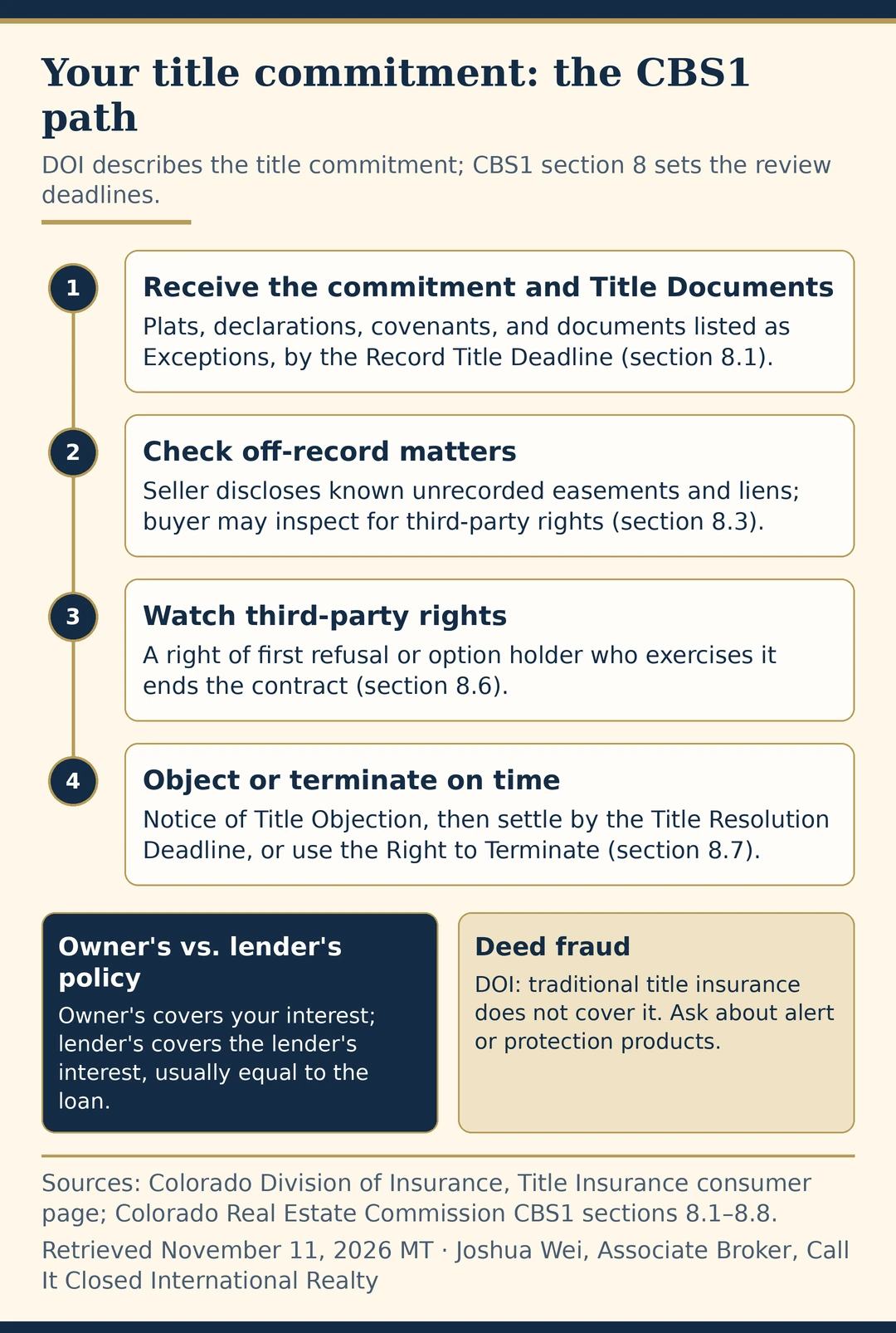
A vertical flow diagram, cream background with navy type and gold accents, titled Your title commitment: the CBS1 path, with the subtitle the Division of Insurance describes the title commitment, and CBS1 section 8 sets the review deadlines. Four numbered steps: 1, receive the commitment and Title Documents, meaning plats, declarations, covenants, and documents listed as Exceptions, by the Record Title Deadline under section 8.1; 2, check off-record matters, where the seller discloses known unrecorded easements and liens and the buyer may inspect for third-party rights under section 8.3; 3, watch third-party rights, since a right of first refusal or option holder who exercises it ends the contract under section 8.6; 4, object or terminate on time, with a Notice of Title Objection and a settlement by the Title Resolution Deadline, or the Right to Terminate under section 8.7. Two lower cards: owner's vs. lender's policy, where the owner's policy covers your interest and the lender's covers the lender's interest, usually equal to the loan; and deed fraud, which the Division of Insurance says traditional title insurance does not cover, so ask about alert or protection products. Sources: Colorado Division of Insurance and Colorado Real Estate Commission contract. Retrieved November 11, 2026 MT.
Sources: DOI Title Insurance (opens in a new tab); DRE contracts and forms (opens in a new tab)
Cream background, navy text, gold rules. Four numbered steps on a gold spine, two side-by-side cards, and a 28px source footer.
The diagram above lays out the CBS1 section 8 title steps and the deadlines that go with them. It summarizes the contract and the DOI page.
What does title insurance cover?
DOI explains: "title insurance is an agreement that should a problem arise in the ownership records of your property, your insurer will fix the problem, defend you against it, or compensate you for any losses."
It looks backward. "While most insurance (auto, home, etc.) provides protection against future events (fires, tornados, hail damage, etc.), title insurance protects you against matters that have already occurred, and that were not caused by any wrongdoing on your part."
There are two policies. "Owner's title insurance covers your interests as owner of the property," while "Lender's title insurance covers your lender's interests in your property and is usually issued in an amount equal to the loan amount."
Who orders the commitment, and for how much?
CBS1 section 8.1 gives the parties two boxes. Under section 8.1.1, if checked, "Seller will select the title insurance company to furnish the owner's title insurance policy at Seller's expense," and "On or before Record Title Deadline, Seller must furnish to Buyer a current commitment for an owner's title insurance policy (Title Commitment) in an amount equal to the Purchase Price." Under section 8.1.2, the buyer can select and pay instead. The contract sets a default: "If neither box in section 8.1.1. or section 8.1.2. is checked, section 8.1.1. applies."
Section 8.1.1 also says the seller "will cause the title insurance policy to be issued and delivered to Buyer as soon as practicable at or after Closing."
Owner's Extended Coverage
Section 8.1.3 has a separate box for whether the commitment "Will" or "Will Not" contain Owner's Extended Coverage (OEC). If it does, it "will commit to delete or insure over the standard exceptions which relate to: (1) parties in possession, (2) unrecorded easements, (3) survey matters, (4) unrecorded mechanics' liens, (5) gap period (period between the effective date and time of commitment to the date and time the deed is recorded) and (6) unpaid taxes, assessments and unredeemed tax sales prior to the year of Closing."
The contract does not promise the title company will agree: "Regardless of whether the Contract requires OEC, the Title Insurance Commitment may not provide OEC or delete or insure over any or all of the standard exceptions for OEC. The Title Insurance Company may require a New Survey or New ILC, defined below, among other requirements for OEC." It adds: "If the Title Insurance Commitment is not satisfactory to Buyer, Buyer has a right to object under section 8.7."
What must the title company tell you?
Colorado law requires some statements with every residential owner's commitment. Under Colorado Revised Statutes section 10-11-122(1) (opens in a new tab), the title insurance agent or company must provide a statement disclosing:
- "(a) That the subject real property may be located in a special taxing district;"
- "(b) That a certificate of taxes due listing each taxing jurisdiction will be obtained from the county treasurer of the county in which the subject real property is located or that county treasurer's authorized agent unless the proposed insured provides written instructions to the contrary; and"
- "(c) That information regarding special districts and the boundaries of such districts may be obtained from the board of county commissioners, the county clerk and recorder, or the county assessor."
Section 10-11-122(3)(a) adds that, before issuing a residential owner's policy and unless the proposed insured instructs otherwise, the title company "shall obtain a certificate of taxes due from the county treasurer or the county treasurer's authorized agent." Section 10-11-122(4)(a) requires one more statement: "COLORADO NOTARIES MAY REMOTELY NOTARIZE REAL ESTATE DEEDS AND OTHER DOCUMENTS USING REAL-TIME AUDIO-VIDEO COMMUNICATION TECHNOLOGY. YOU MAY CHOOSE NOT TO USE REMOTE NOTARIZATION FOR ANY DOCUMENT."
Severed mineral notice
Under Colorado Revised Statutes section 10-11-123(2) (opens in a new tab), when "it is determined that a mineral estate has been severed from the surface estate," the commitment must include a written statement "That there is recorded evidence that a mineral estate has been severed, leased, or otherwise conveyed from the surface estate and that there is a substantial likelihood that a third party holds some or all interest in oil, gas, other minerals, or geothermal energy in the property," and "That such mineral estate may include the right to enter and use the property without the surface owner's permission."
The statute lets the title company rely on the county records: it "may rely on recorded documents that impart constructive notice in the office of the clerk and recorder of the county in which the real property is situated and shall not be liable for any errors or omissions in such records." The section defines "Surface owner" to include "any purchaser with rights under a contract to purchase all or part of the surface estate." See mineral rights for Denver and Aurora buyers.
What documents does the contract list?
CBS1 section 8.1.4 defines "Title Documents" as "(1) copies of any plats, declarations, covenants, conditions and restrictions burdening the Property and (2) copies of any other documents (or, if illegible, summaries of such documents) listed in the schedule of exceptions (Exceptions) in the Title Commitment."
Under section 8.1.5, "Buyer must receive, on or before Record Title Deadline, copies of all Title Documents." That section limits the scope: "This requirement pertains only to documents as shown of record in the office of the clerk and recorder in the county where the Property is located." It also says who pays for the copies: "the party or parties obligated to pay for the owner's title insurance policy."
Section 8.1.6 covers older records: "Seller must deliver to Buyer copies of any abstracts of title covering all or any portion of the Property (Abstract of Title) in Seller's possession on or before Record Title Deadline."
What can a buyer object to?
Section 8.2 is broad. The buyer's objection "may be based on any unsatisfactory form or content of Title Commitment or Abstract of Title, notwithstanding section 13, or any other unsatisfactory title condition, in Buyer's sole subjective discretion."
Late or changed documents get their own window. Section 8.2 gives the buyer "until the earlier of Closing or ten days after receipt of such documents by Buyer to review and object to: (1) any required Title Document not timely received by Buyer, (2) any change to the Abstract of Title, Title Commitment or Title Documents, or (3) any endorsement to the Title Commitment."
DOI calls the exceptions "specific exceptions to coverage." What a specific exception, declaration or covenant means for a property is a question for the title company or a Colorado real estate attorney.
What about problems not in the public record?
Section 8.3 covers "Off-Record Title." The seller "must disclose to Buyer all easements, liens (including, without limitation, governmental improvements approved, but not yet installed) or other title matters not shown by public records, of which Seller has actual knowledge."
The buyer also "has the right to inspect the Property to investigate if any third party has any right in the Property not shown by public records (e.g., unrecorded easement, boundary line discrepancy or water rights)." Objections are due by the Off-Record Title Objection Deadline.
An ILC or survey can help with boundary questions. Section 8.8 also warns that matters outside the Title Documents may affect the property, "including, without limitation, boundary lines and encroachments, set-back requirements, area, zoning, building code violations."
How does the tax certificate fit in?
Section 8.4 is printed in capital letters. It warns that a special taxing or metropolitan district's actions "MAY INCREASE COSTS TO RESIDENTS LIVING IN THE SPECIAL TAXING OR METROPOLITAN DISTRICT," and that "BUYERS SHOULD INVESTIGATE THE SPECIAL TAXING OR METROPOLITAN DISTRICTS IN WHICH THE PROPERTY IS LOCATED BY CONTACTING THE COUNTY TREASURER, BY REVIEWING THE CERTIFICATE OF TAXES DUE FOR THE PROPERTY AND BY OBTAINING FURTHER INFORMATION FROM THE BOARD OF COUNTY COMMISSIONERS, THE COUNTY CLERK AND RECORDER, OR THE COUNTY ASSESSOR."
Under section 8.5, a tax certificate "for the Property listing any special taxing or metropolitan districts that affect the Property (Tax Certificate) must be delivered to Buyer on or before Record Title Deadline," paid for by the party checked. If its content "is unsatisfactory to Buyer, in Buyer's sole subjective discretion," the buyer may terminate by the Record Title Objection Deadline.
What is a third-party right to purchase?
Section 8.6 applies if "any third party has a right to purchase the Property (e.g., right of first refusal on the Property, right to purchase the Property under a lease or an option held by a third party to purchase the Property) or a right of a third party to approve this Contract."
"If the third-party holder of such right exercises its right this Contract will terminate." The seller "will supply to Buyer, in writing, details of any Third Party Right to Purchase the Property on or before the Record Title Deadline."
How do I object?
Section 8.7 covers "any title matters including those matters set forth in section 8.2. (Record Title), section 8.3. (Off-Record Title), section 8.5. (Tax Certificate) and section 13 (Transfer of Title)." It gives two options:
- Object and negotiate. Under section 8.7.1, if the seller receives the buyer's Notice of Title Objection on time "and if Buyer and Seller have not agreed to a written settlement thereof on or before Title Resolution Deadline, this Contract will terminate on the expiration of Title Resolution Deadline," unless the buyer withdraws the objection first.
- Terminate. Under section 8.7.2, the buyer "may exercise the Right to Terminate under section 24.1., on or before the applicable deadline, based on any title matter unsatisfactory to Buyer, in Buyer's sole subjective discretion."
Withdrawal is in writing. Section 8.7.1 describes it as "Buyer's written notice to waive objection to such items and waives the Right to Terminate for that reason." Deadlines can move together: if the Record Title or Off-Record Title Deadline is extended under sections 8.2 or 8.3, "the Title Resolution Deadline also will be automatically extended to the earlier of Closing or fifteen days after Buyer's receipt of the applicable documents."
The deadlines are in the contract's dates table. For legal questions about a title exception, ask a Colorado real estate attorney.
What happens after the commitment?
DOI's page walks through the steps: "The title entity receives written instructions from all parties to the transaction and prepares a settlement statement." After closing, the title entity "disburses the money that was brought to closing," "pays off any outstanding liens," and "records the necessary documents with the appropriate county to show ownership and the lenders' interest in the property." Then: "After recording, title policies are issued, signed, and mailed."
DOI also says: "Your title policy is an important document -- evidencing the contract of insurance between the owner of the property and the title insurer -- and should be kept in a safe location in case any issues arise later."
An invented example
This example is invented; it is not a real property.
A buyer is under contract on an Aurora townhome. The commitment arrives by the Record Title Deadline. Schedule B lists the community's declaration, a utility easement along the back lot line, and a metro district; the commitment also carries the severed-mineral statement.
- The buyer reads the declaration from the Title Documents delivered under section 8.1.5.
- The tax certificate under section 8.5 names the metro district, and the buyer compares it with the section 8.4 warning.
- The buyer asks the title company whether OEC, checked "Will" in section 8.1.3, will delete the standard survey exception or needs a New ILC.
- An endorsement later adds a new exception. Under section 8.2, the buyer has until the earlier of Closing or ten days after receipt to object to it.
What any listed exception means legally is a question for a Colorado real estate attorney.
Buyer checklist
- Note which box is checked in section 8.1.1 or section 8.1.2, and whether OEC is "Will" or "Will Not."
- Calendar the Record Title Deadline, Record Title Objection Deadline, Off-Record Title Objection Deadline, and Title Resolution Deadline.
- Read every Schedule B exception and the Title Documents behind it.
- Look for the special district, tax certificate, remote-notarization, and any severed-mineral statements.
- Ask the title company which exceptions OEC removes.
- Put any objection in writing before the deadline.
Does title insurance cover deed fraud?
DOI addresses one kind of deed fraud directly. It describes a scammer who forges a deed on a home someone already owns, often a home with no mortgage or one that sits empty, records it, and then borrows against the property. About that situation, DOI says: "Traditional title insurance does not cover against title insurance fraud." That warning is about a forged deed recorded after you own the home. Problems in the ownership record from before your purchase are what an owner's policy is designed to address, and the policy's list of covered risks and its exceptions decide what is covered. Ask the title company to walk you through both. It notes "there are products you can buy on the market that alert you to potential title fraud," and suggests asking "the title agent or underwriter whether they offer a product that will protect you from this type of title fraud."
Related: Aurora property tax and metro district checklist (opens in a new tab).
Frequently asked questions
Who picks the title company?
DOI says: "Section 8, of the "Contract to Buy and Sell Real Estate (Residential)," allows the buyer and seller to negotiate who selects and who pays for the Owner's title insurance policy."
Can I shop for title insurance?
DOI says: "The Division of Insurance encourages consumers to shop around before deciding on a title insurance company, agent or agency."
How long does owner's coverage last?
DOI says you pay "a one-time premium, usually at closing, and are covered for as long as you own the property."
What if a new exception shows up later?
Under section 8.2, the buyer has "until the earlier of Closing or ten days after receipt of such documents by Buyer to review and object" to changes or new endorsements.
Are metro district taxes part of title review?
CBS1 handles special taxing and metro districts in sections 8.4 and 8.5.
What does title insurance cost?
DOI says: "The cost of title insurance and closing fees can range from $1,000 to $2,000, depending on the company and the value of the property or loan." It adds that "publicly available rates and fees are a good place to start when comparison shopping." Ask the title company for a quote for your purchase.
Will the commitment tell me about mineral rights?
If the title company determines a mineral estate has been severed, Colorado Revised Statutes section 10-11-123(2) requires a written statement in the commitment for an owner's policy.
Is the commitment the same as the policy?
DOI describes the commitment as listing "requirements to be fulfilled prior to the issuance of a policy." The policy is issued once those requirements are met; ask your title company when you will receive yours.
Related notes
- Special warranty, general warranty, or quitclaim? Colorado deed types for Denver and Aurora buyers, explained
- ILC or survey? What Denver and Aurora buyers should know about Improvement Location Certificates
- Recent renovation? Mechanics' liens when you buy or sell a Colorado home
Sources and method
Official sources, retrieved November 11, 2026, America/Denver: Colorado Division of Insurance, Title Insurance (opens in a new tab) consumer page; and the Colorado Real Estate Commission's Contract to Buy and Sell Real Estate (Residential) (CBS1), sections 8.1–8.8, from the Division of Real Estate contracts and forms page (opens in a new tab). Added November 13, 2026: CBS1 2026 PDF (opens in a new tab) sections 8.1–8.7; Colorado Revised Statutes sections 10-11-122 and 10-11-123 (opens in a new tab) (2026 Colorado Revised Statutes, Title 10); and further passages of the DOI title insurance page (opens in a new tab). Quotations are verbatim. No title premiums or fees are estimated.
This note is general education from a Colorado real estate broker with Call It Closed International Realty. If you are under contract in Denver or Aurora, I can walk through your title commitment's exceptions with you and help you decide what to raise with the title company or an attorney before the deadline.
Disclaimer
This article is general information only. It is not legal, tax, lending, insurance, appraisal, inspection, or financial advice, and it is not a substitute for advice about your situation. Joshua Wei is a Colorado real estate broker, not an attorney. Reading this article does not create a client relationship, an agency relationship, or an attorney-client relationship with Joshua Wei or with Call It Closed International Realty.
Laws, program rules, interest rates, insurance terms, tax figures, and other details change. Examples in this article are hypothetical illustrations unless a source is named for a specific, dated figure. Information in this article is believed accurate as of November 19, 2026 and is not guaranteed. No result is promised, and you should not rely on this article as the last word for your situation.
Before you act, confirm the point with the official source linked or cited in this article, and talk with a licensed professional who can apply the rule to your facts. That may be a licensed attorney, a tax professional, a lender, an insurance agent, a home inspector, or another licensed professional, depending on the question. Links to third-party websites and publications are provided for reference only. They are not an endorsement, and their content can change.
If you already have a brokerage relationship with another broker, this is not a solicitation.
Joshua Wei, Associate Broker, Call It Closed International Realty, Colorado license FA.100108558. Equal Housing Opportunity.