September 17, 2026 · Aurora · Trees · Homeownership · Buying · Selling
Aurora tree rules for homeowners: city trees, private trees, pruning limits, and storm cleanup
Buying or selling in Aurora? What the city's Forestry Division says about city-owned street trees, removing a private tree, pruning limits, licensed arborists, branch clearance, storm debris, and tree roots in sewer lines.
The short answer
In brief: In Aurora, the tree near the curb may belong to the city. The Forestry Division says city-owned trees are most often planted in front of single-family homes in public right-of-way easements, generally within five feet of sidewalks or in planting strips between sidewalks and streets. Rules for pruning, removal and storm cleanup differ for city and private trees.
In Aurora, the tree near the curb may belong to the city. The Forestry Division's Trees FAQs (opens in a new tab) say city-owned trees are "most often planted in front of single-family homes in public right-of-way easements." Those easements are "generally within five feet of sidewalks or in planting strips between sidewalks and streets."
- City trees. "It is illegal for residents to remove city trees."
- Private trees. "In most cases, residents may remove private/non-city trees from their property." HOA rules or a registered site plan may add requirements.
- Clearance. The owner or occupant must cut "all private tree branches lower than 8 feet over sidewalks and 13 feet six inches over street, alley or highway."
I am a licensed Colorado real estate broker with Call It Closed International Realty. I am not an attorney.
Disclaimer. This article is general information only. It is not legal, tax, lending, insurance, appraisal, inspection, or financial advice, and reading it does not create a client, agency, or attorney-client relationship. Laws, rates, programs, and figures change. Confirm the official source, and talk with a licensed attorney, tax professional, lender, insurance agent, or inspector before you act. Joshua Wei is a Colorado real estate broker, not an attorney. He is an Associate Broker with Call It Closed International Realty, license FA.100108558. Equal Housing Opportunity.
 Full size (opens in a new tab)
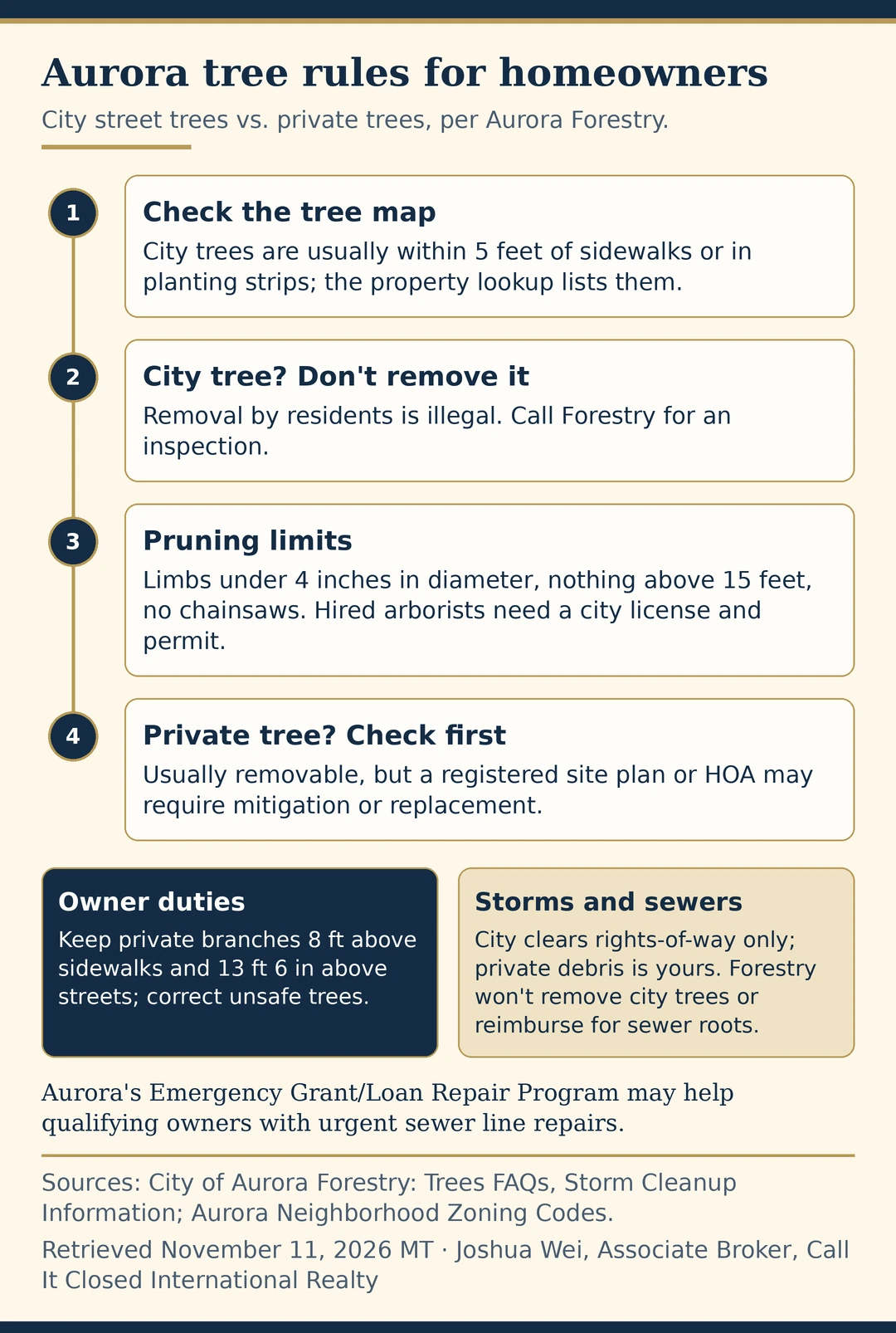
A vertical flow diagram, cream background with navy type and gold accents, titled Aurora tree rules for homeowners. Subtitle: City street trees vs. private trees, per Aurora Forestry. 4 numbered steps: 1, Check the tree map: City trees are usually within 5 feet of sidewalks or in planting strips; the property lookup lists them; 2, City tree? Don't remove it: Removal by residents is illegal. Call Forestry for an inspection; 3, Pruning limits: Limbs under 4 inches in diameter, nothing above 15 feet, no chainsaws. Hired arborists need a city license and permit; 4, Private tree? Check first: Usually removable, but a registered site plan or HOA may require mitigation or replacement. Two cards: Owner duties: Keep private branches 8 ft above sidewalks and 13 ft 6 in above streets; correct unsafe trees; and Storms and sewers: City clears rights-of-way only; private debris is yours. Forestry won't remove city trees or reimburse for sewer roots. A note says: Aurora's Emergency Grant/Loan Repair Program may help qualifying owners with urgent sewer line repairs. Sources: City of Aurora Forestry: Trees FAQs, Storm Cleanup Information; Aurora Neighborhood Zoning Codes. Retrieved November 11, 2026 MT. Joshua Wei, Associate Broker, Call It Closed International Realty.
Sources: Aurora Trees FAQs (opens in a new tab)
Cream background, navy text, gold rules. Numbered navy circles on a gold spine with white step cards, two branch cards (navy and tan), a note, and a source footer.
The figure above shows the rules for city trees, private trees, clearance, and storm cleanup.
How do I know if a tree is a city tree?
The FAQs say to check the city tree map or the Property Information page. When you enter your address there, any city trees in the inventory are listed under My Property. They also say the Forestry Division cares for "nearly 35,000 city street trees as a free service to residents." The FAQs add: "If you find a possible error in our inventory, please let us know."
The city's pruning guide, Aurora's Guide to Proper Tree Pruning (opens in a new tab), adds two clues. City-owned street trees "are deciduous (leaf-dropping), planted in front of single-family detached homes," and "City trees are never planted in backyards." An evergreen in the front yard or any tree in the backyard isn't a city street tree under that description.
The city also plants them. The FAQs say "we plant trees for free!" in the right-of-way easement. Planting there yourself needs permission. Aurora City Code section 142-30 (opens in a new tab) says "No trees or shrubs shall be planted in or removed from any street, residential public right-of-way or other public place in the city without written permission from the director of parks and open space."
How wide is the right-of-way?
Aurora's neighborhood zoning codes page (opens in a new tab) gives two descriptions. In one place it says "The city right of way ranges from seven feet to 11 feet from the flow line (street gutter)." In another it says "Generally, right of way along highways and streets extends towards the property approximately 10 feet from the curb, flow line, or gutter." A survey or the city's tree map is more reliable than a tape measure from the curb.
Can I prune a city tree?
Only lightly. The FAQs say "Residents may only prune limbs that are smaller than 4 inches in diameter and nothing above 15 feet," and "residents are not allowed to use chainsaws to prune city trees."
The code is broad. Under section 142-33(a) (opens in a new tab), it's unlawful for anyone other than the director of parks and open space or an agent "to cut, trim, prune, spray, brace, plant, move or replace any tree in any public street or other public place within the City or to cause such to be done, unless and until written permit to do so shall have first been obtained from the director." The FAQs describe the resident allowance as "Limited maintenance," and add that "it is still illegal to damage, kill or remove a city-owned tree, whether intentionally or accidentally."
You can hire help, but only licensed help: "Only arborists licensed in the city of Aurora may work on city trees and a permit must be obtained from the Forestry Division prior to beginning work."
The pruning guide also says hiring is "at your own expense. You will not be reimbursed."
When the city prunes
The FAQs say to check the Grid Pruning Map "To see when our crew will be in your neighborhood for scheduled maintenance." Earlier work happens only in narrow cases: "Tree maintenance will only be provided ahead of schedule if a tree poses a significant risk to public safety."
Pruning tips from the city's guide
The guide's decision rule on branch size: "Under 2 inches diameter – go ahead," "Between 2" and 4" – think twice," and "Greater than 4" – have a good reason and seek professional assistance." On timing: "Spring- NO; trees are using all of their resources to leaf out," "Summer & Fall- OK," and "Winter- BEST time to prune; trees are dormant." On safety: "Never prune trees that are touching or near utility lines; call the Forestry Division 303-739-7177 for assistance with these trees."
What if a city tree needs to come out?
Call for an inspection. The FAQs say "Only trees that are dead, in very poor condition or health, or pose a risk to public safety will be removed."
What it costs to damage one
The penalty can be the tree's value. Under section 142-33(b), if a tree on city property or in a city right-of-way "is unlawfully removed, damaged, or otherwise destroyed by any person, that person shall be liable to the city for the appraised value of the tree or shrub based upon International Society of Arboriculture Appraisal Standards."
Protecting city trees during a project
Section 142-36 (opens in a new tab) lists things that are violations near public trees. They include:
- Fastening "any sign, card, poster, wire, rope or other material to or around or through any public tree" without a written permit.
- Storing "any stone, brick, sand, concrete or other materials which may impede the free passage of water, air and fertilizer to the roots."
- Letting "any toxic chemical to seep, drain or be emptied on or about any public tree or shrub."
- Excavating "any ditches, tunnels or trenches or lay any drive within a radius of ten feet from any public tree or shrub without first obtaining permission from the director of parks and open space."
It adds: "During building operations, the builder shall erect suitable protective barriers around public trees or shrubs apt to be injured." A buyer planning a new driveway, sewer line replacement, or fence near a street tree should call Forestry first.
Can I remove a tree in my own yard?
Usually. But "some properties may have a site plan registered with the city that outlines approved landscaping. When a site plan is associated with your property, there may be policies for tree mitigation or replacement if trees are removed." Check HOA rules too.
The FAQs say the city "does not offer any assistance programs for private tree removal or pruning." They suggest "getting at least three different quotes from licensed arborists."
The owner's duties for private trees
Section 142-74 (opens in a new tab) sets the duties. Every owner or occupant must keep trees "trimmed to a clear height of 13 feet six inches above the surface of any public street, alley or highway, and eight feet above any public sidewalk." They must "correct or remove any tree upon such lot or open area, the roots of which interfere with any public sidewalk or city-owned utility facility," and "correct or remove any unsafe tree." The section ends: "All city-installed trees on the City's right-of-way shall be maintained by the City."
If a tree violates section 142-74, section 142-78 (opens in a new tab) lets the city send a notice giving "seven days from the transmission of such notice to bring such lot or open area into compliance."
If the city has to do the work, section 142-81 (opens in a new tab) covers the bill. The owner is notified of the cost, and "administrative fees shall also be assessed." Unpaid costs after 30 days "shall become a lien against such lot or open area," certified to the county treasurer "plus 15 percent." The lien "shall be a first lien upon the subject property and shall be superior to all other liens or claims against such property of whatever kind or nature regardless of date, except any lien for general property taxes or special improvement district assessments." For tree removal, the city may offer an extended payment plan, but "any schedule for the payment of such costs and fees shall not exceed two years."
A buyer's title work may show a lien like this, so it's worth asking the title company to check for city assessments.
Diseased trees
Under section 142-35 (opens in a new tab), the director "may inspect all trees, shrubs and logs upon any property within the city limits." If plant material is "infested with any serious disease or insects detrimental to the growth, health and life of such plants or adjoining plants," the director notifies the owner and directs them "to eradicate, remove and destroy these plant materials." If the owner doesn't, the cost is "assessed to such owner, agent or occupant."
What about a neighbor's tree?
"Residents are allowed to trim back branches that overhang their property line, but you may be held responsible for killing or damaging a neighbor's tree if done improperly."
The FAQs add: "If you feel that a neighbor's private tree is dead or poses a safety hazard, please contact Code Enforcement at 303.739.7000."
Who cleans up after a storm?
The city's storm cleanup page (opens in a new tab) says "The city will clear public rights-of-way, including streets and sidewalks, to ensure safety." Private debris is the owner's job: "The city does not pick up private materials, including tree limbs or brush from private property."
The page adds three more points:
- "If a tree on your property, that is not owned by the city, is removed from the public right-of-way, you are still responsible for cleaning up and disposing of the tree debris."
- "The city does not provide public dump sites for storm debris. Please do not place tree debris on city streets or sidewalks."
- "We do not separate private debris from city-owned debris. If private debris is mixed with city-owned debris, the city will not remove it."
To report damage to trees on public rights-of-way, the page says to submit a report online or "call the Forestry division at 303.739.7177," and notes "the form is only active during storms."
What about roots in the sewer line?
The FAQs say "the Forestry Division will not remove city trees for this issue, nor will we reimburse for any expenses related to sewer lines." They explain why: "While tree roots cannot break your line on their own, they can take advantage of any existing breaks." They also point to the city's Emergency Grant/Loan Repair Program, which "offers financial assistance for urgent sewer line repairs to homeowners who meet its qualifications."
Roots and concrete
The FAQs split this by who owns the concrete. "If a city sidewalk is being lifted, please call 303.326.8200 for repair. If city tree roots are lifting your driveway or private walkway, please contact the Forestry Division to determine if root removal is possible." And: "the city is not responsible for either repairing or replacing concrete on private property."
Two hypotheticals
These are invented, to show how the rules apply.
A buyer who wants a wider driveway. The house has a city ash tree in the planting strip, eight feet from where the new driveway edge would go. Section 142-36 bars laying "any drive within a radius of ten feet from any public tree or shrub without first obtaining permission." The buyer needs Forestry's permission before the concrete work. If the tree is damaged anyway, section 142-33(b) makes the person responsible liable for its appraised value.
A seller's backyard cottonwood. At inspection, an arborist flags a large private cottonwood as unsafe. Under section 142-74(c), the owner must "correct or remove any unsafe tree." If the city sends a notice, there are seven days to comply. If the city removes it and the bill isn't paid within 30 days, it becomes a first lien. A buyer can negotiate removal before closing.
A buyer's tree checklist in Aurora
- Look up the address on the city tree map or Property Information page.
- Note any trees within about five feet of the sidewalk or in the planting strip.
- Ask the seller whether the city has sent any tree notices.
- Ask whether a site plan registered with the city covers the landscaping.
- Read HOA rules on tree removal and replacement.
- Have the sewer line scoped if large trees are near it.
- Plan any driveway or trenching work at least ten feet from a city tree, or get Forestry's permission.
Frequently asked questions
Can I cut down the tree between the sidewalk and street in Aurora?
If it's a city tree, no. Call Forestry for an inspection.
Can I trim it myself?
Limbs under 4 inches in diameter, nothing above 15 feet, and no chainsaws.
Do I need a permit to remove a tree in my backyard?
Usually not from Forestry, but check any registered site plan and your HOA.
How high must branches be over a sidewalk?
At least 8 feet over sidewalks and 13 feet six inches over streets and alleys.
Will the city pay if a city tree's roots damage my sewer line?
The FAQs say Forestry won't reimburse sewer line expenses.
Can I hang lights or a sign on the street tree?
Not without a permit. Section 142-36(1) bars fastening "any sign, card, poster, wire, rope or other material" to a public tree "without a written permit of the director of parks and open space, except in emergencies such as storms or accidents."
Can I plant my own tree in the planting strip?
Only with written permission from the director under section 142-30. The city also plants free trees there on request.
Who do I call about a neighbor's dead tree?
The FAQs say to contact Code Enforcement at 303.739.7000 if a neighbor's private tree "is dead or poses a safety hazard."
When is the best time to prune?
The city's guide says winter is the "BEST time to prune; trees are dormant," and spring is "NO."
Can the city put a lien on my house for tree work?
Yes. Under section 142-81, unpaid costs for city removal of an offending tree become a first lien after 30 days, certified to the county treasurer plus 15 percent.
Will the city haul away storm debris from my yard?
No. The city clears public rights-of-way but doesn't collect private material.
Related notes
- Who owns the tree by the curb? Denver street trees, owner duties, permits, and forestry liens for homebuyers
- Buying in a Denver historic district? Landmark review, past unpermitted work, and demolition checks, explained
- Checking permit history before you buy in Denver or Aurora: where to look and what unpermitted work can mean
Sources and method
Official sources, retrieved November 11 and 13, 2026, America/Denver:
- City of Aurora, Trees FAQs (opens in a new tab)
- City of Aurora, Storm Cleanup Information and Tree Care Responsibilities (opens in a new tab)
- City of Aurora, Neighborhood Zoning Codes (opens in a new tab)
- City of Aurora Forestry, Aurora's Guide to Proper Tree Pruning (opens in a new tab)
- Aurora City Code section 142-30 (opens in a new tab), section 142-33 (opens in a new tab), section 142-35 (opens in a new tab), section 142-36 (opens in a new tab), section 142-74 (opens in a new tab), section 142-78 (opens in a new tab), and section 142-81 (opens in a new tab). The Aurora code site blocks automated requests, so these were read through a web fetch on November 13, 2026.
Aurora's arborist licensing code, section 26-526 and following, wasn't reviewed. Denver has different rules. The hypotheticals are invented.
This note is general education from a Colorado real estate broker with Call It Closed International Realty. For a specific tree, call Aurora Forestry or a licensed arborist.
Disclaimer
This article is general information only. It is not legal, tax, lending, insurance, appraisal, inspection, or financial advice, and it is not a substitute for advice about your situation. Joshua Wei is a Colorado real estate broker, not an attorney. Reading this article does not create a client relationship, an agency relationship, or an attorney-client relationship with Joshua Wei or with Call It Closed International Realty.
Laws, program rules, interest rates, insurance terms, tax figures, and other details change. Examples in this article are hypothetical illustrations unless a source is named for a specific, dated figure. Information in this article is believed accurate as of November 13, 2026 and is not guaranteed. No result is promised, and you should not rely on this article as the last word for your situation.
Before you act, confirm the point with the official source linked or cited in this article, and talk with a licensed professional who can apply the rule to your facts. That may be a licensed attorney, a tax professional, a lender, an insurance agent, a home inspector, or another licensed professional, depending on the question. Links to third-party websites and publications are provided for reference only. They are not an endorsement, and their content can change.
If you already have a brokerage relationship with another broker, this is not a solicitation.
Joshua Wei, Associate Broker, Call It Closed International Realty, Colorado license FA.100108558. Equal Housing Opportunity.