October 23, 2026 · Denver · Buying · Selling · Renovation
Buying in a Denver historic district? Landmark review, past unpermitted work, and demolition checks, explained
Denver Landmark Preservation reviews exterior work at landmarks and in historic districts, and a buyer can be cited for a previous owner's unapproved work. What Denver's official pages say about design review, violations, and demolition review, and what to check before you buy.
The short answer
In brief: If a Denver home is an individual landmark or sits in a historic district, Denver Landmark Preservation must review any exterior change that requires a building or zoning permit. For buyers, that means checking the property's landmark status, any past exterior work done without review, and demolition rules before planning changes to the house.
If a Denver home is an individual landmark or sits in a historic district, exterior changes that need a permit also need Landmark Preservation review.
Denver's Landmark Inspections and Enforcement page (opens in a new tab) says: "If your property is an individual landmark or located within a historic district, Denver Landmark Preservation must review any changes to the exterior of the property that requires a building or zoning permit."
For buyers, the key line is this: "If you purchased a property and work was done previously without Landmark approvals or building and/or zoning permits, you may also be issued a violation. There is no statute of limitations."
I am a licensed Colorado real estate broker with Call It Closed International Realty. I am not an attorney or preservation consultant. This is not legal or tax advice.
Disclaimer. This article is general information only. It is not legal, tax, lending, insurance, appraisal, inspection, or financial advice, and reading it does not create a client, agency, or attorney-client relationship. Laws, rates, programs, and figures change. Confirm the official source, and talk with a licensed attorney, tax professional, lender, insurance agent, or inspector before you act. Joshua Wei is a Colorado real estate broker, not an attorney. He is an Associate Broker with Call It Closed International Realty, license FA.100108558. Equal Housing Opportunity.
 Full size (opens in a new tab)
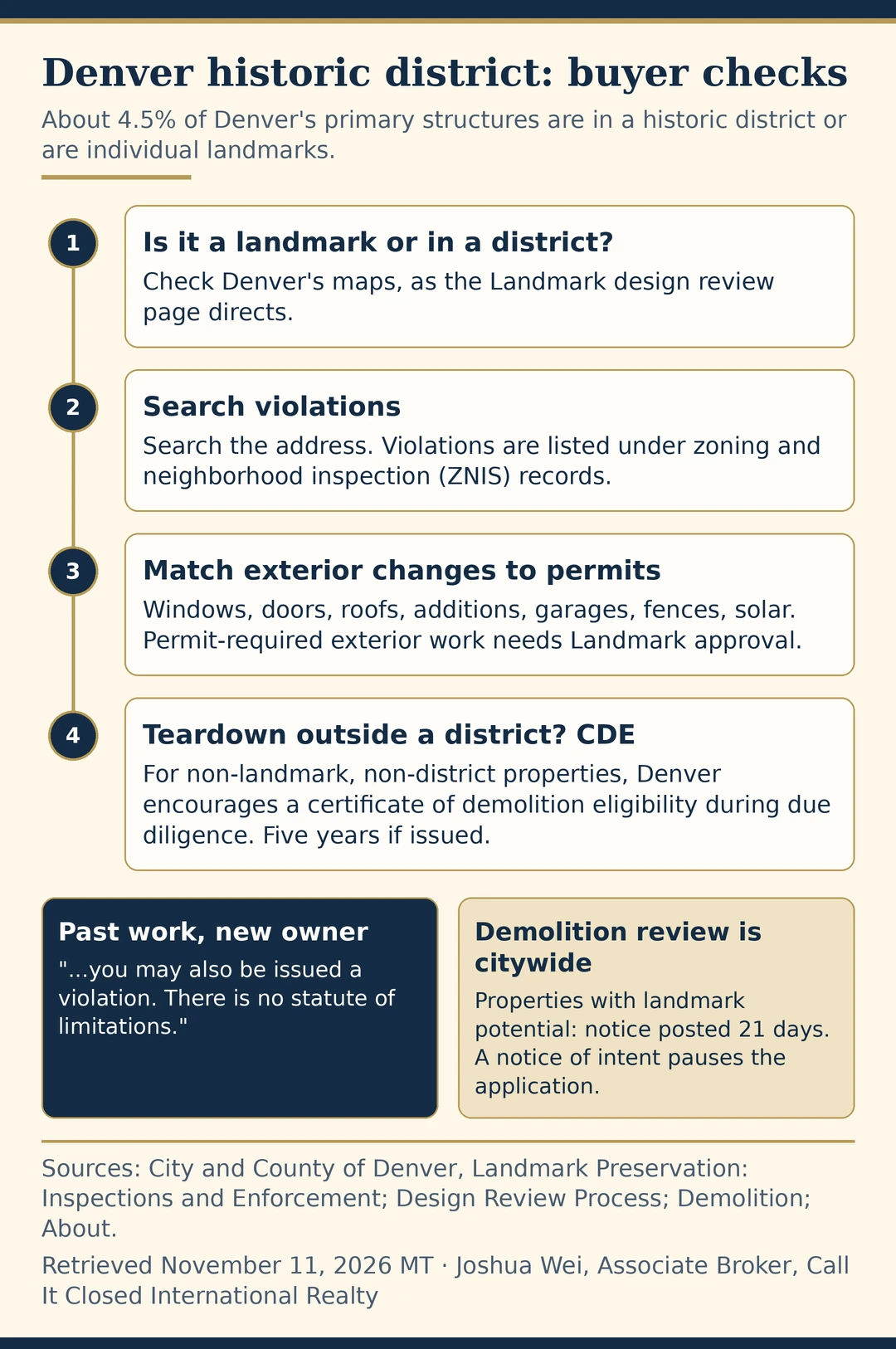
A vertical flow diagram, cream background with navy type and gold accents, titled Denver historic district: buyer checks, with the subtitle about 4.5 percent of Denver's primary structures are in a historic district or are individual landmarks. Four numbered steps: 1, is it a landmark or in a district, check Denver's maps as the Landmark design review page directs; 2, search violations, search the address, and violations are listed under zoning and neighborhood inspection ZNIS records; 3, match exterior changes to permits, such as windows, doors, roofs, additions, garages, fences, and solar, because permit-required exterior work needs Landmark approval; 4, teardown outside a district, consider a CDE, because for non-landmark, non-district properties Denver encourages a certificate of demolition eligibility during due diligence, good for five years if issued. Two lower cards: past work, new owner, quoting you may also be issued a violation, there is no statute of limitations; and demolition review is citywide, where properties with landmark potential have notice posted 21 days and a notice of intent pauses the application. Sources: City and County of Denver Landmark Preservation. Retrieved November 11, 2026 MT.
Sources: Landmark Inspections and Enforcement (opens in a new tab); Demolition review (opens in a new tab)
Cream background, navy text, gold rules. Four numbered steps on a gold spine, two side-by-side cards, and a 28px source footer.
The diagram above summarizes the Landmark Preservation checks a Denver buyer can make, drawn from the City and County of Denver's pages.
What share of Denver properties are historic?
Denver Landmark Preservation's About page (opens in a new tab) says: "About 4.5% of primary structures in Denver are in a historic district or an individual landmark, which is comparable to other cities of similar size."
The same page lists two more counts: "There are 60 historic districts in Denver." and "There are 371 individual landmarks in Denver." It says "The Landmark Preservation ordinance is found in Chapter 30 of the Denver Revised Municipal Code."
The program dates to 1967. The page quotes the City Council: "It is the sense of the council that the economic, cultural and aesthetic standing of this city cannot be maintained or enhanced by disregarding the historical, architectural and geographic heritage of the city and by ignoring the destruction or defacement of such cultural assets."
Who does the reviewing?
The design review page names three reviewers: "Landmark Preservation staff, the Landmark Preservation Commission (LPC) and the Lower Downtown Design Review Commission (LDDRC)." It explains the purpose: "Design review ensures that proposed alterations preserve the key character-defining features and historic qualities of each property."
The About page describes the workload: "In 2025, Landmark Preservation reviewed over 1800 design review applications, 414 demolition review applications, and 36 tax credit applications, which amounted to almost $550,000 in tax credits to owners of non-income producing properties."
What kinds of work need Landmark review?
The design review process page (opens in a new tab) says staff and commissions "review the design of all exterior projects that require building or zoning permits at individual landmark properties and properties in historic districts. Landmark Preservation also reviews all curb cuts and encroachment permit applications for these properties."
It lists project types with their own requirements, including ADUs, additions, basement egress windows, fences and site work, garages, roofs, solar panels, and window and door replacements.
The enforcement page adds: "Landmark must approve the removal, replacement or infill of exterior doors and windows."
Once a project is approved, staff "will issue a Certificate of Appropriateness (COA) and will provide instructions for submitting permit applications."
The enforcement page also says: "Landmark review is also required for right-of-way encroachment permits and curb cut permits." The design review page adds "Electrical and Mechanical Permits" and "Zone Lot Amendments" to the list of project types, with links to the requirements for each. It links to the Landmark Design Guidelines, the LPC Design Review Rules and Regulations, and both a "Landmark Quick Review Application and Checklist" and a "Landmark Design Review Application and Checklist."
Windows and doors
Denver has a Window and Door Replacement (opens in a new tab) page. It says: "The Landmark Preservation Commission and the Lower Downtown Design Review Commission strongly encourage the retention of historic character windows and character front facade doors." It adds: "The replacement of common windows and doors may be an administrative review if the proposed windows and doors meet the design guidelines."
The page lists what "are not allowed for window or door replacement in historic districts or on individual landmark properties":
- "Vinyl windows and doors, except in the La Alma Lincoln Park Historic Cultural District"
- "Windows and doors with only internal muntins between panes of glass"
- "Windows and doors with glued-on muntins"
It describes "Character windows" as including "Windows with arched, round, or bowed glazing or sashes" and "Windows with glazing that is etched, colored, textured, leaded, or stained." "Common windows may include: One-over-one sash configurations" and "Sash with rectangular glazing."
If a listing shows vinyl replacement windows in a historic district, that is a question to raise with Landmark staff and in your permit search.
Quick review
Some smaller jobs use the Landmark Quick Review Application (opens in a new tab). It lists items such as "Roofing (same material as existing only)," "Replacing existing fencing or adding new fencing," "HVAC replacement or new installation," and "Installing 1-2 new flat-profile skylights on a side or rear roof." The form says: "All applications must include" the signed form and checklist, "A photo of the building from the street(s)," and "Photos of the side(s) of the building where the work is proposed."
What happens at inspection?
The enforcement page sets inspection rules after a permit is issued:
- "Any exterior changes made after you obtained a permit must be resubmitted to Landmark for review and approval."
- "Changes made without Landmark approval will cause your inspection to be denied."
- "All construction projects at individual landmark sites and at properties in historic district are required to schedule a pre-construction meeting with an inspector."
- "Inspections will be completed within 2 business days of request. Inspections cannot be scheduled for permits that are still under review."
Choosing a contractor
Denver says: "It is important to hire a contractor with demonstrated experience working on historic properties." It suggests: "When vetting a contractor, ask for references and examples of work they have done on historic building materials and features similar to those found on your property." It also says: "A licensed contractor is required for all building and zoning permits."
What if the previous owner skipped approval?
Denver puts responsibility on the owner: "It is the owner's responsibility to ensure their contractor is licensed and has obtained all necessary Landmark approvals, as well as building and/or zoning permits."
If exterior work that needs a permit is done without Landmark approval or permits, Denver says "you may be issued a violation, which may lead to fines. You may be required to make substantial revisions to the completed work to comply with Landmark requirements, the Denver Zoning Code and the Denver Building Code."
That applies to buyers too, with "no statute of limitations." Before you buy, check:
- Violations. Denver says: "You can check whether a property has an open violation or had a previous violation by searching the address in" its permit system. "Violations will be listed under zoning and neighborhood inspection (ZNIS) records."
- Permits. Compare visible exterior changes, like windows, additions, and garages, with permit records.
- Disclosures. Read the seller's property disclosure. It's not a substitute for checking the city's records.
Denver also explains how to check work against permits: "First, check whether a property has open permits for the scope of work by searching the address in Denver E-permits ." If there is no permit, or "if the construction work differs from the permitted scope of work, you may report violations by calling 311 or by reporting it online."
If something turns up, it can become part of the negotiation. My post on Denver home prices and seller concessions (opens in a new tab) covers how concessions show up in the market.
Planning to tear down or rebuild?
Demolition review isn't limited to historic districts. The Demolition page (opens in a new tab) says: "Landmark Preservation staff review all applications for total demolition permits and for certificates of demolition eligibility (CDEs) citywide, including for structures that are not local landmarks or that are not in historic districts."
For properties with landmark potential, "notice of the demolition/CDE application is posted for 21 days." If someone files a notice of intent to seek designation, "the demolition application is paused."
For properties outside landmarks and districts, the page describes an option for buyers: "Owners of non-landmark, non-historic-district properties who are not currently planning demolition but who want increased certainty about a potential future demolition may apply for a certificate of demolition eligibility (CDE)." It adds: "If you are in the due-diligence or entitlement planning process, we encourage you to apply for a CDE." If a CDE is issued, an owner "may proceed with a demolition application without further review to the structure's potential for designation for a period of five years."
The page describes what happens after a notice of intent: "A facilitated stakeholder meeting must be held to discuss any potential options that do not entail demolition or designation of the property." It warns: "If a review reveals that a property may qualify for historic designation, total demolition may not be allowed." And for properties without that potential: "Properties that do not have potential to be an individual landmark are approved for demolition or granted the CDE."
The Demolition page lists currently posted properties, with dates for each posting period. Checking that list is one way to see how a posting plays out in practice.
What does the state tax credit statute say?
The state credit is in Colorado Revised Statutes section 39-22-514.5 (opens in a new tab). This section quotes it; whether a project qualifies is a question for a tax advisor and the reviewing entity.
- Which homes. A "Qualified residential structure" means "a nonincome producing and owner-occupied residential property located in Colorado that is: (I) At least thirty years old," and listed on the state register or "Listed individually by, or as a contributing property that is included within a designated historic district of, a certified local government."
- Minimum project. For a qualified residential structure, "Substantial rehabilitation" means "rehabilitation for which the qualified rehabilitation expenditures exceed five thousand dollars."
- Credit amount. After completion and review, "the reviewing entity shall issue a tax credit certificate in an amount equal to twenty percent of the actual qualified rehabilitation expenditures," subject to stated exceptions and caps. For tax years commencing on or after January 1, 2025, the certificate "shall not exceed one hundred thousand dollars for each qualified residential structure," calculated "over a ten-year rolling period that commences with each change in ownership of the qualified residential structure."
- Which work. For residential structures, "exterior improvements" is limited to items including "Roof replacement or repair; exterior siding replacement or repair; masonry repair, repointing, or replacement; window repair or replacement; door repair or replacement."
- Time frame. The credit is allowed "For income tax years commencing on or after January 1, 2016, but prior to January 1, 2037."
The rolling period starts with each change in ownership, so a buyer should ask a tax advisor how a seller's past credits affect a new owner's cap.
An invented example
This example is invented; it is not a real property.
A buyer is under contract on a 1910s brick house in a Denver historic district. The listing says the windows were replaced a few years ago.
- The buyer checks the city's map to confirm the district.
- In Denver E-permits, the buyer searches the address and finds no window permit and no ZNIS record.
- Because Denver says a buyer "may also be issued a violation" with "no statute of limitations," the buyer asks the seller for records and asks Landmark staff what a window replacement there would have required.
- The buyer weighs the answer during the inspection period and talks with an attorney about contract options.
What any real finding means depends on the facts; ask Landmark staff and an attorney.
Buyer checklist for a historic Denver home
- Confirm landmark or district status on the city's map.
- Search the address in Denver E-permits, including ZNIS records.
- Compare exterior changes, especially windows, doors, roofs, and additions, with permits.
- Read the Landmark Design Guidelines before planning exterior work.
- If you plan to demolish, review the Demolition page and consider a CDE during due diligence.
- Ask a tax advisor about the state credit before starting work.
Frequently asked questions
How do I find out if a property is in a historic district?
The design review page points owners to Denver's maps to check whether a property "is in a historic district or is an individual landmark."
Does interior work need Landmark review?
Denver's pages describe review of exterior work that needs a building or zoning permit. Interior-only work isn't described as subject to Landmark review. Confirm with Landmark staff for your project.
Are there tax credits?
Denver's Resources for Property Owners page (opens in a new tab) mentions a State Historic Preservation Tax Credit Program "available to property owners of both income-producing and non-income-producing properties," with "strict eligibility requirements and timelines." It also says: "Federal historic preservation tax credits are not available for owner-occupied residential properties." Ask a tax advisor about eligibility.
Does a landmark home need a pre-construction meeting?
Denver says projects at individual landmark sites and in historic districts "are required to schedule a pre-construction meeting with an inspector."
How long does a demolition posting last?
For properties with landmark potential, Denver says "notice of the demolition/CDE application is posted for 21 days."
Can I install vinyl windows in a historic district?
Denver's window page lists "Vinyl windows and doors, except in the La Alma Lincoln Park Historic Cultural District" among replacements that are not allowed in historic districts or on individual landmarks.
How long does a certificate of demolition eligibility last?
Denver says that if a CDE is issued, an owner may proceed with a demolition application without further designation review "for a period of five years."
Does the state tax credit apply to rental properties?
The statute's residential credit covers a "nonincome producing and owner-occupied residential property." Ask a tax advisor about your situation.
Can Landmark recommend a contractor?
No. Denver says: "Denver Landmark Preservation cannot recommend contractors who can complete your project."
Do inspections apply after approval?
Yes. A "Landmark and Zoning inspector will verify that the construction work is completed and matches the building permit and/or zoning permit drawings."
Does this apply in Aurora?
This article covers only the City and County of Denver's Landmark Preservation program. If you're buying in Aurora, check with the City of Aurora.
Related notes
- Checking permit history before you buy in Denver or Aurora: where to look and what unpermitted work can mean
- Who owns the tree by the curb? Denver street trees, owner duties, permits, and forestry liens for homebuyers
- ADUs in Denver and Aurora: what Colorado's 2024 law, Denver's permit rules, and Aurora's pending update say
Sources and method
Official sources, retrieved November 11, 2026, America/Denver (City and County of Denver, Community Planning and Development, Landmark Preservation):
- Landmark Inspections and Enforcement (opens in a new tab)
- Landmark Preservation Design Review Process (opens in a new tab)
- Demolition (opens in a new tab)
- Resources for Property Owners (opens in a new tab)
- About Landmark Preservation (opens in a new tab)
- Added November 13, 2026: further passages of the five Denver pages above; Denver Landmark Preservation Window and Door Replacement (opens in a new tab) and the Landmark Quick Review Application (opens in a new tab) (revised April 24, 2026); and Colorado Revised Statutes section 39-22-514.5 (opens in a new tab) (2026 Colorado Revised Statutes, Title 39)
Quotations are verbatim.
This note is general education from a Colorado real estate broker with Call It Closed International Realty. If you're considering an older Denver home, I can help you build a records check into your due diligence.
Disclaimer
This article is general information only. It is not legal, tax, lending, insurance, appraisal, inspection, or financial advice, and it is not a substitute for advice about your situation. Joshua Wei is a Colorado real estate broker, not an attorney. Reading this article does not create a client relationship, an agency relationship, or an attorney-client relationship with Joshua Wei or with Call It Closed International Realty.
Laws, program rules, interest rates, insurance terms, tax figures, and other details change. Examples in this article are hypothetical illustrations unless a source is named for a specific, dated figure. Information in this article is believed accurate as of November 13, 2026 and is not guaranteed. No result is promised, and you should not rely on this article as the last word for your situation.
Before you act, confirm the point with the official source linked or cited in this article, and talk with a licensed professional who can apply the rule to your facts. That may be a licensed attorney, a tax professional, a lender, an insurance agent, a home inspector, or another licensed professional, depending on the question. Links to third-party websites and publications are provided for reference only. They are not an endorsement, and their content can change.
If you already have a brokerage relationship with another broker, this is not a solicitation.
Joshua Wei, Associate Broker, Call It Closed International Realty, Colorado license FA.100108558. Equal Housing Opportunity.