November 10, 2026 · Denver · Aurora · Buying · Inspections · Permits
Checking permit history before you buy in Denver or Aurora: where to look and what unpermitted work can mean
How to look up a home's permit history in Denver and Aurora, what Denver says does and doesn't need a permit, how Denver treats permits for work already done without one, the owner-occupant permit rules behind some flips, and the disclosure question sellers answer.
The short answer
In brief: Denver and Aurora both publish permit records that can show whether work such as a finished basement, an addition, a new furnace or a re-roof was permitted. In Denver, buyers search the city's e-permits system; in Aurora, the city's property information map shows permits by address. This guide covers where to look and what unpermitted work can mean.
Denver and Aurora both offer public permit records, which can show whether work such as a finished basement, an addition, a new furnace or a re-roof was permitted.
- Denver: the city's e-permits system.
- Aurora: the city's records page points to its property information map for "Information about your property, permits, neighborhood, government and upcoming events in your area by entering an address in the Aurora city limits."
For work done without a permit, Denver's 2025 Building Code says a later permit for that work is reviewed "as an application for new construction" and must "comply with the current Code."
I am a licensed Colorado real estate broker with Call It Closed International Realty. I am not an attorney, a building official or a home inspector.
Disclaimer. This article is general information only. It is not legal, tax, lending, insurance, appraisal, inspection, or financial advice, and reading it does not create a client, agency, or attorney-client relationship. Laws, rates, programs, and figures change. Confirm the official source, and talk with a licensed attorney, tax professional, lender, insurance agent, or inspector before you act. Joshua Wei is a Colorado real estate broker, not an attorney. He is an Associate Broker with Call It Closed International Realty, license FA.100108558. Equal Housing Opportunity.
 Full size (opens in a new tab)
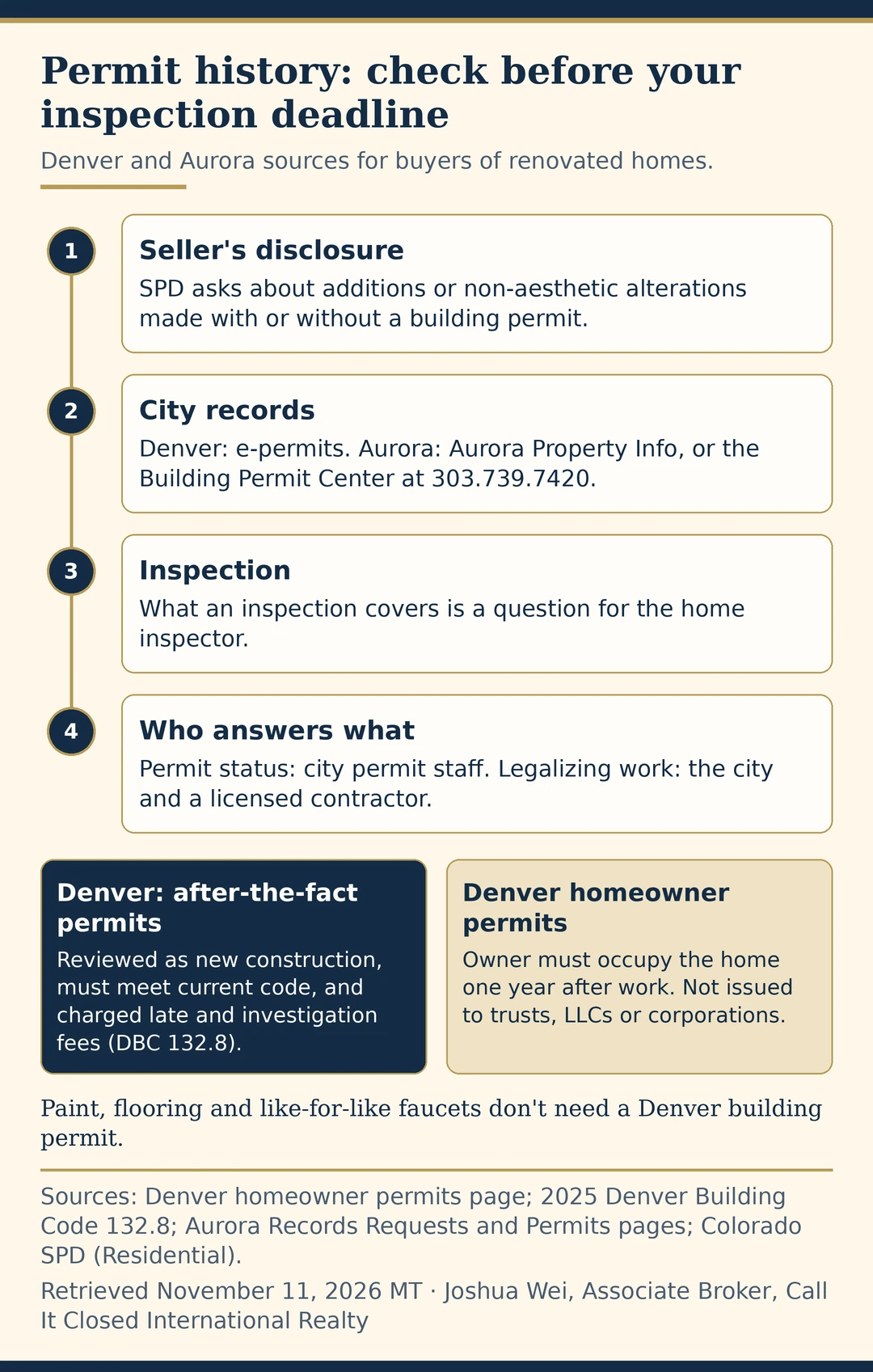
A vertical flow diagram, cream background with navy type and gold accents, titled Permit history: check before your inspection deadline. Subtitle: Denver and Aurora sources for buyers of renovated homes. 4 numbered steps: 1, Seller's disclosure: SPD asks about additions or non-aesthetic alterations made with or without a building permit; 2, City records: Denver: e-permits. Aurora: Aurora Property Info, or the Building Permit Center at 303.739.7420; 3, Inspection: What an inspection covers is a question for the home inspector; 4, Who answers what: Permit status: city permit staff. Legalizing work: the city and a licensed contractor. Two cards: Denver: after-the-fact permits: Reviewed as new construction, must meet current code, and charged late and investigation fees (DBC 132.8); and Denver homeowner permits: Owner must occupy the home one year after work. Not issued to trusts, LLCs or corporations. A note says: Paint, flooring and like-for-like faucets don't need a Denver building permit. Sources: Denver homeowner permits page; 2025 Denver Building Code 132.8; Aurora Records Requests and Permits pages; Colorado SPD (Residential). Retrieved November 11, 2026 MT. Joshua Wei, Associate Broker, Call It Closed International Realty.
Sources: Denver homeowner permits (opens in a new tab); Aurora Property Info (opens in a new tab)
Cream background, navy text, gold rules. Numbered navy circles on a gold spine with white step cards, two branch cards (navy and tan), a note, and a source footer.
The figure above sets out the sources covered here: the seller's disclosure, the city's permit records, the inspection, and the city rules on unpermitted work.
Where do I look up permits?
Denver. Denver's homeowner permits page (opens in a new tab) links to e-permits (opens in a new tab), the city's online permit system. Denver's permitting staff can answer questions about a property's records.
Aurora. Aurora's records requests page (opens in a new tab) links to Aurora Property Info (opens in a new tab). Aurora's permits page (opens in a new tab) says that for permit status, plan review or code questions, "you can reach the Building Permit Center staff at 303.739.7420."
Questions about incomplete search results go to each city's permit staff.
What work needs a permit in Denver?
Denver says: "Most home construction or repair projects on single-family and duplex structures require a permit." Its list of work that doesn't need a building permit includes:
- "Painting (interior and exterior), papering, tiling, floor coverings, refinishing wood floors, countertops, carpeting, cabinets, curtains, or drapes"
- "Replacing like-for-like plumbing fixtures, such as faucets and sinks"
- "General repairs that do not involve altering or changing the existing plumbing or electrical system"
The same list also includes "Drywall, if patching or replacing one sheet no larger than 4 feet by 8 feet" and "Installing entertainment centers and bookcases, provided that no new electrical outlets are involved."
It adds: "A wastewater, zoning, or fire permit may be required even if a building permit is not."
Whether a specific project needed a permit is a question for the city.
What work needs a permit in Aurora?
Aurora's DIY and Do It Right home improvement handbook (opens in a new tab) says: "Permits are generally required for the following:"
- "New buildings (sheds, detached garages, etc.)"
- "Major home additions (bedrooms, bathrooms, family rooms, etc.)"
- "Residential work such as decks, garages, fireplaces, pools, water heaters, etc."
- "Major renovations (garage, basement finishes, kitchen expansions, re-roofing)"
- "Electrical system changes or repairs," "Plumbing system changes or repairs," and "HVAC (heating, ventilation and air-conditioning) changes or repairs"
On specific projects, the handbook says: "Roof replacement requires a building permit to ensure that the materials and installation meet the current building codes." For water heaters: "As a homeowner in Aurora, you may replace a water heater yourself. You will be responsible for making sure all work meets the building code and passes all inspections." For sheds: "A building permit is required to build sheds that are larger than 120 square feet in floor area." For a basement finish, it says code issues "include providing adequate egress from a living area and making sure there is enough heat and lighting."
The handbook adds: "Information in this handbook is subject to changes and updates. Contact the Building Division to verify all rules and requirements before proceeding with your project."
What Aurora says about selling with unpermitted work
The handbook speaks to sellers directly: "if and when you try to sell your house, the buyers' home inspection may uncover remodeling or additions that were not properly permitted and may not be completely up to city code. This may prevent a home sale, and may require that you redo the work-this time with a permit." It also says: "If you decide to sell a home or building that's been modified without a permit, you may be required to tear down an addition, leave a structure unoccupied or make repairs." And: "Property insurers may not cover work done without permits and inspections." How a specific insurer treats unpermitted work is a question for that insurer.
Aurora's online services are listed in the handbook: "Go to Aurora4Biz.org to renew contractor and supervisor licenses, schedule building inspections and review inspection results, submit plans for review and apply for a new permit."
Open, expired and closed permits in Aurora
When you read a permit record, its status matters. Aurora's handbook says: "Building permits are temporary documents, and the permit will expire if the work it covers does not begin within six months or is not completed within one year. Expired permits may be renewed or extended." It describes the last step this way: "When the construction is complete and code compliance is met, a code official will provide you with documentation that the permit has been closed."
It also says who is responsible: "Whether doing it yourself or using a contractor, the property owner or person hired to do the work is responsible for obtaining all necessary permits." For inspections: "The city requires on-site inspections to make sure the work conforms to the permit, city codes and plans."
For a buyer, an issued permit that was not closed is a question to raise with the seller and the Building Permit Center. Ask them whether final inspections were done and what closing out the permit would take. Ask for any closing documentation the seller has.
The handbook also tells homeowners: "Only hire an Aurora-licensed contractor. A listing of licensed contractors is available at AuroraGov.org/Building." Buyers can use the same lookup to check the contractor named on a past permit.
What happens to work done without a permit in Denver?
Section 132.8 of the 2025 Denver Building Code (opens in a new tab) says: "Permit applications for any construction that was done without a permit shall be submitted and reviewed as an application for new construction and shall be required to comply with the current Code." It requires the customary inspections. It also says those permits "shall be charged late fees and investigation fees per Section 138."
What the late and investigation fees are
Section 138.2 sets the late fee: "When work is started without a permit, the fees for permits on the work performed, shall be double those set forth by the building official for a standard permit, with a minimum of $100." Section 138.3 adds: "When any work has been commenced without first obtaining a permit, a special investigation shall be made before a permit may be issued for the work. An investigation fee equal to the amount of the late permit fee required by this code shall be assessed when work has begun without a permit." Neither payment exempts anyone "from compliance with all other provisions of this code."
There is one exception in 138.2, for emergency work "to maintain an existing service or equipment when the maintenance is necessary to protect health, life or safety." The late fees do not apply "if application for a permit is made within 3 normal working days after commencement of the emergency work."
Section 132.8 also says the application "must contain complete drawings, specifications, and surveys in accordance with Section 133."
What the code says about violations
Section 107.1 makes it "unlawful for any person, firm, or corporation to erect, construct, enlarge, reconstruct, alter, repair, move, improve, remove, convert, demolish, equip, occupy, inspect, or maintain any building, structure, or equipment, or cause or permit the same to be done, in the City and County of Denver, contrary to or in violation of any of the provisions of this code." What that means for a buyer who takes title to a home with earlier unpermitted work is a question for a Colorado real estate attorney.
What legalizing earlier work would involve for a specific home is a question for the city and a licensed contractor or engineer.
Why does the owner-occupant permit rule matter?
Denver lets homeowners pull their own permits for a single-family home. Its rules say "You must occupy the home for at least one year after work is complete," and "Permits cannot be issued to trusts, LLCs, or corporations." The city also warns homeowners to avoid "contractors who want you to secure permits in your name rather than the contractor’s name," because "The permit holder is legally responsible for the completion of the job to building code standards."
Denver's page lists other limits on homeowner permits: "A homeowner cannot obtain a permit for work in accessory dwelling units (ADUs), townhomes, condos, or duplexes, even for the unit where you live." It also says: "You will need to pass an exam before doing electrical, plumbing, or mechanical/HVAC work," and "No exam is needed for general construction or roofing/siding." For buyers, these limits explain why some work in a condo or duplex should show a contractor's permit rather than an owner's.
Denver's hiring tips include: "Don't make final payment until building inspections have been approved," and "Verify that your contractor has a current Denver contractor's license."
Whether a specific permit was finaled can be confirmed from the city's records.
What does the seller disclose?
The Commission's Seller's Property Disclosure (Residential), on the Division of Real Estate forms page (opens in a new tab), asks about "Any additions or non-aesthetic alterations made without a Building Permit," and separately about "Any additions or alterations made with a Building Permit." Both are in section L of the 2026 form (opens in a new tab), "USE, ZONING & LEGAL ISSUES," which asks about items "EVER EXISTING" and has a Comments column.
The same section asks about "Building code, city, or county violations," "Notice of any adverse conditions from any governmental or quasi-governmental agency that have not been resolved," and "Grandfathered conditions or uses." The form says it is "correct to Seller's CURRENT ACTUAL KNOWLEDGE."
How does this fit into the purchase contract?
The Commission's 2026 contract (opens in a new tab) gives the buyer an inspection right in section 10.3: "Unless otherwise provided in this Contract, Buyer, acting in good faith, has the right to have inspections (by one or more third parties, personally or both) of the Property, Leased Items, and Inclusions (Inspection), at Buyer's expense." If the physical condition is "unsatisfactory, in Buyer's sole subjective discretion," the buyer may terminate under section 10.3.1 or deliver "a written description of any unsatisfactory condition that Buyer requires Seller to correct" under section 10.3.2, by the deadlines in the contract. Checking permit records before the inspection objection deadline gives a buyer time to ask questions.
An invented example
This example is invented; the house and people are not real.
A buyer is under contract on a Denver bungalow with a finished basement bedroom and a new furnace. The seller's disclosure checks "Yes" for work "made with a Building Permit" and lists the furnace. The buyer's agent searches e-permits and finds a finaled mechanical permit for the furnace, but no permit for the basement finish. The buyer asks the seller about the basement in writing, and the inspector notes the basement window size for the buyer to ask the city about. The buyer calls Denver's permit staff, who explain that a permit for completed work is reviewed as new construction under section 132.8, with late and investigation fees under section 138. The buyer gets a contractor's estimate and uses the inspection objection deadline to decide whether to ask the seller to address it.
A buyer's checklist
- Read SPD section L for permitted and unpermitted work, violations, and grandfathered uses.
- Search the city records: e-permits in Denver, Aurora Property Info in Aurora.
- Match each listed project to a permit, and check whether the permit was finaled.
- Ask the seller in writing about any project with no permit.
- Ask the city's permit staff what legalizing work would involve.
- Get contractor estimates before the inspection objection deadline.
- Ask an attorney about contract terms for unpermitted work.
Frequently asked questions
Does Denver require a permit to replace a faucet?
Denver's list of work not needing a permit includes "Replacing like-for-like plumbing fixtures, such as faucets and sinks."
Can I legalize a basement finished without a permit in Denver?
Under Denver Building Code section 132.8, the permit is reviewed as new construction, must meet the current code, and carries late and investigation fees.
Can an LLC investor pull a Denver homeowner permit?
Denver says "Permits cannot be issued to trusts, LLCs, or corporations."
How do I check Aurora permits?
Aurora points to Aurora Property Info and the Building Permit Center at 303.739.7420.
Will my home inspector check permits?
What an inspection covers is a question for the home inspector. The city permit records are public.
What is the late fee for unpermitted work in Denver?
Under section 138.2, double the standard permit fee, "with a minimum of $100." Section 138.3 adds an investigation fee "equal to the amount of the late permit fee."
Does Aurora require a permit to replace a water heater?
Aurora's handbook lists water heaters among work that needs a permit and says a homeowner "may replace a water heater yourself."
Can a condo owner pull a Denver homeowner permit?
Denver says "A homeowner cannot obtain a permit for work in accessory dwelling units (ADUs), townhomes, condos, or duplexes, even for the unit where you live."
Do Aurora building permits expire?
Aurora's handbook says a permit "will expire if the work it covers does not begin within six months or is not completed within one year," and that "Expired permits may be renewed or extended."
Does unpermitted work have to be fixed before closing?
The sources here don't say. Contract questions are for a Colorado real estate attorney; legalizing questions are for the city and a licensed contractor.
Related notes
- Buying in a Denver historic district? Landmark review, past unpermitted work, and demolition checks, explained
- ADUs in Denver and Aurora: what Colorado's 2024 law, Denver's permit rules, and Aurora's pending update say
- Buying an older Denver or Aurora home to remodel? Colorado's asbestos inspection rules come first
Sources and method
Official sources, retrieved November 11, 2026, America/Denver:
- City and County of Denver, Applying for Permits as a Homeowner (opens in a new tab)
- City and County of Denver, e-permits (opens in a new tab)
- 2025 Denver Building Code (opens in a new tab), section 132.8
- City of Aurora, Records Requests (opens in a new tab) and Permits (opens in a new tab)
- Colorado Division of Real Estate, contracts and forms (opens in a new tab) (Seller's Property Disclosure, Residential)
Added November 13, 2026: further passages of Denver's homeowner permits page (opens in a new tab) (limits, exams, hiring tips); the 2025 Denver Building Code (opens in a new tab) sections 107.1, 132.8, 138.2 and 138.3; Aurora's DIY and Do It Right handbook (opens in a new tab); the Seller's Property Disclosure (2026) (opens in a new tab) section L; and CBS1 section 10.3 (2026 contract PDF (opens in a new tab)). The earlier note that the disclosure has blanks for building permit numbers was corrected: the 2026 form's permit-number blanks are for wells, and section L uses a Comments column.
Quotations are verbatim. Apart from Denver's $100 late-fee minimum, fee amounts aren't stated because they depend on the project. Ask the permit center for current figures.
This note is general education from a Colorado real estate broker with Call It Closed International Realty. If you're buying a renovated home in Denver or Aurora, I'll help you check permit records against the seller's disclosure before your inspection deadline.
Disclaimer
This article is general information only. It is not legal, tax, lending, insurance, appraisal, inspection, or financial advice, and it is not a substitute for advice about your situation. Joshua Wei is a Colorado real estate broker, not an attorney. Reading this article does not create a client relationship, an agency relationship, or an attorney-client relationship with Joshua Wei or with Call It Closed International Realty.
Laws, program rules, interest rates, insurance terms, tax figures, and other details change. Examples in this article are hypothetical illustrations unless a source is named for a specific, dated figure. Information in this article is believed accurate as of November 13, 2026 and is not guaranteed. No result is promised, and you should not rely on this article as the last word for your situation.
Before you act, confirm the point with the official source linked or cited in this article, and talk with a licensed professional who can apply the rule to your facts. That may be a licensed attorney, a tax professional, a lender, an insurance agent, a home inspector, or another licensed professional, depending on the question. Links to third-party websites and publications are provided for reference only. They are not an endorsement, and their content can change.
If you already have a brokerage relationship with another broker, this is not a solicitation.
Joshua Wei, Associate Broker, Call It Closed International Realty, Colorado license FA.100108558. Equal Housing Opportunity.