October 29, 2026 · Denver · Buying · Owning
Who owns the tree by the curb? Denver street trees, owner duties, permits, and forestry liens for homebuyers
In Denver, the adjacent property owner maintains the street trees in the public right-of-way. What Denver's Office of the City Forester says about clearance, removal permits, ash and elm trees, violation notices, and liens, and what buyers can check.
The short answer
In brief: In Denver, the adjacent property owner is responsible for the tree between the sidewalk and street, even though it stands in the public right-of-way. Denver's City Forester says city code requires owners to maintain trees on private property and in the adjacent public right-of-way. Removing a street tree requires a city permit, and tree care services must be licensed.
In Denver, the tree between the sidewalk and the street is the adjacent owner's job under city code, even though it stands in the public right-of-way.
Denver's Office of the City Forester, on its Property Owner Responsibilities page (opens in a new tab), says city code "requires owners to maintain trees on private property along with any trees located within the public right-of-way adjacent to their property."
You can't just cut one down. Denver's Street Tree Permits page (opens in a new tab) says: "Permits are required prior to performing tree removal, tree planting, tree injection, or attaching material to any public or protected tree. Permits are free but must be approved and issued by Denver's Office of the City Forester."
I am a licensed Colorado real estate broker with Call It Closed International Realty. I am not an arborist, surveyor, or attorney. This is not legal advice.
Disclaimer. This article is general information only. It is not legal, tax, lending, insurance, appraisal, inspection, or financial advice, and reading it does not create a client, agency, or attorney-client relationship. Laws, rates, programs, and figures change. Confirm the official source, and talk with a licensed attorney, tax professional, lender, insurance agent, or inspector before you act. Joshua Wei is a Colorado real estate broker, not an attorney. He is an Associate Broker with Call It Closed International Realty, license FA.100108558. Equal Housing Opportunity.
 Full size (opens in a new tab)
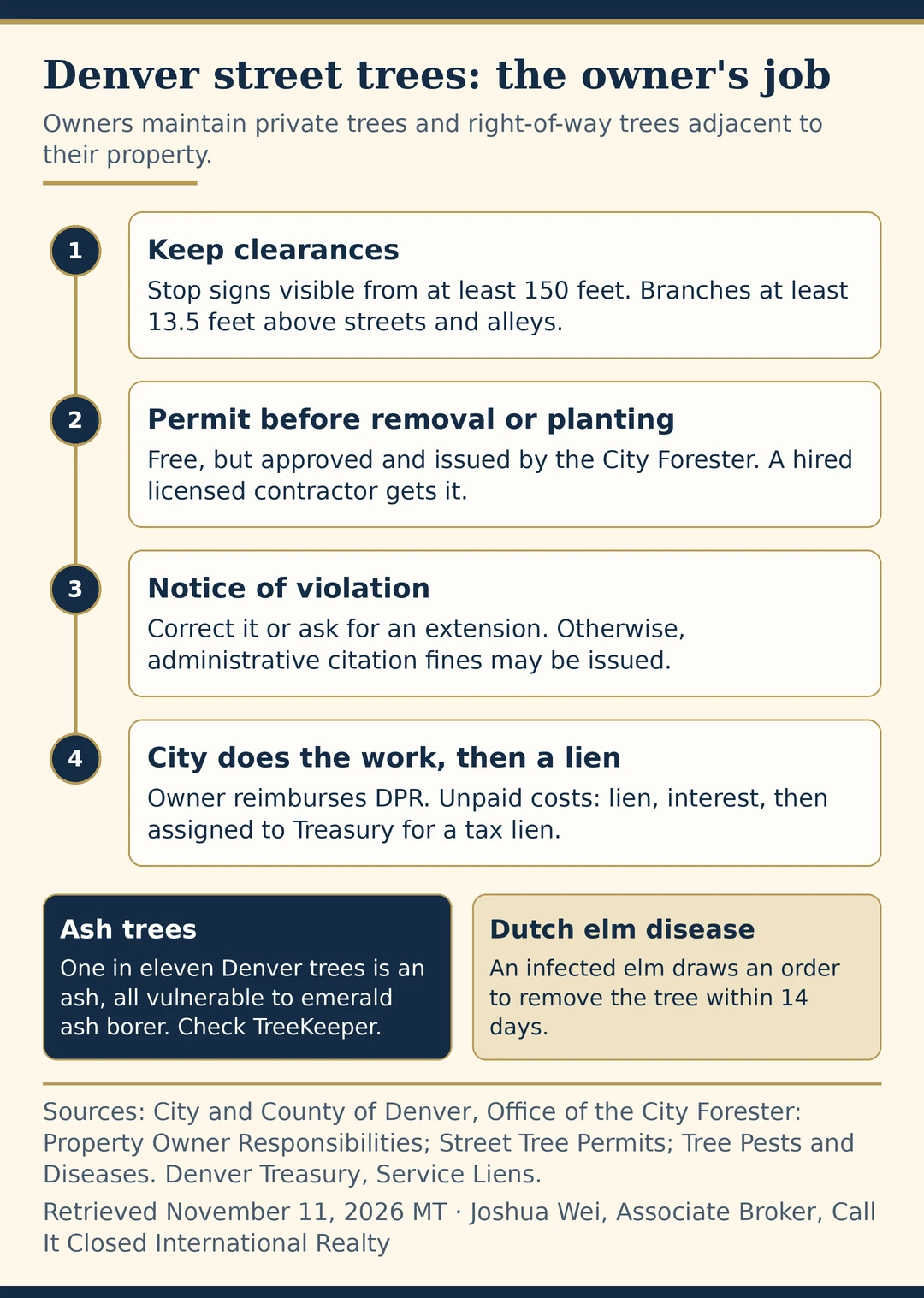
A vertical flow diagram, cream background with navy type and gold accents, titled Denver street trees: the owner's job, with the subtitle owners maintain private trees and right-of-way trees adjacent to their property. Four numbered steps: 1, keep clearances, with stop signs visible from at least 150 feet and branches at least 13.5 feet above streets and alleys; 2, permit before removal or planting, which is free but approved and issued by the City Forester, and a hired licensed contractor gets it; 3, notice of violation, correct it or ask for an extension, otherwise administrative citation fines may be issued; 4, city does the work, then a lien, where the owner reimburses DPR, and unpaid costs become a lien with interest, then are assigned to Treasury for a tax lien. Two lower cards: ash trees, one in eleven Denver trees is an ash, all vulnerable to emerald ash borer, check TreeKeeper; and Dutch elm disease, where an infected elm draws an order to remove the tree within 14 days. Sources: Denver Office of the City Forester and Denver Treasury. Retrieved November 11, 2026 MT.
Sources: Property Owner Responsibilities (opens in a new tab); Street Tree Permits (opens in a new tab)
Cream background, navy text, gold rules. Four numbered steps on a gold spine, two side-by-side cards, and a 28px source footer.
The diagram above summarizes the owner's duties and the enforcement path described by Denver's Office of the City Forester.
Is the tree public or private?
The Forester says it helps to know where the Public Right-of-Way line is: "Some documents that may help you locate the PRW include a property deed, plat or survey." But it also cautions: "Consulting a professional land surveyor is the only way to determine with absolute accuracy the location of a property line."
The page also points to "the city's public tree inventory" to help tell whether a tree is public or private. It adds that maps and records "will not provide the exact legal location of the property or PRW line, but can guide you to the general location." If you can't tell, it says to "contact the Office of the City Forester for assistance."
What the code puts on the owner
The Forester's page cites the ordinance by number: "By Denver ordinance (57-18), the adjoining property owner is responsible for all aspects of street tree care, including but not limited to; planting, pruning, vegetative litter clean-up, and removal." It also says: "The City Forester is directed by municipal code to order the removal or pruning of trees that are determined to be dangerous, diseased, or an obstruction of the right-of-way." Chapter 57 is Denver's vegetation ordinance, and the Street Tree Permits page (opens in a new tab) links to it.
What maintenance is the owner responsible for?
The Forester lists clearance standards. Owners maintain branches so that:
- "Stop signs are completely visible from at least 150 feet away"
- "Tree branches are at least 13.5 feet above streets and alleyways"
- "Tree branches are at least 8 feet above sidewalks"
It adds: "Property owners are responsible for fixing damage to branches under 13.5 feet, so it is better to prepare and remove them ahead of time." For bigger cuts it says: "If you have branches larger than 4 inches in diameter, it is best to have a licensed tree service remove them."
Two more rules: "Tree stumps are not allowed in the right-of-way, and must be ground out to 6 inches below existing grade." And city code "requires that anyone performing tree care services, including pruning and removal, be licensed as a 'Tree Service Company.'"
Pruning and removal: what the Forester allows
The Forester's page separates pruning from removal, and public trees from private ones.
- Pruning a right-of-way tree. "There are no permit requirements to prune trees in the public right-of-way, however, city code requires that their pruning be completed to industry standards." It adds: "Owners can prune city trees within the right-of-way adjacent to their property, but must not damage the trees." And: "If a tree in the right-of-way is improperly pruned (topping for example) the City Forester may deem the tree to be irreparably damaged and require reimbursement for the value of the tree."
- Removing a right-of-way tree. "Chapter 57 of Denver's municipal code makes it is illegal to remove a right-of-way tree without obtaining an approved permit from the City Forester." The page warns that "permit requests for the removal of healthy, valuable trees will often be denied," and that removing a city tree without a permit "will require the responsible party to compensate the City of Denver for the lost monetary value of the tree."
- Private trees. "There are no permit requirements to prune trees on private property." And: "The majority of trees on private property may be removed at the discretion of the owner without a permit."
- Demolition and construction. "However, when a property is in the process of demolition or construction, zoning code grants the City Forester regulation over trees within the front and side setbacks of the property." During that work, "all trees located within these setbacks must be protected and preserved throughout the project, and may not be removed without a permit from the City Forester." The permits page says that for demolition and construction, "inspections will be completed within three (3) to five (5) business days after receipt of the request."
Planting a new street tree
Planting in the right-of-way also needs a permit: "Please remember that permits are required to remove or plant trees in the public right-of-way." The Forester keeps an approved list, and its page says: "Trees not included on the approved street tree list may not be planted in the public right-of-way (as a street tree) without express permission from the Office of the City Forester." Its prohibited list includes "Ash (Fraxinus) species," "Siberian elm (Ulmus pumila)," "Silver maple (Acer saccharinum)," and "Any of the poplar (Populus) species including cottonwoods and aspens."
The page also sets minimum spacing, including "35 feet between shade trees," "20 feet from street lights," "10 feet from alleys, driveways & fire hydrants," and "5 feet from water meters." For a replacement tree, it says: "Denver residents are eligible to apply for free right-of-way trees through the Be a Smart Ash tree planting program." It also mentions free and low-cost trees "through our partnership with The Park People and the Denver Digs Trees program."
What about ash and elm trees?
On its Tree Pests and Diseases page (opens in a new tab), Denver says: "One in eleven trees in Denver is an ash, and all are vulnerable to" emerald ash borer. It suggests the TreeKeeper map, where "you can identify the species of public right-of-way trees adjacent to your Denver property."
The page says: "Denver is working to preemptively identify, treat and/or replace the city's ash trees to preserve the urban canopy." To check a tree in TreeKeeper, it says to "Type your address in the search bar in the upper left corner," then "Click on any visible green diamonds around your house." A pop-up will "tell you the species of the tree and the address it is associated with."
For Dutch elm disease: "if an infected elm is found on a property, the Office of the City Forester will issue an order to remove the tree within 14 days in an effort to contain the spread." It adds that "wood from the removed tree cannot be kept or stored," and that "To apply pesticides, a contractor must be licensed by the State of Colorado Department of Agriculture." The owner page says diseased trees that threaten other trees "must be promptly removed," and "Infected wood must be disposed of as deemed appropriate by the City Forester to prevent further infections."
What happens if a notice is ignored?
The Forester describes escalation:
- Fines. If an owner doesn't correct a violation or ask for an extension, "administrative citation fines may be issued to the property owner."
- City-hired work. If the problem continues, the city "will authorize a low-bid on-call licensed tree service to remove or prune the tree(s) in violation. The property owner is obligated to reimburse Denver Parks & Recreation (DPR) for the costs of this remediation."
- Liens. "If the property owner does not work with DPR to pay back these expenses, city code requires DPR to place a lien on the property to secure the debt."
The page continues: "If the debt continues to go unpaid, it will collect interest and per ordinance, is assigned to the Treasury Department to issue a tax lien."
Denver Treasury's Service Liens page (opens in a new tab) lists "Forestry" in what it calls "some of the most common" service liens. It also says:
- "Service liens are not allowed to be split into installments like the property taxes due (i.e. a 1 st half /2 nd half option). These lien payments are due in full."
- "Service lien delinquencies will continue to accrue interest and fees. Those that remain unpaid as of November of each year are sold at a tax lien sale."
- "If the tax lien and interest is not settled within three years from the date the tax lien is filed, title to the property may be lost to a Treasurer's Deed."
- Treasury "is unable to answer any questions related to the specific debt details or account information. For that information you must contact the agency or program referring the service lien to Treasury." For a forestry lien, that means the Forester's office. For how liens and property tax bills fit together, see my Aurora property tax and metro district buyer checklist (opens in a new tab).
What the seller's disclosure form asks
The Commission's Seller's Property Disclosure (2026) (opens in a new tab) has lines that can touch trees. Under "N. ENVIRONMENTAL CONDITIONS," the seller is asked about anything "EVER EXISTING on any part of the Property," including "Dead, diseased, or infested trees or shrubs." Under "L. USE, ZONING & LEGAL ISSUES," it asks about "Notice of any adverse conditions from any governmental or quasi-governmental agency that have not been resolved" and "Building code, city, or county violations." A Forester notice of violation is a city notice, so read the seller's answers and comments on those lines.
What can a buyer check?
General practice, not legal advice:
- Identify the trees. Look up the right-of-way trees in TreeKeeper, especially ash.
- Ask about notices. Ask the seller whether they've received any Forester notices or citations.
- Look at the canopy. Note low branches over the street or alley, and stumps in the tree lawn.
- Get help with big trees. For a large or declining tree, consider a licensed tree service company's opinion during inspection.
- Check the license. The Forester's page says to "ask to see evidence of license from prospective companies" and links its licensed contractor list.
- Read the disclosure. Look at SPD lines N.11, L.3 and L.5 and any comments.
- Ask about liens. Ask the closing company whether a forestry service lien shows up on the tax certificate or Treasury records for the parcel.
- Plan any changes. If you want to remove or replace a street tree, budget time for a permit, which can take "up to 5 business days" to review.
An invented example
This example is invented; it is not a real property.
A buyer is under contract on a 1920s house in Denver with a large tree lawn. TreeKeeper shows the right-of-way tree in front is an ash. The seller's disclosure marks "Yes" on N.11 with a comment that a Forester notice to prune low branches over the alley was received last spring and the work was done. The buyer's inspector notes a branch over the sidewalk that looks lower than 8 feet. The buyer asks for the Forester notice and the tree company's invoice, and checks the contractor against the city's licensed list. She learns ash trees are on the city's prohibited planting list, so if she later replaces the ash she will need a permit and a species from the approved list. She also asks the closing company to confirm there is no forestry service lien on the parcel.
Frequently asked questions
Do I need a permit to prune a street tree?
The Forester's owner page says: "There are no permit requirements to prune trees in the public right-of-way, however, city code requires that their pruning be completed to industry standards." The permits page lists removal, planting, injection, and attaching material as requiring permits. If you hire someone, Chapter 57 "requires that anyone performing tree care services, including pruning and removal, be licensed" as a Tree Service Company.
Who gets the removal permit if I hire a company?
The permits page says: "if you are hiring a licensed contractor to perform tree work, they are responsible for obtaining the permit."
How long does a permit take?
The page says "it may take up to 5 business days to review the permit request."
Can I appeal a notice?
The owner page says: "Property owners have the right to appeal notices of violation. Within 15 days of the notice being issued, send details of your appeal in writing to the Manager of Parks and Recreation." For fines: "Within 10 days of the citation being served, send details of your appeal in writing to the Manager of Parks and Recreation." It also says to "Stay in close contact with the Forestry Inspector who issued your notice," who can "offer extensions."
Does Denver recommend a tree company?
"The Office of the City Forester does not endorse any company on the list." It recommends getting "at least three written, detailed bids."
What if a previous owner topped the street tree?
The Forester's page says that if a right-of-way tree "is improperly pruned (topping for example) the City Forester may deem the tree to be irreparably damaged and require reimbursement for the value of the tree." Ask the seller about past tree work, and ask the Forester's office if you have questions about a specific tree.
When should I plant a replacement tree?
The Forester's page says: "Late September and October is usually the best time of year to plant trees, and many nurseries offer discounts on their inventory." A right-of-way planting still needs the free permit first.
What pests should I watch for?
The pests page names emerald ash borer, Dutch elm disease and spotted lanternfly. It says: "If you believe you have identified signs or symptoms of any of these pests on your property, please contact Denver's Office of the City Forester at forestry@denvergov.org or (720) 913-0651."
Who do I call about a forestry lien?
Treasury bills the lien, but it says it is "unable to answer any questions related to the specific debt details." Contact the Office of the City Forester at forestry@denvergov.org or (720) 913-0651, the contact the pests page lists.
Does this apply in Aurora?
This article covers only the City and County of Denver. If you're buying in Aurora, check with the City of Aurora.
Related notes
- Buying in Denver? The sidewalk fee, trash fee, and city service liens that come with the house
- ILC or survey? What Denver and Aurora buyers should know about Improvement Location Certificates
- Buying in a Denver historic district? Landmark review, past unpermitted work, and demolition checks, explained
Sources and method
Official sources, retrieved November 11, 2026, America/Denver (City and County of Denver):
- Office of the City Forester: Property Owner Responsibilities (opens in a new tab), Street Tree Permits (opens in a new tab), and Tree Pests and Diseases (opens in a new tab)
- Department of Finance, Treasury Service Liens (opens in a new tab)
Added November 13, 2026: further passages of the Forester's Property Owner Responsibilities page (opens in a new tab) (ordinance 57-18, pruning and removal rules, planting rules, appeals), the Tree Pests and Diseases page (opens in a new tab), the Street Tree Permits page (opens in a new tab), Denver Treasury's Service Liens page (opens in a new tab), and the Commission's Seller's Property Disclosure (2026) (opens in a new tab) sections L and N.
Quotations are verbatim. The buyer checklist is general practice.
This note is general education from a Colorado real estate broker with Call It Closed International Realty. If you're buying an older Denver home with mature trees, I can help you add these questions to your inspection plan.
Disclaimer
This article is general information only. It is not legal, tax, lending, insurance, appraisal, inspection, or financial advice, and it is not a substitute for advice about your situation. Joshua Wei is a Colorado real estate broker, not an attorney. Reading this article does not create a client relationship, an agency relationship, or an attorney-client relationship with Joshua Wei or with Call It Closed International Realty.
Laws, program rules, interest rates, insurance terms, tax figures, and other details change. Examples in this article are hypothetical illustrations unless a source is named for a specific, dated figure. Information in this article is believed accurate as of November 13, 2026 and is not guaranteed. No result is promised, and you should not rely on this article as the last word for your situation.
Before you act, confirm the point with the official source linked or cited in this article, and talk with a licensed professional who can apply the rule to your facts. That may be a licensed attorney, a tax professional, a lender, an insurance agent, a home inspector, or another licensed professional, depending on the question. Links to third-party websites and publications are provided for reference only. They are not an endorsement, and their content can change.
If you already have a brokerage relationship with another broker, this is not a solicitation.
Joshua Wei, Associate Broker, Call It Closed International Realty, Colorado license FA.100108558. Equal Housing Opportunity.