October 27, 2026 · Aurora · Water · Landscaping · Buying · Owning
Buying a home in Aurora? The new turf ban, Stage 1 watering rules, lawn permits, and grass-replacement rebates
Aurora now restricts new cool-season turf and limits spray irrigation by season. What Aurora Water's pages and the council ordinance say about lawns, permits, drought surcharges, and GRIP rebates for Aurora homebuyers and owners.
The short answer
In brief: Buying in Aurora means the yard comes with water rules. Aurora Water says City Council passed an ordinance restricting new turf grass and ornamental water features and setting seasonal limits on spray irrigation. Citywide, residents may not install new cool-weather turf such as Kentucky bluegrass and fescue. Stage 1 watering rules, lawn permits and rebates also apply.
If you're buying in Aurora, the yard comes with water rules. Aurora Water's watering rules page (opens in a new tab) says that on Monday, Sept. 28, "Aurora City Council passed an ordinance that places new restrictions on the installation of turf grass and ornamental water features like fountains and decorative ponds across the city, along with seasonal limits on spray irrigation."
The page summarizes it this way: "Citywide, residents may not install new cool-weather turf (such as Kentucky bluegrass and fescue) or ornamental water features."
I am a licensed Colorado real estate broker with Call It Closed International Realty, not a landscaper, attorney, or tax advisor.
Disclaimer. This article is general information only. It is not legal, tax, lending, insurance, appraisal, inspection, or financial advice, and reading it does not create a client, agency, or attorney-client relationship. Laws, rates, programs, and figures change. Confirm the official source, and talk with a licensed attorney, tax professional, lender, insurance agent, or inspector before you act. Joshua Wei is a Colorado real estate broker, not an attorney. He is an Associate Broker with Call It Closed International Realty, license FA.100108558. Equal Housing Opportunity.
 Full size (opens in a new tab)
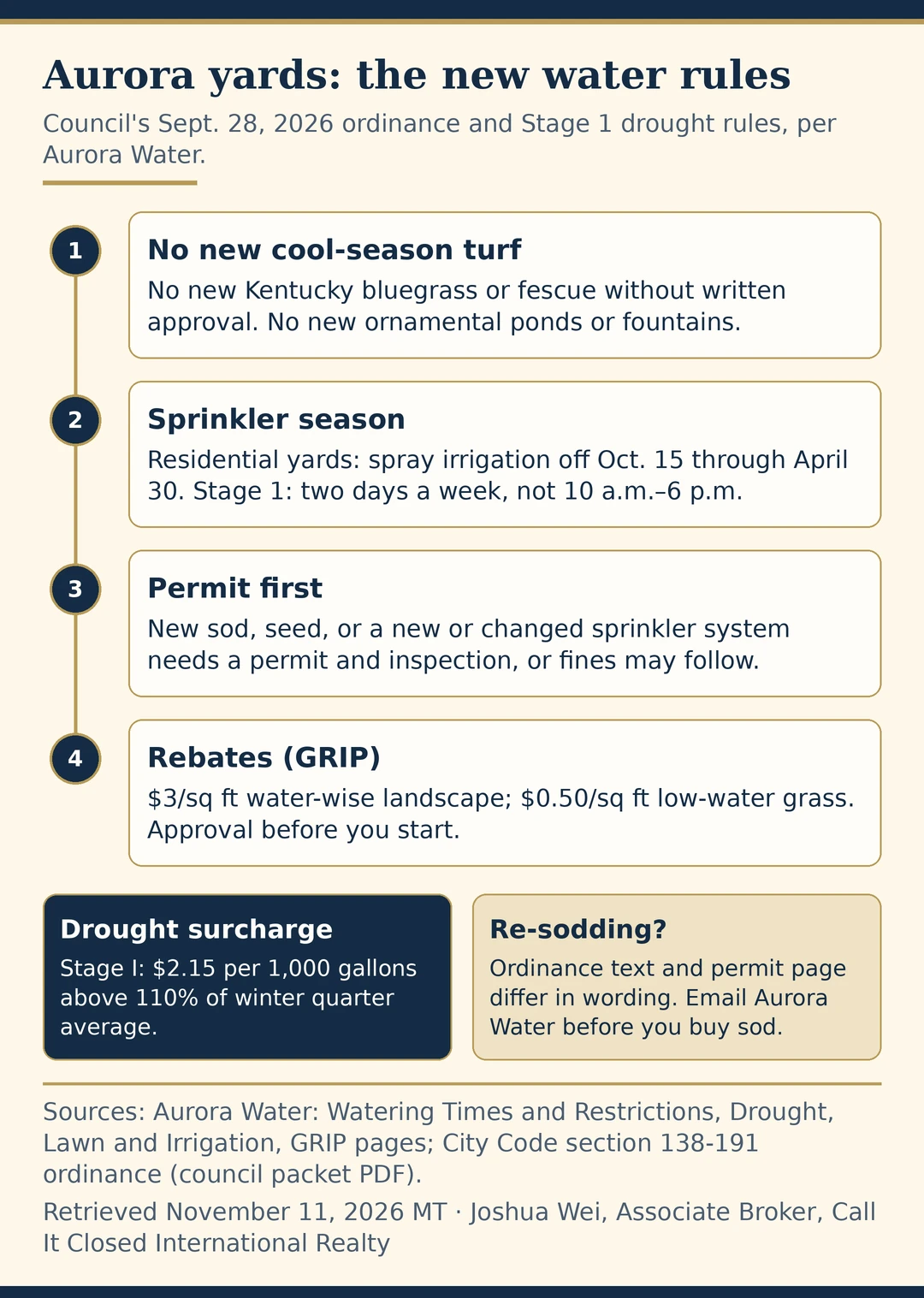
A vertical flow diagram, cream background with navy type and gold accents, titled Aurora yards: the new water rules, with the subtitle council's September 28, 2026 ordinance and Stage 1 drought rules, per Aurora Water. Four numbered steps: 1, no new cool-season turf, meaning no new Kentucky bluegrass or fescue without written approval, and no new ornamental ponds or fountains; 2, sprinkler season, residential yards have spray irrigation off October 15 through April 30, and in Stage 1 watering is two days a week and not between 10 a.m. and 6 p.m.; 3, permit first, new sod, seed, or a new or changed sprinkler system needs a permit and inspection, or fines may follow; 4, rebates through GRIP, 3 dollars per square foot for a water-wise landscape and 50 cents per square foot for low-water grass, with approval before you start. Two lower cards: drought surcharge, Stage I is 2 dollars 15 cents per 1,000 gallons above 110 percent of winter quarter average; and re-sodding, the ordinance text and permit page differ in wording, so email Aurora Water before you buy sod. Sources: Aurora Water pages and the City Code section 138-191 ordinance. Retrieved November 11, 2026 MT.
Sources: Aurora Water watering rules (opens in a new tab); Aurora GRIP (opens in a new tab)
Cream background, navy text, gold rules. Four numbered steps on a gold spine, two side-by-side cards, and a 28px source footer.
The diagram above summarizes Aurora Water's current rules and programs as posted on the city's pages.
What does the ordinance say?
The city links the ordinance text (opens in a new tab) from its watering page. That document amends City Code section 138-191 and says: "Turf installation is prohibited in the City for any purpose unless specifically pre-approved in writing by the General Manager."
It defines turf as grass "including but not limited to Kentucky bluegrass and fescue, which requires greater than fifteen inches (15”) (or (9.345 gallons)) of irrigation water per square foot per year."
It also says: "The removal of water-wise landscaping for the purpose of installing turf is prohibited in the City and no permit for such shall be granted."
The document's definition of installation adds that the term "shall not be interpreted to include the re-installation or replacement of preexisting turf." But Aurora Water's lawn and irrigation permit page (opens in a new tab) says: "Installation of Kentucky bluegrass, Fescue and other high-water-use grass is not permitted." If you plan to re-sod, email Aurora Water before you buy anything.
Key definitions in the ordinance
The packet's new section 138-191 defines the terms that decide what a homeowner can do:
- Water-wise landscape means "any landscape designed utilizing any combination of shrubs, perennials, and warm-season grasses which cumulatively requires less than fifteen inches" of irrigation water per square foot per year.
- Ornamental water feature means "any exterior decorative fountain, waterfall, basin, pond, lake, waterway or other similar aesthetic water structure." It "shall not be interpreted to include any drainage facilities, storm drainage systems, stormwater systems, detention pond, basin, or other feature or facility required to be constructed pursuant to City Code."
- Spray irrigation device means "any device or system that distributes or emits pressurized water through the air to irrigate a specific area, including but not limited to, pop-up spray heads, spray nozzles, rotor heads, rotator nozzles and microsprays."
- Curbside landscape means "any landscaped area between a sidewalk and curb."
The new section also states its reach: "This section 138-191 applies to all development and re-development within the City." And: "To the extent any provision of City Code, as now or hereafter amended, conflicts with this section 138-191, this section shall control."
Why the city says it acted
The packet's council commentary says that "about half of the city's water use is still used for outdoor irrigation" and that "Water used in irrigation cannot be recaptured by Aurora Water's Prairie Waters potable reuse system." It adds: "In 2022, an ordinance was introduced and passed that restricted non-functional turf installation for new development. 2026 has proven to be a significant drought year which has led to the increased need for water savings in Aurora."
The packet also prints earlier text
After the new section, the packet prints a section headed "Sec. 138-191. Use of turf and ornamental water features," with limits for new development such as "Turf shall not be installed in the front or side yards of any single-family dwelling except as specified" and backyard turf that "shall not exceed the lesser of: 45 percent of the backyard area as defined by the Unified Development Ordinance or 500 square feet." The ordinance says section 138-191 "is hereby amended and replaced in its entirety with a new section 138-191." Because the packet shows both texts, confirm with the City of Aurora which text is codified and in force.
When can I run sprinklers?
From the watering rules page: "Spray irrigation is prohibited from Oct. 1 through April 30 for most areas and from Oct. 15 through April 30 for high-traffic active use areas like residential yards, parks and athletic fields."
"Residential customers with lawns serviced by the residential meter must stop irrigating by Oct. 15."
During Stage 1 drought, the page adds: "Non-drip outdoor irrigation is limited to two days per week." And: "No watering permitted between 10 a.m. and 6 p.m. from May 1 through Sept. 30."
The drought page adds detail on counting days: "Watering events that begin in the evening of one calendar day and continue past midnight into the next calendar day will count as two distinct watering days." For HOA landscapes: "Multi-family and HOA areas that are not communal use must stop irrigating by Oct. 1, and communal-use space must stop irrigating by Oct. 15."
The ordinance allows one exception to the seasonal ban: "Spray irrigation devices may be operated solely for maintenance purposes to prevent leaks or other malfunction, as necessary, regardless of the calendar date."
Other Stage 1 rules
The drought page lists more Stage 1 measures that affect a home:
- "Private pools cannot be filled; however, topping off pools that are already full is allowed."
- "Shared community pools will still be allowed in Stage 1."
- "Decorative water features are not permitted."
- "Restrictions for water waste go into effect. This includes water pooling, watering sidewalks or streets, irrigation leaks and unrestricted hose use."
If the house you are buying has a pool, ask how these rules apply before you plan to fill it.
Is Aurora still in a drought stage?
As of the city's drought page (opens in a new tab) when checked on November 11, 2026: "Aurora is in a Stage 1 drought." The page also says: "Drought surcharges for residential, multi-family and commercial users go into effect. (See City Code Sec. 138-223.)" Its table lists a Stage I surcharge of $2.15 per 1,000 gallons used above 110% of winter quarter average.
The page gives context. It says: "Due to the intensity of the worst drought the arid West has seen in 1,200 years, Aurora's reservoirs are currently about half full." Its reservoir table, dated "Oct. 25, 2026," shows a total of "39%" under "Total Storage Level - Low." The narrative and the table give different pictures; check the current table with Aurora Water. The page also says: "Aurora Water is asking the community to work together to reduce outdoor water use by 20%."
The page describes how stages are set: "Stage triggers are determined by an internal Water Supply Watch, which meets regularly to monitor supply and demand." It says restrictions "are limited to outdoor water use, primarily by restricting the number of days permitted for watering landscape in progressive stages."
Stages change. Check the drought page before you close and again in spring.
Do I need a permit for a new lawn or sprinkler system?
Yes. The permit page says a permit is required for "The installation and replacement of new turf (sod or seed) at any time of year." It's also required for "Installing a new irrigation/sprinkler system where none currently exists, or replacing or renovating an existing system (such as adding a zone or changing the size of a system) at a residence."
The page warns: "Failure to obtain a permit and pass the required inspection for new irrigation and/or turf installations may result in fines."
During Stage 1, it says "only the installation of low-water-use turf and grasses is permitted," and it lists examples such as "Buffalograss."
The permit page explains what a permit does: "The permit will exempt the applicant from water restrictions to promote successful establishment of new sod or seed. New seed is granted a watering exemption for 30 days, and new sod is granted a watering exemption for 20 days. The permit does not give you more water, just more time to apply it."
It also sets a soil step: "Add compost amendment to the soil before a permit will be issued. Prepare turf grass area with a minimum of 4 cubic yards/1,000 sq. ft. with compost," rototilled 6 inches deep.
One more note for timing: "During Stage 1 Drought, the portal has temporarily disabled applications for a lawn, seed and irrigation permit." Email Aurora Water for the current process.
Can I get paid to replace grass?
Aurora Water's Grass Replacement Incentive Program (GRIP) (opens in a new tab) pays "$3 per square foot for a traditional water-wise landscape" and "$0.50 per square foot for a water-wise grass landscape using native or low-water grass."
Rules to know before you start:
- "Aurora Water must approve all projects before installation. Rebates are not retroactive."
- "Areas to be converted must have existing, irrigated and well-maintained grass."
- The 2026 Fall Group application period runs "Nov. 1, 2026 to Jan. 1 2027," with a completion deadline of "July 31, 2027."
- The page also says: "Water conservation rebates of $600 or more are considered taxable income by the Internal Revenue Service." It adds that participants "must submit a W-9 form in their application and will receive a 1099 form." Do not read the $600 figure as a rule that a smaller rebate is tax-free. Also note that the IRS says that, for tax years beginning after 2025, the minimum amount for reporting certain payments on information returns such as Form 1099-MISC increased to $2,000. Whether any rebate is taxable to you is a question for a tax professional, whatever the amount and whether or not you receive a form.
The water-wise landscaping page (opens in a new tab) adds: "All Aurora Water customers are entitled to a free water-wise landscape design from our team." Income-qualified owners can look at GreatScapes (opens in a new tab), which offers "a FREE water-wise landscape replacement."
How do exemptions work?
Under the ordinance, a request "to install turf or operate a spray irrigation device" during the seasonal ban "must be submitted, in writing, to the General Manager and include a detailed explanation demonstrating" that the request is "necessary and appropriate based on the totality of the circumstances." The General Manager or a designee "shall have fourteen (14) days from actual receipt of such exemption request to issue a written response." And: "The General Manager's (or designee's) determination shall be final."
The ordinance also exempts certain landscaped tracts: "Landscape common areas for which the owner or responsible party has paid the City all applicable fees set forth in the City Code, including without limitation the fees owed under section 138-221, as amended, prior to the date this section 138-191 is effective are exempt from this section." Otherwise, "there shall be no exemptions, waivers, or variances to this section 138-191 permitted."
How does Colorado HOA law fit in?
State law limits what an HOA can require for landscaping. For a single-family detached home, Colorado Revised Statutes section 38-33.3-106.5(1)(i.5) protects "The use of xeriscape, nonvegetative turf grass, or drought-tolerant or nonvegetative landscapes to provide ground covering to property for which a unit owner is responsible." See what a Colorado HOA can't prohibit. Where an HOA rule and the city rule point different ways, ask the HOA and an attorney.
An invented example
This example is invented; it is not a real property.
A buyer is under contract on an Aurora house with a patchy Kentucky bluegrass front lawn and an old fountain in the backyard.
- The buyer reads the city's watering page and the ordinance packet during the inspection period.
- Because the ordinance bars new cool-weather turf and ornamental water features, the buyer emails Aurora Water about re-sodding and about the fountain.
- The buyer asks about a free water-wise landscape design and checks the GRIP dates and the "Areas to be converted must have existing, irrigated and well-maintained grass" rule.
- The buyer reads the HOA's landscaping guidelines and asks about approval steps.
What a real yard needs depends on Aurora Water's answer and the HOA; get both in writing.
Buyer checklist for an Aurora yard
- Check the drought stage and the watering days.
- Note the seasonal spray-irrigation dates.
- Ask Aurora Water before re-sodding or adding a sprinkler zone.
- Confirm any existing fountain or pond can't be run under the rules.
- Look at GRIP before removing grass; projects must be approved first.
- Read the HOA's landscaping rules alongside the city's.
For other water issues around Aurora homes, see my Aurora and Denver flood map and drainage guide (opens in a new tab).
Frequently asked questions
Can I put in a decorative pond or fountain?
The ordinance document says: "The installation or construction of any public or private ornamental water feature is prohibited in the City."
Are exemptions possible?
The document allows a written request to the General Manager. It also says: "No exemption shall be granted for: the development of a golf course; the installation of any ornamental water feature; or the removal of water-wise landscaping for the purpose of installing turf."
Can I water my vegetable garden during the day?
The watering page says: "Between 10 a.m. and 6 p.m., hand-watering vegetable or flower gardens is allowed."
What about curbside strips?
The ordinance document says: "After January 1, 2027 the installation of permanent spray irrigation device(s) to irrigate in medians or curbside landscapes is prohibited in the City."
Can I run my sprinklers in winter to check for leaks?
The ordinance allows operation "solely for maintenance purposes to prevent leaks or other malfunction, as necessary, regardless of the calendar date."
How long do I get to water new sod with a permit?
The permit page says "new sod is granted a watering exemption for 20 days" and "New seed is granted a watering exemption for 30 days."
Can I fill a new pool?
During Stage 1, the drought page says: "Private pools cannot be filled; however, topping off pools that are already full is allowed."
Why does Aurora focus on lawns?
The drought page says: "The Front Range receives approximately 15 inches of precipitation in the form of rain and snow on an annual basis, which is insufficient moisture to meet the needs for most non-native landscapes without supplemental irrigation." The permit page says: "Since almost half of the water used by our customers is used to water lawns and landscaping, Aurora Water requires lawn and irrigation permits."
What happens if someone breaks the rules?
The watering page says violations of the Water Shortage Response Plan "are subject to warnings, charges and potential discontinuance of service or the installation of a flow restrictor."
Does the HOA still control my front yard?
Your HOA documents still matter. Read them alongside the city rules, and ask about any landscaping approval process before you change the yard.
Related notes
- What a Colorado HOA can't prohibit: flags, signs, xeriscape, EV chargers, heat pumps, and more for Denver and Aurora owners
- Who owns the tree by the curb? Denver street trees, owner duties, permits, and forestry liens for homebuyers
- Outside the floodplain is not the whole answer: an Aurora homebuyer's water-risk checklist
Sources and method
Official sources, retrieved November 11, 2026, America/Denver:
- Aurora Water, Watering Times and Restrictions (opens in a new tab)
- Aurora Water, Drought (opens in a new tab)
- Aurora Water, Lawn and Irrigation permits (opens in a new tab)
- Aurora Water, Grass Replacement Incentive Program (opens in a new tab)
- Aurora Water, Water-wise Landscaping (opens in a new tab)
- Aurora Water, GreatScapes (opens in a new tab)
- City of Aurora, ordinance amending City Code section 138-191, as linked by Aurora Water (council packet PDF) (opens in a new tab)
Added November 13, 2026: further sections of the ordinance packet (council commentary, definitions, exemptions, and the earlier section text), the drought page (opens in a new tab) (Stage 1 measures and reservoir table), the Lawn and Irrigation page (opens in a new tab), and Colorado Revised Statutes section 38-33.3-106.5(1)(i.5) (2026 Colorado Revised Statutes, Title 38 (opens in a new tab)).
Quotations are verbatim. The linked ordinance document is a council packet version; confirm the final codified text with the City of Aurora.
This note is general education from a Colorado real estate broker with Call It Closed International Realty. If you're buying in Aurora and the yard matters to you, I can help you plan questions for Aurora Water and the HOA during your inspection period.
Added November 19, 2026, after an expert review, and checked that day: IRS, Instructions for Forms 1099-MISC and 1099-NEC (opens in a new tab).
Disclaimer
This article is general information only. It is not legal, tax, lending, insurance, appraisal, inspection, or financial advice, and it is not a substitute for advice about your situation. Joshua Wei is a Colorado real estate broker, not an attorney. Reading this article does not create a client relationship, an agency relationship, or an attorney-client relationship with Joshua Wei or with Call It Closed International Realty.
Laws, program rules, interest rates, insurance terms, tax figures, and other details change. Examples in this article are hypothetical illustrations unless a source is named for a specific, dated figure. Information in this article is believed accurate as of November 19, 2026 and is not guaranteed. No result is promised, and you should not rely on this article as the last word for your situation.
Before you act, confirm the point with the official source linked or cited in this article, and talk with a licensed professional who can apply the rule to your facts. That may be a licensed attorney, a tax professional, a lender, an insurance agent, a home inspector, or another licensed professional, depending on the question. Links to third-party websites and publications are provided for reference only. They are not an endorsement, and their content can change.
If you already have a brokerage relationship with another broker, this is not a solicitation.
Joshua Wei, Associate Broker, Call It Closed International Realty, Colorado license FA.100108558. Equal Housing Opportunity.