October 24, 2026 · Denver · Aurora · HOA · Owning · Buying
What a Colorado HOA can't prohibit: flags, signs, xeriscape, EV chargers, heat pumps, and more for Denver and Aurora owners
Colorado's Common Interest Ownership Act limits what homeowners associations can ban, even when the covenants say otherwise. What the statute says about flags, signs, drought-tolerant landscaping, EV charging, energy efficiency devices, renewable energy, and home businesses, and the reasonable rules HOAs can still adopt.
The short answer
In brief: Colorado's legislature has found that "Most homes in Colorado, including the vast majority of new homes, are in common interest communities." Their covenants matter, but Colorado law overrides some restrictions. Section 38-33.3-106.5 of the Colorado Common Interest Ownership Act limits what an association can prohibit, notwithstanding its declaration, bylaws or rules, on items such as flags, signs, xeriscape, EV chargers and heat pumps. The details vary by item.
The Colorado legislature found that "Most homes in Colorado, including the vast majority of new homes, are in common interest communities" (C.R.S. 38-33.3-106.8(1)(b)). The covenants matter, but Colorado law overrides some covenant restrictions.
Section 38-33.3-106.5(1) of the Colorado Common Interest Ownership Act opens: "Notwithstanding any provision in the declaration, bylaws, or rules and regulations of the association to the contrary, an association shall not prohibit any of the following." The list includes flags, signs, certain landscaping, rain barrels, licensed family child care homes, and home-based businesses.
Several of the same sections also refer to "reasonable" rules an association may adopt. How they apply to a specific HOA is a question for a Colorado attorney who handles HOA matters.
I am a licensed Colorado real estate broker with Call It Closed International Realty. I am not an attorney. This is not legal advice. For a dispute with your association, talk to a Colorado attorney.
Disclaimer. This article is general information only. It is not legal, tax, lending, insurance, appraisal, inspection, or financial advice, and reading it does not create a client, agency, or attorney-client relationship. Laws, rates, programs, and figures change. Confirm the official source, and talk with a licensed attorney, tax professional, lender, insurance agent, or inspector before you act. Joshua Wei is a Colorado real estate broker, not an attorney. He is an Associate Broker with Call It Closed International Realty, license FA.100108558. Equal Housing Opportunity.
 Full size (opens in a new tab)
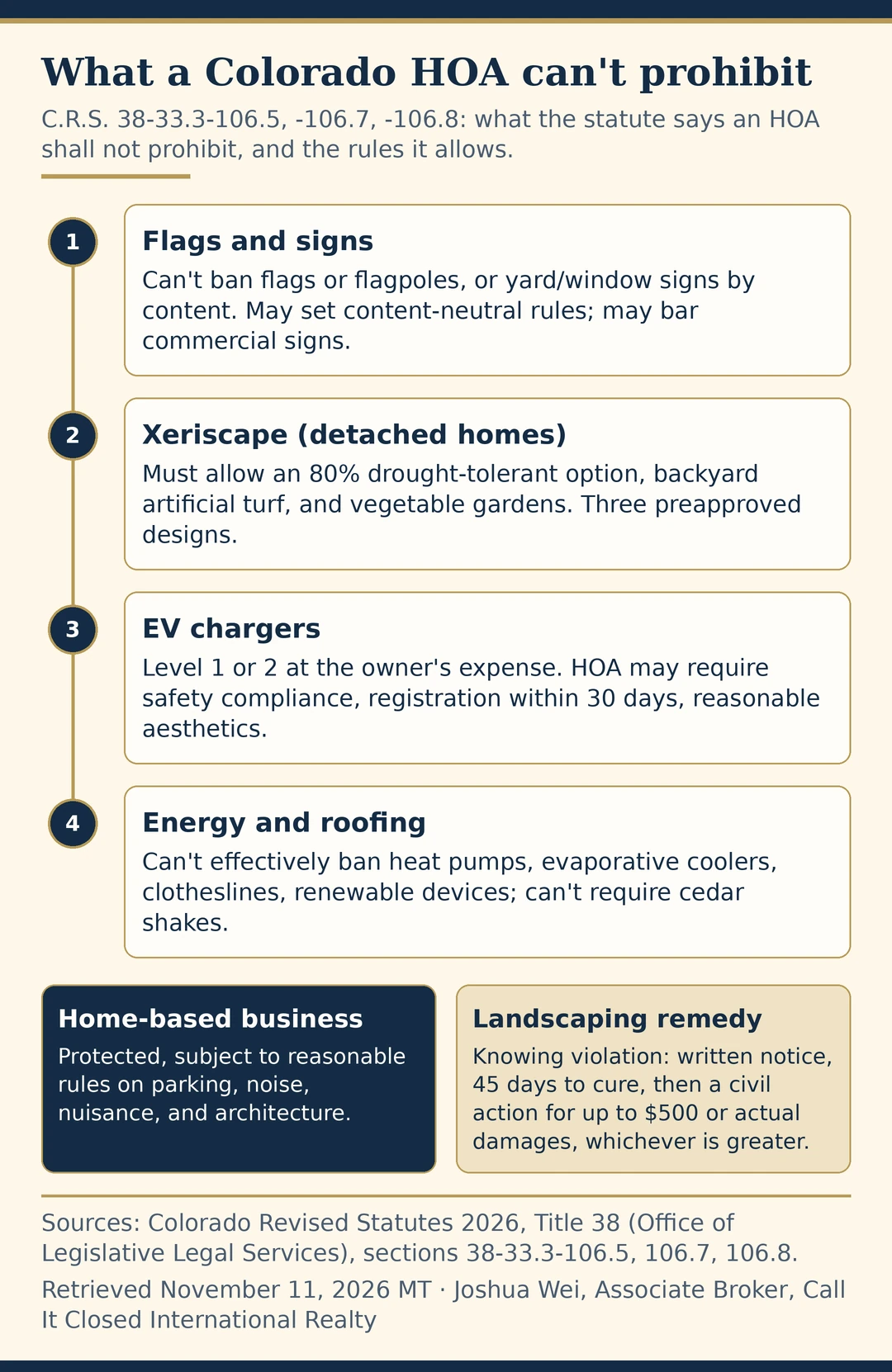
A vertical flow diagram, cream background with navy type and gold accents, titled What a Colorado HOA can't prohibit, with the subtitle C.R.S. 38-33.3-106.5, 106.7, and 106.8, showing what the statute says an HOA shall not prohibit and the rules it allows. Four numbered items: 1, flags and signs, where an HOA cannot ban flags or flagpoles or ban yard or window signs by content, but may set content-neutral rules and may bar commercial signs; 2, xeriscape for detached homes, where the HOA must allow an 80 percent drought-tolerant option, backyard artificial turf, and vegetable gardens, with three preapproved designs; 3, EV chargers, level 1 or 2 at the owner's expense, where the HOA may require safety compliance, registration within 30 days, and reasonable aesthetics; 4, energy and roofing, where the HOA cannot effectively ban heat pumps, evaporative coolers, clotheslines, or renewable devices and cannot require cedar shakes. Two lower cards: home-based business, protected subject to reasonable rules on parking, noise, nuisance, and architecture; and landscaping remedy, for a knowing violation, with written notice, 45 days to cure, then a civil action for up to 500 dollars or actual damages, whichever is greater. Source: Colorado Revised Statutes 2026, Title 38. Retrieved November 11, 2026 MT.
Sources: C.R.S. Title 38 (2026) (opens in a new tab)
Cream background, navy text, gold rules. Four numbered items on a gold spine, two side-by-side cards, and a 28px source footer.
The diagram above lists several protections and the type of rule an HOA can still adopt for each. All quotes are from the Colorado Revised Statutes 2026, Title 38 (opens in a new tab), published by the Office of Legislative Legal Services.
Can a Colorado HOA ban flags and signs?
- Flags. Section 106.5(1)(a) protects "The display of a flag on a unit owner's property, in a window of the unit, or on a balcony adjoining the unit." The association "may adopt reasonable, content-neutral rules to regulate the number, location, and size of flags and flagpoles, but shall not prohibit the installation of a flag or flagpole."
- Signs. Section 106.5(1)(c) protects "The display of a sign by the owner or occupant of a unit on property within the boundaries of the unit or in a window of the unit." The HOA "may prohibit signs bearing commercial messages" and may set "reasonable, content-neutral sign regulations."
Religious items on an entry door
Section 106.5(1)(c.5) protects "The display of a religious item or symbol on the entry door or entry door frame of a unit." The association may prohibit an item to the extent that it, among other things, "Threatens public health or safety," "Hinders the opening or closing of an entry door," or, "Individually or in combination with other religious items or symbols, covers an area greater than thirty-six square inches." If the association is working on the door, the owner "may be required to remove a religious item or symbol during the time the work is being performed," and "After completion of the association's work, the unit owner may again display or affix the religious item or symbol."
What other items does section 106.5(1) cover?
The list in subsection (1) goes beyond flags, signs, and landscaping:
- Emergency-service vehicles. Subsection (1)(d) protects parking a vehicle "on a street, driveway, or guest parking area in the common interest community if the vehicle is required to be available at designated periods at such occupant's residence as a condition of the occupant's employment," if listed criteria are met. They include that "The vehicle has a gross vehicle weight rating of ten thousand pounds or less" and that the occupant "is a bona fide member of a volunteer fire department or is employed by a primary provider of emergency fire fighting, law enforcement, ambulance, or emergency medical services."
- Public right-of-way. Subsection (1)(d.5) protects "The use of a public right-of-way in accordance with a local government's ordinance, resolution, rule, franchise, license, or charter provision regarding use of the public right-of-way."
- Defensible space. Subsection (1)(e) protects removing "trees, shrubs, or other vegetation to create defensible space around a dwelling for fire mitigation purposes," if it complies with a written plan from the Colorado State Forest Service or another listed source. "The plan shall be registered with the association before the commencement of work." The work "shall comply with applicable association standards regarding slash removal, stump height, revegetation, and contractor regulations."
- Disability modifications. Subsection (1)(g) protects "Reasonable modifications to a unit or to common elements as necessary to afford a person with disabilities full use and enjoyment of the unit in accordance with the federal" Fair Housing Act of 1968.
- Rain barrels. Subsection (1)(j) protects "The use of a rain barrel, as defined in section 37-96.5-102 (1), C.R.S., to collect precipitation from a residential rooftop." It "does not confer" a right to place one on property that is leased without the lessor's permission, "A common element or a limited common element," or property "Maintained by the unit owners' association." The community "may impose reasonable aesthetic requirements that govern the placement or external appearance of a rain barrel." See Colorado's rain barrel law.
Can an HOA prohibit xeriscape or drought-tolerant landscaping?
For a single-family detached home, section 106.5(1)(i.5) protects "The use of xeriscape, nonvegetative turf grass, or drought-tolerant or nonvegetative landscapes to provide ground covering to property for which a unit owner is responsible." HOA guidelines must, among other things:
- "Not prohibit the use of nonvegetative turf grass in the backyard of a unit owner's property"
- "Allow a unit owner an option that consists of at least eighty percent drought-tolerant plantings"
- "Not prohibit vegetable gardens in the front, back, or side yard of a unit owner's property"
Each association "shall select at least three preplanned water-wise garden designs that are preapproved for installation in front yards." Subsection (1)(i.5)(VI) says it "applies only to a unit that is a single-family detached home." Single-family homes that share a wall are addressed in subsection (1)(i).
For those attached homes, subsection (1)(i)(I)(A) protects "The use of xeriscape, nonvegetative turf grass, or drought-tolerant vegetative landscapes to provide ground covering to property for which a unit owner is responsible, including a limited common element or property owned by the unit owner." There the statute allows more association control: "Associations may adopt and enforce design or aesthetic guidelines or rules," and "An association may restrict the installation of nonvegetative turf grass to rear yard locations only." It also says the paragraph "does not supersede any subdivision regulation of a county, city and county, or other municipality."
Subsection (1)(i.5) itself "does not apply to" a single-family attached home that shares a wall, "or (B) A condominium."
Can an HOA prohibit EV charging?
Section 38-33.3-106.8(2)(a) says an association shall not "Prohibit a unit owner from using, or installing at the unit owner's expense for the unit owner's own use, a level 1 or level 2 electric vehicle charging system." That covers a unit, "An assigned or deeded parking space," or a shared space.
Exceptions in subsection (3) include "Bona fide safety requirements," a requirement "that the charging system be registered with the association within thirty days after installation," and "Reasonable aesthetic provisions."
Can an HOA prohibit energy-efficiency or renewable-energy devices?
- Energy efficiency measures. Section 38-33.3-106.7(1)(a): an association "shall not effectively prohibit the installation or use of an energy efficiency measure." The list includes "An evaporative cooler," "A retractable clothesline," and "A heat pump system." From January 1, 2027, it adds "a portable-scale solar generation device."
- Renewable energy. Section 106.5(1.5): an association "shall not effectively prohibit renewable energy generation devices, as defined in section 38-30-168."
- Roofing and fire-hardening. Section 106.5(2): an association "shall not require the use of cedar shakes or other flammable roofing materials." Section 106.5(3) limits bans on "fire-hardened building materials." Under (3)(a), a provision in place "on March 12, 2024, that prohibits the installation, use, or maintenance of fire-hardened building materials on a unit owner's property is void and unenforceable," with an exception in (3)(c). That exception lets an association set "reasonable restrictions on the design, dimensions, placement, or external appearance of fire-hardened building materials used for fencing," so long as the standards do not "Increase the cost of the fencing by more than ten percent compared to other fire-hardened building materials used for fencing" or "Require a period of review and approval that exceeds sixty days after the date on which the application for review is filed."
Can an HOA prohibit home businesses or child care?
- Home-based businesses. Section 106.5(1)(l) protects "The operation of a home-based business at a unit by the unit owner or a resident of the unit with the unit owner's permission," subject to "reasonable and applicable rules" on parking, noise, and similar matters.
- Family child care homes. Section 106.5(1)(k) protects the operation of a licensed "family child care home," with conditions, including possible liability insurance requirements. The subsection "does not supersede any of the association's regulations concerning architectural control, parking, landscaping, noise, or other matters not specific to the operation of a business per se." It also says: "The association shall make reasonable accommodation for fencing requirements applicable to licensed family child care homes." And it "does not apply to a community qualified as housing for older persons under the federal" Housing for Older Persons Act of 1995.
What about ADUs and middle housing?
Subsections (4) through (6) address housing types. Subsection (6)(a) says: "An association shall not prohibit or restrict the construction of accessory dwelling units or middle housing if the zoning laws of the local jurisdiction would otherwise allow such uses on a property." Its reach is limited by date. It "applies only to any declaration recorded on or after" July 1, 2024, "or in any bylaws or rules and regulations of the association adopted or amended on or after July 1, 2024, unless the declaration, bylaws, or rules and regulations contained such a restriction as of May 30, 2024."
The statute defines "Accessory dwelling unit" as "an internal, attached, or detached dwelling unit that is located on the same lot as a proposed or existing primary residence." Subsections (4) and (5) apply in defined jurisdictions and centers and set other dates. Because the dates and definitions control, whether a particular HOA's ADU rule survives is a question for a Colorado attorney. See ADU rules in Denver and Aurora.
What does the contract tell a buyer about HOA rules?
Contract quotations here are from the 2026 CBS1 PDF (opens in a new tab). Section 7.1 is printed in capitals. It says the owner "WILL BE REQUIRED TO BE A MEMBER OF THE OWNERS' ASSOCIATION FOR THE COMMUNITY AND WILL BE SUBJECT TO THE BYLAWS AND RULES AND REGULATIONS OF THE ASSOCIATION." It warns that those documents "MAY PROHIBIT THE OWNER FROM MAKING CHANGES TO THE PROPERTY WITHOUT AN ARCHITECTURAL REVIEW BY THE ASSOCIATION (OR A COMMITTEE OF THE ASSOCIATION) AND THE APPROVAL OF THE ASSOCIATION." And it advises: "PURCHASERS SHOULD CAREFULLY READ THE DECLARATION FOR THE COMMUNITY AND THE BYLAWS AND RULES AND REGULATIONS OF THE ASSOCIATION."
Under section 7.2, "Seller is obligated to provide to Buyer the Association Documents (defined below), at Seller's expense, on or before Association Documents Deadline." That window is the time to compare the rules with any plans you have, such as a charger, solar, a heat pump, or a home business.
An invented example
This example is invented; it is not a real community.
A buyer is under contract on a detached home in an Aurora HOA. The buyer plans to replace the front lawn with drought-tolerant plants and add a level 2 charger in the garage.
- In the Association Documents, the buyer looks for the association's "preplanned water-wise garden designs" under section 106.5(1)(i.5).
- The rules require registering an EV charger. Section 106.8(3) allows a requirement "that the charging system be registered with the association within thirty days after installation."
- The architectural rules require approval for exterior changes. Whether a particular requirement is "reasonable" under the statute is a question for a Colorado HOA attorney.
Buyer checklist
- Get the declaration, bylaws, rules, and architectural guidelines by the Association Documents Deadline.
- List the changes you plan, and find the matching rule for each.
- Check the statute section for each item in this article.
- Ask the association about approval steps and timelines in writing.
- Bring any conflict to a Colorado attorney who handles HOA matters before you close.
Who can apply this to a specific HOA?
The statute sections are linked above. Whether a specific plan, such as an EV charger, xeriscape or a home business, fits a specific HOA's declaration and rules is a question for a Colorado attorney who handles HOA matters.
Related: Aurora property tax and metro district buyer checklist (opens in a new tab).
Frequently asked questions
Can my HOA still require architectural approval?
Sections 38-33.3-106.5 through 106.8 refer to "reasonable" rules in several places. Ask a Colorado HOA attorney about a specific requirement.
What if the HOA ignores the landscaping law?
For the detached-home landscaping protections, if an association "knowingly violates" them, section 106.5(1)(i.5)(III) allows an affected owner to "bring a civil action to restrain further violation and to recover up to a maximum of five hundred dollars or the unit owner's actual damages, whichever is greater." Before suing, the owner must give written notice and allow "forty-five days after receipt of the notice to cure the violation." Ask a Colorado attorney about a specific dispute.
Can an HOA charge me to install an EV charger in my unit?
Section 106.8(2)(b) bars "any fee for the placement or use of an electric vehicle charging system on or in the unit owner's unit," with exceptions for the actual cost of electricity the association supplies or "a reasonable fee for access."
Can the HOA ban political signs?
Section 106.5(1)(c) says the association "shall not prohibit or regulate the display of window signs or yard signs on the basis of their subject matter, message, or content," but it may set content-neutral rules.
Can an HOA require cedar shake roofs?
Section 106.5(2) says an association "shall not require the use of cedar shakes or other flammable roofing materials."
Can an HOA stop me from creating defensible space?
Subsection (1)(e) protects removal of vegetation for fire mitigation that complies with a written defensible space plan and "is no more extensive than necessary to comply with such plan." The plan must be registered with the association first.
Does this apply to metro districts?
This statute addresses associations under the Common Interest Ownership Act. Metro districts are different entities.
Does an HOA have to allow ADUs?
Section 106.5(4) through (6) addresses ADUs and middle housing in certain jurisdictions and dates. Ask a Colorado attorney how it applies to a specific property.
Related notes
- Who oversees Colorado HOAs? What the state HOA Center can and can't do for Denver and Aurora owners and buyers
- A metro district is not an HOA: how Denver and Aurora buyers can tell them apart
- Buying a home with solar panels in Denver or Aurora? Owned, financed, leased, or a power purchase agreement, explained
Sources and method
Official source, retrieved November 11, 2026, America/Denver: Colorado Revised Statutes 2026, Title 38 (opens in a new tab) (Office of Legislative Legal Services), sections 38-33.3-106.5, 38-33.3-106.7, and 38-33.3-106.8. Added November 13, 2026: further subsections of Colorado Revised Statutes section 38-33.3-106.5 (opens in a new tab) ((1)(c.5), (1)(d), (1)(d.5), (1)(e), (1)(g), (1)(i), (1)(j), (1)(k), (2), and (3)); and CBS1 2026 PDF (opens in a new tab) sections 7.1 and 7.2. Quotations are verbatim. This article summarizes selected subsections and is not exhaustive.
This note is general education from a Colorado real estate broker with Call It Closed International Realty. If you're comparing HOA communities in Denver or Aurora, I can help you gather the governing documents early.
Disclaimer
This article is general information only. It is not legal, tax, lending, insurance, appraisal, inspection, or financial advice, and it is not a substitute for advice about your situation. Joshua Wei is a Colorado real estate broker, not an attorney. Reading this article does not create a client relationship, an agency relationship, or an attorney-client relationship with Joshua Wei or with Call It Closed International Realty.
Laws, program rules, interest rates, insurance terms, tax figures, and other details change. Examples in this article are hypothetical illustrations unless a source is named for a specific, dated figure. Information in this article is believed accurate as of November 13, 2026 and is not guaranteed. No result is promised, and you should not rely on this article as the last word for your situation.
Before you act, confirm the point with the official source linked or cited in this article, and talk with a licensed professional who can apply the rule to your facts. That may be a licensed attorney, a tax professional, a lender, an insurance agent, a home inspector, or another licensed professional, depending on the question. Links to third-party websites and publications are provided for reference only. They are not an endorsement, and their content can change.
If you already have a brokerage relationship with another broker, this is not a solicitation.
Joshua Wei, Associate Broker, Call It Closed International Realty, Colorado license FA.100108558. Equal Housing Opportunity.