October 19, 2026 · Denver · Aurora · Buying · Selling
Earnest money in Colorado: who holds it, when you get it back, and what happens in a dispute
How earnest money works in a Denver or Aurora purchase under Colorado's residential contract. What CBS1 says about the holder's trust account, release forms, liquidated damages, and the earnest money dispute process, plus the Commission's release, receipt, and promissory note forms.
The short answer
In brief: Earnest money is the deposit a buyer puts down when a Colorado contract is signed. Under section 4.3 of the state's residential contract, it is payable to and held by the named Earnest Money Holder in its trust account, on behalf of both seller and buyer. Whether the buyer gets it back depends on how the contract ends.
Earnest money is the deposit a buyer puts down when a Colorado contract is signed. Under section 4.3 of the Colorado Real Estate Commission's residential contract (CBS1), it is "payable to and held by" the named Earnest Money Holder "in its trust account, on behalf of both Seller and Buyer."
Whether a buyer gets it back depends on how the contract ends. If the buyer "has a Right to Terminate and timely terminates, Buyer is entitled to the return of Earnest Money as provided in this Contract," per section 4.3.2. Section 20 covers buyer default. How it applies to a specific contract is a question for a Colorado real estate attorney.
Release normally takes both signatures. Section 23 says the holder "must release the Earnest Money following receipt of written mutual instructions (e.g., Earnest Money Release form), signed by both Buyer and Seller."
CBS1 and the Commission's earnest money forms are on the Division of Real Estate's contracts and forms page (opens in a new tab). Contract quotations here are from the 2026 CBS1 PDF (opens in a new tab).
I am a licensed Colorado real estate broker with Call It Closed International Realty. I am not an attorney. This is not legal advice.
Disclaimer. This article is general information only. It is not legal, tax, lending, insurance, appraisal, inspection, or financial advice, and reading it does not create a client, agency, or attorney-client relationship. Laws, rates, programs, and figures change. Confirm the official source, and talk with a licensed attorney, tax professional, lender, insurance agent, or inspector before you act. Joshua Wei is a Colorado real estate broker, not an attorney. He is an Associate Broker with Call It Closed International Realty, license FA.100108558. Equal Housing Opportunity.
 Full size (opens in a new tab)
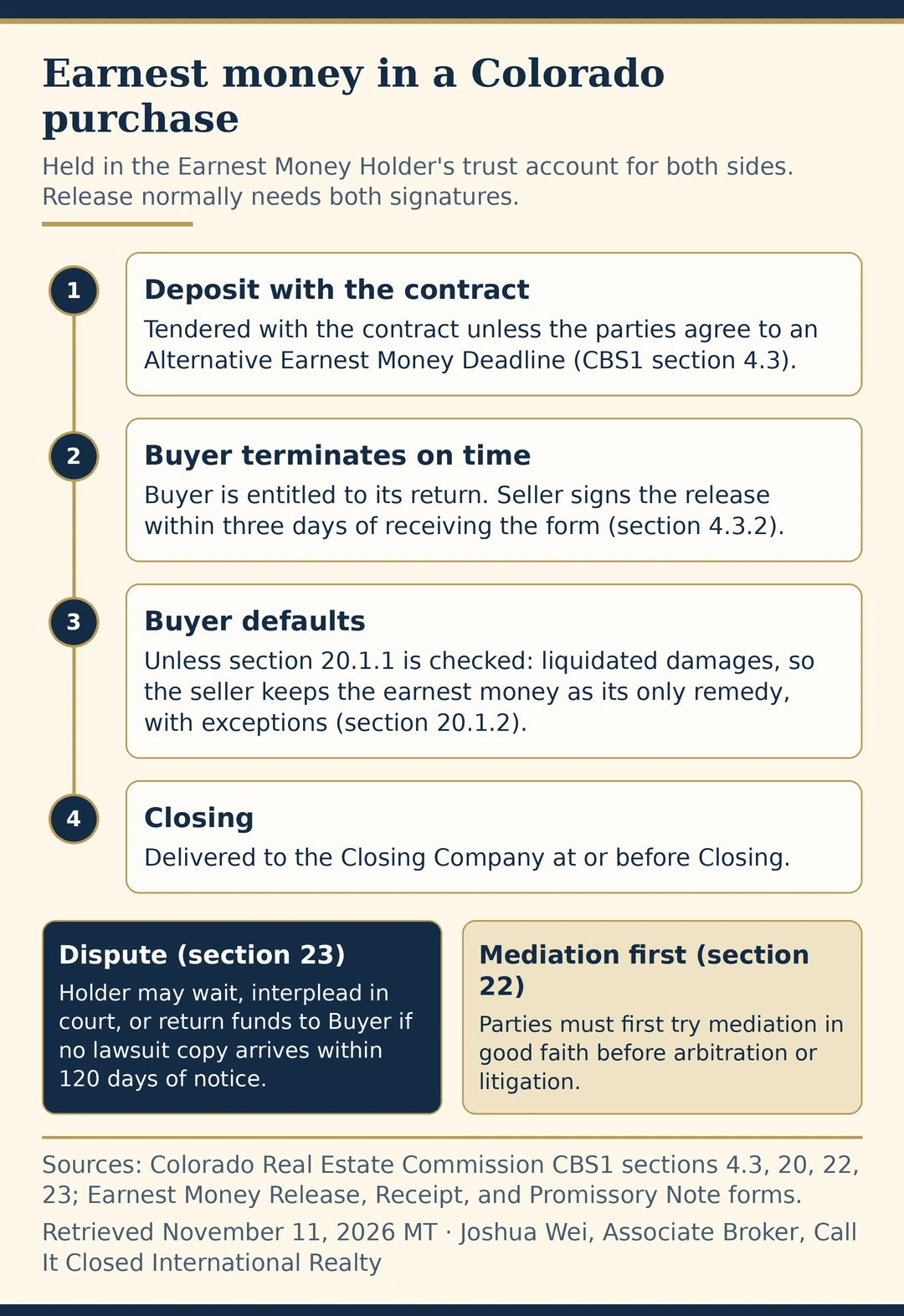
A vertical flow diagram, cream background with navy type and gold accents, titled Earnest money in a Colorado purchase, with the subtitle held in the Earnest Money Holder's trust account for both sides, and release normally needs both signatures. Four numbered steps: 1, deposit with the contract, tendered with the contract unless the parties agree to an Alternative Earnest Money Deadline under CBS1 section 4.3; 2, buyer terminates on time, so the buyer is entitled to its return and the seller signs the release within three days of receiving the form under section 4.3.2; 3, buyer defaults, where unless section 20.1.1 is checked liquidated damages apply and the seller keeps the earnest money as its only remedy, with exceptions, under section 20.1.2; 4, closing, when it is delivered to the Closing Company at or before Closing. Two lower cards: dispute under section 23, where the holder may wait, interplead in court, or return funds to the buyer if no lawsuit copy arrives within 120 days of notice; and mediation first under section 22, where the parties must first try mediation in good faith before arbitration or litigation. Sources: Colorado Real Estate Commission contract and forms. Retrieved November 11, 2026 MT.
Sources: DRE contracts and forms (opens in a new tab); Earnest Money Release (opens in a new tab)
Cream background, navy text, gold rules. Four numbered steps on a gold spine, two side-by-side cards, and a 28px source footer.
The diagram above traces earnest money from deposit to release, and the dispute path if the parties disagree. It summarizes CBS1 and the Commission forms.
When is earnest money due?
Section 4.3 says: "The Earnest Money must be tendered, by Buyer, with this Contract unless the parties mutually agree to an Alternative Earnest Money Deadline for its payment."
The holder confirms receipt. The Commission's Earnest Money Receipt (opens in a new tab) has the holder acknowledge the deposit, "to be held by Earnest Money Holder in its trust account, on behalf of both Seller and Buyer."
Section 20 treats a missed payment seriously: "If any payment due, including Earnest Money, is not paid, honored or tendered when due, or if any obligation is not performed timely as provided in this Contract or waived, the non-defaulting party has the following remedies."
What if the parties agree on a later deadline?
Section 4.3.1 says: "The deadline for delivering the Earnest Money, if other than at the time of tender of this Contract, is as set forth as the Alternative Earnest Money Deadline." The date goes in the contract's dates and deadlines table, and the Section 20 default language above applies if it is missed.
Who is responsible for the deposit once it is held?
The contract leaves a blank to name the Earnest Money Holder. Colorado law and Commission rules then add duties for brokers and brokerage firms that receive it.
- The designated broker. Under Colorado Revised Statutes section 12-10-203(7) (opens in a new tab), the broker designated for a partnership, limited liability company, or corporation "is personally responsible for the handling of any and all earnest money deposits or escrow or trust funds received or disbursed by the partnership, limited liability company, or corporation." The same subsection says a person "aggrieved or damaged by the breach of fiduciary duty shall have a claim for relief against the partnership, limited liability company, or corporation, as well as against the designated broker."
- Rule definitions. The Commission's rules, 4 CCR 725-1 (opens in a new tab), Rule 1.36, define "Money Belonging to Others" to include money received "in connection with licensed duties," listing among other things "security deposits, or earnest money deposits."
- Delivery. Chapter 6 of the rules states: "Any Broker receiving earnest money must deliver earnest money as set forth in Rule 5.12.A."
- Disbursement. The same rule says that, "Pursuant to section 38-35-125, C.R.S, a Broker or a Brokerage Firm must not disburse or authorize disbursement of funds until those funds have been received" and are available for immediate withdrawal as the rule describes.
The Earnest Money Receipt ties the holder to the contract's dispute terms: "until Closing Instructions have been signed by Buyer, Seller and Earnest Money Holder, section 23 (Earnest Money Dispute) and section 24 (Termination) of the Contract to Buy and Sell Real Estate will apply to the holding of the Earnest Money by Earnest Money Holder."
Can earnest money be a promissory note?
Section 4.3 leaves a blank for "the form of" earnest money. The Commission publishes an Earnest Money Promissory Note (opens in a new tab). It states: "This note is given as earnest money for the contract on the following property." It also says: "If this note is not paid when due, I/we agree to pay all reasonable costs of collection, including attorney's fees."
Ask your broker and the seller's broker whether a note is acceptable before you offer one.
How does a buyer get it back after terminating?
Section 4.3.2 requires the seller's cooperation. After a buyer's timely termination, "Seller agrees to execute and deliver to Buyer or Broker working with Buyer, written mutual instructions (e.g., Earnest Money Release form), within three days of Seller's receipt of such form."
Failing to sign has consequences. Under section 4.3.2.1: "If Seller fails to timely execute and return the Earnest Money Release Form, or other written mutual instructions, Seller is in default," unless the seller is entitled to the money because of a buyer default. Section 4.3.2.2 applies the same rule to a buyer who fails to release money the seller is owed. The seller-side duty is in section 4.3.2: if the seller is entitled to the money, "Buyer agrees to execute and return to Seller or Broker working with Seller, written mutual instructions (e.g., Earnest Money Release form), within three days of Buyer's receipt."
How termination works
Under section 24.1, termination "is effective upon the other party's receipt of a written notice to terminate (Notice to Terminate), provided such written notice was received on or before the applicable deadline specified in this Contract." A late notice does not work: "Any Notice to Terminate delivered after the applicable deadline specified in the Contract is ineffective and does not terminate this Contract." And if no notice arrives in time, the party "accepts the specified matter, document or condition as satisfactory and waives the Right to Terminate under such provision."
Section 24.2 covers what happens next: "In the event this Contract is terminated, all Earnest Money received hereunder must be timely returned to Buyer and the parties are then relieved of all obligations hereunder, subject to sections 10.4. and 21."
The Commission's Earnest Money Release (opens in a new tab) form sets out how the money "will be distributed" and includes a "Mutual Release" of claims, except claims under the contract's "Damage, Liens and Indemnity" section. A checkbox allows: "If this box is checked, the parties do NOT release each other of liability from the Contract." The form adds: "This Earnest Money Release may affect legal rights or claims of the parties. Buyer and Seller are advised of their right to obtain legal counsel."
The form's header reads: "THIS FORM HAS IMPORTANT LEGAL CONSEQUENCES AND THE PARTIES SHOULD CONSULT LEGAL AND TAX OR OTHER COUNSEL BEFORE SIGNING." It also has a line for interest: "If the Contract required the Earnest Money to be placed in an interest-bearing account, the interest shall be disbursed as follows."
What if the buyer defaults?
CBS1 offers two seller remedies, chosen by checkbox:
- Liquidated damages (the default). Section 20.1.2 "applies unless the box in section 20.1.1. is checked." The seller may cancel and keep the earnest money. "It is agreed that the Earnest Money amount specified in section 4.1. is LIQUIDATED DAMAGES and not a penalty," and, with stated exceptions, it is "SELLER'S ONLY REMEDY for Buyer's failure to perform the obligations of this Contract."
- Specific performance. If section 20.1.1 is checked, the seller may keep the earnest money and "recover such additional damages as may be proper," or instead treat the contract as in effect and seek "specific performance or damages, or both."
The full liquidated damages clause adds that the amount is one "the parties agree is fair and reasonable," and says: "Seller expressly waives the remedies of specific performance and additional damages." Under the specific performance option in section 20.1.1, "all Earnest Money (whether or not paid by Buyer) will be paid to Seller and retained by Seller."
If the seller defaults, section 20.2.1 lets the buyer cancel, in which case "all Earnest Money received hereunder will be returned to Buyer and Buyer may recover such damages as may be proper."
What happens in a dispute?
Under section 23: "In the event of any controversy regarding the Earnest Money, Earnest Money Holder is not required to release the Earnest Money." The holder may:
- "wait for any proceeding between Buyer and Seller"
- "interplead all parties and deposit Earnest Money into a court of competent jurisdiction"
- give notice that unless it receives a copy of a lawsuit "within one hundred twenty days of Earnest Money Holder's notice to the parties, Earnest Money Holder is authorized to return the Earnest Money to Buyer."
If the holder interpleads, the contract says the "Earnest Money Holder is entitled to recover court costs and reasonable attorney and legal fees incurred with such action." If a lawsuit is filed and the holder "has not interpled the monies at the time of any Order, Earnest Money Holder must disburse the Earnest Money pursuant to the Order of the Court." Section 23 "will survive cancellation or termination of this Contract."
Section 23 also says: "The parties reaffirm the obligation of section 22 (Mediation)." Section 22 says the parties "must first proceed, in good faith, to mediation before proceeding to arbitration or litigation."
Mediation and legal fees
Section 22 describes mediation as "a process in which the parties meet with an impartial person who helps to resolve the dispute informally and confidentially," and says "Mediators cannot impose binding decisions." The parties "will jointly appoint an acceptable mediator and will share equally in the cost of such mediation." The obligation to mediate, "unless otherwise agreed, will terminate if the entire dispute is not resolved within thirty days of the date of written notice requesting mediation."
Mediation does not freeze everything. Section 22 says: "Nothing in this Section prohibits either party from filing a lawsuit and recording a lis pendens affecting the Property, before or after the date of written notice requesting mediation." It also says: "This Section will not alter any date in this Contract, unless otherwise agreed."
Section 21 then sets the fee rule: "in the event of any arbitration or litigation relating to this Contract, prior to or after Closing Date, the arbitrator or court must award to the prevailing party all reasonable costs and expenses, including attorney fees, legal fees and expenses."
An invented example
This example is invented; it is not a real transaction.
A buyer signs a CBS1 contract on a Denver condo and tenders earnest money with the contract. The holder signs an Earnest Money Receipt. During the inspection period the buyer delivers a written Notice to Terminate before the Inspection Termination Deadline.
- Termination is effective on the seller's receipt of the notice under section 24.1, because it arrived on time.
- The buyer's broker sends the seller an Earnest Money Release form.
- Under section 4.3.2 the seller has "three days of Seller's receipt of such form" to sign and return it.
- If the seller signs, the holder releases the money under section 23 on the written mutual instructions.
- If the seller does not sign and disputes the termination, section 23 lets the holder wait, interplead, or send the 120-day notice, and section 22 sends the parties to mediation first.
Whether a specific termination was valid is a question for a Colorado real estate attorney.
Checklist for buyers and sellers
- Confirm who is named as Earnest Money Holder and the form of the deposit in section 4.3.
- Note whether an Alternative Earnest Money Deadline is set under section 4.3.1.
- Get a signed Earnest Money Receipt.
- Calendar every termination deadline; a late Notice to Terminate "is ineffective."
- Deliver notices in writing as section 26 requires.
- Read the Earnest Money Release, including the mutual release and the checkbox, before signing.
- In a dispute, start with section 22 mediation and talk with an attorney.
Related: Denver home prices and seller concessions (opens in a new tab).
Frequently asked questions
Who holds my earnest money?
Whoever is named as Earnest Money Holder in section 4.3, "in its trust account, on behalf of both Seller and Buyer."
Does earnest money go toward my purchase?
Section 4.3 authorizes "delivery of the Earnest Money to the company conducting the Closing (Closing Company), if any, at or before Closing." Your closing statement shows how it is applied.
How fast must a seller sign the release after I terminate?
Section 4.3.2 says "within three days of Seller's receipt of such form."
Can the seller keep my deposit if my loan falls through?
Section 5.2.2 warns that if the seller is not in default and does not timely receive the buyer's notice, "BUYER'S EARNEST MONEY WILL BE NONREFUNDABLE, except as otherwise provided in this Contract (e.g., Appraisal, Title, Survey)." A specific situation is a question for a Colorado real estate attorney.
Does my earnest money earn interest?
Section 4.3 addresses holders that send interest "to a fund established for the purpose of providing affordable housing to Colorado residents." Ask the holder how your deposit is held.
Can my broker's brokerage keep part of my deposit if the seller backs out?
Commission Rule 6.22.A says that if the seller "fails, refuses, neglects, or is unable to consummate the transaction" and, "through no fault or neglect of the buyer," it cannot be completed, "the Brokerage Firms representing the Clients in the transaction" "have no right to any portion of the earnest money deposit which was deposited by the buyer."
Does the release end every claim?
The form carves out one category. The Earnest Money Release says the parties "do not release each other from any claims arising under the Section titled" Damage, Liens and Indemnity, which "specifically survive this Earnest Money Release." A checkbox also lets the parties keep liability under the contract.
Can we change the earnest money amount or deadline after signing?
Section 25 says: "No subsequent modification of any of the terms of this Contract is valid, binding upon the parties, or enforceable unless made in writing and signed by the parties." Ask your broker about the Commission's amendment form.
Should I sign an earnest money release?
The form says it "may affect legal rights or claims of the parties." Ask an attorney if you are unsure.
Related notes
- Colorado purchase contract deadlines, in plain English
- Why you can't bring a personal check to closing: Colorado's good funds law for Denver and Aurora buyers and sellers
- Wire fraud at closing: how Denver and Aurora buyers can protect their down payment
Sources and method
Official sources, retrieved November 11, 2026, America/Denver: the Colorado Real Estate Commission's Contract to Buy and Sell Real Estate (Residential) (CBS1), sections 4.3, 5.2.2, 20, 22, and 23; the Commission's Earnest Money Release (opens in a new tab) (EMR 83-6-21), Earnest Money Receipt (opens in a new tab) (EM9-6-23), and Earnest Money Promissory Note (opens in a new tab), all from the Division of Real Estate contracts and forms page (opens in a new tab). Added November 13, 2026: CBS1 2026 PDF (opens in a new tab) sections 4.3.1, 4.3.2, 20.1, 21, 22, 23, and 24; Colorado Revised Statutes section 12-10-203(7) (opens in a new tab) (2026 Colorado Revised Statutes, Title 12); and Commission rules 4 CCR 725-1 (opens in a new tab) Rules 1.36, 6.22.A, and the closing rule on earnest money delivery and disbursement. Quotations are verbatim. No typical deposit amounts are suggested.
This note is general education from a Colorado real estate broker with Call It Closed International Realty. If you are writing an offer in Denver or Aurora, I can help you think through the earnest money amount, form, and deadlines.
Disclaimer
This article is general information only. It is not legal, tax, lending, insurance, appraisal, inspection, or financial advice, and it is not a substitute for advice about your situation. Joshua Wei is a Colorado real estate broker, not an attorney. Reading this article does not create a client relationship, an agency relationship, or an attorney-client relationship with Joshua Wei or with Call It Closed International Realty.
Laws, program rules, interest rates, insurance terms, tax figures, and other details change. Examples in this article are hypothetical illustrations unless a source is named for a specific, dated figure. Information in this article is believed accurate as of November 13, 2026 and is not guaranteed. No result is promised, and you should not rely on this article as the last word for your situation.
Before you act, confirm the point with the official source linked or cited in this article, and talk with a licensed professional who can apply the rule to your facts. That may be a licensed attorney, a tax professional, a lender, an insurance agent, a home inspector, or another licensed professional, depending on the question. Links to third-party websites and publications are provided for reference only. They are not an endorsement, and their content can change.
If you already have a brokerage relationship with another broker, this is not a solicitation.
Joshua Wei, Associate Broker, Call It Closed International Realty, Colorado license FA.100108558. Equal Housing Opportunity.