October 28, 2026 · Denver · Aurora · Closing · Buying · Selling
Why you can't bring a personal check to closing: Colorado's good funds law for Denver and Aurora buyers and sellers
Colorado law limits when a closing company can disburse money. What C.R.S. 38-35-125 and the Colorado purchase contract say about wires, cashier's checks, instant payments, and how sellers receive proceeds.
The short answer
In brief: Colorado has a good funds statute. Under C.R.S. 38-35-125(2), a company providing closing and settlement services may not disburse funds until they have been received and are available for immediate withdrawal, as the statute defines. That is why Denver and Aurora buyers are asked for wired or certified funds rather than a personal check.
Colorado has a "good funds" statute. Under C.R.S. 38-35-125(2) (opens in a new tab), "No person or entity that provides closing and settlement services for a real estate transaction shall disburse funds as a part of such services until those funds have been received and are either: Available for immediate withdrawal as a matter of right from the financial institution in which the funds have been deposited; or available for immediate withdrawal as a consequence of an agreement of a financial institution ..."
Questions about how to send cash to close go to the closing company, using contact details verified as the Consumer Financial Protection Bureau's closing scams guidance describes: "by using the phone number you previously agreed to."
I am a licensed Colorado real estate broker with Call It Closed International Realty. I am not an attorney or a lender. This is not legal advice.
Disclaimer. This article is general information only. It is not legal, tax, lending, insurance, appraisal, inspection, or financial advice, and reading it does not create a client, agency, or attorney-client relationship. Laws, rates, programs, and figures change. Confirm the official source, and talk with a licensed attorney, tax professional, lender, insurance agent, or inspector before you act. Joshua Wei is a Colorado real estate broker, not an attorney. He is an Associate Broker with Call It Closed International Realty, license FA.100108558. Equal Housing Opportunity.
 Full size (opens in a new tab)
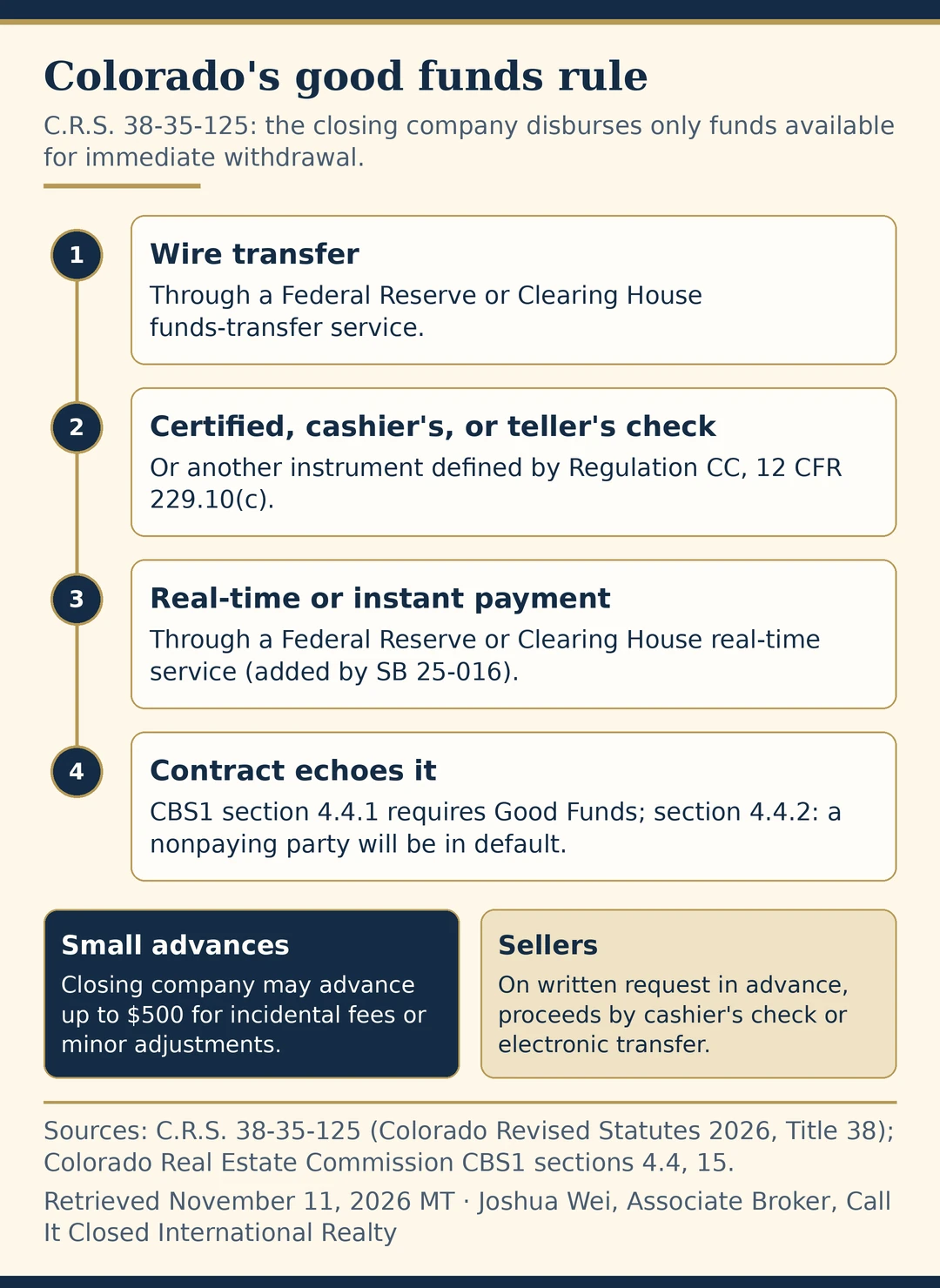
A vertical flow diagram, cream background with navy type and gold accents, titled Colorado's good funds rule, with the subtitle C.R.S. 38-35-125: the closing company disburses only funds available for immediate withdrawal. Four numbered steps: 1, wire transfer through a Federal Reserve or Clearing House funds-transfer service; 2, certified, cashier's, or teller's check, or another instrument defined by Regulation CC, 12 CFR 229.10(c); 3, real-time or instant payment through a Federal Reserve or Clearing House real-time service, added by SB 25-016; 4, the contract echoes it, CBS1 section 4.4.1 requires Good Funds and section 4.4.2 says a nonpaying party will be in default. Two lower cards: small advances, the closing company may advance up to 500 dollars for incidental fees or minor adjustments; and sellers, on written request in advance, proceeds by cashier's check or electronic transfer. Sources: C.R.S. 38-35-125 and Colorado Real Estate Commission CBS1. Retrieved November 11, 2026 MT.
Sources: C.R.S. Title 38 (PDF) (opens in a new tab); CREC contracts and forms (opens in a new tab)
Cream background, navy text, gold rules. Four numbered steps on a gold spine, two side-by-side cards, and a 28px source footer.
The diagram above summarizes what the statute and the Colorado Real Estate Commission's purchase contract say about closing funds.
What counts as good funds?
Subsection (1)(a) of the statute says "Available for immediate withdrawal as a matter of right" includes:
- "A wire transfer made through a funds-transfer service operated by the federal reserve or the Clearing House Payments Company;"
- "A certified check, cashier's check, teller's check, or any other instrument as defined by federal regulation CC, 12 CFR 229.10 (c); and"
- "A real-time or an instant payment made through a funds-transfer service operated by the federal reserve or the Clearing House Payments Company's real-time payments system."
The statute's source note lists a 2025 amendment to (1)(a) by SB 25-016, effective August 6, 2025.
Which banks count?
The funds have to sit in, or be drawn on, a "financial institution." Subsection (1)(b) defines that as "an entity that is authorized under the laws of this state, another state, or the United States to make loans and receive deposits and has its deposits insured by the federal deposit insurance corporation or its successor or the national credit union share insurance fund." A bank or credit union that is authorized to make loans and take deposits, and whose deposits carry that insurance, fits the definition. The statute's list does not name a brokerage account, a payment app, or a cryptocurrency wallet. If your money sits somewhere like that, ask the closing company early how it wants the money moved into an account it will accept.
Where the federal check rule fits
The statute's check category points to "federal regulation CC, 12 CFR 229.10 (c)." That federal section, titled "Certain check deposits," sets a general rule (opens in a new tab): "A depositary bank shall make funds deposited in an account by check available for withdrawal not later than the business day after the banking day on which the funds are deposited," for the listed types of checks. One listed type is "A cashier's, certified, or teller's check deposited-(A) In an account held by a payee of the check; (B) In person to an employee of the depositary bank; and (C) With a special deposit slip or deposit envelope, if such slip or envelope is required by the depositary bank."
Paragraph (c)(2) covers "Checks not deposited in person." For those, the bank must make the funds available "not later than the second business day after the banking day on which funds are deposited." A personal check drawn on a different bank is not one of the listed check types. Item (vii) gives next-day availability only to a small portion of other check deposits: the lesser of $225 or that day's total of such checks. Your closing company decides how it handles the timing of a cashier's check it receives, so ask how far ahead of closing it needs one.
The second path: an agreement with a bank
Subsection (2) also allows disbursement when funds are "available for immediate withdrawal as a consequence of an agreement of a financial institution in which the funds are to be deposited or a financial institution upon which the funds are to be drawn." It adds: "Any such agreement shall be made with or for the benefit of the person or entity providing closing and settlement services for a real estate transaction." The statute's text is about the closing company's arrangement with a bank. It does not describe a buyer arranging this on their own.
What does the purchase contract say?
The Commission's Contract to Buy and Sell Real Estate (Residential), CBS1 (opens in a new tab), section 4.4.1, says: "All amounts payable by the parties at Closing, including any loan proceeds, Cash at Closing and closing costs, must be in funds that comply with all applicable Colorado laws, including wire transfers, certified check, teller’s check, cashier’s check, and real-time or instant payment (Good Funds)."
Section 4.4.2 adds that funds "must be paid before or at Closing or as otherwise agreed in writing between the parties to allow disbursement by Closing Company at Closing OR SUCH NONPAYING PARTY WILL BE IN DEFAULT."
Section 4.4.3 asks the buyer to check whether they "Does" or "Does Not have funds that are immediately verifiable and available in an amount not less than the amount stated as Cash at Closing."
Other sections tie back to the same term. Section 15.1 says: "Buyer and Seller must pay, in Good Funds, their respective closing costs and all other items required to be paid at Closing, except as otherwise provided herein." Section 12.1 says: "Buyer and Seller will furnish any additional information and documents required by Closing Company that will be necessary to complete this transaction." Section 13 says the seller must deliver the deed "Subject to Buyer's compliance with the terms and provisions of this Contract, including the tender of any payment due at Closing."
Earnest money is handled differently. Section 4.3 leaves a blank for the form of payment: "The Earnest Money set forth in this Section, in the form of a , will be payable to and held by __ (Earnest Money Holder), in its trust account, on behalf of both Seller and Buyer." It also says: "The parties authorize delivery of the Earnest Money to the company conducting the Closing (Closing Company), if any, at or before Closing." Read your own contract to see what form of earnest money was agreed. The earnest money article covers deadlines and disputes.
What the Commission's Closing Instructions say
Section 12.2 of the contract has a checkbox: "Colorado Real Estate Commission's Closing Instructions Are Are Not executed with this Contract." The Commission's Closing Instructions form, CL8 (opens in a new tab) (mandatory use date January 1, 2026), has several provisions about funds.
- Conflicts. "In the event of any conflict between these Closing Instructions and the Contract, these Closing Instructions control, subject to subsequent amendments to the Contract or these Closing Instructions." It adds: "The Buyer's lender may enter into separate closing instructions with the Closing Company regarding the closing of the Buyer's loan."
- Release. Section 6: "Closing Company is not authorized to release any signed documents or things of value prior to receipt and disbursement of Good Funds, except as provided in sections 10, 11 and 12."
- Disburser. Section 7: "Closing Company must disburse all funds, including real estate commissions, except those funds as may be separately disclosed in writing to Buyer and Seller by Closing Company or Buyer's lender on or before closing." It continues: "All parties agree that no one other than the disburser can assure that the payoff of loans and other disbursements will actually be made."
- Seller's net proceeds. Section 8 gives checkboxes: "Cashier's Check, at Seller's expense," "Funds Electronically Transferred (wire transfer) to an account specified by Seller, at Seller's expense," or "Closing Company's trust account check."
- Earnest money. Section 11 says a release under written mutual instructions "must be made within five days of Closing Company's receipt of the written mutual instructions signed by both Buyer and Seller, provided the Earnest Money check has cleared." Section 12 says: "In no event shall Closing Company be required to return Earnest Money deposits to Buyer until funds deposited are verified, credited to the Closing Company escrow or trust account, and available for immediate withdrawal as a matter of right."
Section 9 of CL8 is a fraud warning: "Caution: Wire and other frauds are a significant risk in real estate transactions." It says: "Wire instructions should only be sent by the Closing Company to the Buyer or Seller via encrypted e-mails or encrypted web portals that require end-user authentication (i.e., password protected)." And: "To protect against fraud, money should never be wired based on email instructions alone, and wire transfer details and payment instructions should always be verified in person or by telephone using a trusted and independently verified contact number."
Is there any wiggle room?
The statute says the closing company "may advance funds, not to exceed five hundred dollars, on behalf of interested parties for the transaction to pay incidental fees for such items as tax certificates and recording costs or to cover minor changes in the closing adjustments."
Subsection (3) lets the seller waive the requirement only if, in advance written closing instructions, the closing company "is not to handle the receipt and disbursement of funds as part of the closing," and any lienholder agrees in writing to release its lien "regardless of whether the payoff check received has been or will be honored."
How do sellers get paid?
Subsection (4): "Any seller who so requests as part of written closing instructions in advance of closing shall be entitled to receive the proceeds of closing in a cashier's check or in funds electronically transferred to an account specified by the seller."
Section 8 of the CL8 form adds a third checkbox, "Closing Company's trust account check." The statute's subsection (4) names a cashier's check or an electronic transfer as what a seller is "entitled to receive" on request. If you want one of those two, put the request in your written closing instructions before closing, as subsection (4) says.
Related: Seller concessions post (opens in a new tab).
Frequently asked questions
Can I pay my cash to close with a personal check?
A personal check isn't on the statute's list in (1)(a). Ask your closing company what it will accept and when.
What if a closing company ignores the rule?
Subsection (5): "Failure to comply with the provisions of this section shall be deemed a deceptive trade practice, as provided in section 6-1-105 (1)(v), C.R.S."
Who enforces it?
The same subsection says "the attorney general or a district attorney may apply to the appropriate district court of this state for an order to effect the purposes of this section."
Who pays the closing company's fee?
That's negotiated. CBS1 section 15.2 says: "The fee for real estate closing services must be paid at Closing by" Buyer, Seller, one-half each, or Other, as checked in the contract.
What does "closing and settlement services" mean?
The statute defines it as services that benefit the parties to a real property sale, lease, or loan, and "the receipt and disbursement of money in connection with any sale, lease, encumbrance, mortgage, or deed of trust."
How do I avoid wire fraud?
The Consumer Financial Protection Bureau's closing scams guidance (opens in a new tab) says: "Never follow instructions contained in an email. Verify the closing instructions, including the account name and number, with your trusted representatives either in person or by using the phone number you previously agreed to."
Can the closing company cover a small shortfall?
Only within the statute's limit. The closing company "may advance funds, not to exceed five hundred dollars," and only for the listed purposes: "to pay incidental fees for such items as tax certificates and recording costs or to cover minor changes in the closing adjustments." A larger gap has to be covered with good funds before disbursement.
Can I pay with a real-time or instant payment?
The statute has listed "A real-time or an instant payment made through a funds-transfer service operated by the federal reserve or the Clearing House Payments Company's real-time payments system" since the 2025 amendment, and CBS1 section 4.4.1 lists "real-time or instant payment." Ask your closing company whether it accepts them and what limits apply before you count on one.
What should I do if I think I wired money to a scammer?
The CFPB guidance says: "Contact your bank or wire-transfer company immediately" and "Ask for a wire recall." It adds: "Reporting the error as soon as possible can increase the likelihood that you'll be able to recover your money." It also says to "File a complaint with the FBI" through the Internet Crime Complaint Center at www.ic3.gov.
The FBI's 2025 IC3 annual report (opens in a new tab) describes one case: "In August 2025, the RAT received a complaint reporting a BEC/Real Estate incident. The individuals were closing on a home when they received an email impersonating their legitimate attorneys." The report says a wire "for over $449,000" was sent, and after the complaint was filed, "The RAT received notification from the recipient bank that the full amount was still in the account and on hold." (RAT is the IC3 Recovery Asset Team.) The same report lists 12,368 "Real Estate" complaints and $275,110,419 in reported "Real Estate" losses for 2025. The report defines that category as "Loss of funds from a real estate investment or fraud involving rental or timeshare property." So those totals are not a count of closing wire fraud alone.
How to prepare: a checklist
- Read CBS1 section 4.4 in your signed contract, including the section 4.4.3 box on available funds.
- Check section 12.2 to see whether the Commission's Closing Instructions were signed, and read CL8 sections 6–9 if they were.
- Ask the closing company which forms of payment it accepts, how far ahead it needs them, and whether it takes real-time or instant payments.
- Line up the transfer with your bank early, and ask the bank about its wire cutoff time and any transfer limit on your account.
- Verify wire instructions by phone using a number you already had, as the CFPB and CL8 section 9 say. Do not use a number from an email.
- Sellers: put your choice of cashier's check or wire in written closing instructions before closing, per C.R.S. 38-35-125(4).
- Keep receipts for the wire or cashier's check until you see the funds on your closing statement.
An invented example
This example is invented; it is not a real transaction.
A buyer in Aurora has $62,000 cash to close, with closing set for a Friday. On Wednesday she asks whether she can bring a personal check. The closing company says no and points to C.R.S. 38-35-125(2) and CBS1 section 4.4.1. She calls the closing company's main number from its website, not a number from an email, to confirm the wire instructions. Her bank sends the wire Thursday morning, and the closing company confirms it arrived. At the table, a $140 recording-fee change comes up. That falls within the statute's $500 advance limit for "minor changes in the closing adjustments," so the closing company can advance it if it chooses. The seller had asked in writing for a wire of her proceeds, and she receives one under subsection (4).
Related notes
- Wire fraud at closing: how Denver and Aurora buyers can protect their down payment
- Closing costs in Denver and Aurora: what is set by law, what is negotiated, and what to read on the forms
- Earnest money in Colorado: who holds it, when you get it back, and what happens in a dispute
Sources and method
Official sources, retrieved November 11, 2026, America/Denver:
- C.R.S. 38-35-125, Colorado Revised Statutes 2026, Title 38 (official OLLS PDF) (opens in a new tab)
- Colorado Real Estate Commission, Contract to Buy and Sell Real Estate (Residential), CBS1, sections 4.4 and 15 (opens in a new tab)
- Consumer Financial Protection Bureau, Mortgage closing scams (opens in a new tab)
Added November 13, 2026: the full text of C.R.S. 38-35-125(1)(b), (2) and (4) (Title 38 (opens in a new tab)); the 2026 CBS1 contract PDF (opens in a new tab) sections 4.3, 4.4, 12, 13 and 15.1; the Commission's CL8 Closing Instructions (opens in a new tab) sections 1, 6–9, 11 and 12; 12 CFR 229.10(c) (opens in a new tab); further passages of the CFPB closing scams guidance (opens in a new tab); and the FBI's 2025 IC3 annual report (opens in a new tab).
Quotations are verbatim. Contract forms are revised from time to time, so confirm the version on your contract.
This note is general education from a Colorado real estate broker with Call It Closed International Realty. If you're buying or selling in Denver or Aurora, I can help you plan the funding steps with your closing company and lender well before closing day.
Disclaimer
This article is general information only. It is not legal, tax, lending, insurance, appraisal, inspection, or financial advice, and it is not a substitute for advice about your situation. Joshua Wei is a Colorado real estate broker, not an attorney. Reading this article does not create a client relationship, an agency relationship, or an attorney-client relationship with Joshua Wei or with Call It Closed International Realty.
Laws, program rules, interest rates, insurance terms, tax figures, and other details change. Examples in this article are hypothetical illustrations unless a source is named for a specific, dated figure. Information in this article is believed accurate as of November 13, 2026 and is not guaranteed. No result is promised, and you should not rely on this article as the last word for your situation.
Before you act, confirm the point with the official source linked or cited in this article, and talk with a licensed professional who can apply the rule to your facts. That may be a licensed attorney, a tax professional, a lender, an insurance agent, a home inspector, or another licensed professional, depending on the question. Links to third-party websites and publications are provided for reference only. They are not an endorsement, and their content can change.
If you already have a brokerage relationship with another broker, this is not a solicitation.
Joshua Wei, Associate Broker, Call It Closed International Realty, Colorado license FA.100108558. Equal Housing Opportunity.