October 6, 2026 · Denver · Aurora · Buying · Selling
Wire fraud at closing: how Denver and Aurora buyers can protect their down payment
Criminals spoof emails from agents and title companies to redirect closing funds. What the FBI's IC3 and the CFPB say about real estate wire fraud, how to verify wiring instructions, and what to do in the first hours if money goes to the wrong place.
The short answer
In brief: Real estate wire fraud starts with a spoofed email carrying new wiring instructions. The CFPB says never follow instructions contained in an email; verify the account name and number in person or by a phone number you already agreed on. If money goes out, the FBI's IC3 says time is of the essence: call your bank, then file at ic3.gov.
The most expensive email a homebuyer can get is a fake one with new wiring instructions. The Consumer Financial Protection Bureau's mortgage closing scams guidance (opens in a new tab) describes the pattern: "During the closing process, scammers send spoofed emails to homebuyers – posing as the real estate agent, settlement agent, legal representative or another trusted individuals – with false instructions for wiring closing funds."
Its core advice is direct: "Never follow instructions contained in an email. Verify the closing instructions, including the account name and number, with your trusted representatives either in person or by using the phone number you previously agreed to."
If money has already gone out, the FBI's Internet Crime Complaint Center (IC3 (opens in a new tab)) says: "If you discover a fraudulent transfer, time is of the essence." Call your bank first and ask for a recall, then file at ic3.gov.
I am a licensed Colorado real estate broker with Call It Closed International Realty. I am not a lawyer, a banker, or a law-enforcement official.
Disclaimer. This article is general information only. It is not legal, tax, lending, insurance, appraisal, inspection, or financial advice, and reading it does not create a client, agency, or attorney-client relationship. Laws, rates, programs, and figures change. Confirm the official source, and talk with a licensed attorney, tax professional, lender, insurance agent, or inspector before you act. Joshua Wei is a Colorado real estate broker, not an attorney. He is an Associate Broker with Call It Closed International Realty, license FA.100108558. Equal Housing Opportunity.
 Full size (opens in a new tab)
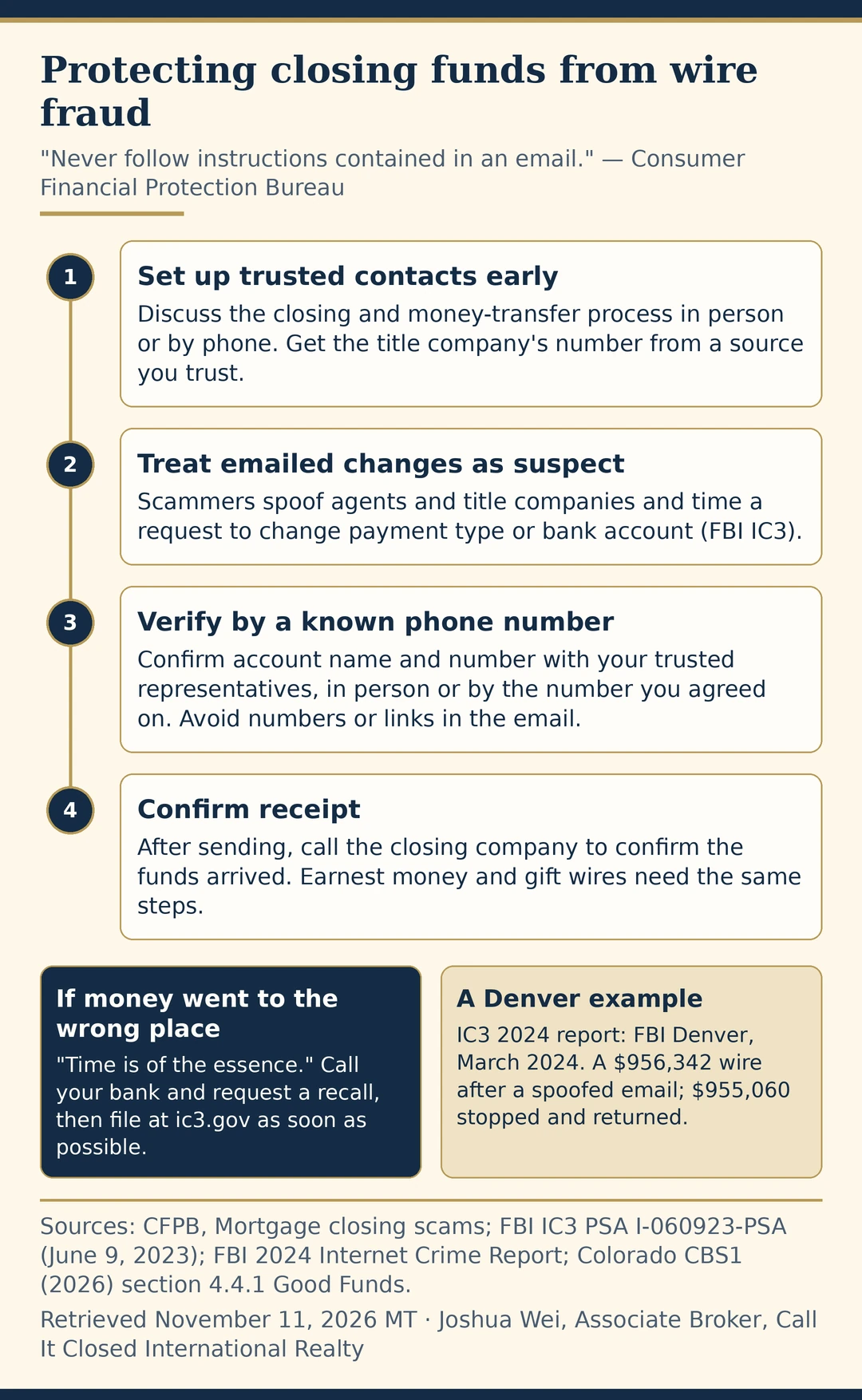
A vertical flow diagram, cream background with navy type and gold accents, titled Protecting closing funds from wire fraud, with the quotation never follow instructions contained in an email, from the Consumer Financial Protection Bureau. Four numbered steps: 1, set up trusted contacts early by discussing the closing and money-transfer process in person or by phone and getting the title company's number from a source you trust; 2, treat emailed changes as suspect, because scammers spoof agents and title companies and time a request to change payment type or bank account, per FBI IC3; 3, verify by a known phone number, confirming the account name and number with trusted representatives in person or by the number agreed on, and avoid numbers or links in the email; 4, confirm receipt by calling the closing company after sending, with earnest money and gift wires needing the same steps. Two lower cards: if money went to the wrong place, time is of the essence, so call your bank and request a recall, then file at ic3.gov as soon as possible; and a Denver example from the IC3 2024 report, FBI Denver, March 2024, where a 956,342 dollar wire was sent after a spoofed email and 955,060 dollars was stopped and returned. Sources: CFPB, FBI IC3, and the Colorado contract. Retrieved November 11, 2026 MT.
Sources: CFPB, Mortgage closing scams (opens in a new tab); FBI IC3 PSA I-060923-PSA (opens in a new tab); FBI 2024 Internet Crime Report (opens in a new tab)
Cream background, navy text, gold rules. Four numbered steps on a gold spine, two side-by-side cards, and a 28px source footer.
The diagram above shows a safe path for closing funds: agree on contacts early, distrust emailed changes, verify by a known phone number, and act within hours if something goes wrong. It summarizes CFPB and FBI IC3 guidance.
How does real estate wire fraud work?
The FBI calls it business email compromise (BEC). In a June 2023 public service announcement (opens in a new tab), IC3 explained: "The BEC scam targets all participants in real estate transactions,to include buyers, seller, real estate attorneys, title companies, and agents." Once criminals get into someone's email, "they are able to monitor the real estate proceeding and often time the fraudulent request for a change in payment type (frequently from check to wire transfer) or a change from one bank account to a different bank account under their control."
The CFPB adds that scammers seek "to compromise their email in order to monitor email correspondences with clients and identify upcoming real estate transactions." It warns that "scammers can closely replicate the email address, phone number and format of an exchange from your agents."
The same PSA reported that "From calendar years 2020 to 2022, there was a 27% increase in victim reports to the IC3 of BECs with a real estate nexus," and "a 72% increase in victim loss" over the same period.
There is a Denver example in the FBI's 2024 Internet Crime Report (opens in a new tab). In a "Financial Fraud Kill Chain" success story labeled FBI Denver, March 2024, buyers received a spoofed email from their supposed real estate agents and wired $956,342. Two days later they realized the instructions were fake, and IC3's Recovery Asset Team stopped $955,060, which was returned. That outcome depended on fast reporting. It is not guaranteed.
The FBI's 2025 Internet Crime Report (opens in a new tab) has a similar case: "In August 2025, the RAT received a complaint reporting a BEC/Real Estate incident. The individuals were closing on a home when they received an email impersonating their legitimate attorneys. A wire was submitted at their bank for over $449,000 and was sent to the recipient bank." After the IC3 complaint, the report says, "the RAT immediately initiated the FFKC to request a freeze of the fraudulent account at the recipient bank. The RAT received notification from the recipient bank that the full amount was still in the account and on hold." Note what happened first in that story: the buyers' bank and their attorneys tried the recipient bank "with negative results." The IC3 complaint is what triggered the freeze.
What the 2025 numbers show, and what they don't
The 2025 report lists 24,768 Business Email Compromise complaints with $3,046,598,558 in losses, and 12,368 Real Estate complaints with $275,110,419 in losses. Those are two separate crime types. The report's glossary defines Real Estate Fraud as "Loss of funds from a real estate investment or fraud involving rental or timeshare property." A spoofed closing email can land under Business Email Compromise instead, as the "BEC/Real Estate" label in the case above suggests. So neither number is a count of closing-wire thefts alone. The report also says complaint information "assists the IC3 Recovery Asset Team (RAT) Financial Fraud Kill Chain (FFKC) process when complaints are filed as quickly as possible."
For Colorado, the report lists 18,847 complaints and $355,049,719 in losses across all crime types in 2025.
How do I protect my closing funds?
The CFPB's checklist, quoted:
- "Ahead of your mortgage closing, discuss in person, or by phone, the closing process and money transfer protocols with these trusted individuals (realtor, settlement agent, etc.)."
- "Never follow instructions contained in an email."
- "Avoid using phone numbers or links in an email."
- "Email is never a secure way to send financial information."
- "When in doubt, always refer back to your trusted professionals to confirm whether it's legitimate."
IC3's suggestions include "Use secondary channels or two-factor authentication to verify requests for changes in account information" and "Be alert to hyperlinks that may contain misspellings of the actual domain name."
The CFPB's page adds three setup steps worth doing the week you go under contract:
- "Identify two trusted individuals to confirm the closing process and payment instructions."
- "You may want to use this opportunity to also create a code phrase, known only by these trusted parties, if you need a secure way to confirm their identities in the future."
- "Write down their names and contact information." The CFPB points to its Mortgage Closing Checklist as a place to list them.
It also warns about calls, not just email: "It may be difficult to identify whether a phone call is fraudulent or legitimate. Scammers may call and ask you to verify your personal or financial information." And about attachments: "Avoid clicking on any links or downloading attachments without first confirming with your trusted representatives."
IC3's PSA lists more checks, including "Verify the email address used to send emails, especially when using a mobile or handheld device, by ensuring the sender's address appears to match who it is coming from," and "Refrain from supplying login credentials or PII of any sort via email." On a phone, open the sender details and read the full address before acting on anything.
The PSA also says banks differ: "Different financial institutions have varying policies; it is important to know what assistance your financial institution will provide when attempting to recover funds." Before you wire, find your bank's fraud line and ask how it handles a recall request.
How the CFPB's steps line up with a Denver or Aurora purchase:
- Get the title company's phone number at the start, from its own website or your contract paperwork, not from a later email.
- Treat any change in wiring instructions as fraud until proven otherwise. Call the number you already have.
- Call again before you send money, read back the account details, and confirm after sending that the funds arrived.
- Earnest money and gift funds count too. Anyone wiring money for your purchase should follow the same steps.
The 2026 Colorado Contract to Buy and Sell Real Estate (Residential), section 4.4.1, says closing funds "must be in funds that comply with all applicable Colorado laws, including wire transfers, certified check, teller's check, cashier's check, and real-time or instant payment (Good Funds)." Ask your title company which methods it accepts and how it confirms them.
That contract language tracks Colorado's good funds statute. C.R.S. 38-35-125(2) (opens in a new tab) says: "No person or entity that provides closing and settlement services for a real estate transaction shall disburse funds as a part of such services until those funds have been received and are either: Available for immediate withdrawal as a matter of right from the financial institution in which the funds have been deposited," or available by a bank agreement. Subsection (1)(a) lists what counts, including "A wire transfer made through a funds-transfer service operated by the federal reserve or the Clearing House Payments Company" and "A certified check, cashier's check, teller's check, or any other instrument as defined by federal regulation CC." The statute governs when the closer can disburse. It doesn't verify who is asking you to send money; that part is up to you and the verified phone call.
Why does the account number matter so much?
Colorado's funds-transfer law, the state version of Uniform Commercial Code Article 4A, answers a specific question: what if the name and the account number on a wire don't match? C.R.S. 4-4.5-207(b)(1) (opens in a new tab) says that if the receiving bank "does not know that the name and number refer to different persons, it may rely on the number as the proper identification of the beneficiary of the order. The beneficiary's bank need not determine whether the name and number refer to the same person."
So a wire that names the right title company can land in a fraudster's account if the account number is theirs. That's why the CFPB's advice is to verify "the account name and number," not just the company name. What rights you have against a bank in a specific case is a question for a Colorado attorney.
What should I do if I wired money to a scammer?
IC3's guidance:
- "First, contact your financial institution and request a recall of the funds along with any necessary indemnification documents."
- "Regardless of the amount lost, file a complaint with www.ic3.gov, as soon as possible. The FBI IC3 will be able to assist both the financial institutions and law enforcement in possible recovery efforts."
Then call your title company and your broker using known numbers. Do not reply to the suspicious email thread.
A short incident checklist, built from the IC3 guidance above:
- Call your bank's fraud line. Ask for a recall and write down the time, the name of the person you spoke to, and any reference number.
- File at ic3.gov the same day. Include the wire date, amount, sending and receiving banks, the receiving account number, and the fraudulent email with its full sender address.
- Call the title company at the number you verified at the start, so it can alert its own bank and pause anything pending.
- Keep the emails. Don't delete the thread; investigators may need the headers.
- Change your email password and turn on two-factor authentication, since IC3 describes criminals who "monitor the real estate proceeding" from inside an account.
Who is targeted, and when?
IC3's PSA says the scam "targets all participants in real estate transactions,to include buyers, seller, real estate attorneys, title companies, and agents," and that criminals "often time the fraudulent request for a change in payment type (frequently from check to wire transfer) or a change from one bank account to a different bank account under their control." It adds: "The funds may also be transferred to a secondary fraudulent domestic or international account."
In a Colorado purchase, money moves at two points. The first is earnest money. Section 4.3 of the 2026 contract says "The Earnest Money must be tendered, by Buyer, with this Contract unless the parties mutually agree to an Alternative Earnest Money Deadline for its payment," and that it is "held by" the named Earnest Money Holder "in its trust account, on behalf of both Seller and Buyer." The second is the balance due at closing. Both can be targets, so verify the earnest money holder's instructions the same way as the closing wire. On the seller's side, the loan payoff and the proceeds wire move money too.
Are sellers at risk too?
Yes. IC3 lists sellers among the targets. A seller's payoff and proceeds can be redirected the same way. Give your title company your proceeds instructions in person or through its verified process, and confirm by phone with a number you already have.
A hypothetical
This example is invented. Two days before closing on an Aurora townhome, a buyer gets an email that appears to come from her title officer, with the right file number, a note saying the company changed banks this week, and a new account number. She doesn't reply or use the phone number in the email. She calls the title company's number from her contract paperwork, and the officer says no instructions have changed. The buyer forwards the email to the title company, reports it at ic3.gov, and wires to the original account after reading the account name and number back on the phone. The title company confirms receipt before closing.
Frequently asked questions
My agent emailed me wiring instructions. Is that normal?
Whoever sent it, do not act on the email alone. Verify by phone using a number you already know, as the CFPB advises, and confirm the details with the closing company.
Is a text message safer than email?
The CFPB warns that scammers can mimic phone numbers too. Verify through a channel you set up in advance.
Will my bank get the money back?
Maybe, if you act fast. IC3 says "time is of the essence." Recovery is not guaranteed.
Should I avoid wiring entirely?
The Colorado contract lists several forms of Good Funds. Ask your title company which ones it accepts.
Can I send closing money by instant payment instead of a wire?
C.R.S. 38-35-125(1)(a) counts "A real-time or an instant payment made through a funds-transfer service operated by the federal reserve or the Clearing House Payments Company's real-time payments system" as good funds. Whether your title company accepts it is up to the company. The same verification steps apply to any method.
What is a code phrase for?
The CFPB suggests creating "a code phrase, known only by these trusted parties," so you can confirm who you're talking to later. Agree on it in person or by a phone call you placed.
Who do I report to?
Your bank first, then www.ic3.gov, then your title company and broker.
If the name on the wire is right, am I safe?
Not necessarily. Under C.R.S. 4-4.5-207(b)(1), a receiving bank that doesn't know the name and number refer to different persons "may rely on the number." Verify the account number by phone.
Does title insurance cover wire fraud?
Coverage depends on the policy and the facts; ask the title company and a Colorado attorney.
Related notes
- Why you can't bring a personal check to closing: Colorado's good funds law for Denver and Aurora buyers and sellers
- Reading your title commitment: what Denver and Aurora buyers should check before the title objection deadline
- Earnest money in Colorado: who holds it, when you get it back, and what happens in a dispute
Sources and method
Official sources, retrieved November 11 and 13, 2026, America/Denver: CFPB, Mortgage closing scams: how to protect yourself and your closing funds (opens in a new tab); FBI IC3, Business Email Compromise: The $50 Billion Scam (opens in a new tab) (I-060923-PSA, June 9, 2023); FBI, 2024 Internet Crime Report (opens in a new tab) (the FBI Denver Recovery Asset Team example is summarized, not quoted, because the PDF's two-column layout prevents a clean verbatim extraction; figures were checked by hand against the report); FBI, 2025 Internet Crime Report (opens in a new tab); C.R.S. 38-35-125 (opens in a new tab) and C.R.S. 4-4.5-207 (opens in a new tab) (2026 Colorado Revised Statutes); Colorado Division of Real Estate forms page (opens in a new tab) (2026 Contract to Buy and Sell Real Estate (Residential) (opens in a new tab), section 4.4.1). Quotations are verbatim, including the CFPB's and IC3's original punctuation. The hypothetical, including the company name in the account-number example, is invented.
This note is general education from a Colorado real estate broker with Call It Closed International Realty. On every transaction, I set up phone verification with the title company before any money moves.
Disclaimer
This article is general information only. It is not legal, tax, lending, insurance, appraisal, inspection, or financial advice, and it is not a substitute for advice about your situation. Joshua Wei is a Colorado real estate broker, not an attorney. Reading this article does not create a client relationship, an agency relationship, or an attorney-client relationship with Joshua Wei or with Call It Closed International Realty.
Laws, program rules, interest rates, insurance terms, tax figures, and other details change. Examples in this article are hypothetical illustrations unless a source is named for a specific, dated figure. Information in this article is believed accurate as of November 13, 2026 and is not guaranteed. No result is promised, and you should not rely on this article as the last word for your situation.
Before you act, confirm the point with the official source linked or cited in this article, and talk with a licensed professional who can apply the rule to your facts. That may be a licensed attorney, a tax professional, a lender, an insurance agent, a home inspector, or another licensed professional, depending on the question. Links to third-party websites and publications are provided for reference only. They are not an endorsement, and their content can change.
If you already have a brokerage relationship with another broker, this is not a solicitation.
Joshua Wei, Associate Broker, Call It Closed International Realty, Colorado license FA.100108558. Equal Housing Opportunity.