September 7, 2026 · Colorado · HOA · Condos · Electric Vehicles · Denver · Aurora · Home Buying · Home Selling
Buying or selling a Colorado condo with an EV charger in the garage: who owns it, who maintains it, and what the HOA can require
When a Colorado condo or townhome has an owner-installed EV charger on a limited common element, C.R.S. 38-33.3-106.8(4) to (6) set the HOA consent conditions, pass repair, maintenance, removal and insurance duties to each successive owner, and make the charger the installing owner's property to remove or sell. Plus the parallel renter rule in C.R.S. 38-12-601.
The short answer
In brief: Colorado's HOA law on EV chargers, Colorado Revised Statutes section 38-33.3-106.8, addresses chargers on limited common elements such as an assigned garage stall. Under subsection (5), unless a written contract or the association's documents say otherwise, each successive unit owner with exclusive rights to that element assumes responsibility for the charger's repair, maintenance, removal and replacement until it is removed.
Colorado's HOA law on EV chargers, Colorado Revised Statutes section 38-33.3-106.8 (opens in a new tab), addresses chargers on limited common elements. Under subsection (5), if a charger sits on a limited common element, like an assigned garage stall or carport, then unless a written contract or the association's documents say otherwise, "each successive unit owner with exclusive rights to the limited common element shall assume responsibility for the repair, maintenance, removal, and replacement of the charging system until the system has been removed."
Subsection (6) says "A charging system installed at the unit owner's cost is property of the unit owner."
I am a licensed Colorado real estate broker with Call It Closed International Realty. I am not an attorney.
Disclaimer. This article is general information only. It is not legal, tax, lending, insurance, appraisal, inspection, or financial advice, and reading it does not create a client, agency, or attorney-client relationship. Laws, rates, programs, and figures change. Confirm the official source, and talk with a licensed attorney, tax professional, lender, insurance agent, or inspector before you act. Joshua Wei is a Colorado real estate broker, not an attorney. He is an Associate Broker with Call It Closed International Realty, license FA.100108558. Equal Housing Opportunity.
 Full size (opens in a new tab)
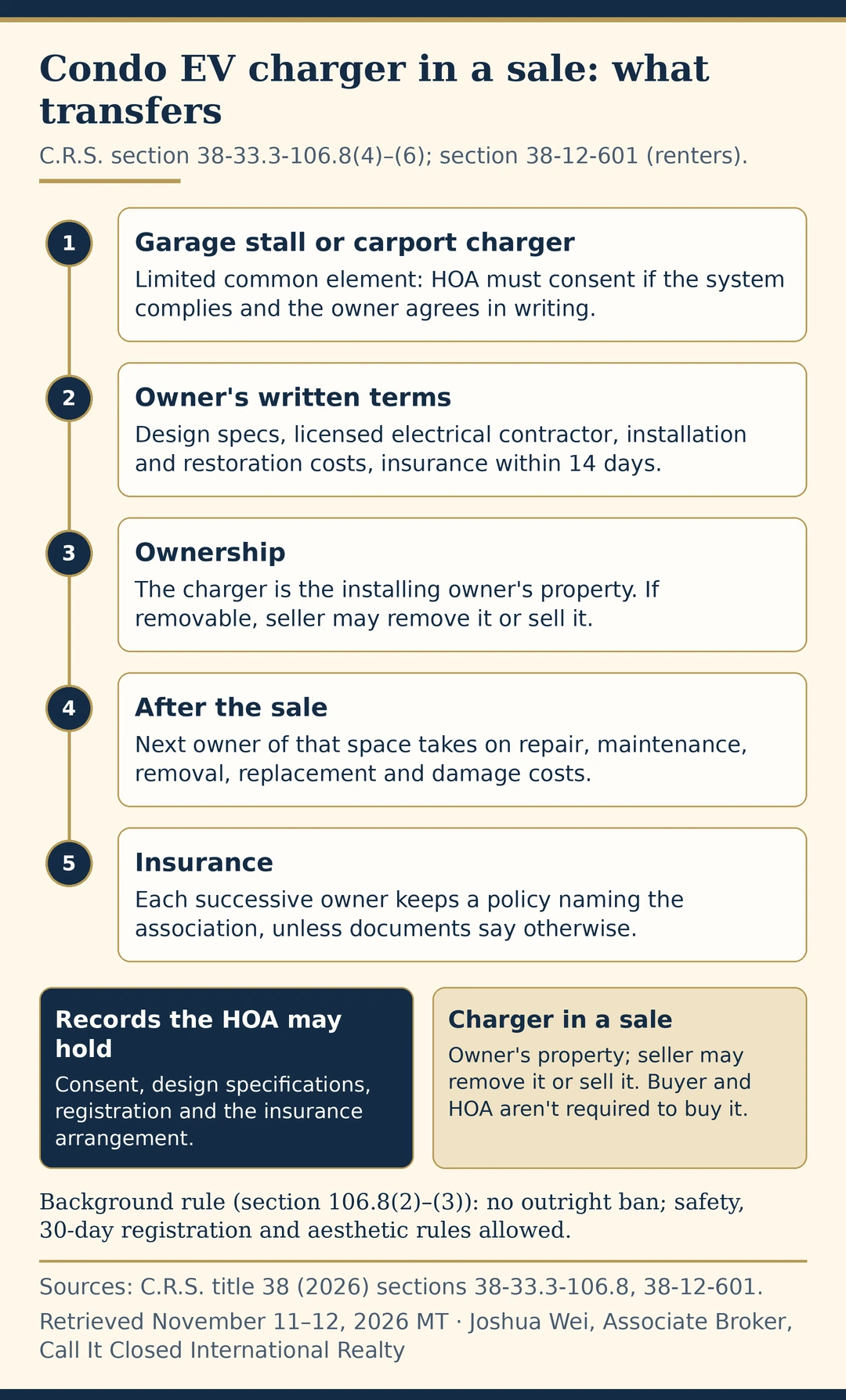
A vertical flow diagram, cream background with navy type and gold accents, titled Condo EV charger in a sale: what transfers. Subtitle: Colorado Revised Statutes section 38-33.3-106.8(4)–(6); section 38-12-601 (renters). 5 numbered steps: 1, Garage stall or carport charger: Limited common element: HOA must consent if the system complies and the owner agrees in writing; 2, Owner's written terms: Design specs, licensed electrical contractor, installation and restoration costs, insurance within 14 days; 3, Ownership: The charger is the installing owner's property. If removable, seller may remove it or sell it; 4, After the sale: Next owner of that space takes on repair, maintenance, removal, replacement and damage costs; 5, Insurance: Each successive owner keeps a policy naming the association, unless documents say otherwise. Two cards: Records the HOA may hold: Consent, design specifications, registration and the insurance arrangement; and Charger in a sale: Owner's property; seller may remove it or sell it. Buyer and HOA aren't required to buy it. A note says: Background rule (section 106.8(2)–(3)): no outright ban; safety, 30-day registration and aesthetic rules allowed. Sources: C.R.S. title 38 (2026) sections 38-33.3-106.8, 38-12-601. Retrieved November 11–12, 2026 MT. Joshua Wei, Associate Broker, Call It Closed International Realty.
Sources: C.R.S. title 38 (2026) (opens in a new tab)
Cream background, navy text, gold rules. Numbered navy circles on a gold spine with white step cards, two branch cards (navy and tan), a note, and a source footer.
The figure above summarizes the consent conditions, the successor-owner provisions and the ownership rule.
What's the background rule?
Subsection (2) bars an association from prohibiting, with stated exceptions, an owner's level 1 or level 2 charger installed "at the unit owner's expense for the unit owner's own use," and subsection (3) still allows safety, 30-day registration and aesthetic rules. Time share units are excluded. The statute's definition says a charging system "must be certified by underwriters laboratories or an equivalent certification and must comply with the current version of article 625 of the national electrical code."
Why the legislature wrote it
The findings in subsection (1) explain the purpose. Subsection (1)(b) says "Most homes in Colorado, including the vast majority of new homes, are in common interest communities." Subsection (1)(c) says "The primary purpose of this section is to ensure that common interest communities provide their residents with at least a meaningful opportunity to take advantage of the availability of plug-in electric vehicles rather than create artificial restrictions on the adoption of this promising technology."
The section was added by SB 13-126 in 2013. HB 23-1233, effective May 23, 2023, amended (1)(d), (2)(a) and the lead-in to (4), and added (2)(c).
Where an owner can install
Subsection (2)(a) bars an association from prohibiting a level 1 or level 2 charger on or in:
- "A unit"
- "An assigned or deeded parking space that is part of or assigned to a unit"
- "A parking space that is accessible to both the unit owner and other unit owners"
The statute defines the two levels in (7). "Level 1" provides charging "through a one-hundred-twenty volt AC plug," and "Level 2" through "a two-hundred-eight to two-hundred-forty volt AC plug," each "with a cord connector that meets the SAE international J1772 standard or a successor standard."
Fees and parking
Subsection (2)(b) says an association shall not "Assess or charge a unit owner any fee for the placement or use of an electric vehicle charging system on or in the unit owner's unit." There's an exception: the association "may require reimbursement for the actual cost of electricity provided by the association that was used by the charging system or, alternatively, may charge a reasonable fee for access." If the charger is on a network, the reimbursement "may include the amount of the network fee."
Subsection (2)(c), added in 2023, bars an association from restricting "parking based on a vehicle being a plug-in hybrid vehicle or plug-in electric vehicle."
What the association can still require
Subsection (3) carves out three kinds of rules from (2):
- "Bona fide safety requirements, consistent with an applicable building code or recognized safety standard, for the protection of persons and property"
- "A requirement that the charging system be registered with the association within thirty days after installation"
- "Reasonable aesthetic provisions that govern the dimensions, placement, or external appearance of an electric vehicle charging system"
Subsection (8) says "This section applies only to residential units."
What must the owner agree to for a garage or carport charger?
For a limited common element space assigned to the owner, subsection (4) says the association "shall consent" if the system complies with the association's documents and the owner agrees in writing to:
- "Comply with the association's design specifications for the installation of the system"
- "Engage the services of a duly licensed and registered electrical contractor"
- Pay for installation, "including costs to restore any common elements disturbed"
- Provide insurance naming the association as an additional insured, or reimburse an added premium for a system on a common element, within fourteen days
The contractor requirement in (4)(b)(II) is more specific than it looks. The owner agrees to use "a duly licensed and registered electrical contractor familiar with the installation and code requirements of an electric vehicle charging system."
The consent duty in (4)(a) applies "Notwithstanding any existing ban on electric vehicle charging systems," as long as the system "otherwise complies with the declaration, bylaws, and rules and regulations of the association." An older rule banning chargers outright doesn't override it.
The insurance timing in (4)(b)(IV)(B) has two clocks. A certificate of insurance "must be provided within fourteen days after the unit owner receives the association's consent for the installation." A premium reimbursement is due within fourteen days after the owner receives the association's invoice for it.
What happens when the condo sells?
Under subsection (5), unless a written contract or the association's documents say otherwise, "each successive unit owner with exclusive rights to the limited common element shall assume responsibility for the repair, maintenance, removal, and replacement of the charging system until the system has been removed." Each successive owner must also "at all times have and maintain an insurance policy" covering those obligations and name the association as an additional insured.
Under subsection (6), "A charging system installed at the unit owner's cost is property of the unit owner." If it's removable, the seller "may either remove it or sell it to the buyer of the unit or to the association for an agreed price." Nothing "requires the buyer or the association to purchase the charging system."
Subsection (5) also makes each successive owner "responsible for any costs for damages" to the system, common elements, and adjacent units, garage stalls, carports or parking spaces that result from its installation, maintenance, repair, removal or replacement. And the owner must remove the system "if reasonably necessary or convenient for the repair, maintenance, or replacement" of the common elements.
Shared chargers and community charging
Not every condo has assigned stalls. The ban in (2)(a)(III) covers a charger in "A parking space that is accessible to both the unit owner and other unit owners," subject to the same safety, registration and aesthetic rules in (3). The limited common element procedure in (4) and the successor duties in (5) are written for limited common elements, though, so how they apply to a charger in a shared space depends on the association's documents and any written agreement. That's a question for a Colorado HOA attorney.
The legislature also nudged associations to add charging themselves. Subsection (1)(d) says it "encourages common interest communities not only to allow electric vehicle charging stations and the parking of electric vehicles in accordance with this section, but also to apply for grants from the electric vehicle grant fund created in section 24-38.5-103 or otherwise fund the installation of charging stations on common property as an amenity for residents and guests." This article doesn't cover whether any grant is available now.
What the statute doesn't settle
A few questions come up often that subsection (5) and (6) leave to other documents:
- Whether a hard-wired charger is a fixture included in a sale. The contract language in sections 2.5.1, 2.5.3 and 2.6 is where the parties settle that.
- Who pays to upgrade a building's electrical service. The statute assigns installation cost to the owner in (4)(b)(III), but a building-wide upgrade depends on the association's documents.
- Whether a charger needs a permit. That's for the local building department.
How the purchase contract handles a charger
The Commission's Contract to Buy and Sell Real Estate (Residential) (opens in a new tab) doesn't name EV chargers in its standard inclusion lists. Section 2.5.1 includes listed items "If attached to the Property on the date of this Contract," such as lighting and garage door openers, "unless excluded under Exclusions." Whether a particular charger counts as attached is the kind of question that causes disputes. It's cleaner for the parties to write it down.
The contract gives three places to do that:
- Section 2.5.3, Other Inclusions. "The following items, whether fixtures or personal property, are also included in the Purchase Price." A buyer who wants the charger can list it here.
- Section 2.6, Exclusions. "The following items are excluded." A seller who plans to remove a charger under subsection (6) can list it here.
- Section 2.5.7, Parking and Storage Facilities. It records "The use or ownership of the following parking facilities," with a note that "If exact rights to the parking and storage facilities is a concern to Buyer, Buyer should investigate."
If the charger is leased rather than owned, section 2.5.8 covers "personal property ... currently leased to Seller," with a checkbox for whether the buyer will assume the lease. Under section 2.5.5, owned inclusions "must be conveyed at Closing by Seller free and clear of all taxes" (with listed exceptions), "liens and encumbrances." Section 2.5.6 says "Conveyance of all personal property will be by bill of sale or other applicable legal instrument."
A hypothetical
Here's an invented example. A seller in a Denver condo building installed a level 2 charger in an assigned garage stall that the declaration makes a limited common element. The seller signed the association's written agreement under subsection (4) and registered the charger.
The buyer wants the charger. The seller would rather sell it than remove it. Subsection (6) lets them agree on a price, and nothing requires the buyer to pay one. They list the charger in section 2.5.3, or set a price in an addendum drafted by their brokers or an attorney.
After closing, unless a written contract or the association's documents say otherwise, the buyer is the "successive unit owner" under subsection (5). That means taking on repair, maintenance, removal and replacement, and keeping an insurance policy naming the association as an additional insured. If the association later needs the stall for garage repairs, the buyer may have to remove the charger.
The facts are made up. The association's documents may change any of this.
Questions to ask before you write an offer
Buyers:
- Is the charger owned, leased, or on a network subscription?
- Is the parking space a limited common element assigned to the unit, a deeded space, or a shared space?
- Did the seller sign a written agreement with the association under subsection (4)? Ask for a copy.
- Was the charger registered with the association within thirty days, if the association requires it?
- What does the association charge for electricity or access under subsection (2)(b)?
- Does your insurance agent see any issue with naming the association as an additional insured?
Sellers:
- Decide early whether you'll remove, sell, or include the charger, and put it in the contract.
- Gather the association agreement, registration and insurance certificates for the buyer.
- If you remove it, check the association's documents about restoring the common elements.
Who answers which question?
- The association: its consent, design specifications, registration and insurance records for a charger.
- A Colorado real estate attorney: whether a charger is included in a sale, and how subsections (5) and (6) apply to a specific unit.
- The local building department: electrical permits.
What about renters?
Colorado Revised Statutes section 38-12-601 (opens in a new tab) gives tenants a parallel right: "A tenant may install, at the tenant's expense for the tenant's own use, a level 1 or level 2 electric vehicle charging system," subject to similar safety, registration and aesthetic rules. A landlord may require reimbursement for installation if the landlord installs it at the tenant's request.
The tenant statute tracks the HOA one closely. A landlord "shall not restrict parking based on a vehicle being a plug-in hybrid vehicle or plug-in electric vehicle," under (1)(c). For a charger in an area other tenants can reach, a landlord "may assess or charge the tenant a reasonable fee to reserve a specific parking spot." Under (5), "A charging system installed at the tenant's cost is property of the tenant." At the end of the lease, the tenant "may either remove it or sell it to the landlord or another tenant for an agreed price." Subsection (7) says the section "applies to residential rental properties and commercial rental properties."
For an investor buying a rented condo, both statutes can apply at once: the HOA rule to the owner, and the tenant rule to the renter.
Frequently asked questions
Does the HOA have to approve a charger in my assigned garage stall?
Subsection (4) says it "shall consent" if the system complies with the association's documents and the owner agrees in writing to the listed conditions.
Who pays for damage the charger causes after I buy?
Subsection (5) makes each successive owner "responsible for any costs for damages" listed in the statute, unless a written contract or the association's documents say otherwise.
Who maintains a charger in a condo garage after a sale?
Subsection (5) says "each successive unit owner with exclusive rights to the limited common element shall assume responsibility for the repair, maintenance, removal, and replacement of the charging system," unless documents say otherwise.
What does the statute say about the charger in a sale?
Subsection (6) says it "is property of the unit owner," and if removable, the seller "may either remove it or sell it to the buyer of the unit or to the association for an agreed price." Contract terms are a question for a Colorado real estate attorney.
Can my HOA charge me a fee to have a charger?
Subsection (2)(b) bars a fee "for the placement or use" of a charger on or in the owner's unit. The association may require reimbursement for the actual cost of electricity it provides, or charge a reasonable fee for access.
Is my EV charger included when I sell my condo?
The 2026 contract's standard inclusion lists don't name EV chargers. Listing it in section 2.5.3 (Other Inclusions) or section 2.6 (Exclusions) avoids a dispute.
What does the statute say about electricians?
For a limited common element installation, the statute requires agreeing to use "a duly licensed and registered electrical contractor." Permit questions are for the local building department.
Related notes
- Buying a Denver or Aurora condo: read the building before you price the unit
- What a Colorado HOA can't prohibit: flags, signs, xeriscape, EV chargers, heat pumps, and more for Denver and Aurora owners
- Buying a home with solar panels in Denver or Aurora? Owned, financed, leased, or a power purchase agreement, explained
Sources and method
Official sources, retrieved November 11–13, 2026, America/Denver:
- C.R.S. title 38 (2026) (opens in a new tab): section 38-33.3-106.8 (common interest communities) and section 38-12-601 (residential tenancies)
- Colorado Real Estate Commission, Contract to Buy and Sell Real Estate (Residential), for use on and after January 1, 2026 (opens in a new tab): sections 2.5.1, 2.5.3, 2.5.5 to 2.5.8, 2.6
This article summarizes the statutes only. It doesn't address local electrical permits, utility programs, rebates, or tax credits, or any specific association's documents. The hypothetical is invented.
This note is general education from a Colorado real estate broker with Call It Closed International Realty. For questions about your association's documents, consult a Colorado HOA attorney.
Disclaimer
This article is general information only. It is not legal, tax, lending, insurance, appraisal, inspection, or financial advice, and it is not a substitute for advice about your situation. Joshua Wei is a Colorado real estate broker, not an attorney. Reading this article does not create a client relationship, an agency relationship, or an attorney-client relationship with Joshua Wei or with Call It Closed International Realty.
Laws, program rules, interest rates, insurance terms, tax figures, and other details change. Examples in this article are hypothetical illustrations unless a source is named for a specific, dated figure. Information in this article is believed accurate as of November 13, 2026 and is not guaranteed. No result is promised, and you should not rely on this article as the last word for your situation.
Before you act, confirm the point with the official source linked or cited in this article, and talk with a licensed professional who can apply the rule to your facts. That may be a licensed attorney, a tax professional, a lender, an insurance agent, a home inspector, or another licensed professional, depending on the question. Links to third-party websites and publications are provided for reference only. They are not an endorsement, and their content can change.
If you already have a brokerage relationship with another broker, this is not a solicitation.
Joshua Wei, Associate Broker, Call It Closed International Realty, Colorado license FA.100108558. Equal Housing Opportunity.