September 22, 2026 · Denver · Aurora · Buying · Selling
Buying a Denver or Aurora condo: read the building before you price the unit
A condo can have an appealing asking price and still be the wrong purchase for your budget. How to build an association packet, read dues, reserves, insurance, and lender project review — without treating a metro median as the building file.
The short answer
In brief: Before pricing a Denver or Aurora condo, read the association: what the dues cover, reserves for planned work, any special assessment, the master insurance policy against your own coverage, and, for many condo loans, the lender's project review, separate from your preapproval. None of these makes a condo a bad choice. They make the building part of the decision.
A condo can have an appealing asking price and still be the wrong purchase for your budget. The association may be planning a roof project. The master insurance policy may leave responsibilities you have not priced into your own coverage. Your lender may need information about the project that your personal preapproval did not address. None of those possibilities makes a condo a bad choice. They make the building part of the buying decision, not paperwork to leave until the end.
The current market gives that work some context, and it should stay in its place. In its October 2026 public market summary, published November 4, the Denver Metro Association of Realtors reported an attached-home median sale price of $375,000, down 3.25 percent from October a year earlier, after a median of 48 days, with more than seven months of attached supply. Those are October metro figures for attached homes as DMAR defines them, not today’s Aurora listings, not a ZIP-level forecast, and not a measurement of the same units losing that percentage of value. A shift in the mix of sales can change a median. The figures do not tell you what a particular association has in reserve, what its insurance deductibles are, or whether a lender will accept the project.
This article is about that building file. It follows my note on Denver prices and concessions and a companion contract-deadlines note, but it takes a different path: how to investigate the association and keep open questions from becoming closing-week surprises. I am a licensed Colorado real estate broker with Call It Closed International Realty. I am not an attorney or an appraiser. This is not accounting, tax, insurance, engineering, or lending advice.
Disclaimer. This article is general information only. It is not legal, tax, lending, insurance, appraisal, inspection, or financial advice, and reading it does not create a client, agency, or attorney-client relationship. Laws, rates, programs, and figures change. Confirm the official source, and talk with a licensed attorney, tax professional, lender, insurance agent, or inspector before you act. Joshua Wei is a Colorado real estate broker, not an attorney. He is an Associate Broker with Call It Closed International Realty, license FA.100108558. Equal Housing Opportunity.
 Full size (opens in a new tab)
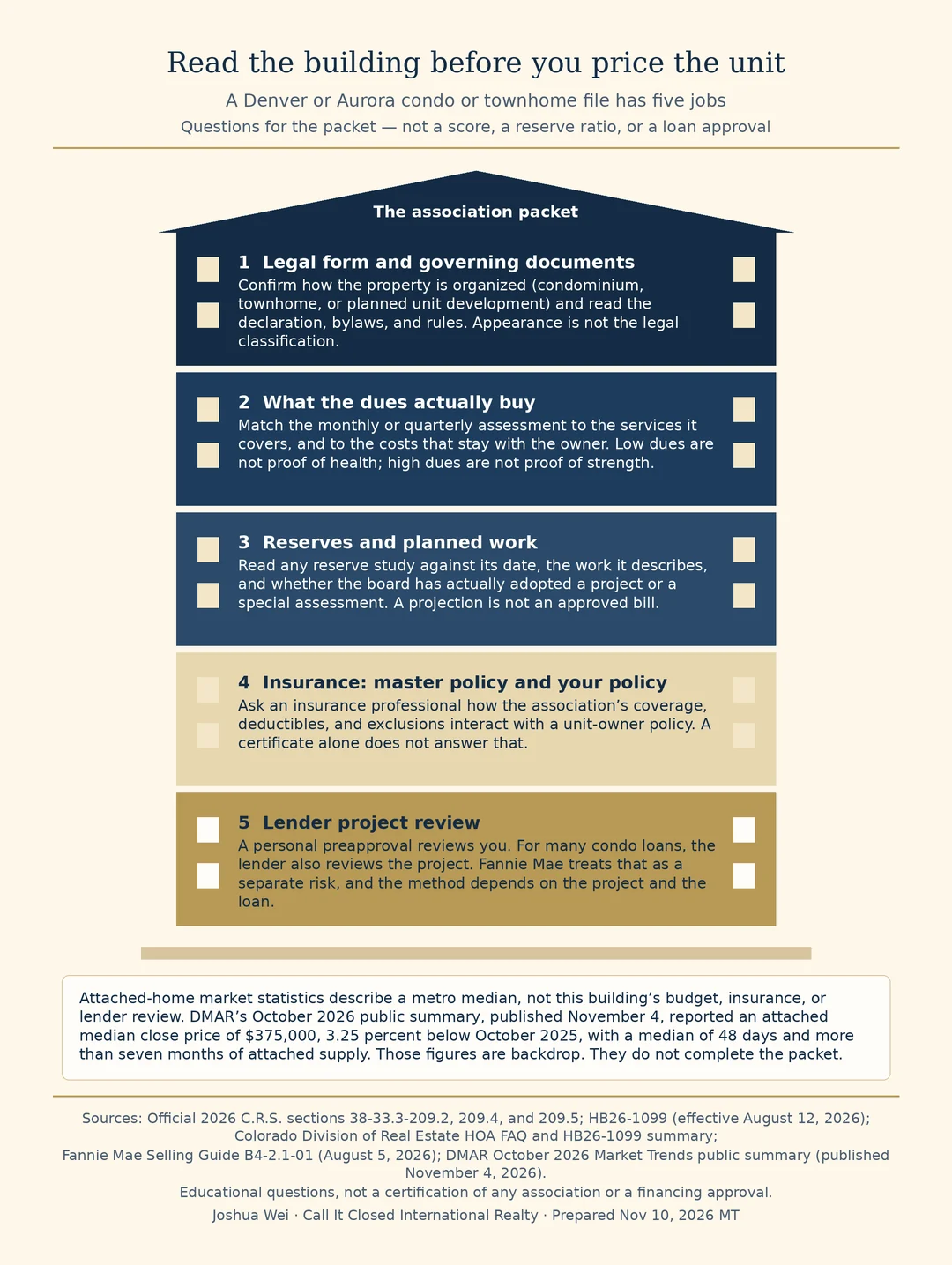
Illustrated building cross-section on a cream background. A navy roofline labeled “The association packet” sits above five floors: legal form and governing documents; what the dues actually buy; reserves and planned work; insurance, master policy and unit policy; and lender project review, which is separate from a personal preapproval. A caption box states that DMAR’s October 2026 attached median of $375,000, down 3.25 percent from October 2025, with a median of 48 days and more than seven months of attached supply, is backdrop and does not complete the packet. Sources: Colorado Division of Real Estate HOA FAQ, Fannie Mae B4-2.1-01 dated August 5, 2026, and DMAR’s October 2026 public summary. Prepared November 10, 2026 MT.
Sources: Official 2026 Colorado Revised Statutes sections 38-33.3-209.2, 209.4, and 209.5 (OLLS CRS PDF) (opens in a new tab); House Bill 26-1099, signed act, effective August 12, 2026 (opens in a new tab); DMAR October 2026 Market Trends public summary (opens in a new tab); Colorado Division of Real Estate, HOA FAQ (opens in a new tab); Fannie Mae Selling Guide B4-2.1-01 (08/05/2026) (opens in a new tab)
Cream background, a navy house roof over five stacked floors in navy, mid-navy, and gold, each with window marks and a short plain-language job description, plus a white caption box for the October 2026 attached-market backdrop.
The diagram above is a map of the five jobs in an association packet. The October DMAR attached figures in the caption are backdrop only. They do not complete the file or certify any building.
Keep the market map separate from the building file
DMAR’s reports page describes a residential market covering Adams, Arapahoe, Boulder, Broomfield, Clear Creek, Denver, Douglas, Elbert, Gilpin, Jefferson, and Park counties, using REcolorado statistics. That regional scope is useful background. It is not a condo-project financial statement, and it does not establish the condition of any particular building. Attached-property statistics also do not establish that every townhome has the same legal ownership structure as a condominium.
If you are comparing a Denver condo with an Aurora townhome, do not let a shared search category settle the question. Ask how each property is legally organized, what you own directly, what the association maintains, and what the lender needs to review. Fannie Mae Selling Guide topic B4-2.1-01, General Information on Project Standards (08/05/2026) (opens in a new tab), retrieved November 10, 2026, distinguishes condos, co-ops, and planned unit developments. It states: "Project eligibility risk is a risk that is distinct from the credit risk presented by individual borrowers." A building’s appearance is not the same as its legal classification.
The October DMAR figures are not a statewide market measure. I would not carry them into a Colorado Springs or Fort Collins pricing analysis as if those cities were part of the same report. The due-diligence questions travel more readily than the statistics. Use local comparable sales to investigate price, and project-specific records to investigate obligations.
Build a packet, not a pile of attachments
Start with an index. For every document, record its name, the period it covers, who supplied it, whether it appears complete, and the question it is supposed to answer. Mark missing items as missing. A blank reserve-study folder should not become “no reserve concerns” in your notes. An insurance summary without an expiration date should not become “coverage confirmed.” This is a practical organizing method, not a legal completeness certification.
The official 2026 text of Colorado Revised Statutes section 38-33.3-209.4 (opens in a new tab) requires associations to make specified information available to unit owners, including the operating budget, current regular and special assessments, annual financial statements with reserve amounts, insurance-policy information (company names, limits, deductibles, and expiration dates), governing documents, and meeting minutes. A 2026 amendment, effective August 12, 2026, added the most recent reserve study required under section 38-33.3-209.2 to that list. The Division of Real Estate’s HOA FAQ (opens in a new tab), accessed November 10, 2026, summarizes those annual-disclosure categories; the living FAQ page I opened had not yet listed the new reserve-study item. The FAQ also explains that there is no central repository of every association’s governing documents. Prospective buyers should work through their broker and the seller to request the materials, rather than assume a state registration search will produce the complete purchase file.
The residential purchase contract, if section 7 applies, gives that request a deadline. The seller is obligated to provide the Association Documents, at the seller’s expense, on or before the Association Documents Deadline, and the buyer has a right to terminate, in the buyer’s sole subjective discretion, on or before the Association Documents Termination Deadline based on any unsatisfactory provision in those documents. The list in section 7 is specific: governing documents, certain minutes, insurance-policy information, assessments, recent financial documents including a reserve study if any, and certain construction-defect notices. A missed termination deadline, under section 24.1, waives that right if the notice is not received in time. The companion contract-deadlines note explains how those clocks run. This article is about what to look for inside the packet.
Group the file by purpose: governing rules; recurring finances; long-term repairs and funding; insurance; and open legal or lender questions. Keep the original documents intact alongside your summary. A sales brochure is not the declaration. A management-company email is not the full policy. If a summary conflicts with an underlying document, write down the conflict and ask for clarification rather than silently choosing the more reassuring version.
What do the dues actually purchase?
A dues amount is meaningful only beside the services and responsibilities it covers. Ask whether it includes utilities, exterior maintenance, common-area insurance, amenities, management, or reserve contributions. Then ask what stays with the owner. Similar-looking homes may divide responsibility differently. Compare the governing documents and the budget rather than assuming that a townhome arrangement works like a condo you owned before.
Separate recurring operating expenses from long-term repair planning. A budget is a plan for collecting and spending money; financial statements show what has happened during their reporting period. Neither is a guarantee that future costs will be unchanged. Ask whether the financial statements are current, whether the budget has been adopted or is still proposed, and whether meeting materials discuss a change that has not yet appeared on the dues statement.
Low dues are not proof of efficient management, and high dues are not proof of financial strength. You need the services, the condition of the common elements, and the funding plan to interpret them. Conversely, do not assume every increase reflects mismanagement. Ask what changed and request the supporting explanation. The useful comparison is what an owner must pay and what obligations remain, not which listing advertises the smallest association payment.
Read reserves against the work they are meant to fund
Reserve cash is not a standalone score. Ask what components the association expects to replace, when it expects the work, what the estimates assume, and how the current funding plan relates to those estimates. A roof, elevator, pavement, or exterior system may have a very different remaining useful life from the same component in another property. A larger account balance can still be inadequate for a larger set of obligations.
Look for the reserve study, if one exists, and its date. Ask whether its recommendations have been incorporated into the budget and whether conditions have changed since it was prepared. Two official rules are easy to mix together. Under Colorado Revised Statutes section 38-33.3-209.5 (1)(b)(IX) (opens in a new tab), an association must adopt a policy that says when it has a reserve study prepared, whether there is a funding plan for work the study recommends, and whether the study is based on a physical and a financial analysis. That subsection states: "For the purposes of this subparagraph (IX), an internally conducted reserve study shall be sufficient." The Division of Real Estate’s HOA FAQ (opens in a new tab), still a living page accessed November 10, 2026, summarizes that policy rule and states that the act "does not require reserve studies to occur." A 2026 amendment added a separate, narrower duty. Colorado Revised Statutes section 38-33.3-209.2 (opens in a new tab), added by House Bill 26-1099 (opens in a new tab) and effective August 12, 2026, states: "Prior to transfer of control from the declarant to the association of a planned community or condominium, the declarant shall commission and pay for a reserve study for the planned community or condominium, which study addresses the components of the common elements and property that the association is responsible for maintaining, repairing, or replacing, as described in the declaration. The reserve study must project costs over a thirty-year period." Subsection (3) states that the study "must be conducted by an independent reserve study professional or other qualified professional that:" "(a) Has knowledge of industry standards for reserve studies;" "(b) Has no business relationship with or financial interest in the declarant, other than being retained by the declarant to conduct reserve studies; and" "(c) Is not an affiliate of the declarant." Those clauses are quoted from the official 2026 text of section 38-33.3-209.2, retrieved November 10, 2026. The Division of Real Estate’s HB26-1099 summary (opens in a new tab) makes the same point: the General Assembly determined one time when a reserve study is required, namely prior to that transfer of control. Beginning with the same effective date, Colorado Revised Statutes section 38-33.3-209.4 (2)(j) (opens in a new tab) requires the association to make the most recent reserve study required under section 209.2 available as part of its annual disclosures. That is not a promise that every existing association has a recent independent engineering assessment, or that every older community was required to commission one on a fixed schedule. Whether those sections apply to a particular association, including communities created before July 1, 1992, is a question for a Colorado real estate attorney.
If no study is available, do not invent a funding gap or declare the association healthy. Record the missing evidence and ask how the board evaluates replacement needs. If a study is available, do not treat every projected item as a legally approved assessment. Distinguish a consultant’s estimate, a board discussion, an adopted project, a signed contract, and a payment obligation allocated to the unit. Those are different stages with different consequences.
A special assessment needs a source and a status
The state HOA FAQ distinguishes regular assessments from special assessments, which are generally less frequent and tied to a particular purpose. For a buyer, the next questions are concrete: what work does the assessment fund, has it been approved, what remains unpaid, and what written documents establish the obligation? Do not reduce the investigation to whether the seller checked a box that says “assessment.”
Read the relevant notices and minutes beside the seller’s disclosures. Ask whether the stated amount is final or estimated, whether additional work is under discussion, and whether the contractor’s scope matches the problem described. A project may be planned without a final price. An assessment may be paid without proving all work is complete. A completed repair may still need documentation for the lender or insurer.
Who pays at a sale is a contract and closing question, not something this article can decide. The residential contract has specific boxes and rules in sections 15 and 16 for status-letter fees, record-change fees, working capital, and special assessments. Have the broker, the closing team, and, where needed, an attorney reconcile the documents and the negotiated allocation. Ask the lender how the assessment and the underlying condition affect the proposed financing. Do not accept an informal assurance that a seller payment automatically resolves eligibility, insurance, or construction concerns.
Insurance review is more than a certificate
Ask for the association’s current insurance information and route it to a licensed insurance agent and to your lender. The state’s FAQ lists policy limits, deductibles, insurers, and expiration dates among annual-disclosure insurance information. Those details matter because “the HOA has insurance” does not tell you which losses, property, or owner responsibilities are covered.
Ask a licensed insurance agent to explain how the master policy and a unit-owner policy interact, including deductibles, exclusions, and any owner obligations after a loss. A certificate of insurance is evidence that a policy was issued. It is not, by itself, an explanation of coverage. If a deductible is large relative to your cash reserve, that is a budgeting fact, not a reason this article can declare the coverage adequate or inadequate.
Flood and drainage questions, if they apply to the building or the site, still belong in their own evidence file. The Aurora and Denver flood and drainage checklist is the place for maps and insurance questions, not this association-packet note.
Personal preapproval and project review are different jobs
A preapproval reviews the borrower. For many condominium loans, the lender also reviews the project. Fannie Mae’s B4-2.1-01 (opens in a new tab), retrieved November 10, 2026, states: "Project eligibility risk is a risk that is distinct from the credit risk presented by individual borrowers." It also states: "The project review is in addition to the review the lender completes for underwriting the borrower, the transaction terms, and the individual unit appraisal." On waivers, the same topic says: "Fannie Mae does not require a thorough project review for several types of projects or loan transactions," and it points to basic requirements that still apply. Fannie Mae’s standards apply to loans sold to Fannie Mae; they are not a universal rule for every lender or program. Ask a licensed lender what review applies to the loan you want.
Ask your lender, early, what project review applies to the loan you want and what documents the lender needs from the association. Do not assume that a personal preapproval has already answered that question, or that a project approved for one loan type is approved for another. If the review is still open as a contract deadline approaches, discuss the available options before the date passes. A request to change terms is not an agreed amendment.
Read the minutes for questions, not for rumors
Minutes are useful when they show what the board actually discussed and decided. They are not a complete engineering report, and they are not a substitute for the financial statements. Look for adopted motions, pending bids, insurance claims, rule changes, and recurring complaints that might point to a physical or financial issue. Then ask for the underlying document. A heated comment in an old meeting is not proof of a current defect, and a quiet set of minutes is not proof that nothing is pending.
If the property has had radon testing or mitigation in a unit or in a common area, keep those records with the packet. The radon note explains how to organize that evidence. If a metropolitan district also taxes or serves the community, that is a separate institution from the association; a companion metro-districts note is the place to tell them apart.
Sellers can prepare a cleaner file
A seller’s useful response is not to minimize buyer questions. Assemble the current documents, identify who handles association requests, and confirm which materials may be shared. Label older documents accurately. If the budget is changing or a repair is in progress, provide the current written information through the proper disclosure process instead of relying on a reassuring verbal summary.
Ask the listing broker to distinguish presentation problems from substantive issues. A missing attachment may be fixable with a request. An unresolved repair or insurance concern may require professional work and a financing discussion. Better photography will not solve the latter. Neither will an unsupported claim that the project is approved for every buyer or loan type.
Price comparisons still matter, but use relevant sales and today’s competing properties with attention to differences in obligations and condition. A condo in another association may look similar while carrying different responsibilities. Do not manufacture a dollar adjustment for reserves or insurance without a defensible basis. A well-organized file helps buyers evaluate uncertainty; it does not guarantee a higher price or a faster sale.
Decide from answers, not from a slogan
At the end of the investigation, a useful decision summary has three parts: what the documents establish, what the professionals have concluded, and what remains uncertain. A buyer may accept a known obligation and reject a poorly understood one. Another buyer may make a different decision because their cash cushion, intended use, financing, or time horizon differs. That is more informative than calling every attached listing a bargain because the metro median is lower than it was a year ago.
For Denver and Aurora buyers, my practical starting point is straightforward: bring the association packet into the conversation before treating the asking price as the complete offer. For sellers, make it easier for a serious buyer and lender to understand the property without reconstructing the file at the last minute. Market statistics can explain why you are looking. The building file helps determine whether this is the purchase you actually want.
If you are preparing to buy or sell, I can help organize the property-specific questions and comparable sales with you. The lender decides financing requirements, the insurance professional interprets coverage, and qualified legal or technical advisers address their respective issues. The goal is not to eliminate every uncertainty. It is to identify the uncertainties that matter while you still have a meaningful decision to make.
Frequently asked questions
What HOA documents should a Colorado condo buyer review?
Colorado Revised Statutes section 38-33.3-209.4, and the Division of Real Estate’s HOA FAQ summary of it, point to annual-disclosure materials such as budgets, assessments, financial statements with reserve amounts, insurance information, governing documents, and meeting minutes. The 2026 amendment also added the most recent reserve study required under section 38-33.3-209.2. The residential contract’s section 7 list, when it applies, is a useful transaction checklist of those materials plus any reserve study and certain construction-defect notices. There is no central state repository of every association’s documents.
Do Colorado HOAs have to have a reserve study?
Two different rules apply. Colorado Revised Statutes section 38-33.3-209.5 requires an association to have a reserve-study policy, and says an internally conducted study is sufficient for that policy. The Division of Real Estate’s living FAQ still describes that policy rule with the sentence that the act does not require reserve studies to occur. Separately, Colorado Revised Statutes section 38-33.3-209.2, effective August 12, 2026, requires a declarant to commission and pay for an independent thirty-year reserve study before transferring control of a planned community or condominium to the association, and section 38-33.3-209.4 requires the association to disclose the most recent study required under that section. Absence of a recent independent study is a missing-evidence fact, not proof that the association is healthy or unhealthy. Ask a Colorado real estate attorney how the statutes apply to the building you are considering.
Is a townhome the same as a condo for a lender?
Not necessarily. Fannie Mae distinguishes condos, co-ops, and planned unit developments, and it treats project review as a separate job from underwriting the borrower. Ask how the property is legally organized and what review the lender will require.
Does a lower attached-home median mean this building is a bargain?
No. DMAR’s October 2026 attached median of $375,000, down 3.25 percent from October 2025, describes the middle sale in a metro attached-home group. It is not a repeat-sales measure and not a statement about one association’s dues, reserves, or insurance.
Can I terminate the contract over HOA documents?
If section 7 applies, the buyer has a Right to Terminate, in the buyer’s sole subjective discretion, on or before the Association Documents Termination Deadline based on any unsatisfactory provision in the Association Documents. Late delivery of the documents changes that timing under the form. A missed, unreceived notice can waive the right. That is a form summary, not legal advice about your contract.
Related notes
- A metro district is not an HOA: how Denver and Aurora buyers can tell them apart
- Who oversees Colorado HOAs? What the state HOA Center can and can't do for Denver and Aurora owners and buyers
- Energize Denver for condo and small-building buyers: what to ask before you buy
Sources and method
October attached-home figures are from DMAR’s October 2026 Market Trends public summary (opens in a new tab), published November 4, 2026, and re-opened November 10, 2026 after an intermittent fetch failure on the same URL. The median, year-over-year percentage, median days, and “more than seven months of supply” wording are DMAR’s. Geography and the REcolorado attribution are from DMAR’s reports page (opens in a new tab). Annual-disclosure and reserve-study rules are from the official 2026 Colorado Revised Statutes, Colorado Revised Statutes sections 38-33.3-209.2, 38-33.3-209.4, and 38-33.3-209.5 (opens in a new tab), downloaded from the Office of Legislative Legal Services host linked at the 2026 CRS titles index (opens in a new tab) on November 10, 2026; from the signed House Bill 26-1099 (opens in a new tab) act, effective August 12, 2026; and from the Division of Real Estate’s HB26-1099 summary (opens in a new tab). The Division’s HOA Frequently Asked Questions (opens in a new tab), a living page accessed November 10, 2026, still summarizes the reserve-study policy rule and the annual-disclosure list without the 2026 reserve-study addition, so the official statute controls where they differ. Association-document delivery in a transaction is also from section 7 of CBS1, the Contract to Buy and Sell Real Estate (Residential), Mandatory Use Date January 1, 2026. Project-review statements are from Fannie Mae Selling Guide B4-2.1-01, General Information on Project Standards (08/05/2026) (opens in a new tab), accessed November 10, 2026, and apply to Fannie Mae’s project standards, not every financing program.
This note is general education from a Colorado real estate broker with Call It Closed International Realty. It is not a legal opinion, an engineering or insurance assessment, an appraisal, or a financing approval. If you are considering a particular building, I will help you organize the packet and the comparable sales, and I will tell you which remaining questions belong with the lender, an insurer, or counsel.
Disclaimer
This article is general information only. It is not legal, tax, lending, insurance, appraisal, inspection, or financial advice, and it is not a substitute for advice about your situation. Joshua Wei is a Colorado real estate broker, not an attorney. Reading this article does not create a client relationship, an agency relationship, or an attorney-client relationship with Joshua Wei or with Call It Closed International Realty.
Laws, program rules, interest rates, insurance terms, tax figures, and other details change. Examples in this article are hypothetical illustrations unless a source is named for a specific, dated figure. Information in this article is believed accurate as of November 13, 2026 and is not guaranteed. No result is promised, and you should not rely on this article as the last word for your situation.
Before you act, confirm the point with the official source linked or cited in this article, and talk with a licensed professional who can apply the rule to your facts. That may be a licensed attorney, a tax professional, a lender, an insurance agent, a home inspector, or another licensed professional, depending on the question. Links to third-party websites and publications are provided for reference only. They are not an endorsement, and their content can change.
If you already have a brokerage relationship with another broker, this is not a solicitation.
Joshua Wei, Associate Broker, Call It Closed International Realty, Colorado license FA.100108558. Equal Housing Opportunity.