October 17, 2026 · Denver · Aurora · Buying · Selling
Buying a home with solar panels in Denver or Aurora? Owned, financed, leased, or a power purchase agreement, explained
Solar panels can be owned outright, financed, leased, or run by a third party under a power purchase agreement. How Colorado's residential contract (CBS1) handles each, what documents a buyer should get, and what Colorado law says about HOA limits on solar.
The short answer
In brief: Before buying a Denver or Aurora home with solar panels, find out how the system is held: owned and paid off, owned but financed, leased, or on a power purchase agreement. Colorado's standard residential contract treats each situation differently, in different sections, and Colorado law also limits how far an HOA can restrict solar.
Before you buy a Denver or Aurora home with solar panels, find out how the system is held. Colorado's standard residential contract treats four situations differently:
- Owned and paid off. Section 2.5.1 of the Colorado Real Estate Commission's residential contract (CBS1) has a checkbox for "Solar Panels" that are "owned by the Seller and included."
- Owned but financed. Under section 2.5.5, "Any Inclusions owned by Seller (e.g., owned solar panels) must be conveyed at Closing by Seller free and clear of all taxes (except personal property and general real estate taxes for the year of Closing), liens and encumbrances," except as listed.
- Leased. Section 2.5.8 covers "personal property" that "is currently leased to Seller which will be transferred to Buyer at Closing."
- Power purchase agreement. Section 2.5.9 covers a "solar power purchase agreement, regardless of the name or title, to authorize a third party to operate and maintain a photovoltaic system on the Property and provide electricity."
CBS1 is on the Division of Real Estate's contracts and forms page (opens in a new tab); the quotations here are from the 2026 CBS1 PDF (opens in a new tab).
I am a licensed Colorado real estate broker with Call It Closed International Realty. I am not an attorney or tax advisor. This is not legal or tax advice.
Disclaimer. This article is general information only. It is not legal, tax, lending, insurance, appraisal, inspection, or financial advice, and reading it does not create a client, agency, or attorney-client relationship. Laws, rates, programs, and figures change. Confirm the official source, and talk with a licensed attorney, tax professional, lender, insurance agent, or inspector before you act. Joshua Wei is a Colorado real estate broker, not an attorney. He is an Associate Broker with Call It Closed International Realty, license FA.100108558. Equal Housing Opportunity.
 Full size (opens in a new tab)
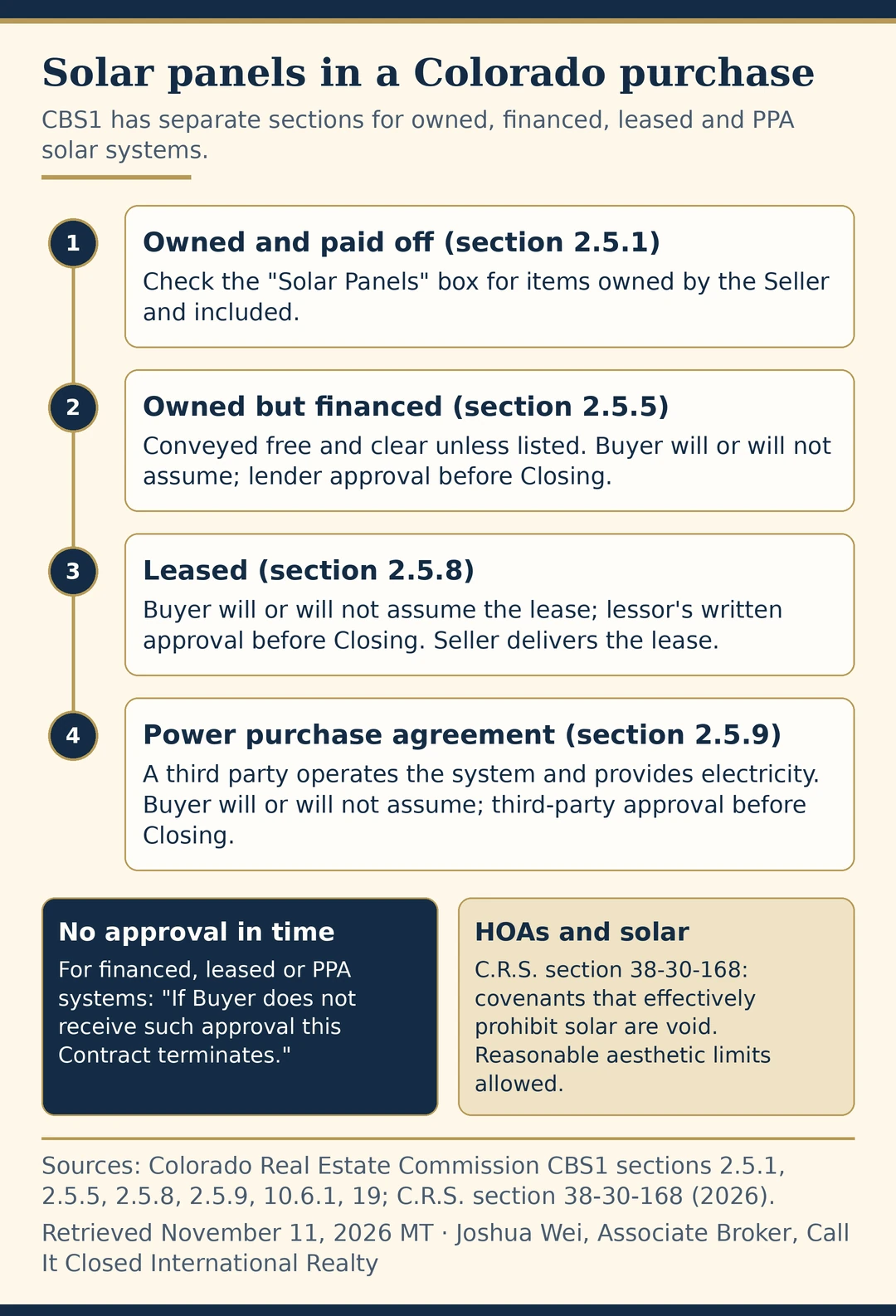
A vertical flow diagram, cream background with navy type and gold accents, titled Solar panels in a Colorado purchase, with the subtitle CBS1 has separate sections for owned, financed, leased and PPA solar systems. Four numbered cards: 1, owned and paid off under section 2.5.1, check the Solar Panels box for items owned by the Seller and included; 2, owned but financed under section 2.5.5, conveyed free and clear unless listed, where the buyer will or will not assume and lender approval is needed before Closing; 3, leased under section 2.5.8, where the buyer will or will not assume the lease, the lessor's written approval is needed before Closing, and the seller delivers the lease; 4, power purchase agreement under section 2.5.9, where a third party operates the system and provides electricity, the buyer will or will not assume, and third-party approval is needed before Closing. Two lower cards: no approval in time, quoting for financed, leased or PPA systems, if Buyer does not receive such approval this Contract terminates; and HOAs and solar, under C.R.S. section 38-30-168 covenants that effectively prohibit solar are void, while reasonable aesthetic limits are allowed. Sources: Colorado Real Estate Commission contract and Colorado Revised Statutes. Retrieved November 11, 2026 MT.
Sources: DRE contracts and forms (opens in a new tab); C.R.S. Title 38 (2026) (opens in a new tab)
Cream background, navy text, gold rules. Four numbered cards on a gold spine, two side-by-side cards, and a 28px source footer.
The diagram above sorts the four ways solar can be held and what CBS1 asks for each. It summarizes the Commission contract.
Owned panels: what the contract says
Section 2.5.1 covers attached items. It says that if checked, "the following are owned by the Seller and included: Solar Panels Water Softeners Security Systems Satellite Systems (including satellite dishes)." The same section adds: "Leased items should be listed under section 2.5.8. (Leased Items)."
The checkbox is a statement about ownership. If the panels are leased or on a power purchase agreement, the 2.5.1 box is not the place for them.
Owned panels can still carry a loan. Section 2.5.5 is titled "Inclusions - Encumbered," and its example is "owned solar panels."
What happens if the panels are financed?
Section 2.5.5 lets the buyer choose, with boxes for whether the buyer will or will not "assume the debt and obligations on the Encumbered Inclusions subject to Buyer's review under section 10.6. (Encumbered Inclusion Documents) and Buyer's receipt of written approval by such lender before Closing. If Buyer does not receive such approval this Contract terminates."
If the buyer checks "Will Not," the default in the first sentence applies: the owned panels "must be conveyed at Closing by Seller free and clear of all taxes (except personal property and general real estate taxes for the year of Closing), liens and encumbrances." How a seller clears a solar loan before closing is a question for the seller's lender and the title company.
Under section 10.6.1.3, the seller agrees "to deliver copies of the evidence of debt, security and any other documents creating the encumbrance to Buyer on or before Due Diligence Documents Delivery Deadline."
What if the panels are leased?
Section 2.5.8 works the same way for leases. The buyer checks whether the buyer will "assume Seller's debt and obligations under such leases for the Leased Items subject to Buyer's review under section 10.6. (Leased Items Documents) and Buyer's receipt of written approval by such lessor before Closing. If Buyer does not receive such approval this Contract terminates."
Under section 10.6.1.2, "Seller agrees to deliver copies of the leases and information pertaining to the personal property to Buyer on or before Due Diligence Documents Delivery Deadline."
What is a solar power purchase agreement?
Under this kind of agreement, a third party operates the system and provides electricity. CBS1 section 2.5.9 applies "If the box is checked." The buyer checks whether the buyer will or will not "assume Seller's obligations under such Solar Power Plan subject to Buyer's review under section 10.6. (Solar Power Plan) and Buyer's receipt of written approval by the third party before Closing. If Buyer does not receive such approval this Contract terminates."
Section 10.6.1.4 calls for a "Copy of any Solar Power Plan not included in Leased Items (regardless of its name or title)."
The full definition in section 2.5.9 adds a time element: the agreement is one "that will remain in effect after Closing." The label on the agreement does not control; the contract says "regardless of the name or title."
What does the Seller's Property Disclosure ask?
The Commission's Seller's Property Disclosure (Residential) (opens in a new tab) (2026 form) has a "Solar panels" line in its electrical section, with boxes for "Owned" and "Leased." It says: "If leased, provide the name and contact information of entity leased from:"
A later part of the electrical section asks the seller to check "Yes" "If you know of any problems EVER EXISTING with the following," and "Solar panels" is on that list. A buyer can compare the SPD's "Owned" or "Leased" box with the contract boxes the seller checked in sections 2.5.1, 2.5.5, 2.5.8, and 2.5.9.
How does a lender look at solar?
Fannie Mae's Selling Guide B2-3-04, Special Property Eligibility Considerations (opens in a new tab), has a section on "Properties with Solar Panels." It says: "If the borrower is, or will be, the owner of the solar panels (meaning the panels were a cash purchase, were included in the home purchase price, were otherwise financed and repaid in full, or are secured by the existing first mortgage), our standard requirements apply (for example, appraisal, insurance, and title)."
On ownership, it says: "Lenders are responsible for determining the ownership and any financing structure of the subject property's solar panels in order to properly underwrite the loan and maintain first lien position of the mortgage." It adds: "If insufficient documentation is available and the ownership status of the panels is unclear, no value for the panels may be attributed to the property value on the appraisal" unless the lender gets a Uniform Commercial Code (UCC) personal property search "that confirms the solar panels are not claimed as collateral by any non-mortgage lender."
For financed panels: "Separately financed solar panels must not contribute to the value of the property unless the related documents indicate the panels cannot be repossessed in the event of default on the associated financing."
For leased panels and power purchase agreements, the guide lists lender requirements, including:
- "The lender must obtain and review copies of the lease or power purchase agreement."
- "The monthly lease payment must be included in the DTI ratio calculation unless the lease is structured to provide delivery of a specific amount of energy at a fixed payment during a given period, and have a production guarantee that compensates the borrower on a prorated basis in the event the solar panels fail to meet the energy output required for in the lease for that period."
- "Payments under power purchase agreements where the payment is calculated solely based on the energy produced may be excluded from the DTI ratio."
- "The value of the solar panels cannot be included in the appraised value of the property."
- "The property must maintain access to an alternate source of electric power that meets community standards."
The guide also addresses PACE financing: "Properties with solar panels and other energy efficient items financed with a PACE loan are not eligible for delivery to Fannie Mae if the PACE loan is not paid in full prior to or at closing."
Those are Fannie Mae's rules. FHA, VA, and other loan programs have their own; ask your lender which apply.
What documents does CBS1 point to?
- Which of the four is it? CBS1 has separate sections for owned (section 2.5.1), financed (section 2.5.5), leased (section 2.5.8) and PPA (section 2.5.9) systems.
- The documents. The loan papers, the lease, or the power purchase agreement, delivered by the Due Diligence Documents Delivery Deadline.
- Transfer approval. For financed, leased, or PPA systems, CBS1 makes the contract terminate if the needed written approval doesn't arrive before closing.
- Lender questions. How a lease, loan or PPA affects a mortgage is a question for your lender.
- Legal and tax questions. CBS1 section 19 records that brokers recommend buyers and sellers "consult with their own attorney if Water Rights, Mineral Rights or Leased Items are included or excluded in the sale."
Can an HOA block solar panels?
Colorado law limits it. Colorado Revised Statutes section 38-30-168(1)(a) (opens in a new tab) says a covenant or restriction "that effectively prohibits or restricts the installation or use of a renewable energy generation device is void and unenforceable."
Associations can still set some rules. Under section 38-30-168(2)(a), the ban does not apply to "Aesthetic provisions that impose reasonable restrictions on the dimensions, placement, or external appearance of a renewable energy generation device" that do not, among other things, "Increase the cost of the device by more than ten percent." The statute adds that if an application "is not denied or returned for modifications within sixty days, it is deemed approved."
The full list of limits on aesthetic rules in section 38-30-168(2)(a)(I) is that they may not "(A) Increase the cost of the device by more than ten percent; (B) Decrease the performance or efficiency of the device by more than ten percent; or (C) Require a period of review and approval that exceeds sixty days after the date of application." The statute also says: "The review process must be transparent; denial of approval must not be arbitrary or capricious; and the basis for any denial must be described in reasonable detail."
Two other carve-outs apply. The ban does not reach "Bona fide safety requirements, required by an applicable building code or recognized electrical safety standard, for the protection of persons and property." And section 38-30-168(3) says the section does not give an owner the right to place a device on property that is "Owned by another person," "Leased, except with permission of the lessor," "Collateral for a commercial loan, except with permission of the secured party," or "A limited common element or general common element of a common interest community." For a condo or townhome, that last item can matter for roof-mounted panels; ask the association which parts of the roof are common elements.
Under section 38-30-168(4), in litigation over "the significance of an increase in cost," the party that prevails on that issue "shall be entitled to its reasonable attorney fees and costs incurred in litigating that issue."
What is a solar easement?
Colorado law lets owners protect sunlight by agreement. Under Colorado Revised Statutes section 38-32.5-100.3(1) (opens in a new tab), a "Solar easement" means "the right of receiving sunlight across real property for any solar energy device." Section 38-32.5-101 says such an easement "shall be created in writing and shall be subject to the same conveyancing and instrument recording requirements as other easements; except that a solar easement shall not be acquired by prescription."
Section 38-32.5-102(1) lists what the instrument must include, such as "A description of the vertical and horizontal angles" within which the easement extends, and "The restrictions placed upon vegetation, structures, and other objects which would impair or obstruct the passage of sunlight through the easement." If a solar easement is recorded for the home, it would appear in the county records; ask the title company.
An invented example
This example is invented; it is not a real property.
A buyer is under contract on a Denver home with rooftop panels. The listing says "solar," the seller's SPD checks "Leased," and the contract checks section 2.5.8 with the buyer marked "Will" assume the lease, subject to the lessor's written approval.
- By the Due Diligence Documents Delivery Deadline, the seller delivers the lease under section 10.6.1.2.
- The buyer's lender uses Fannie Mae guidelines. Under B2-3-04, the lender reviews the lease, counts the monthly payment in the debt-to-income ratio unless the lease meets the stated exception, and gives the panels no appraised value.
- The lessor's approval does not arrive before closing. Under section 2.5.8, "If Buyer does not receive such approval this Contract terminates."
In a real deal, the parties' options at that point are questions for a Colorado real estate attorney.
Buyer checklist
- Ask how the system is held: owned, owned and financed, leased, or PPA.
- Match the SPD "Owned" or "Leased" box with the contract boxes in sections 2.5.1, 2.5.5, 2.5.8, and 2.5.9.
- Request the loan papers, lease, or PPA by the Due Diligence Documents Delivery Deadline.
- Give the documents to your lender early.
- Ask the title company about any UCC fixture filing or solar easement of record.
- In an HOA, read the architectural rules alongside section 38-30-168.
Related: Aurora property tax and metro district checklist (opens in a new tab).
Frequently asked questions
Are owned solar panels included automatically?
CBS1 section 2.5.1 lists "Solar Panels" as a checkbox for items "owned by the Seller and included." Contract questions are for a Colorado real estate attorney.
Can I refuse to take over a solar lease?
The contract has boxes for whether the buyer will or will not assume a lease. What happens to the panels if you decline is a question for the lease terms and an attorney.
What if the solar company doesn't approve me in time?
For financed, leased, or PPA systems, CBS1 says: "If Buyer does not receive such approval this Contract terminates."
Can my HOA reject a panel layout?
It can apply reasonable aesthetic limits under section 38-30-168(2)(a), within the statute's cost, performance, and review-time limits.
Will the panels add to the appraised value?
Under Fannie Mae's B2-3-04, leased or PPA panels' value "cannot be included in the appraised value of the property," and separately financed panels "must not contribute to the value of the property unless the related documents indicate the panels cannot be repossessed." Ask your lender which rules apply to your loan.
Can a neighbor's tree block my panels?
Colorado law allows a written "Solar easement," which "shall not be acquired by prescription." Whether one exists for a property is a question for the title company and the county records.
Do solar panels change my property taxes or tax credits?
That is a tax question. Ask a tax advisor.
Is a heat pump treated like solar under the HOA law?
Section 38-30-168(1)(b) includes "A heat pump system, as defined in section 39-26-732 (2)(c)" in its definition.
Related notes
- What a Colorado HOA can't prohibit: flags, signs, xeriscape, EV chargers, heat pumps, and more for Denver and Aurora owners
- Reading your title commitment: what Denver and Aurora buyers should check before the title objection deadline
- Who owns what's under the house? Mineral rights and oil and gas disclosures for Denver and Aurora buyers
Sources and method
Official sources, retrieved November 11, 2026, America/Denver: the Colorado Real Estate Commission's Contract to Buy and Sell Real Estate (Residential) (CBS1), sections 2.5.1, 2.5.5, 2.5.8, 2.5.9, 10.6.1.2–10.6.1.4, and 19, from the Division of Real Estate contracts and forms page (opens in a new tab); and Colorado Revised Statutes section 38-30-168 (opens in a new tab) (2026 Colorado Revised Statutes, Title 38). Added November 13, 2026: CBS1 2026 PDF (opens in a new tab) sections 2.5.1, 2.5.5, 2.5.8, 2.5.9, and 10.6.1; Colorado Revised Statutes sections 38-30-168(2)–(4) and 38-32.5-100.3 to 38-32.5-102 (Title 38 (opens in a new tab)); Fannie Mae Selling Guide B2-3-04 (opens in a new tab); and the Seller's Property Disclosure (Residential), 2026 PDF (opens in a new tab). Quotations are verbatim. No energy savings, costs, or tax effects are estimated.
This note is general education from a Colorado real estate broker with Call It Closed International Realty. If a Denver or Aurora home you like has solar, I can help you sort out which contract boxes apply and which documents to request.
Disclaimer
This article is general information only. It is not legal, tax, lending, insurance, appraisal, inspection, or financial advice, and it is not a substitute for advice about your situation. Joshua Wei is a Colorado real estate broker, not an attorney. Reading this article does not create a client relationship, an agency relationship, or an attorney-client relationship with Joshua Wei or with Call It Closed International Realty.
Laws, program rules, interest rates, insurance terms, tax figures, and other details change. Examples in this article are hypothetical illustrations unless a source is named for a specific, dated figure. Information in this article is believed accurate as of November 13, 2026 and is not guaranteed. No result is promised, and you should not rely on this article as the last word for your situation.
Before you act, confirm the point with the official source linked or cited in this article, and talk with a licensed professional who can apply the rule to your facts. That may be a licensed attorney, a tax professional, a lender, an insurance agent, a home inspector, or another licensed professional, depending on the question. Links to third-party websites and publications are provided for reference only. They are not an endorsement, and their content can change.
If you already have a brokerage relationship with another broker, this is not a solicitation.
Joshua Wei, Associate Broker, Call It Closed International Realty, Colorado license FA.100108558. Equal Housing Opportunity.