November 1, 2026 · Denver · Aurora · First-time buyers · Buying · Taxes
Still have a Colorado first-time home buyer savings account? What to know before you buy in 2027
Colorado stopped new first-time home buyer savings accounts after 2024, and the state subtraction ended for tax years beginning in 2025. The recapture and penalty rules still apply, and the law is set to repeal at the end of 2028. What the statute says about eligible expenses.
The short answer
In brief: Colorado's First-time Home Buyer Savings Account Act let savers subtract account earnings from Colorado taxable income, and the program is winding down. C.R.S. 39-22-4704(1) allowed new accounts beginning January 1, 2017, and before January 1, 2025, and the subtraction covers income tax years in that same window, to the extent the statute describes. Ask a tax professional about your account.
Colorado's First-time Home Buyer Savings Account Act let savers subtract account earnings from Colorado taxable income. The program is winding down:
- C.R.S. 39-22-4704(1) (opens in a new tab) allowed new accounts "Beginning January 1, 2017, and prior to January 1, 2025."
- The subtraction in C.R.S. 39-22-104(4)(w)(I) (opens in a new tab) covers "income tax years commencing on or after January 1, 2017, and prior to January 1, 2025, to the extent included in federal taxable income and as permitted under part 47 of this article 22." This subtraction is a Colorado income-tax item only. The interest is still part of federal taxable income unless some other federal rule applies. A tax advisor should review both returns.
- C.R.S. 39-22-4708 (opens in a new tab) says: "This part 47 is repealed, effective December 31, 2028."
For anyone who opened one of these accounts earlier, the recapture and penalty rules in section 39-22-4705 remain in the 2026 statutes. How they apply to a withdrawal is a question for a tax advisor.
I am a licensed Colorado real estate broker with Call It Closed International Realty. I am not giving tax advice here.
Disclaimer. This article is general information only. It is not legal, tax, lending, insurance, appraisal, inspection, or financial advice, and reading it does not create a client, agency, or attorney-client relationship. Laws, rates, programs, and figures change. Confirm the official source, and talk with a licensed attorney, tax professional, lender, insurance agent, or inspector before you act. Joshua Wei is a Colorado real estate broker, not an attorney. He is an Associate Broker with Call It Closed International Realty, license FA.100108558. Equal Housing Opportunity.
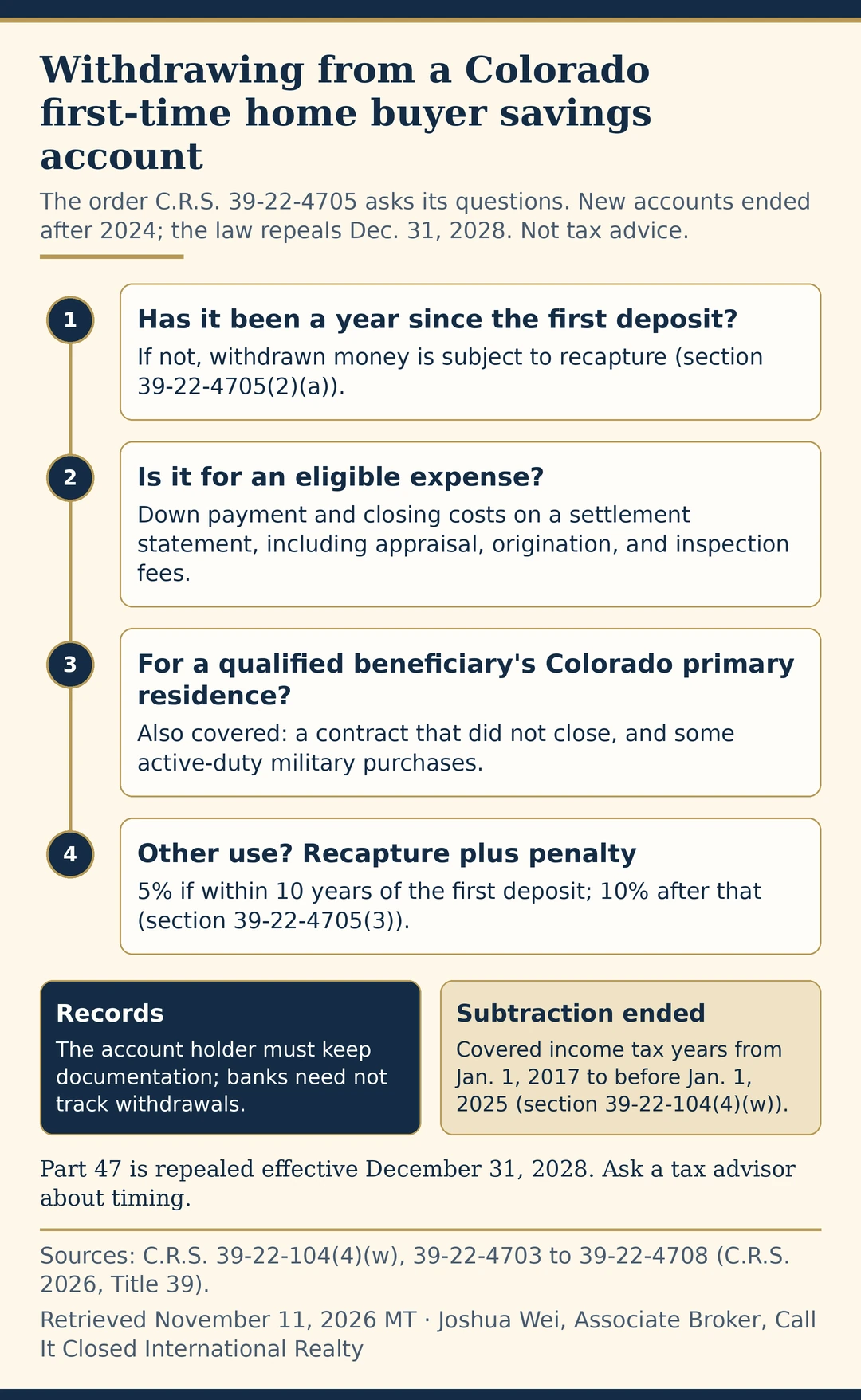 Full size (opens in a new tab)
A vertical flow diagram, cream background with navy type and gold accents, titled Withdrawing from a Colorado first-time home buyer savings account. Subtitle: The order C.R.S. 39-22-4705 asks its questions. New accounts ended after 2024; the law repeals Dec. 31, 2028. Not tax advice. 4 numbered steps: 1, Has it been a year since the first deposit?: If not, withdrawn money is subject to recapture (section 39-22-4705(2)(a)); 2, Is it for an eligible expense?: Down payment and closing costs on a settlement statement, including appraisal, origination, and inspection fees; 3, For a qualified beneficiary's Colorado primary residence?: Also covered: a contract that did not close, and some active-duty military purchases; 4, Other use? Recapture plus penalty: 5% if within 10 years of the first deposit; 10% after that (section 39-22-4705(3)). Two cards: Records: The account holder must keep documentation; banks need not track withdrawals; and Subtraction ended: Covered income tax years from Jan. 1, 2017 to before Jan. 1, 2025 (section 39-22-104(4)(w)). A note says: Part 47 is repealed effective December 31, 2028. Ask a tax advisor about timing. Sources: C.R.S. 39-22-104(4)(w), 39-22-4703 to 39-22-4708 (C.R.S. 2026, Title 39). Retrieved November 11, 2026 MT. Joshua Wei, Associate Broker, Call It Closed International Realty.
Sources: Colorado Revised Statutes 2026, Title 39 (opens in a new tab)
Cream background, navy text, gold rules. Numbered navy circles on a gold spine with white step cards, two branch cards (navy and tan), a note, and a source footer.
The flow above follows the statute's questions about a withdrawal, in order.
Why the law existed, and how the accounts were set up
The legislative declaration in C.R.S. 39-22-4702 (opens in a new tab) says the purpose was "to encourage first-time home ownership through incentivizing saving for a down payment and closing costs because of the significant financial and civic benefits home ownership provides for our state."
Section 39-22-4704(1) let "any individual" open an account "and designate the account, in its entirety, as a first-time home buyer savings account to be used to pay or reimburse a qualified beneficiary's eligible expenses for the purchase of a primary residence in Colorado." It adds: "An individual may be the account holder of multiple accounts, and an individual may jointly own the account with another person if they file a joint income tax return."
The beneficiary
Section 39-22-4704(2) says an account holder "must designate, no later than April 15 of the year following the taxable year during which the account is established, a first-time home buyer as the qualified beneficiary." The account holder "may designate himself or herself as the qualified beneficiary" and "may change the designated qualified beneficiary at any time, but there may not be more than one qualified beneficiary at any time." And: "An account holder cannot have multiple accounts with the same qualified beneficiary, but an individual may be designated as the qualified beneficiary of multiple accounts."
So a parent could have opened an account for a child, and the child is the person whose first-time status counts. Section 39-22-4703(7) defines a qualified beneficiary as "a first-time home buyer designated by an account holder for whom the money in a first-time home buyer savings account is or will be used for eligible expenses for the purchase of his or her primary residence in the state."
The limits
Section 39-22-4704(3)(a) sets three caps:
- "The maximum contribution to a first-time home buyer savings account for a taxable year is fourteen thousand dollars for an individual and twenty-eight thousand dollars for account holders who file a joint return;"
- "The maximum amount of all contributions for all taxable years to a first-time home buyer savings account is fifty thousand dollars; and"
- "The maximum total amount in an account is one hundred fifty thousand dollars."
Subsection (3)(b) says that if a limit is exceeded, "then thereafter no interest or other income earned on the investment of money in a first-time home buyer savings account may be subtracted from taxable income." The definition of "financial institution" in section 39-22-4703(4) is broad. It includes "any state bank, state trust company, savings and loan association," credit unions, "national bank, broker-dealer, mutual fund, insurance company, or other similar financial entity qualified to do business in the state of Colorado."
What the subtraction covered
The subtraction in section 39-22-104(4)(w)(I) is "an amount equal to any interest and other income earned on the investment of the money in a first-time home buyer savings account during the taxable year." It applies only to income tax years "prior to January 1, 2025." It covers earnings, not contributions. Subsection (4)(w)(II) adds: "Any exclusion taken under subparagraph (I) of this paragraph (w) is subject to recapture under paragraph (k) of subsection (3) of this section as specified in section 39-22-4705."
What counts as an eligible expense?
C.R.S. 39-22-4703(3) (opens in a new tab) defines eligible expenses as "a down payment and any closing costs included on a real estate settlement statement, including, but not limited to, appraisal fees, mortgage origination fees, and inspection fees."
Under section 39-22-4705(1)(a), the money may be "Used for eligible expenses related to a qualified beneficiary's purchase of his or her primary residence in the state." It can also cover expenses that would have qualified when "the contract for purchase did not close."
The full list in section 39-22-4705(1)(a) has five permitted uses: (I) eligible expenses for a primary residence in Colorado; (II) eligible expenses "in or outside the state, if the qualified beneficiary is active-duty military and was stationed in Colorado for any time after the creation of the account"; (III) expenses for a contract that "did not close"; (IV) "Transferred to another newly created first-time home buyer savings account"; or (V) "Used to pay a service fee that is deducted by the financial institution."
The statute puts recordkeeping on the account holder. Section 39-22-4704(4) (opens in a new tab) says: "The account holder is responsible for maintaining documentation for the first-time home buyer savings account and for eligible expenses related to the qualified beneficiary's purchase of his or her primary residence."
Who is a first-time home buyer under this law?
Section 39-22-4703(5) (opens in a new tab) defines a first-time home buyer as someone who "Has never owned or purchased under contract for deed, either individually or jointly, a single-family, owner-occupied primary residence," or who, "As a result of the individual's dissolution of marriage, has not been listed on a property title for at least three consecutive years or more." The statute does not limit this test to Colorado. A beneficiary who has owned a primary home in another state does not meet this definition, except for the dissolution-of-marriage rule quoted above.
What happens if money is used for something else?
Section 39-22-4705(2) (opens in a new tab) says withdrawn money "is subject to recapture" if "it has been less than a year since the first deposit" or "The money is used for any purpose other than those specified in subsection (1)."
Recapture is calculated "in the taxable year in which it is withdrawn based on a proportion from the account subtracted under section 39-22-104 (4)(w)(I) to the total amount in the account." In plain terms, the statute ties recapture to the share of the account that had been subtracted. The math for a particular account is a question for a tax advisor.
For non-qualifying uses, section 39-22-4705(3) adds a penalty: "If the withdrawal was made ten or fewer years after the first deposit in the first-time home buyer savings account, then the penalty is equal to five percent of the amount subject to recapture, and if the withdrawal was made more than ten years after the first deposit in the account, then the penalty is equal to ten percent of the amount subject to recapture."
The same subsection lists two cases where "these penalties do not apply": when "The money is used for eligible expenses related to a qualified beneficiary's purchase of his or her primary residence outside of the state," or when the money "is from a first-time home buyer savings account for which the qualified beneficiary dies and the account holder does not designate a new qualified beneficiary during the same taxable year."
Subsection (4) covers the account holder's death: "all of the money in the account that was subtracted from taxable income is subject to recapture in the taxable year of the death or deaths, but no penalty is due to the department."
Does the bank track this for me?
Section 39-22-4707(1) (opens in a new tab) says a financial institution is not required to "Track the use of money withdrawn from a first-time home buyer savings account." Under section 39-22-4706, an account holder claiming the subtraction "must annually file with his or her state income tax return the completed form, the form 1099 for the account issued by the financial institution, and any other supporting documentation the department requires."
Section 39-22-4707(2) also says a financial institution "is not responsible or liable for" determining eligibility, "Determining or ensuring that money in the account is used for an eligible expense," or "Reporting or remitting taxes or penalties related to use of money in a first-time home buyer savings account." Under section 39-22-4707(1)(a), the bank is not even required to "Designate an account as a first-time home buyer savings account." The designation and the records sit with the account holder.
The Department of Revenue form
The Department's form is DR 0350 (opens in a new tab). The latest version found on November 13, 2026 is the 2024 form (DR 0350, 07/30/24); a 2025 version URL returned 404. Its instructions say: "You must complete this form annually and file it with your income tax return if you open and designate an account as a first-time home buyer account." They also say: "You must submit account statements AND a 1099 showing only the taxable interest and/or earnings on the account in the tax year claimed." For a purchase: "Upon withdrawal, you must also submit a real estate settlement statement that shows that the withdrawal was used for an eligible expense." The form's attestation includes: "I am NOT claiming mortgage interest (reported on a 1098) for a house I currently own."
What about the 2028 repeal?
The statute says part 47 "is repealed, effective December 31, 2028," and the subtraction subsection is "repealed, effective December 31, 2028." The 2026 statutes don't spell out what happens to remaining balances after that.
Two provisions sit side by side and are quoted here as written. Section 39-22-4704(3)(c) says: "Money may remain in a first-time home buyer savings account for unlimited duration without the interest or income being subject to recapture or penalty." Section 39-22-4708 says: "This part 47 is repealed, effective December 31, 2028." The statute text does not say how the first applies after the second takes effect. Ask the Colorado Department of Revenue or a tax advisor. How the repeal affects timing is a question for a tax advisor.
How does this fit a 2027 purchase?
The eligible-expense definition refers to costs "included on a real estate settlement statement." How those costs will appear on a particular statement is a question for the lender and title company.
If you have an account and are buying in 2027, the sources above point to a short list of records to keep: account statements and the 1099, the settlement statement showing the down payment and closing costs, and proof of who the qualified beneficiary was. DR 0350 asks for the settlement statement "Upon withdrawal."
An invented example
This example is invented; it is not tax advice.
A parent opened an account in 2019 and named her son as qualified beneficiary by April 15, 2020. She contributed under the yearly and lifetime caps and claimed the subtraction on earnings for tax years through 2024. In 2027 her son, who has not owned a home before, buys a condo in Aurora. She withdraws money to pay his down payment and closing costs, and the closing company's settlement statement shows those amounts. She keeps the statement with her account records for her tax filing. Her tax advisor reviews the rest of the account, given the December 31, 2028 repeal date.
A checklist for account holders
- Find your designation. Confirm who the qualified beneficiary is and when they were named.
- Check first-time status. Compare the beneficiary to the definition in section 39-22-4703(5).
- Check the caps. Review contributions against the $14,000/$28,000 yearly, $50,000 total and $150,000 balance limits.
- Time the withdrawal. Recapture applies if "it has been less than a year since the first deposit."
- Keep the settlement statement. DR 0350 asks for it on withdrawal.
- Ask about 2028. Talk to a tax advisor about timing before the repeal date.
Related: Denver home prices and seller concessions (opens in a new tab).
Frequently asked questions
Can I still open a new account?
The statute allowed new accounts only "prior to January 1, 2025."
Can I use it for a home outside Colorado?
For active-duty military "stationed in Colorado for any time after the creation of the account," section 39-22-4705(1)(a)(II) treats it as an eligible use. For other buyers, section 39-22-4705(3)(a) says the penalty does not apply when money is "used for eligible expenses related to a qualified beneficiary's purchase of his or her primary residence outside of the state." For a buyer who is not active-duty military, buying a home outside Colorado is not one of the uses the statute allows. Money used for any other purpose is subject to recapture, which means the Colorado subtraction taken in earlier years can be added back to income. The statute turns off the 5% or 10% penalty for an out-of-state primary home, but it does not turn off the recapture. Confirm this with a tax advisor before withdrawing.
Can I move the money to a new account?
Section 39-22-4705(1)(a)(IV) lists "Transferred to another newly created first-time home buyer savings account" as a permitted use. Since section 39-22-4704(1) allowed new accounts only before January 1, 2025, ask a tax advisor how that item applies now.
Can I still claim the subtraction for my 2025 or 2026 return?
The subtraction in section 39-22-104(4)(w)(I) is limited to "income tax years commencing on or after January 1, 2017, and prior to January 1, 2025." The statute text does not extend it to later years. Ask a tax advisor about your own returns.
Can spouses share one account?
Section 39-22-4704(1) says "an individual may jointly own the account with another person if they file a joint income tax return." The yearly contribution cap for joint filers is "twenty-eight thousand dollars."
Who pays the penalty, and when?
Section 39-22-4705(3) says "the account holder shall pay to the department a penalty in the same taxable year as the recapture." The penalty applies to money recaptured for a non-qualifying use under subsection (2)(b).
Is a condo eligible?
The first-time buyer definition refers to a "single-family, owner-occupied primary residence, including, but not limited to, a condominium unit or a manufactured or mobile home that is assessed and taxed as real property."
Can I pay the bank's fees from the account?
Section 39-22-4704(4) says "a service fee may be deducted from the account by a financial institution."
What if my purchase falls through?
Section 39-22-4705(1)(a)(III) covers expenses that would have qualified when "the contract for purchase did not close."
Can a co-buyer who isn't a first-time buyer be on title?
Section 39-22-4705(1)(b) says the rules apply "regardless of whether the qualified beneficiary is the sole owner of the primary residence or joint owner with another person who does not qualify as qualified beneficiary."
Does a manufactured home qualify?
The statute excludes "a manufactured or mobile home that is not taxed as real property."
Related notes
- CHFA first-time buyer programs in Denver and Aurora: what the 2026 limits and assistance options actually say
- Closing costs in Denver and Aurora: what is set by law, what is negotiated, and what to read on the forms
- Denver's affordable homeownership program: income limits, price caps, and resale rules
Sources and method
Official source, retrieved November 11, 2026, America/Denver:
- Colorado Revised Statutes 2026, Title 39 (opens in a new tab): sections 39-22-104(4)(w), 39-22-4703, 39-22-4704, 39-22-4705, 39-22-4706, 39-22-4707, 39-22-4708
Added November 13, 2026: the full text of C.R.S. 39-22-4702 through 39-22-4708 and 39-22-104(4)(w) (Title 39 (opens in a new tab)), and the Department of Revenue's DR 0350 (2024) (opens in a new tab) PDF.
Quotations are verbatim. Colorado Department of Revenue web pages returned HTTP 403 to my fetcher, so this article relies on the statute and the DR 0350 PDF. No tax amounts are calculated.
This note is general education from a Colorado real estate broker with Call It Closed International Realty. If you're a first-time buyer in Denver or Aurora, I can help you plan the purchase side and coordinate with your lender and tax advisor.
Added November 19, 2026, after an expert review, and checked that day: Colorado Department of Revenue, Income Tax Topics: First-Time Home Buyer Savings Account Subtraction (opens in a new tab).
Disclaimer
This article is general information only. It is not legal, tax, lending, insurance, appraisal, inspection, or financial advice, and it is not a substitute for advice about your situation. Joshua Wei is a Colorado real estate broker, not an attorney. Reading this article does not create a client relationship, an agency relationship, or an attorney-client relationship with Joshua Wei or with Call It Closed International Realty.
Laws, program rules, interest rates, insurance terms, tax figures, and other details change. Examples in this article are hypothetical illustrations unless a source is named for a specific, dated figure. Information in this article is believed accurate as of November 19, 2026 and is not guaranteed. No result is promised, and you should not rely on this article as the last word for your situation.
Before you act, confirm the point with the official source linked or cited in this article, and talk with a licensed professional who can apply the rule to your facts. That may be a licensed attorney, a tax professional, a lender, an insurance agent, a home inspector, or another licensed professional, depending on the question. Links to third-party websites and publications are provided for reference only. They are not an endorsement, and their content can change.
If you already have a brokerage relationship with another broker, this is not a solicitation.
Joshua Wei, Associate Broker, Call It Closed International Realty, Colorado license FA.100108558. Equal Housing Opportunity.