November 9, 2026 · Colorado · Buying · Selling · Home Warranty
Home warranties in a Colorado home sale: what the law requires, what to read, and what a warranty isn't
Colorado regulates home warranty service contracts in C.R.S. 12-10-901 to 905. What every contract must disclose, the rule that no one can require you to buy one, the gas-to-electric replacement option, and how a warranty fits with inspections and the purchase contract.
The short answer
In brief: A home warranty is optional in a Colorado home sale. Under C.R.S. 12-10-902, a home warranty company shall not in any manner require a buyer, seller or person refinancing to purchase a home warranty service contract, and C.R.S. 12-10-905 makes it unlawful for a lending institution to require one as a condition of financing. Read the contract's coverage and exclusions.
A home warranty is optional in a Colorado home sale. Under C.R.S. 12-10-902, a home warranty company "shall not in any manner require a home buyer or seller, or prospective home buyer or seller, or person refinancing a home to purchase a home warranty service contract." C.R.S. 12-10-905 says it is "unlawful for any lending institution to require the purchase of a home warranty service contract as a condition for granting financing."
If you do buy one, Colorado law says what the contract has to spell out. That includes "A specific listing of all items or elements excluded from coverage" and any exclusion of "preexisting conditions if applicable." What a particular contract covers is a question for the warranty company.
I am a licensed Colorado real estate broker with Call It Closed International Realty. I am not an attorney or an insurance professional.
Disclaimer. This article is general information only. It is not legal, tax, lending, insurance, appraisal, inspection, or financial advice, and reading it does not create a client, agency, or attorney-client relationship. Laws, rates, programs, and figures change. Confirm the official source, and talk with a licensed attorney, tax professional, lender, insurance agent, or inspector before you act. Joshua Wei is a Colorado real estate broker, not an attorney. He is an Associate Broker with Call It Closed International Realty, license FA.100108558. Equal Housing Opportunity.
 Full size (opens in a new tab)
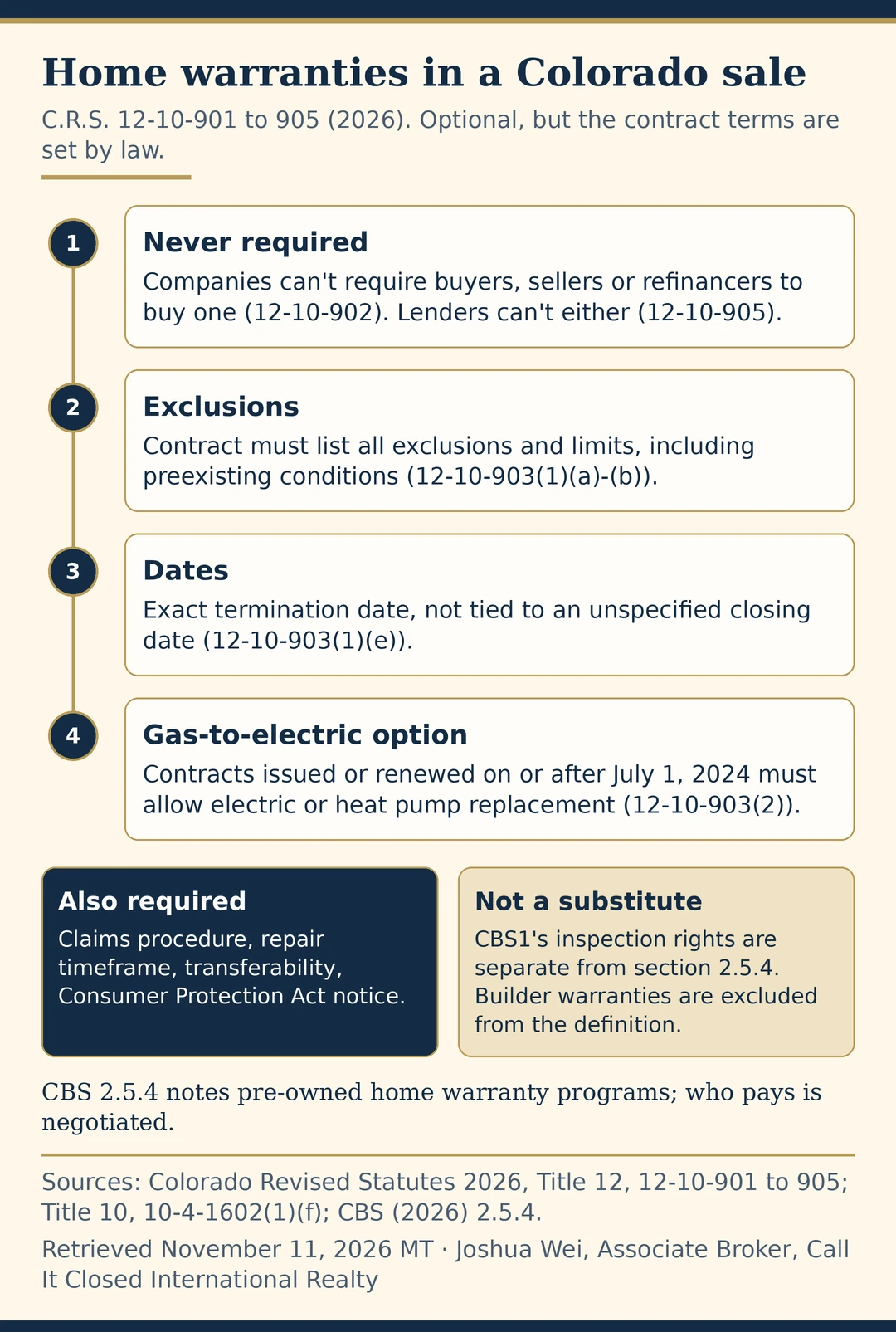
A vertical flow diagram, cream background with navy type and gold accents, titled Home warranties in a Colorado sale. Subtitle: C.R.S. 12-10-901 to 905 (2026). Optional, but the contract terms are set by law. 4 numbered steps: 1, Never required: Companies can't require buyers, sellers or refinancers to buy one (12-10-902). Lenders can't either (12-10-905); 2, Exclusions: Contract must list all exclusions and limits, including preexisting conditions (12-10-903(1)(a)-(b)); 3, Dates: Exact termination date, not tied to an unspecified closing date (12-10-903(1)(e)); 4, Gas-to-electric option: Contracts issued or renewed on or after July 1, 2024 must allow electric or heat pump replacement (12-10-903(2)). Two cards: Also required: Claims procedure, repair timeframe, transferability, Consumer Protection Act notice; and Not a substitute: CBS1's inspection rights are separate from section 2.5.4. Builder warranties are excluded from the definition. A note says: CBS 2.5.4 notes pre-owned home warranty programs; who pays is negotiated. Sources: Colorado Revised Statutes 2026, Title 12, 12-10-901 to 905; Title 10, 10-4-1602(1)(f); CBS (2026) 2.5.4. Retrieved November 11, 2026 MT. Joshua Wei, Associate Broker, Call It Closed International Realty.
Sources: C.R.S. 2026 Title 12 (opens in a new tab)
Cream background, navy text, gold rules. Numbered navy circles on a gold spine with white step cards, two branch cards (navy and tan), a note, and a source footer.
The figure above lists the seven items Colorado requires in every home warranty contract, plus the rules that keep a warranty optional.
What counts as a home warranty under Colorado law?
C.R.S. 12-10-901(4) defines a home warranty service contract as an agreement where a company "undertakes for a predetermined fee, with respect to a specified period of time, to maintain, repair, or replace" structural components, utility systems or appliances in a home.
The three categories the statute lists are:
- "Structural components, such as the roof, foundation, basement, walls, ceilings, or floors;"
- "Utility systems, such as electrical, air conditioning, plumbing, HVAC, and heating systems, including furnaces;" and
- "Appliances, such as stoves, washers, dryers, and dishwashers."
A contract can cover "any or all" of these. The statute does not require any one of them to be covered, so what a given plan includes depends on its terms.
Subsection (7) defines "Preowned" as a single-family residence, "A residential unit in a multiple-dwelling structure," or "A mobile home on a foundation," when it "is occupied as a residence and not owned by the builder-developer or first occupant." Subsection (3) defines the company as "any person that undertakes a contractual obligation on a new or preowned home through a home warranty service contract."
Two things are excluded from that definition:
- Certain public utility service plans.
- "A builder's warranty provided in connection with the sale of a new home." Builder warranties on new construction are a separate subject.
Home warranties are also not regulated like insurance service contracts. Colorado's insurance service-contract law, at C.R.S. 10-4-1602(1)(f), exempts "Home warranty service contracts governed by part 9 of article 10 of title 12."
What must the contract say?
C.R.S. 12-10-903(1) requires every home warranty service contract to include:
- "A specific listing of all items or elements excluded from coverage"
- "A specific listing of all other limitations in coverage, including the exclusion of preexisting conditions if applicable"
- "The procedure that is required to be followed in order to obtain repairs or replacements"
- The time period within which repairs or replacements will be provided
- "The specific duration of the home warranty service contract, including an exact termination date that is not contingent upon an unspecified future closing date or other indefinite event"
- "A statement as to whether the home warranty service contract is transferable"
- A statement that the contract may be covered by the Colorado Consumer Protection Act or the Unfair Practices Act, and that a party "may have a right of civil action under those laws"
How a particular contract's exclusions and preexisting-condition terms apply to a specific system is a question for the warranty company.
The full text of two of these items is worth reading closely. Item 4, in subsection (1)(d), requires "A statement as to the time period, following notification to the company, within which the requested repairs will be made or replacements will be provided." The statute sets no particular number of days; it requires the contract to state one. Item 7, in subsection (1)(g), requires a statement that actions under the contract "may be covered by the provisions of the" Colorado Consumer Protection Act or the Unfair Practices Act, "articles 1 and 2 of title 6," and that a party "may have a right of civil action under those laws, including obtaining the recourse or penalties specified in those laws."
Reading the contract against the statute
Before signing, a buyer can check the contract for each required item:
- A list of exclusions, and a separate list of other limitations.
- Whether preexisting conditions are excluded, and how the contract describes them.
- The claim procedure: who you call, and what you must do first.
- The stated repair or replacement time after you notify the company.
- An exact termination date.
- A transferability statement.
- The consumer-protection statement.
If one is missing, ask the company about it in writing before you buy.
What if a gas appliance needs replacing?
C.R.S. 12-10-903(2) applies to contracts "issued or renewed in this state on or after July 1, 2024." If such a contract covers replacing a gas appliance, it has to give the homeowner the option to replace it "with a similar device of the homeowner's choosing that operates on electricity rather than gas."
For a gas furnace, HVAC system, boiler or water heater, the contract must allow replacement "with a heat pump-based system." The statute addresses the homeowner paying a cost difference, with limits on that amount; the warranty company can explain how its contract applies them.
The limit is in subsection (2)(a)(I). A contract "may require a homeowner to pay any additional cost to replace a gas-fueled appliance with an appliance that has a cost that exceeds the cost of replacing the gas-fueled appliance with another gas-fueled appliance." But "any additional cost to the homeowner for the replacement electric appliance, excluding any installation or other associated costs, must not exceed the retail cost of the replacement electric appliance minus the retail cost of a replacement gas-fueled appliance." Installation and associated costs are carved out of that cap, so ask the company how it handles them.
Subsection (2)(a)(II) requires the company "to provide a replacement appliance that satisfies the efficiency requirements set forth in article 7.5 of title 6 and any other state law." For stoves, (2)(b)(II) requires terms "that allow the homeowner to replace the gas-fueled stove with either an electric stove or an induction stove, at the homeowner's discretion."
The definitions frame these rules. "Gas-fueled appliance" means "a furnace, HVAC system, boiler, water heater, oven, stove, or dryer that directly combusts a gaseous or liquid fuel to provide services within a home." A "Heat pump" is "an electrical device that uses a refrigeration cycle" to heat or cool a structure by moving thermal energy in or out.
How does a warranty fit into the purchase contract?
The Commission's residential Contract to Buy and Sell Real Estate (opens in a new tab) mentions warranties in section 2.5.4: "Seller and Buyer are aware of the existence of pre-owned home warranty programs that may be purchased and may cover the repair or replacement of certain Inclusions." The contract itself doesn't say who pays; that is a term the parties negotiate, and contract questions are for a Colorado real estate attorney.
The contract's inspection rights and deadlines are separate provisions from section 2.5.4.
Before closing, the seller's contract duties apply
A warranty bought for the buyer starts on the date stated in the warranty contract. Before closing, the purchase contract has its own rule. CBS section 18.2 says that if "any Inclusion or service (including utilities and communication services), system, component or fixture of the Property" fails or is damaged "between the date of this Contract and Closing or possession, whichever is earlier, then Seller is liable for the repair or replacement of such Inclusion or Service with a unit of similar size, age and quality, or an equivalent credit." That duty applies "only to the extent that the maintenance or replacement of such Inclusion or Service is not the responsibility of the Association, if any, less any insurance proceeds received by Buyer covering such repair or replacement."
Under section 18.4, "Buyer, upon reasonable notice, has the right to walk through the Property prior to Closing to verify that the physical condition of the Property and Inclusions complies with this Contract." A walk-through is a chance to check that covered systems are working on the day a warranty starts.
Where a warranty term goes in the contract
The form has no checkbox for a home warranty. If the parties agree that one side will buy or pay for a plan, that term has to be written somewhere. Section 30 (Additional Provisions) says: "The following additional provisions have not been approved by the Colorado Real Estate Commission." How to draft a warranty term is a question for a Colorado real estate attorney.
What the seller's disclosure says
The Seller's Property Disclosure (2026) (opens in a new tab) is not a warranty. It says: "Seller and Buyer understand that this SPD is not a warranty or guarantee of any kind by the Seller or by any Broker or Agent representing the Seller." It adds that disclosure of an item's condition "is not to be construed as a warranty of its continued operability or as a representation or warranty that such item is fit for Buyer's intended purposes."
The SPD does ask about one manufacturer-type warranty. In the roof section, the seller indicates whether the "Roof is under warranty," the "Date of warranty expiration," and whether the "Warranty is transferable." A roof warranty and a home warranty service contract are separate things. Ask the seller for the roof warranty paperwork if that box is checked.
Questions buyers can ask a warranty company
- What's excluded, and how does the contract define a preexisting condition?
- What's the exact start date and end date?
- Is it transferable on a sale?
- What does a service call cost, and how long do repairs take?
- Are there coverage caps for each system or appliance?
- What is the stated time for repairs after I file a claim?
- For a gas furnace or water heater, how does the contract handle a switch to a heat pump, and what installation costs would I pay?
- Does coverage start at closing, and what date is written in the contract?
An invented example
This example is invented; the people, the home and the plan are not real.
A buyer is under contract on a 1998 Aurora house with a gas furnace and gas water heater. The seller agrees in the Additional Provisions to pay for a one-year warranty plan, wording the buyer's attorney reviews. The buyer reads the plan before closing. It lists exclusions and a preexisting-condition limit, a claim phone line, a stated repair time, an exact end date, a transferability clause and the consumer-protection statement. Two weeks after closing, the furnace fails. The buyer files a claim and asks about the heat pump option the statute requires the contract to offer. The plan quotes the gas replacement cost, the heat pump cost, and the buyer's share. The buyer checks that the share for the unit itself is no more than the retail price difference, and asks separately about installation.
A buyer's checklist
- Decide whether you want a plan; neither a warranty company nor a lender can require one.
- Get the full contract, not a brochure.
- Check the seven required items in C.R.S. 12-10-903(1).
- Write down the start and end dates.
- Put any agreement about who pays in writing in the purchase contract, with your attorney's help.
- Do the walk-through before closing.
- Keep the claim procedure with your closing documents.
Frequently asked questions
Can a lender require a home warranty?
C.R.S. 12-10-905 makes it unlawful to require one as a condition of financing.
Does Colorado's Division of Insurance regulate home warranties?
Home warranty service contracts are governed by title 12, part 9, and are exempt from the insurance service-contract part under C.R.S. 10-4-1602(1)(f).
Is a builder's warranty the same thing?
The definition excludes "A builder's warranty provided in connection with the sale of a new home."
Can my warranty start "at closing" without a date?
The statute requires "an exact termination date that is not contingent upon an unspecified future closing date or other indefinite event."
Can I switch from a gas furnace to a heat pump under my warranty?
For covered contracts issued or renewed on or after July 1, 2024, C.R.S. 12-10-903(2) requires the option of replacement "with a heat pump-based system." The warranty company can explain its terms.
Does a warranty replace a home inspection?
The statute doesn't address inspections. The SPD says "Property inspection services may be purchased and are advisable." The contract's inspection rights are separate from section 2.5.4.
Can a home warranty cover the roof?
The statute's definition lists "Structural components, such as the roof, foundation, basement, walls, ceilings, or floors" among the elements a contract may cover. Whether a specific plan covers the roof, and on what terms, is in that plan's exclusions and limitations, which C.R.S. 12-10-903(1) requires it to list.
What should I keep after closing?
The warranty contract itself, with its claim procedure, stated repair time and termination date. Keep it with the settlement statement and the inspection report.
Who pays for a home warranty in a Colorado sale?
The contract doesn't say. It is a term the parties negotiate.
Does a home warranty cover a condo?
The statute's definition of "Preowned" includes "A residential unit in a multiple-dwelling structure." What a plan covers in a unit, and what the HOA is responsible for, depends on the plan and the declaration.
What happens if a company violates these rules?
C.R.S. 12-10-904 says a person "who knowingly violates any provision of this part 9 commits a class 2 misdemeanor." It adds: "Each instance of violation shall be considered a separate offense." Civil remedies are a question for a Colorado attorney.
Related notes
- What if the furnace dies or a pipe bursts before closing? Colorado's contract rules for damage and the final walk-through
- Buying a new-build home in Denver or Aurora: the builder's contract, the 2026 legal-advice rule, and Colorado's defect-claim process
- Sewer scopes and roof inspections in Denver and Aurora: what they catch that a general inspection can miss
Sources and method
Official sources, retrieved November 11, 2026, America/Denver:
- Colorado Revised Statutes 2026, Title 12 (opens in a new tab), C.R.S. 12-10-901 to 12-10-905 (12-10-906 repealed by HB26-1287, effective August 12, 2026)
- Colorado Revised Statutes 2026, Title 10 (opens in a new tab), C.R.S. 10-4-1602(1)(f)
- Colorado Real Estate Commission, Contract to Buy and Sell Real Estate (Residential), for use on and after January 1, 2026 (opens in a new tab), section 2.5.4
Added November 13, 2026: further passages of C.R.S. 12-10-901, -903 and -904 (opens in a new tab) (definitions, full contract requirements, gas-appliance cost limit, efficiency and stove terms, separate offenses); CBS1 sections 18.2, 18.4 and 30 (2026 contract PDF (opens in a new tab)); and the Seller's Property Disclosure (2026) (opens in a new tab) (not-a-warranty statement, roof warranty questions).
Quotations are verbatim. The example is invented. HB26-1287 repealed the part's sunset-review section; the contract rules in this article remain in the 2026 statutes. I don't recommend or rate warranty companies.
This note is general education from a Colorado real estate broker with Call It Closed International Realty. If a home warranty is part of your negotiation, I'll help you write it into the contract clearly and line it up against your inspection report.
Disclaimer
This article is general information only. It is not legal, tax, lending, insurance, appraisal, inspection, or financial advice, and it is not a substitute for advice about your situation. Joshua Wei is a Colorado real estate broker, not an attorney. Reading this article does not create a client relationship, an agency relationship, or an attorney-client relationship with Joshua Wei or with Call It Closed International Realty.
Laws, program rules, interest rates, insurance terms, tax figures, and other details change. Examples in this article are hypothetical illustrations unless a source is named for a specific, dated figure. Information in this article is believed accurate as of November 13, 2026 and is not guaranteed. No result is promised, and you should not rely on this article as the last word for your situation.
Before you act, confirm the point with the official source linked or cited in this article, and talk with a licensed professional who can apply the rule to your facts. That may be a licensed attorney, a tax professional, a lender, an insurance agent, a home inspector, or another licensed professional, depending on the question. Links to third-party websites and publications are provided for reference only. They are not an endorsement, and their content can change.
If you already have a brokerage relationship with another broker, this is not a solicitation.
Joshua Wei, Associate Broker, Call It Closed International Realty, Colorado license FA.100108558. Equal Housing Opportunity.