September 26, 2026 · Denver · Aurora · Buying · Selling
Sewer scopes and roof inspections in Denver and Aurora: what they catch that a general inspection can miss
In Denver and Aurora, the sewer lateral is the property owner’s responsibility all the way to the tap at the city main, and Colorado’s purchase contract expressly names the roof as part of the buyer’s inspection right. What the cities, the contract, and the Division of Insurance actually say — without inventing a typical repair bill.
The short answer
In brief: A general home inspection is not the same as a camera inspection of the sewer line or a roofing specialist's inspection. Colorado's 2026 purchase contract gives the buyer, acting in good faith, the right to have inspections by one or more third parties, which is how Denver and Aurora buyers add a sewer scope or a roof inspection.
A general home inspection is not the same thing as a camera inspection of the sewer line, and it is not the same thing as a roofing specialist’s inspection. Colorado’s standard residential purchase contract gives the buyer, acting in good faith, the right to have inspections "by one or more third parties, personally or both." Section 10.3 of the Colorado Real Estate Commission’s Contract to Buy and Sell Real Estate (Residential), CBS1, mandatory beginning January 1, 2026, and retrieved November 10, 2026 from the Division of Real Estate contracts and forms page (opens in a new tab), states that the buyer may act if "the physical condition of the Property, including, but not limited to, the roof, walls, structural integrity of the Property, the electrical, plumbing, HVAC and other mechanical systems of the Property" is unsatisfactory, in the buyer’s sole subjective discretion.
The sewer line that leaves the house is usually not the city’s problem. The City and County of Denver’s utility locates page (opens in a new tab), retrieved November 10, 2026, states: "The City and County of Denver locates main sewer lines only. The service line (lateral) line is the responsibility of the property owner up to and including the tap into the main sewer line." Denver’s wastewater FAQ (opens in a new tab), retrieved the same day, states: "The City and County of Denver is only responsible for main public sewers. For information about your private tap/service line, we recommend you to hire a licensed plumbing company that provides such services." Aurora Water’s wastewater page (opens in a new tab), retrieved November 10, 2026, states that "it’s the property owner’s responsibility to maintain and repair the wastewater (sanitary sewer) service line that runs from their home or building to the city’s sewer mains in the alley or right of way," and that "A video scope of your service line can be attained from a plumber or other vendor."
The roof sits in a different official conversation: the contract’s inspection language, already quoted, and the separate property-insurance deadline. Whether hail damage is usually a covered peril is a question the Colorado Division of Insurance answers in general terms, quoted later. What any one policy will do with a particular roof is a question for an insurance professional, not for a blog post.
This article explains those official lines of responsibility and the contract path for acting on what an inspection finds. It does not tell you that you must order a sewer scope or a roof inspection, it does not invent a typical cost, and it is not an inspection report or insurance advice.
I am a licensed Colorado real estate broker with Call It Closed International Realty. I am not a home inspector, a plumber, a roofing contractor, an engineer, an attorney, or an insurance agent. If a report raises a repair, a permit, or a coverage question, that question belongs with the appropriate licensed professional.
Disclaimer. This article is general information only. It is not legal, tax, lending, insurance, appraisal, inspection, or financial advice, and reading it does not create a client, agency, or attorney-client relationship. Laws, rates, programs, and figures change. Confirm the official source, and talk with a licensed attorney, tax professional, lender, insurance agent, or inspector before you act. Joshua Wei is a Colorado real estate broker, not an attorney. He is an Associate Broker with Call It Closed International Realty, license FA.100108558. Equal Housing Opportunity.
 Full size (opens in a new tab)
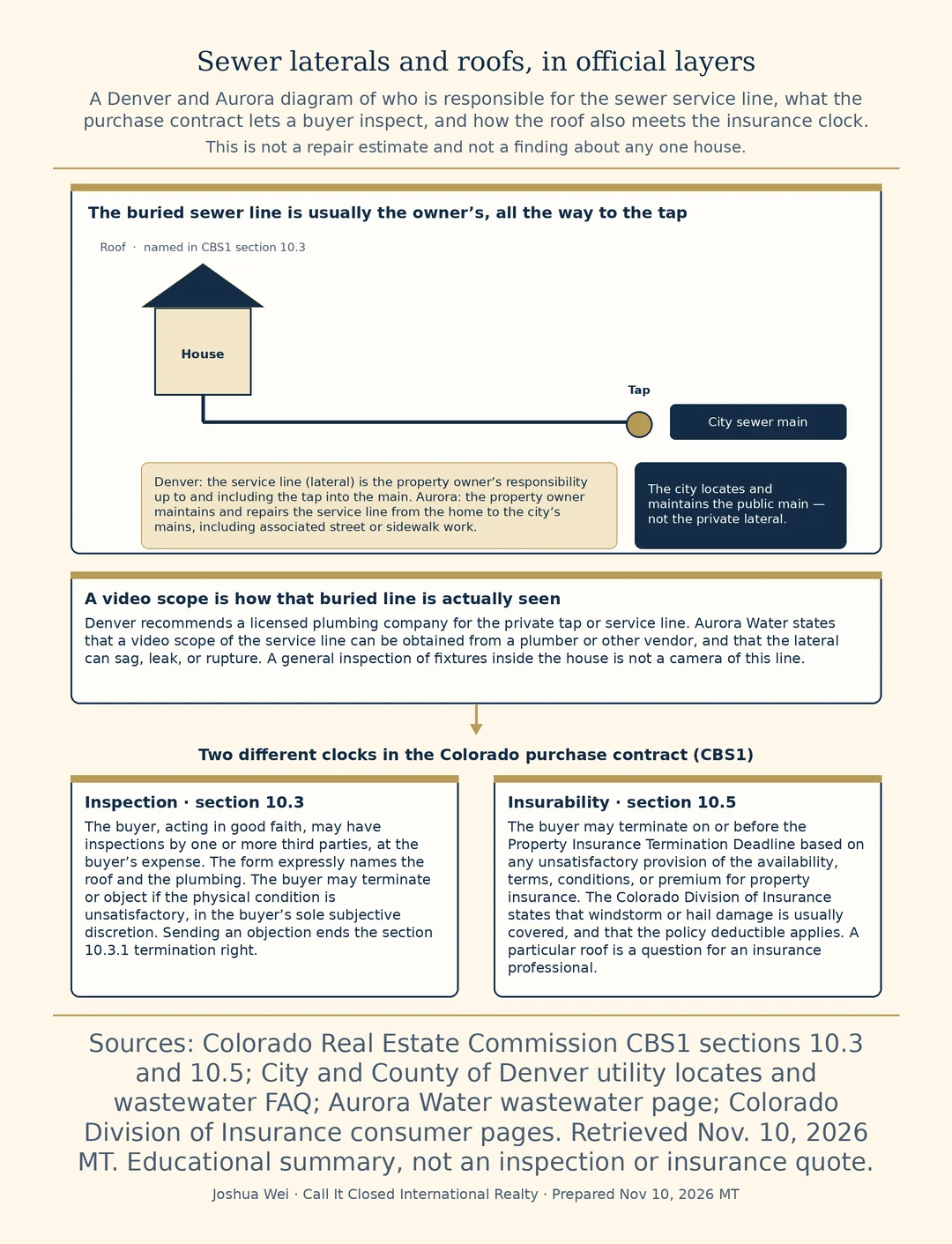
A vertical diagram, cream background and navy type, of sewer-lateral responsibility and roof-inspection clocks for Denver and Aurora buyers. A house drawing shows a roof labeled as named in Colorado contract section 10.3, a private sewer service line running to a gold tap at the city main, and captions stating that Denver and Aurora place that lateral on the property owner, while the city maintains the public main. A middle card explains that a video scope from a plumber or other vendor is how that buried line is seen, and that a general inspection of indoor fixtures is not a camera of the lateral. Two lower cards compare the contract’s inspection path in section 10.3, including the roof and plumbing, with the separate property-insurance termination clock in section 10.5 and a Colorado Division of Insurance statement that wind or hail damage is usually covered, subject to the policy deductible. Sources: CBS1, Denver and Aurora official pages, and the Division of Insurance, retrieved November 10, 2026 MT.
Sources: Colorado Division of Real Estate, broker contracts and forms (opens in a new tab); City and County of Denver, utility locates (opens in a new tab); Aurora Water, wastewater (opens in a new tab); Colorado Division of Insurance, homeowners coverage (opens in a new tab)
Cream background, navy text, gold rules. A house-and-lateral illustration with a gold tap at the city main, a video-scope explanation card, and two side-by-side contract-clock cards for inspection and insurability. Footer cites official sources at 28px, prepared November 10, 2026 MT.
The diagram above is a map of official responsibility, not a repair estimate. It shows the homeowner’s sewer lateral running to the tap at the city main, the city’s responsibility for that main, the contract’s inspection and insurance clocks, and the separate roof path into a specialist inspection and an insurance review. It assigns no day counts and no typical prices.
What, exactly, is the buyer allowed to inspect?
Section 10.3 of CBS1, already introduced, is broader than a single walk-through. It states: "Unless otherwise provided in this Contract, Buyer, acting in good faith, has the right to have inspections (by one or more third parties, personally or both) of the Property, Leased Items, and Inclusions (Inspection), at Buyer’s expense." The unsatisfactory conditions that can support a termination or an objection include, as already quoted, the roof and the plumbing, and also "service to the Property (including utilities and communication services), systems and components of the Property (e.g., heating and plumbing)." A sewer camera inspection is a third-party inspection of a plumbing system and of service to the property. A roofing inspection is a third-party inspection of the roof. The form does not require either one by name. It also does not forbid them.
How the buyer then acts is a choice between two paths on the form. On or before the Inspection Termination Deadline, section 10.3.1 allows the buyer to "notify Seller in writing, pursuant to section 24.1., that this Contract is terminated due to any unsatisfactory condition, provided the Buyer did not previously deliver an Inspection Objection." The same subsection states: "Buyer’s Right to Terminate under this provision expires upon delivery of an Inspection Objection to Seller pursuant to section 10.3.2." On or before the Inspection Objection Deadline, the buyer may instead "deliver to Seller a written description of any unsatisfactory condition that Buyer requires Seller to correct." If that objection is not resolved in writing by the Inspection Resolution Deadline, the contract terminates unless the buyer withdraws the objection in time.
Two practical consequences follow from those sentences. First, a sewer scope or a roof inspection has to be completed, and the buyer has to decide, in time for whichever path the buyer intends to use. The form does not fill in the number of days; the parties do. Second, sending an inspection objection is a choice that, under section 10.3.1, ends the termination right in that subsection. The dates should be read together before a notice goes out. An oral plan to "extend inspection" is not an extension. Section 25 of CBS1 states: "No subsequent modification of any of the terms of this Contract is valid, binding upon the parties, or enforceable unless made in writing and signed by the parties."
The buyer also pays for the work and is responsible for damage from it, unless another writing says otherwise. Section 10.4 states that the buyer, "except as otherwise provided in this Contract or other written agreement between the parties, is responsible for payment for all inspections, tests, surveys, engineering reports, or other reports performed at Buyer’s request (Work) and must pay for any damage that occurs to the Property, included Leased Items and Inclusions as a result of such Work."
What do Denver and Aurora say about the sewer line?
They draw a line between the public main and the private service line, sometimes called a lateral. Denver’s locates page, already quoted, places responsibility for that service line on the property owner "up to and including the tap into the main sewer line." Denver’s wastewater FAQ, already quoted, says the city "is only responsible for main public sewers" and recommends "a licensed plumbing company" for information about the private tap or service line.
Aurora is equally direct. The wastewater page states that property owners are responsible for "Maintenance and repairs to the wastewater/sewer service line from the sewer tap to the service address, as well as plumbing lines and services inside the building," and for "Associated street and/or property damage if repairs/maintenance on the property owner’s service line or sewer tap affects these areas." Aurora Water, the same page states, is responsible for "Maintenance and repairs to the city’s wastewater/sewer main and manholes, as well as associated street and/or property damage" and for "Locating the city’s sewer mains." The page also describes what a main lateral problem can look like: the line "can also sag, leak or rupture. In such a scenario, you may notice a backup of water in the lowest level of your house." It tells customers who are "uncertain on repairs or maintenance of their sewer line" that "A video scope of your service line can be attained from a plumber or other vendor – customers usually receive a copy of the video in the form of a YouTube link or email attachment" that can be forwarded to Aurora Water for review.
Aurora’s service line protection plan page (opens in a new tab), retrieved November 10, 2026, repeats the responsibility rule: "Homeowners are responsible for the maintenance and repair of their service lines -- the portion of the pipe that extends from the home into the city’s main line, as well as any street or sidewalk repairs that are needed after work is completed." It also states a material observation, not a condition report on any one house: "Generally speaking, homes built after 1985 have PVC sewer service lines - those tend to be much more durable. Homes built before" that period are discussed on the same page as more likely to have older materials such as clay. That is Aurora’s general statement. It is not a finding about the house you are buying, and it is not a reason to skip a current video. A protection plan, if you later consider one, is a product. It is not a substitute for knowing what is in the ground before you close, and I am not selling or recommending a plan.
A general home inspector may look at fixtures, visible drains, and signs of a backup inside the house. The official city pages above are about a buried line from the house to the tap. If you want that line reviewed, the cities are pointing you to a plumber or other vendor who can camera it, not to the city’s locate crew.
Do not assume homeowners insurance will pay for a sewer problem. The Colorado Division of Insurance tells consumers to read the policy for excluded perils and to purchase additional coverage they may need, and it names sewer backup coverage as one example. Ask the insurance professional whether the policy you are quoted includes it, and remember that the repair of the line itself is the owner’s responsibility under the city pages quoted above.
What about the roof, and why does insurance come into the same week?
CBS1 section 10.3 already names "the roof" in the inspection right. A general inspector often comments on what is visible from the ground or from a ladder. A roofing contractor or a licensed inspector who specializes in roofs may look more closely at covering, flashing, ventilation, prior repairs, and, in this climate, hail marks. I am not going to invent a roof age at which insurance becomes unavailable, or a typical replacement cost. Those figures depend on the house, the carrier, and the market, and they belong with a roofing professional and an insurance professional.
The contract gives the buyer a separate insurance clock for a reason. Section 10.5, Insurability, states: "Buyer has the Right to Terminate under section 24.1. on or before Property Insurance Termination Deadline, based on, in Buyer’s sole subjective discretion, any unsatisfactory provision of the availability, terms and conditions and premium for property insurance (Property Insurance) on the Property." A roof condition that is acceptable to a buyer as a repair issue can still be unsatisfactory as an insurance issue, or the other way around. The two deadlines are not interchangeable.
The Colorado Division of Insurance has described, in general terms, what a standard homeowners policy often does with hail. Its consumer page My homeowners insurance doesn’t cover what? (opens in a new tab), retrieved November 10, 2026, states: "Damage caused by windstorms or hail storms is usually covered. However, flood damage caused by storms is not." The same page states: "Remember that with any claim, you’ll have to pay your deductible, as detailed in your policy." It also tells readers not to wait: "take time to speak to your agent or insurer to understand what is and isn’t covered in your homeowners or renters policy." After a storm, the Division’s After a Hail Storm - Insurance FAQs (opens in a new tab) page, retrieved November 10, 2026, states: "There are no laws that address this; however, if you have had multiple losses (including hail) an insurer may consider non-renewing the policy." That sentence is about a later non-renewal decision, not about a rule that every hail claim ends coverage. The Division also warns that after major hail events, "contractors will flock to Colorado," and it points consumers to reputability checks through its #NoRoofScams campaign.
None of those official statements is a finding about the roof on a particular listing, a quote for a new policy, or advice to file or not file a claim. They are reasons to put the insurance conversation on the calendar next to the roof inspection, and to let an insurance professional read the actual declarations page, including any separate wind or hail deductible.
How should a buyer use the reports without turning them into legal or insurance advice?
Read them as information for the contract path you actually have. If a sewer video shows a sag, a break, a root intrusion, or a collapsed section, that is an unsatisfactory condition the buyer may consider under section 10.3, in the buyer’s sole subjective discretion. If a roof report shows worn covering, soft decking, or repeated hail repairs, that may be an inspection issue, an insurance issue under section 10.5, or both. The seller’s disclosure, if one was delivered, is not a substitute for the current inspection. Section 10.1 requires the most current applicable Seller’s Property Disclosure, completed to the seller’s actual knowledge. Section 10.2 requires written disclosure of adverse material facts actually known to the seller. Neither section converts the property into a warranted condition. Section 10.2 also states: "Except as otherwise provided in this Contract, Buyer acknowledges that Seller is conveying the Property, Inclusions, and included Leased Items to Buyer in an “As Is” condition, “Where Is” and “With All Faults.”"
I can help you schedule the work inside the dates in your contract, gather the reports, and talk through whether a question is an inspection objection, a termination notice, an insurance issue, or a conversation with a plumber, a roofing contractor, or the city. I cannot tell you that a particular defect is or is not acceptable, and I cannot tell you what a seller "must" repair.
What this article does not do
It does not require a sewer scope or a roof inspection in every transaction. It does not quote a typical price for either service, or a typical repair. It does not interpret a city permit, a plumber’s video, a roofing estimate, or an insurance application. It does not address a private septic system, which is a different official path under CBS1 section 10.6.1.5 when a septic use permit is required. If you are buying a Denver or Aurora house, the official city pages above are about a connection to a public main.
Frequently asked questions
Does Colorado’s contract require a sewer scope or a roof inspection?
No. Section 10.3 gives the buyer the right to have inspections by one or more third parties, at the buyer’s expense, and it expressly names the roof and the plumbing among the conditions the buyer may find unsatisfactory. It does not name a sewer camera, and it does not require any particular specialist.
If the city locates utilities, will it inspect my lateral?
Not on the official Denver and Aurora pages quoted above. Denver locates main sewer lines only and places the service line, through the tap, on the property owner. Aurora Water locates the city’s mains and tells customers that a video scope can be obtained from a plumber or other vendor.
Who pays if the lateral has to be repaired after closing?
After closing, Denver and Aurora treat the service line as the property owner’s responsibility, including, in Aurora’s words, associated street or sidewalk repairs if work on that line affects those areas. Before closing, any repair obligation is a contract question — an inspection objection, a resolution, or a decision to terminate — not a city warranty. I cannot tell you what a seller must pay.
Is hail damage to a roof covered by homeowners insurance?
The Division of Insurance states that damage caused by windstorms or hail storms is "usually covered," and that you will have to pay the deductible in your policy. Flood damage caused by storms is not covered by a standard homeowners policy. That statement is about future storms. Hail damage that is already on the roof when you buy is not a new loss under your new policy, so it needs to be found and dealt with before closing, during your inspection and insurance deadlines. The Division also says a standard policy generally pays either the actual cash value or the replacement value of your property. Ask the insurance professional how this roof would be valued in a claim, and whether the policy has a separate wind or hail deductible, before your Property Insurance Termination Deadline. What a particular carrier will do with a particular roof is a question for an insurance professional.
Can I still terminate after I send the seller a list of roof or sewer repairs?
Section 10.3.1, already quoted, says the buyer’s right to terminate under that provision expires upon delivery of an Inspection Objection. The objection then follows the resolution path. Read both dates with your broker before a notice is sent.
What if I need more time to get a plumber or a roofing inspector out?
The form does not automatically extend a deadline. Section 25, already quoted, requires a written, signed modification. If you need more time, the extension needs to be documented before the deadline passes.
Related notes
- Swelling soils in Denver and Aurora: Colorado’s most common geologic hazard, and what a buyer can actually check
- Buying a Denver or Aurora home? Make radon testing a plan, not a checkbox.
- Colorado purchase contract deadlines, in plain English
Sources and method
Contract language is from the Colorado Real Estate Commission’s Contract to Buy and Sell Real Estate (Residential), CBS1, Adoption Date August 5, 2025, Mandatory Use Date January 1, 2026, downloaded from the Division of Real Estate contracts and forms page (opens in a new tab) on November 10, 2026. Quoted provisions include sections 10.3, 10.3.1, 10.3.2, 10.4, 10.5, 10.1, 10.2, and 25. Denver responsibility and locate statements are from the City and County of Denver utility locates (opens in a new tab) and wastewater FAQ (opens in a new tab) pages, retrieved November 10, 2026. Aurora responsibility, video-scope, and material statements are from Aurora Water’s wastewater (opens in a new tab) and service line protection plan (opens in a new tab) pages, retrieved the same day. Insurance statements are from the Colorado Division of Insurance pages My homeowners insurance doesn’t cover what? (opens in a new tab) and After a Hail Storm - Insurance FAQs (opens in a new tab), retrieved November 10, 2026. This is an educational summary of those official sources, not an inspection, not a city determination, and not insurance or legal advice.
This note is general education from a Colorado real estate broker with Call It Closed International Realty. If you are negotiating or already under contract on a Denver or Aurora home, I will go through the inspection and insurance dates in your contract with you, and I will tell you when a question belongs with a plumber, a roofing professional, the city, an insurance professional, or an attorney.
Disclaimer
This article is general information only. It is not legal, tax, lending, insurance, appraisal, inspection, or financial advice, and it is not a substitute for advice about your situation. Joshua Wei is a Colorado real estate broker, not an attorney. Reading this article does not create a client relationship, an agency relationship, or an attorney-client relationship with Joshua Wei or with Call It Closed International Realty.
Laws, program rules, interest rates, insurance terms, tax figures, and other details change. Examples in this article are hypothetical illustrations unless a source is named for a specific, dated figure. Information in this article is believed accurate as of November 19, 2026 and is not guaranteed. No result is promised, and you should not rely on this article as the last word for your situation.
Before you act, confirm the point with the official source linked or cited in this article, and talk with a licensed professional who can apply the rule to your facts. That may be a licensed attorney, a tax professional, a lender, an insurance agent, a home inspector, or another licensed professional, depending on the question. Links to third-party websites and publications are provided for reference only. They are not an endorsement, and their content can change.
If you already have a brokerage relationship with another broker, this is not a solicitation.
Joshua Wei, Associate Broker, Call It Closed International Realty, Colorado license FA.100108558. Equal Housing Opportunity.