October 31, 2026 · Denver · Aurora · New construction · Buying · Contracts
Buying a new-build home in Denver or Aurora: the builder's contract, the 2026 legal-advice rule, and Colorado's defect-claim process
Builders usually use their own purchase contracts, not the Real Estate Commission's forms. A 2026 Colorado law now requires your broker to advise you to see an attorney first. Here is what that law says, plus the basics of Colorado's Construction Defect Action Reform Act.
The short answer
In brief: A builder selling a new home in Denver or Aurora can require its own purchase contract instead of the Colorado Real Estate Commission form. Since August 12, 2026, C.R.S. 12-10-408.5 says that when a principal such as a home builder requires its own contract, the broker shall advise the consumer to seek legal advice from a licensed attorney before signing.
When you buy from a builder, the builder can require you to sign its own purchase contract instead of the Colorado Real Estate Commission form brokers use for resale deals. Since August 12, 2026, Colorado law has put that situation in writing. C.R.S. 12-10-408.5 (opens in a new tab) says that when a principal, "including a home builder, a bank, or a buyer, requires the use of a purchase contract that was created by the principal, the broker shall advise the consumer to seek legal advice from a licensed attorney before the consumer enters into the purchase contract."
If problems show up after you move in, Colorado's Construction Defect Action Reform Act sets out a notice process before a lawsuit. This article covers the basics so you know what to ask an attorney.
I am a licensed Colorado real estate broker with Call It Closed International Realty. I am not an attorney. This is not legal advice.
Disclaimer. This article is general information only. It is not legal, tax, lending, insurance, appraisal, inspection, or financial advice, and reading it does not create a client, agency, or attorney-client relationship. Laws, rates, programs, and figures change. Confirm the official source, and talk with a licensed attorney, tax professional, lender, insurance agent, or inspector before you act. Joshua Wei is a Colorado real estate broker, not an attorney. He is an Associate Broker with Call It Closed International Realty, license FA.100108558. Equal Housing Opportunity.
 Full size (opens in a new tab)
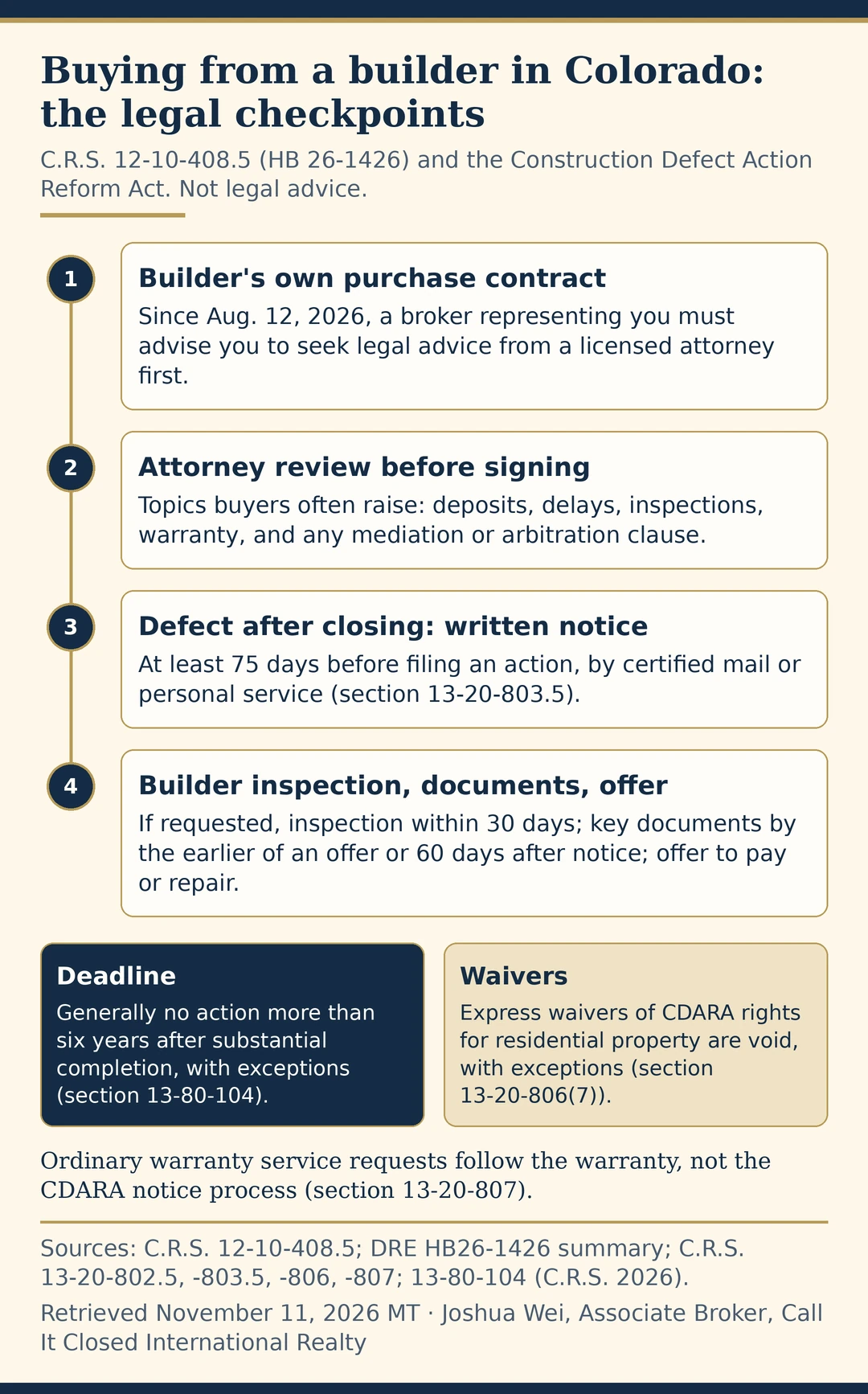
A vertical flow diagram, cream background with navy type and gold accents, titled Buying from a builder in Colorado: the legal checkpoints. Subtitle: C.R.S. 12-10-408.5 (HB 26-1426) and the Construction Defect Action Reform Act. Not legal advice. 4 numbered steps: 1, Builder's own purchase contract: Since Aug. 12, 2026, a broker representing you must advise you to seek legal advice from a licensed attorney first; 2, Attorney review before signing: Topics buyers often raise: deposits, delays, inspections, warranty, and any mediation or arbitration clause; 3, Defect after closing: written notice: At least 75 days before filing an action, by certified mail or personal service (section 13-20-803.5); 4, Builder inspection, documents, offer: If requested, inspection within 30 days; key documents by the earlier of an offer or 60 days after notice; offer to pay or repair. Two cards: Deadline: Generally no action more than six years after substantial completion, with exceptions (section 13-80-104); and Waivers: Express waivers of CDARA rights for residential property are void, with exceptions (section 13-20-806(7)). A note says: Ordinary warranty service requests follow the warranty, not the CDARA notice process (section 13-20-807). Sources: C.R.S. 12-10-408.5; DRE HB26-1426 summary; C.R.S. 13-20-802.5, -803.5, -806, -807; 13-80-104 (C.R.S. 2026). Retrieved November 11, 2026 MT. Joshua Wei, Associate Broker, Call It Closed International Realty.
Sources: C.R.S. Title 12 (2026), section 12-10-408.5 (opens in a new tab); DRE HB26-1426 summary (opens in a new tab); C.R.S. Title 13 (2026), CDARA and section 13-80-104 (opens in a new tab)
Cream background, navy text, gold rules. Numbered navy circles on a gold spine with white step cards, two branch cards (navy and tan), a note, and a source footer.
The flow above follows a new-build purchase from the builder's contract to the defect-notice process.
Why is the builder's contract different?
Brokers use the Commission's approved forms, but a builder selling its own homes can require its own document. The Division of Real Estate's HB26-1426 summary (opens in a new tab) says the law "requires a broker to advise a consumer to seek legal advice before executing the purchase contract, if the broker is representing a consumer in a transaction" when a principal, "including a home builder," requires its own contract.
The same section adds a second rule: "If a broker contract includes a unilateral cancellation clause in favor of the broker, that provision must be clearly and conspicuously disclosed to the consumer."
What can a buyer raise with an attorney?
The statute requires a broker representing the buyer to advise seeking legal advice before signing. Topics a buyer can raise with an attorney reviewing a builder's contract include:
- What deposits are required, and when they are refundable.
- How the contract handles delays and the completion date.
- What inspections the contract allows during construction and before closing.
- Whether there is a written warranty, what it covers, and how service is requested.
- Whether there is a mediation or arbitration clause, and what it means.
- Whether the home is in a metro district. Metro district records are public; the Aurora checklist linked below covers them.
- How the contract handles the upgrade options Colorado law requires builders to offer (next section), including their deposits and deadlines.
- What the contract says about the CDARA notice process, mediation and arbitration, and whether any clause tries to limit CDARA rights.
The statute's full text is short: "When a broker is representing a consumer in a transaction for which a principal to the transaction, including a home builder, a bank, or a buyer, requires the use of a purchase contract that was created by the principal, the broker shall advise the consumer to seek legal advice from a licensed attorney before the consumer enters into the purchase contract." Its source note reads "L. 2026: Entire section added, (HB 26-1426)."
What options must a builder offer?
Three sections of Title 38 require builders to offer options to a buyer under contract. Each says the offer "must be made in accordance with the builder's construction schedule for the residence," so the timing depends on how far along the home is when you sign.
Solar
C.R.S. 38-35.7-106(1)(a) (opens in a new tab) says: "Every person that builds a new single-family detached residence for which a buyer is under contract shall offer the buyer the opportunity to have each of the following options included in the residence's electrical system or plumbing system, or both." The options are a solar system, "Upgrades of wiring or plumbing, or both, planned by the builder to accommodate future installation of such systems," and "A chase or conduit, or both, constructed to allow ease of future installation of the necessary wiring or plumbing for such systems."
Subsection (2) adds that the builder "shall provide to every buyer under contract a list of businesses in the area that offer residential solar installation services." Subsection (6)(a) lets the builder subject solar upgrades "to the same terms and conditions as other upgrades, including but not limited to charges related to upgrades, deposits required for upgrades, deadlines, and construction timelines." The section "does not apply to: (I) An unoccupied home serving as sales inventory or a model home; or (II) A manufactured home."
EV charging and electric heat
C.R.S. 38-35.7-109(1)(a) (opens in a new tab) says a builder "shall offer the buyer the opportunity to have the residence's electrical system include one of the following: (I) An electric vehicle charging system," or wiring upgrades for future charging, or "A two-hundred-eight- to two-hundred-forty-volt alternating current plug-in receptacle in an appropriate place accessible to a motor vehicle parking area." Subsection (1)(b) requires an offer of "an efficient electrical heating system, including an electric water heater, electric boiler, or electric furnace or heat-pump system." Subsection (1)(c) requires the builder to offer "pricing, energy efficiency, and utility bill information for each natural gas, electric, or other option available."
There is a timing carve-out: "Subsection (1)(a) of this section does not apply to a residence in which the electrical system has been substantially installed before a buyer enters into a contract to purchase the residence." The heating offer has a matching carve-out. In this section, "Residence" means "a single-family owner-occupied detached dwelling."
Water-smart options
C.R.S. 38-35.7-107(1)(a) (opens in a new tab) requires an offer of "one or more of the following watersmart home options for the residence." The listed options include Energy Star dishwashers and clothes washers if appliances are sold as upgrades through the builder, a water-conserving landscape design if landscaping is sold as an upgrade "and will be maintained by the home owner," and "Installation of a pressure-reducing valve that limits static service pressure in the residence to a maximum of sixty pounds per square inch."
Metro district disclosures
If the subdivision is inside a metropolitan district, two more sections matter. C.R.S. 38-35.7-110(2) (opens in a new tab) applies to "an owner of residential real property that is located within the boundaries of a metropolitan district organized on or after January 1, 2000, that sells the property." That owner must provide, "concurrently with or prior to the execution of a contract to sell the property," items including a link or copy of the district's notice to electors and its service plan, plus a written statement that the district "has authority to issue up to dollars of debt" and what its maximum debt service mill levy is. It also requires "An estimate of the dollar amount of property taxes levied by the metropolitan district that are applicable to the property for collection during the year in which the sale occurs."
C.R.S. 38-35.7-111 (opens in a new tab) adds that such an owner "shall provide the purchaser of the property with the official website established by the metropolitan district." Ask your attorney how these disclosures appear in the builder's paperwork.
What if defects show up after closing?
Colorado's Construction Defect Action Reform Act (CDARA), C.R.S. 13-20-801 and following, applies to claims against a "construction professional," defined in section 13-20-802.5(4) (opens in a new tab) as "an architect, contractor, subcontractor, developer, builder, builder vendor, engineer, or inspector performing or furnishing the design, supervision, inspection, construction, or observation of the construction of any improvement to real property."
Before suing, a homeowner must give notice. Section 13-20-803.5(1)(a) (opens in a new tab) says: "No later than seventy-five days before filing an action against a construction professional, or no later than ninety days before filing the action in the case of a commercial property, a claimant shall send or deliver a written notice of claim to the construction professional by certified mail, return receipt requested, or by personal service."
The builder can then inspect. Under section 13-20-803.5(2), "The inspection shall be completed within thirty days of service of the notice of claim." Under section 13-20-803.5(3), the builder may then make "an offer to settle the claim by payment of a sum certain or by agreeing to remedy the claimed defect."
The same subsection sets the offer's timing: "within thirty days after the completion of the inspection process." It also sets what an offer to repair must contain: "a report of the scope of the inspection, the findings and results of the inspection, a description of the additional construction work necessary to remedy the defect described in the notice of claim and all damage to the improvement to real property caused by the defect, and a timetable for the completion of the remedial construction work."
The homeowner then has a short window. Subsection (4): "Unless a claimant accepts an offer made pursuant to subsection (3) of this section in writing within fifteen days of the delivery of the offer, the offer shall be deemed to have been rejected." Subsection (5) adds that if an offer to repair is accepted, "the remedial construction work shall be completed in accordance with the timetable set forth in the offer unless the delay is caused by events beyond the reasonable control" of the builder.
What did the 2025 amendments add?
HB 25-1272 added section 13-20-803.5(3.5). By the earlier of a settlement offer or "sixty days after a construction professional receives actual notice of claim," a builder (other than an architect or engineer) must provide items in its possession, custody, or control, including "Copies of all plans, specifications, and soil reports related to the claim" and "Maintenance and preventive maintenance recommendations related to the claim."
The list also includes "The name, last-known address, and scope of work of each construction professional who contracted to perform work or provide services and did perform work or provide services related to the claim," "All documents related to the third-party inspection of the property," and "Copies of each insurance policy purchased by the construction professional and related to the claim." Subsection (3.5)(b) says the builder "may charge reasonable copying costs" for the documents in (3.5)(a)(I), (II), (IV) and (V).
Are there deadlines?
C.R.S. 13-80-104(1)(a) (opens in a new tab) says such actions must be brought within the time in section 13-80-102 "after the claim for relief arises," but "in no case shall such an action be brought more than six years after the substantial completion of the improvement to the real property, except as provided in subsection (2)." Subsection (1)(b)(I) says when the clock starts: "a claim for relief arises under this section at the time the claimant or the claimant's predecessor in interest discovers or in the exercise of reasonable diligence should have discovered the physical manifestations of a defect in the improvement which ultimately causes the injury." Subsection (2) gives a later window: "In case any such cause of action arises during the fifth or sixth year after substantial completion of the improvement to real property, said action shall be brought within two years after the date upon which said cause of action arises."
How that deadline applies to a specific home is a question for a Colorado construction attorney. Keep dated photos and written warranty requests, since the statute ties the start of the clock to when a defect's "physical manifestations" were or should have been discovered.
Can the contract waive my rights?
Section 13-20-806(7)(a) (opens in a new tab) says that for residential property, "any express waiver of, or limitation on, the legal rights, remedies, or damages provided by the 'Construction Defect Action Reform Act'" is void "as against public policy," with exceptions. One exception: "Nothing contained in this section shall be deemed to render void any requirement to participate in mediation prior to filing a suit or arbitration proceeding." Whether a specific clause is enforceable is a question for your attorney.
Related: Aurora property tax and metro district buyer checklist (opens in a new tab).
Related: Denver home prices and seller concessions post (opens in a new tab).
An invented example
This example is invented; it is not a real builder or home.
A buyer signs a builder's contract for a detached home in an Aurora subdivision that has not started framing. Her broker tells her in writing to have an attorney review the builder's contract before she signs, as C.R.S. 12-10-408.5 requires. The builder's design-center packet offers EV-charger wiring, a heat pump, solar conduit and a pressure-reducing valve, each with its own price and selection deadline. Because her electrical system is not yet installed, the EV options in 38-35.7-109 apply to her. She also receives the metro district's service plan link and the property tax estimate. Eighteen months after closing, cracks appear in the garage slab. She sends a warranty request first. When that does not resolve it, her attorney evaluates whether to send a CDARA notice of claim by certified mail at least 75 days before any lawsuit.
A new-build checklist
- Get the builder's contract early and book attorney review before you sign, per C.R.S. 12-10-408.5.
- Ask for the option sheets for solar, EV charging, electric heat and water-smart items, with prices and deadlines.
- Ask for the metro district documents under 38-35.7-110 and the district website under 38-35.7-111.
- Read the warranty and how to request service; CDARA notice is not needed for "ordinary warranty service."
- Find the dispute clause (mediation or arbitration) and ask your attorney what it means.
- Keep records of walkthroughs, punch lists, warranty requests and photos.
Frequently asked questions
Does a warranty request require a formal notice of claim?
Section 13-20-807 (opens in a new tab) says CDARA does not require a warranty beneficiary "to comply with the notice provisions of section 13-20-803.5 to request ordinary warranty service in accordance with the terms of such warranty."
Do the builder option laws apply to a spec home that is already finished?
Not entirely. The solar section "does not apply to" an "unoccupied home serving as sales inventory or a model home," and the EV and heating offers do not apply once the electrical or heating system "has been substantially installed before a buyer enters into a contract." Ask the builder what is still selectable.
Does a homeowner have to mitigate damage before filing a claim?
Subsection 13-20-803.5(1)(b) sets a duty to mitigate "for program claims": "A claimant satisfies the duty to mitigate by taking reasonable action to prevent further damage from the construction defect." Whether your claim is a program claim is a question for your attorney.
Do I need my own broker in a new-build purchase?
The statute doesn't require one. It says that if a broker represents you, the broker must advise you to seek legal advice before signing a builder-created contract.
Can I negotiate with a builder?
The sources here don't address negotiation. Contract terms are a question for a Colorado real estate attorney.
Is the Commission's resale contract ever used for new homes?
The legal-advice rule turns on whether the principal "requires the use of a purchase contract that was created by the principal."
When did the legal-advice rule take effect?
The statute's source note says "effective August 12," 2026.
What does "actual damages" mean under CDARA?
Section 13-20-802.5(2) defines it, starting with "the fair market value of the real property without the alleged construction defect, the replacement cost of the real property, or the reasonable cost to repair the alleged construction defect, whichever is less." How it applies to a specific claim is a question for a Colorado construction attorney.
Related notes
- Swelling soils in Denver and Aurora: Colorado’s most common geologic hazard, and what a buyer can actually check
- Colorado purchase contract deadlines, in plain English
- Home warranties in a Colorado home sale: what the law requires, what to read, and what a warranty isn't
Sources and method
Official sources, retrieved November 11, 2026, America/Denver:
- C.R.S. 12-10-408.5, Colorado Revised Statutes 2026, Title 12 (opens in a new tab)
- Colorado Division of Real Estate, HB26-1426 summary (opens in a new tab)
- C.R.S. 13-20-802.5, 13-20-803.5, 13-20-806(7), 13-20-807, and 13-80-104, Colorado Revised Statutes 2026, Title 13 (opens in a new tab)
Added November 13, 2026: further subsections of C.R.S. 13-20-803.5 and 13-80-104 (Title 13 (opens in a new tab)), and C.R.S. 38-35.7-106, -107, -109, -110 and -111 (Title 38 (opens in a new tab)).
Quotations are verbatim. This article does not cover multifamily or commercial claims, insurance, or the CDARA program provisions.
This note is general education from a Colorado real estate broker with Call It Closed International Realty. If you're touring new-build communities in Denver or Aurora, I can help you compare builders' incentives and line up your questions for the attorney before you sign.
Disclaimer
This article is general information only. It is not legal, tax, lending, insurance, appraisal, inspection, or financial advice, and it is not a substitute for advice about your situation. Joshua Wei is a Colorado real estate broker, not an attorney. Reading this article does not create a client relationship, an agency relationship, or an attorney-client relationship with Joshua Wei or with Call It Closed International Realty.
Laws, program rules, interest rates, insurance terms, tax figures, and other details change. Examples in this article are hypothetical illustrations unless a source is named for a specific, dated figure. Information in this article is believed accurate as of November 13, 2026 and is not guaranteed. No result is promised, and you should not rely on this article as the last word for your situation.
Before you act, confirm the point with the official source linked or cited in this article, and talk with a licensed professional who can apply the rule to your facts. That may be a licensed attorney, a tax professional, a lender, an insurance agent, a home inspector, or another licensed professional, depending on the question. Links to third-party websites and publications are provided for reference only. They are not an endorsement, and their content can change.
If you already have a brokerage relationship with another broker, this is not a solicitation.
Joshua Wei, Associate Broker, Call It Closed International Realty, Colorado license FA.100108558. Equal Housing Opportunity.