October 20, 2026 · Denver · Aurora · Buying · Selling
What if the furnace dies or a pipe bursts before closing? Colorado's contract rules for damage and the final walk-through
Between contract and closing, things break, especially in a Denver or Aurora winter. What section 18 of Colorado's residential contract says about failed systems, insured property damage, condemnation, and the buyer's final walk-through.
The short answer
In brief: Colorado's standard residential contract sets a baseline for the home's condition between signing and closing. Section 18 says the property and inclusions will be delivered in the condition existing on the contract date, ordinary wear and tear excepted, unless the contract provides otherwise. Section 18.2 addresses a system that fails before closing, with limits, and the walk-through checks condition.
Colorado's standard residential contract sets a baseline for the home's condition between signing and closing. Section 18 of the Colorado Real Estate Commission's residential contract (CBS1) says: "Except as otherwise provided in this Contract, the Property and Inclusions will be delivered in the condition existing as of the date of this Contract, ordinary wear and tear excepted."
If a system fails before closing, section 18.2 makes the seller "liable for the repair or replacement of such Inclusion or Service with a unit of similar size, age and quality, or an equivalent credit, but only to the extent that the maintenance or replacement of such Inclusion or Service is not the responsibility of the Association, if any, less any insurance proceeds received by Buyer covering such repair or replacement." Section 18.2 also lists the buyer's options if it isn't fixed: termination or a credit at closing.
Before closing, the buyer can check. Section 18.4: "Buyer, upon reasonable notice, has the right to walk through the Property prior to Closing to verify that the physical condition of the Property and Inclusions complies with this Contract."
CBS1 is on the Division of Real Estate's contracts and forms page (opens in a new tab); quotations here are from the 2026 CBS1 PDF (opens in a new tab).
I am a licensed Colorado real estate broker with Call It Closed International Realty. I am not an attorney or insurance professional. This is not legal or insurance advice.
Disclaimer. This article is general information only. It is not legal, tax, lending, insurance, appraisal, inspection, or financial advice, and reading it does not create a client, agency, or attorney-client relationship. Laws, rates, programs, and figures change. Confirm the official source, and talk with a licensed attorney, tax professional, lender, insurance agent, or inspector before you act. Joshua Wei is a Colorado real estate broker, not an attorney. He is an Associate Broker with Call It Closed International Realty, license FA.100108558. Equal Housing Opportunity.
 Full size (opens in a new tab)
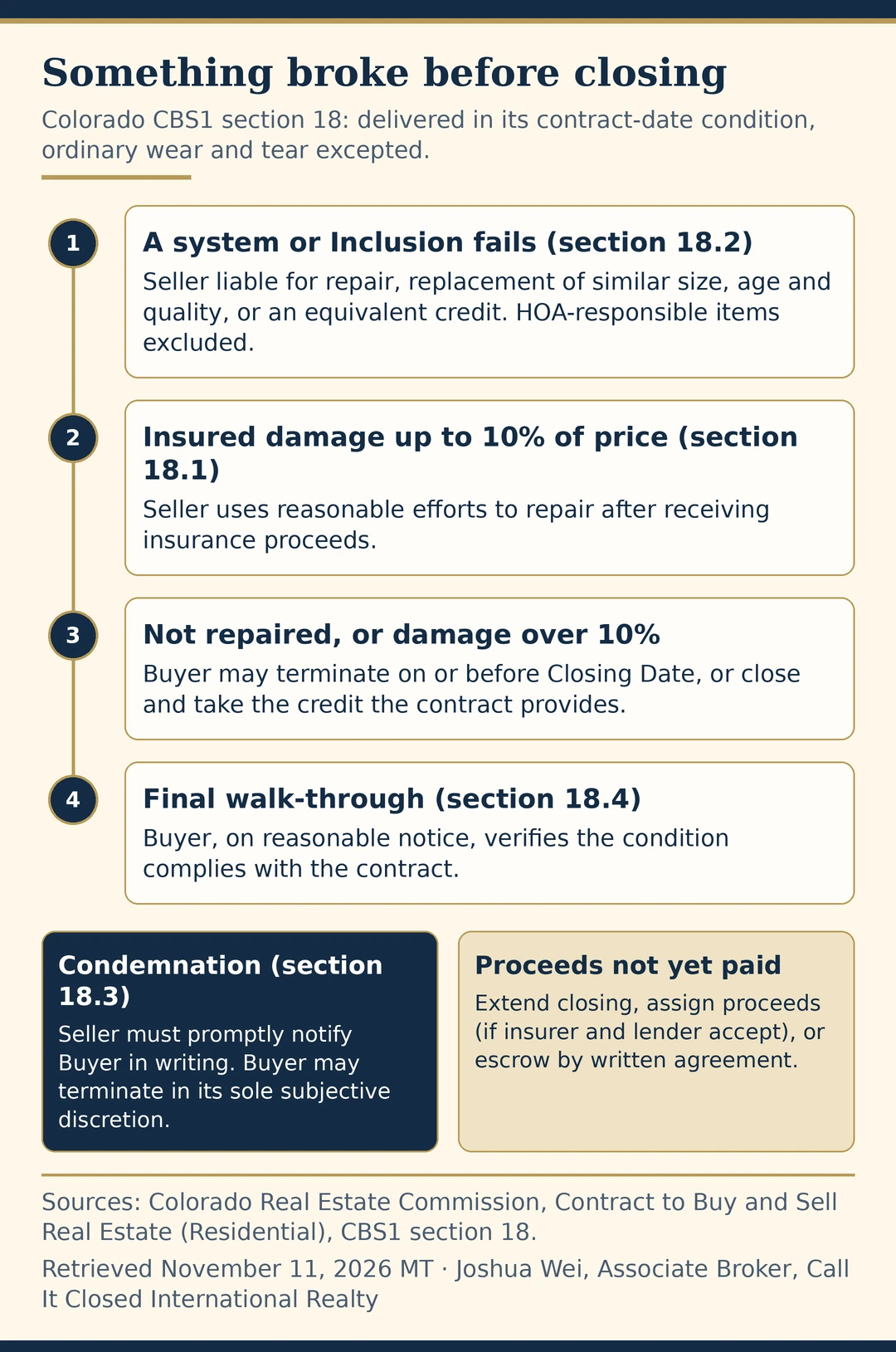
A vertical flow diagram, cream background with navy type and gold accents, titled Something broke before closing, with the subtitle Colorado CBS1 section 18, delivered in its contract-date condition, ordinary wear and tear excepted. Four numbered steps: 1, a system or Inclusion fails under section 18.2, so the seller is liable for repair, replacement of similar size, age and quality, or an equivalent credit, with HOA-responsible items excluded; 2, insured damage up to 10 percent of price under section 18.1, where the seller uses reasonable efforts to repair after receiving insurance proceeds; 3, if not repaired or the damage is over 10 percent, the buyer may terminate on or before Closing Date or close and take the credit the contract provides; 4, final walk-through under section 18.4, where the buyer on reasonable notice verifies the condition complies with the contract. Two lower cards: condemnation under section 18.3, where the seller must promptly notify the buyer in writing and the buyer may terminate in its sole subjective discretion; and proceeds not yet paid, where the parties can extend closing, assign proceeds if the insurer and lender accept, or escrow by written agreement. Source: Colorado Real Estate Commission CBS1 section 18. Retrieved November 11, 2026 MT.
Sources: DRE contracts and forms (opens in a new tab)
Cream background, navy text, gold rules. Four numbered steps on a gold spine, two side-by-side cards, and a 28px source footer.
The diagram above sorts what happens under CBS1 section 18 depending on what goes wrong before closing. It summarizes the contract.
What if a furnace, water heater, or appliance fails?
Section 18.2 covers any "Inclusion or service (including utilities and communication services), system, component or fixture of the Property (collectively Service) (e.g., heating or plumbing)" that fails "between the date of this Contract and Closing or possession, whichever is earlier."
The seller is responsible "but only to the extent that the maintenance or replacement of such Inclusion or Service is not the responsibility of the Association, if any, less any insurance proceeds received by Buyer covering such repair or replacement."
If it isn't fixed in time, "Buyer has the Right to Terminate under section 24.1., on or before Closing Date, or, at the option of Buyer, Buyer is entitled to a credit at Closing for the repair or replacement of such Inclusion or Service. Such credit must not exceed the Purchase Price."
The section adds one more line about associations: "If Buyer receives such a credit, Seller's right for any claim against the Association, if any, will survive Closing."
What counts as an Inclusion?
Section 2.5.1 lists items that are included "If attached to the Property on the date of this Contract," unless excluded, among them "lighting, heating, plumbing, ventilating and air conditioning units," "builtin kitchen appliances, sprinkler systems and controls, built-in vacuum systems (including accessories) and garage door openers." Section 2.5.2 adds items "If on the Property on the date of this Contract, whether attached or not," such as "storm windows, storm doors, window and porch shades, awnings, blinds, screens, window coverings and treatments." Section 2.5.3 leaves a blank for "Other Inclusions."
The list matters because section 18.2's repair duty applies to an "Inclusion or service." It is worth reading your own contract's Inclusions and Exclusions before a walk-through.
What if there's fire, storm, or other insured damage?
Section 18.1 covers "Property Damage" from "fire, other perils or causes of loss prior to Closing."
- Smaller insured losses. If the damage is "not more than ten percent of the total Purchase Price and if the repair of the damage will be paid by insurance (other than the deductible to be paid by Seller), then Seller, upon receipt of the insurance proceeds, will use Seller's reasonable efforts to repair the Property before Closing Date."
- The buyer's options. "Buyer has the Right to Terminate under section 24.1., on or before Closing Date, if the Property is not repaired before Closing Date, or if the damage exceeds such sum."
- Closing anyway. A buyer who goes forward "is entitled to a credit at Closing for all insurance proceeds that were received by Seller (but not the Association, if any) resulting from damage to the Property and Inclusions, plus the amount of any deductible provided for in the insurance policy."
If the insurance money hasn't arrived, section 18.1 lets the parties extend closing, or at the buyer's option have the seller assign the right to the proceeds "if acceptable to Seller's insurance company and Buyer's lender," or escrow the amount under "a written agreement prepared by the parties or their attorney."
The escrow option has its own terms. The written agreement would require "the Seller to escrow at Closing from Seller's sale proceeds the amount Seller has received and will receive due to such damage, not exceeding the total Purchase Price, plus the amount of any deductible that applies to the insurance claim." The buyer's credit is capped too: "This credit may not exceed the Purchase Price."
What section 18.1 does not say
Section 18.1's repair language applies when the damage is "not more than ten percent of the total Purchase Price" and insurance will pay. The contract text does not set out a seller repair duty for larger or uninsured losses; it gives the buyer the Right to Terminate "if the Property is not repaired before Closing Date, or if the damage exceeds such sum." How a particular loss fits these terms is a question for a Colorado real estate attorney, and how a claim is handled is a question for the insurer.
What about condemnation?
Section 18.3: if the seller gets "actual notice prior to Closing that a pending condemnation action may result in a taking of all or part of the Property or Inclusions, Seller must promptly notify Buyer, in writing." The buyer then "has the Right to Terminate under section 24.1., on or before Closing Date, based on such condemnation action, in Buyer's sole subjective discretion."
A buyer who goes ahead anyway "is entitled to a credit at Closing for all condemnation proceeds awarded to Seller for the diminution in the value of the Property or Inclusions." The contract limits it: "Such credit will not include relocation benefits or expenses or exceed the Purchase Price."
How should a buyer use the walk-through?
Section 18.4 gives the right to walk through "prior to Closing to verify that the physical condition of the Property and Inclusions complies with this Contract."
The contract does not list what to check. The checklist below is general practice, not contract language. Section 2.5 lists the Inclusions, and an inspection resolution lists any agreed repairs. Questions about a home's condition are for a home inspector; questions about contract rights are for a Colorado real estate attorney.
The section 18 rights run "on or before Closing Date."
A walk-through checklist
This list is general practice. Adjust it to your contract.
- Bring a copy of the Inclusions and Exclusions (section 2.5) and any signed Inspection Resolution.
- Run the furnace or boiler, air conditioning, and water heater.
- Run every faucet and check under sinks for leaks.
- Test kitchen appliances listed as Inclusions.
- Open and close the garage door with the remotes listed in section 2.5.1.
- Check ceilings and walls for new water stains, especially after a cold snap.
- Look at any repair items and ask for receipts or invoices if the resolution called for them.
- Note anything that differs from the condition "existing as of the date of this Contract."
- Report problems to your broker in writing the same day.
Does the seller have to tell me about new problems?
The 2026 Seller's Property Disclosure (opens in a new tab) says: "Any changes to the disclosures herein must be disclosed by Seller to Buyer promptly after discovery." It continues: "In the event Seller discovers a new adverse material fact after completing this SPD, Seller must disclose in writing any such new adverse material fact to Buyer."
The form limits the seller's knowledge standard. It says the term current actual knowledge "is intended to limit Seller's disclosure only to facts actually known by the Seller," and it excludes what the seller should have known. It also says: "The Seller has no duty to investigate or inspect the Property or inclusions." Its Advisory to Buyer says: "Even though Seller has answered the above questions to Seller's current actual knowledge, Buyer should thoroughly inspect the Property and obtain expert assistance to accurately and fully evaluate the Property."
How do the inspection deadlines interact with section 18?
Section 10.3 lets a buyer object to the "physical condition of the Property" and to "service to the Property (including utilities and communication services), systems and components of the Property (e.g., heating and plumbing)" before the inspection deadlines. If an Inspection Objection is made and the parties "have not agreed in writing to a settlement thereof on or before Inspection Resolution Deadline, this Contract will terminate on Inspection Resolution Deadline," unless the buyer withdraws the objection in time.
Section 18 covers a different period: a failure or damage "between the date of this Contract and Closing or possession, whichever is earlier." A problem that existed at signing is an inspection question; a new failure is a section 18 question. Whether a specific item falls under one or the other is a question for a Colorado real estate attorney.
Time is of the essence
Section 20 says: "Time is of the essence for all dates and deadlines in this Contract. This means that all dates and deadlines are strict and absolute." Section 19 records that each broker "has recommended" consultation with "legal and tax or other counsel before signing this Contract," and adds: "Such consultations must be done timely as this Contract has strict time limits, including deadlines, that must be complied with."
What if the buyer's own inspection causes damage?
Section 18 is about loss from "fire, other perils or causes of loss" and failed systems. Damage from the buyer's own testing falls under a different section. Under section 10.4, the buyer "is responsible for payment for all inspections, tests, surveys, engineering reports, or other reports performed at Buyer's request (Work) and must pay for any damage that occurs to the Property, included Leased Items and Inclusions as a result of such Work."
The buyer also "must not permit claims or liens of any kind against the Property for Work performed on the Property," and agrees to "indemnify, protect and hold Seller harmless" from liability caused by the Work. The contract says: "The provisions of this Section survive the termination of this Contract." It adds: "This section 10.4. does not apply to items performed pursuant to an Inspection Resolution."
Where does the buyer's own insurance fit?
Section 18.1 refers to the seller's insurance proceeds. The buyer's coverage is a separate contract right. Under section 10.5, "Buyer has the Right to Terminate under section 24.1. on or before Property Insurance Termination Deadline, based on, in Buyer's sole subjective discretion, any unsatisfactory provision of the availability, terms and conditions and premium for property insurance (Property Insurance) on the Property." See shopping homeowners insurance before your deadline. When a buyer's policy starts is a question for the buyer's insurance agent.
What if the seller stays after closing?
Section 18.2 runs to "Closing or possession, whichever is earlier." If possession comes later under a Post-Closing Occupancy Agreement, section 17 says "such agreement will control Possession Date and Possession Time." If the seller, "after Closing occurs, fails to deliver possession as specified, Seller will be subject to eviction" and is liable for the per-day amount written into section 17. See seller rent-backs after closing.
An invented example
This example is invented; it is not a real property.
Two weeks before closing on an Aurora house, a cold night freezes and splits a pipe in an exterior wall. The seller's insurer accepts the claim, and the estimate is well under ten percent of the price.
- Section 18.1 applies, so the seller, "upon receipt of the insurance proceeds, will use Seller's reasonable efforts to repair the Property before Closing Date."
- The insurer has not paid by closing. The parties may agree to extend closing, or, at the buyer's option, the seller assigns the proceeds (if the insurer and the buyer's lender accept) or the parties sign a written escrow agreement.
- The buyer could instead terminate on or before Closing Date if the property is not repaired.
- At the walk-through, the buyer checks the repaired wall and the water heater the plumber replaced.
Which option fits a real loss depends on the facts; ask an attorney about contract rights and the insurer about the claim.
Related: Flood maps, drainage, and insurance for Denver and Aurora buyers (opens in a new tab).
Frequently asked questions
Does "ordinary wear and tear" cover a broken furnace?
Section 18.2 treats a failed "system, component or fixture" (e.g., "heating or plumbing") separately, with the seller liable for repair or replacement, subject to its conditions.
What if the HOA is responsible for the damaged item?
Section 18.2 excludes items whose maintenance or replacement is "the responsibility of the Association." Section 18.1 excludes insurance proceeds received by the Association from the buyer's credit.
Can I get a credit instead of a repair?
Under section 18.2, if the item isn't repaired or replaced by closing or possession, the buyer may take "a credit at Closing for the repair or replacement."
What if the damage is more than 10% of the price?
Under section 18.1, the buyer "has the Right to Terminate" on or before Closing Date "if the damage exceeds such sum."
Does the seller have to repair with a brand-new unit?
Section 18.2 says "a unit of similar size, age and quality, or an equivalent credit."
Does section 18 cover the period after closing?
Section 18.2 covers failures "between the date of this Contract and Closing or possession, whichever is earlier."
Who pays if my inspector breaks something?
Under section 10.4, the buyer "must pay for any damage that occurs to the Property, included Leased Items and Inclusions as a result of such Work."
Do I need to give notice for a walk-through?
Section 18.4 says "upon reasonable notice."
What if I find a problem at the walk-through on closing day?
The section 18 rights run "on or before Closing Date." A specific problem is a question for a Colorado real estate attorney.
Related notes
- Home warranties in a Colorado home sale: what the law requires, what to read, and what a warranty isn't
- Shop homeowners insurance before your deadline: Colorado's insurability right and the Division of Insurance's buyer guide for Denver and Aurora
- Colorado purchase contract deadlines, in plain English
Sources and method
Official source, retrieved November 11, 2026, America/Denver: the Colorado Real Estate Commission's Contract to Buy and Sell Real Estate (Residential) (CBS1), section 18, from the Division of Real Estate contracts and forms page (opens in a new tab). Added November 13, 2026: CBS1 2026 PDF (opens in a new tab) sections 2.5, 10.3, 17, 18, 19, and 20; and the 2026 Seller's Property Disclosure (Residential) (opens in a new tab). Quotations are verbatim. The walk-through checklist is general practice, not contract language.
This note is general education from a Colorado real estate broker with Call It Closed International Realty. If something breaks while you're under contract in Denver or Aurora, I can help you sort out which section 18 option fits before the deadline.
Disclaimer
This article is general information only. It is not legal, tax, lending, insurance, appraisal, inspection, or financial advice, and it is not a substitute for advice about your situation. Joshua Wei is a Colorado real estate broker, not an attorney. Reading this article does not create a client relationship, an agency relationship, or an attorney-client relationship with Joshua Wei or with Call It Closed International Realty.
Laws, program rules, interest rates, insurance terms, tax figures, and other details change. Examples in this article are hypothetical illustrations unless a source is named for a specific, dated figure. Information in this article is believed accurate as of November 13, 2026 and is not guaranteed. No result is promised, and you should not rely on this article as the last word for your situation.
Before you act, confirm the point with the official source linked or cited in this article, and talk with a licensed professional who can apply the rule to your facts. That may be a licensed attorney, a tax professional, a lender, an insurance agent, a home inspector, or another licensed professional, depending on the question. Links to third-party websites and publications are provided for reference only. They are not an endorsement, and their content can change.
If you already have a brokerage relationship with another broker, this is not a solicitation.
Joshua Wei, Associate Broker, Call It Closed International Realty, Colorado license FA.100108558. Equal Housing Opportunity.