November 12, 2026 · Colorado · Buying · Selling · Title · Renovation
Recent renovation? Mechanics' liens when you buy or sell a Colorado home
Colorado's mechanics' lien law lets unpaid contractors, subcontractors and suppliers claim a lien on a home, and the lien can relate back to when work started. The statutory deadlines, the notice owners receive with a permit, the purchase contract and title provisions involved, and the questions to ask before closing.
The short answer
In brief: Under C.R.S. 38-22-106(1), Colorado mechanics' liens relate back to the start of work under the owner's contract with the first contractor or, if that contract isn't in writing, to the start of work on the structure. Apart from day or piece laborers who don't supply materials, lien claimants must record a lien statement within four months after their last labor or materials, subject to the statute's exceptions.
Colorado's mechanics' lien law ties liens to when work began. Under C.R.S. 38-22-106(1), liens "shall relate back to the time of the commencement of work under the contract between the owner and the first contractor, or, if said contract is not in writing, then such liens shall relate back to and take effect as of the time of the commencement of the work upon the structure or improvement."
Under C.R.S. 38-22-109(5), "Except as provided in subsections (10) and (11) of this section," claimants other than day or piece laborers must record a lien statement "before the expiration of four months after the day on which the last labor is performed or the last laborers or materials are furnished." How these deadlines line up with a particular closing date is a question for a Colorado real estate attorney.
I am a licensed Colorado real estate broker with Call It Closed International Realty. I am not an attorney or a title insurer.
Disclaimer. This article is general information only. It is not legal, tax, lending, insurance, appraisal, inspection, or financial advice, and reading it does not create a client, agency, or attorney-client relationship. Laws, rates, programs, and figures change. Confirm the official source, and talk with a licensed attorney, tax professional, lender, insurance agent, or inspector before you act. Joshua Wei is a Colorado real estate broker, not an attorney. He is an Associate Broker with Call It Closed International Realty, license FA.100108558. Equal Housing Opportunity.
 Full size (opens in a new tab)
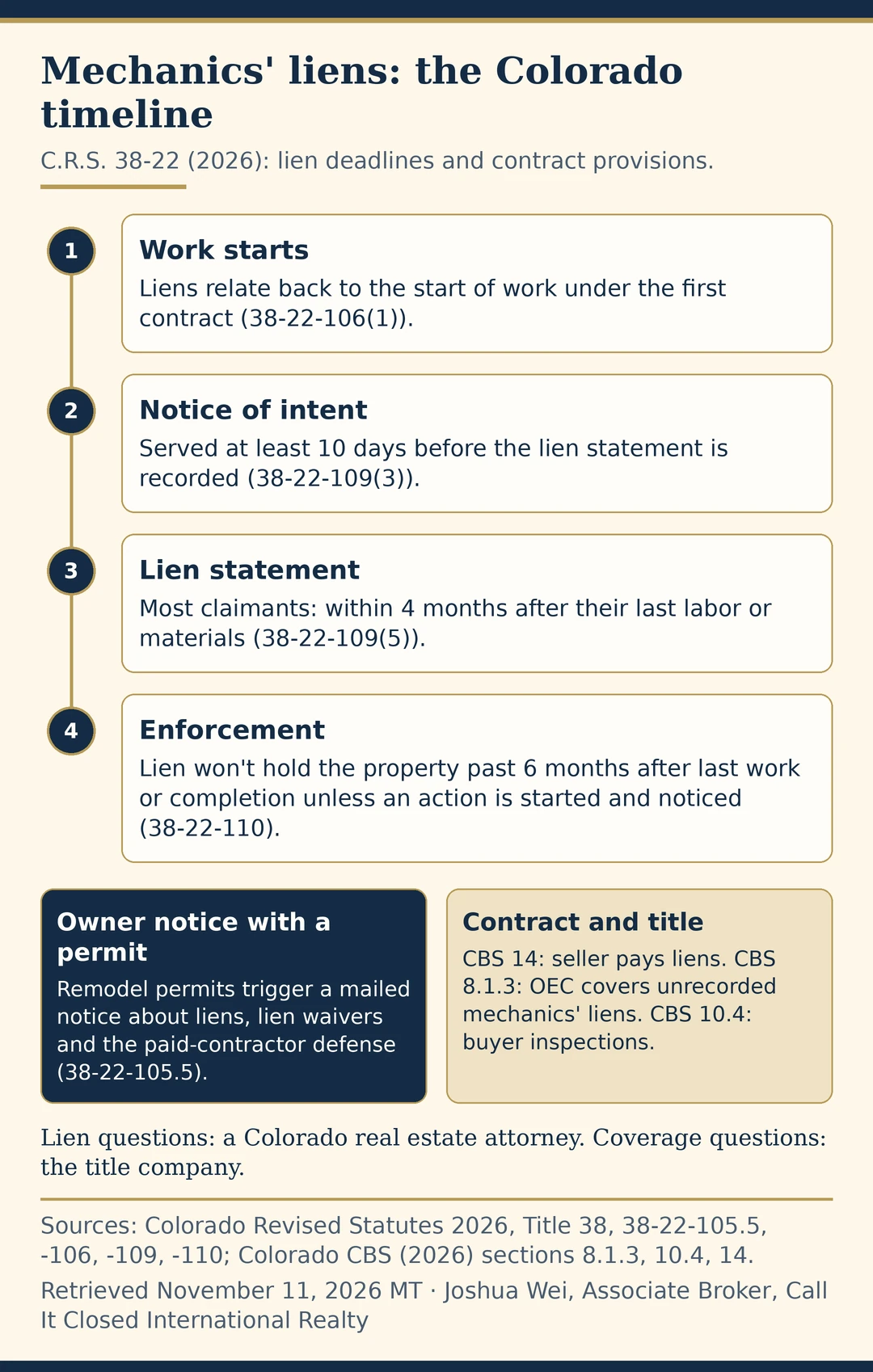
A vertical flow diagram, cream background with navy type and gold accents, titled Mechanics' liens: the Colorado timeline. Subtitle: C.R.S. 38-22 (2026): lien deadlines and contract provisions. 4 numbered steps: 1, Work starts: Liens relate back to the start of work under the first contract (38-22-106(1)); 2, Notice of intent: Served at least 10 days before the lien statement is recorded (38-22-109(3)); 3, Lien statement: Most claimants: within 4 months after their last labor or materials (38-22-109(5)); 4, Enforcement: Lien won't hold the property past 6 months after last work or completion unless an action is started and noticed (38-22-110). Two cards: Owner notice with a permit: Remodel permits trigger a mailed notice about liens, lien waivers and the paid-contractor defense (38-22-105.5); and Contract and title: CBS 14: seller pays liens. CBS 8.1.3: OEC covers unrecorded mechanics' liens. CBS 10.4: buyer inspections. A note says: Lien questions: a Colorado real estate attorney. Coverage questions: the title company. Sources: Colorado Revised Statutes 2026, Title 38, 38-22-105.5, -106, -109, -110; Colorado CBS (2026) sections 8.1.3, 10.4, 14. Retrieved November 11, 2026 MT. Joshua Wei, Associate Broker, Call It Closed International Realty.
Sources: C.R.S. 2026 Title 38 (opens in a new tab)
Cream background, navy text, gold rules. Numbered navy circles on a gold spine with white step cards, two branch cards (navy and tan), a note, and a source footer.
The figure above shows the statute's timeline, from start of work to the lien deadlines.
Who can file a lien, and what notice do owners get?
When a city or county issues a building permit for remodeling or repair of residential property, C.R.S. 38-22-105.5 requires it to mail the owner a notice. That notice says suppliers, subcontractors and others "MAY HAVE A RIGHT TO COLLECT THEIR MONEY FROM YOU BY FILING A LIEN AGAINST YOUR PROPERTY" when they're "NOT PAID BY YOUR CONTRACTOR."
The notice also describes an "AFFIRMATIVE DEFENSE IN ANY ACTION TO ENFORCE A LIEN IF YOU OR SOME PERSON ACTING ON YOUR BEHALF HAS PAID YOUR CONTRACTOR AND SATISFIED YOUR LEGAL OBLIGATIONS," under sections 38-22-102(3.5) and 38-22-113(4). It suggests owners discuss precautions "INCLUDING THE USE OF LIEN WAIVERS."
Section 38-22-105.5(3) says the notice isn't required for "new residential construction" or for buildings with more than four units.
The notice goes "by first-class mail addressed to the property for which the permit was issued" and must "identify the contractor by name and address." It also mentions a second precaution: "REQUIRING THAT EVERY CHECK ISSUED BY YOU OR ON YOUR BEHALF IS MADE PAYABLE TO THE CONTRACTOR, THE SUBCONTRACTOR, AND THE SUPPLIER." Subsection (6) adds that a permit office's failure to send the notice "shall not be an affirmative defense to any lien claimed pursuant to the provisions of this article."
Who has lien rights
C.R.S. 38-22-101(1) is long. It covers people who furnish "laborers, machinery, tools, or equipment," along with "mechanics, materialmen, contractors, subcontractors, builders," and "architects, engineers, draftsmen, and artisans who have furnished designs, plans, plats, maps, specifications." The lien is "for the value, whether disputed or undisputed," of what they supplied. The same subsection says the contractor and others "having charge of the construction, alteration, addition to, or repair" of the improvement "shall be held to be the agent of the owner for the purposes of this article 22."
Under C.R.S. 38-22-108(1), anyone whose contract "is with the owner or reputed owner or owner's agent or other representative, is a principal contractor and all others are subcontractors."
The owner's paid-in-full defense
The notice refers to two sections. C.R.S. 38-22-102(3.5) makes it "an affirmative defense in any action to enforce a lien pursuant to this article that the owner or some person acting on the owner's behalf has paid an amount sufficient to satisfy the contractual and legal obligations of the owner, including the initial purchase price or contract amount plus any additions or change orders, to the principal contractor or any subcontractor." The defense applies when:
- "(a) The property is an existing single-family dwelling unit;"
- "(b) The property is a residence constructed by the owner or under a contract entered into by the owner prior to its occupancy as the owner's primary residence; or"
- "(c) The property is a single-family, owner-occupied dwelling unit, including a residence constructed and sold for occupancy as a primary residence."
Paragraph (c) "shall not apply to a developer or builder of multiple residences except for the residence that is occupied as the primary residence of the developer or builder." C.R.S. 38-22-113(4) repeats the defense for enforcement proceedings. Whether it applies to a given property and payment record is a question for a Colorado attorney. Proof of payment is the kind of record to keep.
What are the deadlines?
These come from the 2026 Colorado Revised Statutes, Title 38 (opens in a new tab):
- Notice of intent: "at least ten days before the time of filing the lien statement" (38-22-109(3)).
- Lien statement, other claimants: within four months after the claimant's last labor or materials (38-22-109(5)).
- Lien statement, day or piece laborers who don't supply materials: within two months after the improvement is completed (38-22-109(4)).
- Lawsuit to enforce: a lien won't hold the property "longer than six months after the last work or labor is performed" or after completion, unless an enforcement action is started and a notice is recorded within that time (38-22-110).
Subsection (10) of 38-22-109 also lets a claimant record a notice that can extend the filing time. The statute has more exceptions; applying them to a specific situation is a question for a Colorado attorney.
What a lien statement contains
Under 38-22-109(1), the statement is filed with "the county clerk and recorder of the county wherein the property, or the principal part thereof, to be affected by the lien is situated." It must contain:
- "(a) The name of the owner or reputed owner of such property," or a statement that the name isn't known;
- (b) the name of the claimant, the name of the person who furnished the labor or materials, and "the name of the contractor when the lien is claimed by a subcontractor";
- "A description of the property to be charged with the lien, sufficient to identify the same;" and
- "(d) A statement of the amount due or owing such claimant."
Subsection (2) says it "shall be signed and sworn to" by the claimant or someone on the claimant's behalf. Subsection (3) says the notice of intent goes to the owner and "the principal or prime contractor," and is served "by personal service or by registered or certified mail, return receipt requested." An "affidavit of such service or mailing" is filed with the statement.
Completion, abandonment and the notice extension
Subsection (7) says "No trivial imperfection in or omission from the said work" counts as a lack of completion. It also says abandonment "shall be deemed equivalent to a completion," and defines "abandonment" as "discontinuance of all labor, work, services, and furnishing of laborers or materials for a three-month period."
Under subsection (10), a recorded notice "shall extend the time for filing of the mechanic's lien statement to four months after completion of the structure or other improvement or six months after the date of filing of said notice, whichever occurs first." That notice "shall automatically terminate six months after the date said notice is filed" unless terminated sooner or renewed. Under subsection (11), once the agreement to provide labor or materials ends, "the owner, or someone in such owner's behalf, may demand from the person filing said notice a termination of said notice."
Does a buyer take the home subject to a lien filed later?
C.R.S. 38-22-125 addresses buyers of homes. It says "No lien, excepting those claimed by laborers or mechanics as defined in section 38-22-108 (1)(a), filed for record more than two months after completion of the building, improvement, or structure shall encumber the interest of any bona fide purchaser for value of real property, the principal improvement upon which is a single- or double-family dwelling." Three exceptions follow. The protection doesn't apply:
- "unless said purchaser at the time of conveyance has actual knowledge that the amounts due and secured by such lien have not been paid,"
- "or unless such lien statement has been recorded prior to conveyance,"
- "or unless a notice as provided in section 38-22-109 (10) has been filed within one month subsequent to completion or prior to conveyance, whichever is later."
The section adds that "nothing in this section shall extend the time for recording lien statements," and that "the dwelling shall be deemed complete upon conveyance and occupancy if not completed before." Whether a buyer qualifies, and when work counts as complete, are questions for a Colorado attorney and the title company. A recorded lien or 109(10) notice would show up in the public record the title company searches.
How a recorded lien gets cleared
The statute describes several routes.
- Payment and release. Under C.R.S. 38-22-118, a claimant who is paid "shall enter or cause to be entered an acknowledgment of satisfaction of the same of record." A claimant who "neglects or refuses to do so within ten days after the written request of any person so interested" must pay "the sum of ten dollars per day for every day of such neglect or refusal." The section adds: "A valid tender of payment, refused by any such claimant, shall be equivalent to a payment for the purpose of this section."
- A bond. Under C.R.S. 38-22-131(1), an owner "may, at any time, file with the clerk of the district court of the county wherein the property is situated a corporate surety bond or any other undertaking which has been approved by a judge of said district court." Subsection (2) sets the amount at "one and one-half times the amount of the lien plus costs allowed to date." Under 38-22-132, after court approval and recording of a certificate of release, the lien "shall be immediately discharged and released in full."
- Excessive claims. Under C.R.S. 38-22-128(1), a person who files a lien "for an amount greater than is due without a reasonable possibility that said amount claimed is due and with the knowledge that said amount claimed is greater than that amount then due" forfeits the lien and is liable for "the costs and all attorney's fees." Subsection (2) says a smaller court award doesn't make the amount excessive "if the person had a good faith basis to believe the lien amount was due at time of filing."
Choosing among these is a question for a Colorado attorney. The title company decides what it needs to see before closing.
Lien waivers and construction loans
C.R.S. 38-22-119(1) says "No agreement to waive, abandon, or refrain from enforcing any lien provided for by this article shall be binding except as between the parties to such contract." Under subsection (2), a waiver "shall contain a statement, by the person waiving lien rights, providing in substance that all debts owed to any third party by the person waiving the lien rights and relating to the goods or services covered by the waiver of lien rights have been paid or will be timely paid." A waiver from the general contractor is, by that text, binding between the parties to it; waivers from subcontractors and suppliers are separate documents.
When work is paid in draws, C.R.S. 38-22-126 applies to a "disburser," which includes a lender making a loan whose proceeds "are to be disbursed from time to time as work upon a structure or other improvement progresses." Under subsection (2), "It is the duty of the disburser, prior to the first disbursement, to see that there has been recorded" a notice naming the owner, the principal contractor and the disburser.
How does the purchase contract deal with liens?
The Commission's residential Contract to Buy and Sell Real Estate (opens in a new tab) covers this in several places:
- Section 14: "any amounts owed on any liens or encumbrances against the Property or Inclusions ... will be paid before Closing by Seller, at Closing from the proceeds of this transaction, or from any other source."
- Section 8.1.3: if the title commitment includes Owner's Extended Coverage, it commits to delete or insure over standard exceptions, including "(4) unrecorded mechanics’ liens." Whether to get OEC, and who pays for it, is a contract choice.
- Section 10.4: "Buyer must not permit claims or liens of any kind against the Property for Work performed on the Property" during the buyer's inspections. The buyer also "agrees to indemnify, protect and hold Seller harmless from and against any liability, damage, cost or expense incurred by Seller and caused by any such Work, claim, or lien."
- Section 8.3: the seller "must disclose to Buyer all easements, liens (including, without limitation, governmental improvements approved, but not yet installed) or other title matters not shown by public records, of which Seller has actual knowledge (Off-Record Matters)." An unpaid bill for recent work that hasn't been recorded is something to raise with the seller and the title company under this section.
An invented example
This example is invented to show how the timeline works. It is not legal advice, and the dates are made up.
A Denver seller finishes a basement remodel under a permit. The general contractor's last day on site is March 1. The seller paid the contractor in full, but the contractor didn't pay the drywall supplier. The home goes under contract in April, with closing set for May 15.
- The supplier must serve a notice of intent "at least ten days before the time of filing the lien statement" (38-22-109(3)).
- Under 38-22-109(5), the supplier's deadline to record runs four months from its own last delivery, not from the contractor's last day.
- If a lien is recorded before closing, it shows up in the title work. Section 14 of the contract says liens "will be paid before Closing by Seller, at Closing from the proceeds of this transaction, or from any other source."
- If nothing is recorded by closing, 38-22-125 and the title company's requirements come into play, along with whether the buyer had OEC under section 8.1.3.
- Because the home is an existing single-family dwelling and the seller paid the contractor, the seller can ask an attorney about the defense in 38-22-102(3.5).
The practical step for the seller is to gather the contract, change orders, proof of payment and any waivers, and send them to the title company early.
A checklist for sellers with recent work
- List all work in the past several months, with contractor names and the last day of work.
- Collect the contract, change orders, final invoices and proof of payment.
- Ask the general contractor for waivers from the subcontractors and major suppliers, and check that each waiver includes the statement 38-22-119(2) requires.
- Find the city's permit notice under 38-22-105.5 if you have it, and note whether permits were finaled.
- Tell the title company about the work early, and disclose off-record liens you know of under section 8.3.
- If a lien is recorded, talk with an attorney about payment and release under 38-22-118, a bond under 38-22-131, or the excessive-claim rule in 38-22-128.
Questions buyers can raise about recent work
- What work was done in the past several months, and by whom?
- Are there final invoices and lien waivers from the contractor and major subcontractors and suppliers?
- Were permits pulled and finaled?
- Will the title commitment include Owner's Extended Coverage?
- Has the title company been told about the recent work?
Frequently asked questions
Can a supplier or subcontractor I didn't hire put a lien on my house?
The statutory notice says suppliers, subcontractors and others may file a lien when they're not paid by your contractor. It also describes an affirmative defense if the owner has paid the contractor and met their legal obligations.
How long does a contractor have to file a lien in Colorado?
For claimants other than day or piece laborers who don't supply materials, four months after their last labor or materials, subject to subsections (10) and (11), after serving a notice of intent at least ten days before filing (C.R.S. 38-22-109).
Does a lien last forever?
C.R.S. 38-22-110 says a lien won't hold the property longer than six months after the last work or completion unless an enforcement action is started and noticed within that time.
Does title insurance cover mechanics' liens?
Under CBS section 8.1.3, OEC commits to delete or insure over the standard exception for unrecorded mechanics' liens. Coverage details are a question for the title company.
Can a buyer's inspector cause a lien?
CBS section 10.4 says the buyer "must not permit claims or liens of any kind against the Property for Work performed on the Property."
Does buying the house cut off a lien filed later?
C.R.S. 38-22-125 protects a "bona fide purchaser for value" of a single- or double-family dwelling against some liens filed "more than two months after completion," with exceptions for laborers or mechanics under 38-22-108(1)(a), actual knowledge, liens recorded before conveyance, and recorded 109(10) notices. Whether it applies to you is a question for an attorney.
How long can a recorded lien sit if work isn't finished?
Under C.R.S. 38-22-109(8), a lien can't remain effective "longer than one year from the filing of such lien" unless an affidavit that the improvements "have not been completed" is filed within thirty days after each annual anniversary. That is subject to the six-month enforcement rule in 38-22-110.
Can a lien be removed before the dispute is settled?
C.R.S. 38-22-131 allows an owner to file a bond of "one and one-half times the amount of the lien plus costs allowed to date," and 38-22-132 discharges the lien once the bond is approved and the certificate of release is recorded.
What's a lien waiver?
The statutory notice mentions "LIEN WAIVERS" as a possible precaution. An attorney can explain what a particular waiver covers.
Related notes
- Reading your title commitment: what Denver and Aurora buyers should check before the title objection deadline
- Checking permit history before you buy in Denver or Aurora: where to look and what unpermitted work can mean
- Buying a new-build home in Denver or Aurora: the builder's contract, the 2026 legal-advice rule, and Colorado's defect-claim process
Sources and method
Official sources, retrieved November 11, 2026, America/Denver:
- Colorado Revised Statutes 2026, Title 38 (opens in a new tab): C.R.S. 38-22-105.5, 38-22-106, 38-22-109, 38-22-110
- Colorado Real Estate Commission, Contract to Buy and Sell Real Estate (Residential), for use on and after January 1, 2026 (opens in a new tab): sections 8.1.3, 10.4, 14
Added November 13, 2026: further passages of C.R.S. 38-22-101, -102(3.5), -105.5, -108, -109, -113(4), -118, -119, -125, -126, -128, -131 and -132 (opens in a new tab) (who has lien rights, the paid-in-full defense, lien statement contents and notices, bona fide purchasers, releases, bonds, waivers, disbursers, excessive claims) and CBS1 sections 8.3 and 10.4 (2026 contract PDF (opens in a new tab)). Lines that said "most" claimants now name the claimants each deadline covers.
Quotations are verbatim. The example is invented. The statute's all-caps notice text is quoted as printed. Exceptions and case law aren't summarized here.
This note is general education from a Colorado real estate broker with Call It Closed International Realty. If the home you're buying or selling had recent work, I'll help you get the right paperwork to the title company early.
Disclaimer
This article is general information only. It is not legal, tax, lending, insurance, appraisal, inspection, or financial advice, and it is not a substitute for advice about your situation. Joshua Wei is a Colorado real estate broker, not an attorney. Reading this article does not create a client relationship, an agency relationship, or an attorney-client relationship with Joshua Wei or with Call It Closed International Realty.
Laws, program rules, interest rates, insurance terms, tax figures, and other details change. Examples in this article are hypothetical illustrations unless a source is named for a specific, dated figure. Information in this article is believed accurate as of November 13, 2026 and is not guaranteed. No result is promised, and you should not rely on this article as the last word for your situation.
Before you act, confirm the point with the official source linked or cited in this article, and talk with a licensed professional who can apply the rule to your facts. That may be a licensed attorney, a tax professional, a lender, an insurance agent, a home inspector, or another licensed professional, depending on the question. Links to third-party websites and publications are provided for reference only. They are not an endorsement, and their content can change.
If you already have a brokerage relationship with another broker, this is not a solicitation.
Joshua Wei, Associate Broker, Call It Closed International Realty, Colorado license FA.100108558. Equal Housing Opportunity.