September 23, 2026 · Denver · Aurora · Buying
A metro district is not an HOA: how Denver and Aurora buyers can tell them apart
Metropolitan districts are local governments that can levy property taxes and issue debt. HOAs are private associations that charge dues. A property can have both, one, or neither — and the documents live in different places.
The short answer
In brief: A Colorado metropolitan district is a local government that can levy property taxes and issue debt. An HOA is a private association that charges assessments, or dues, under a declaration. A Denver or Aurora property can have both, only one, or neither, and the records for each live in different places, so a buyer checks them separately.
A metropolitan district and a homeowners association can share a community name, a landscaped entrance, and even some of the same amenities, and still be different institutions. A metro district is a local government. An HOA is a private association. One shows up on the property-tax bill as a mill levy, and often as bond debt being repaid over time. The other charges assessments, or dues, under a declaration. A property in Denver or Aurora can have both, only one, or neither. Treating them as interchangeable is one of the more expensive shortcuts a buyer can take.
This note is about telling them apart, finding the right documents for each, and knowing which questions belong to which body. It is not a second version of my Aurora property-tax and metro-district checklist. That earlier article is where the mill-levy arithmetic, tax-year labels, escrow estimates, and Colorado’s current metro-district sale disclosure live. This one does not repeat those calculations, and it does not estimate a bill for any parcel.
I am a licensed Colorado real estate broker with Call It Closed International Realty. I am not an attorney, an appraiser, or a tax advisor for your purchase. The Division of Local Government’s own briefing on special districts is informational and, in its words, is not to be considered legal advice about special districts in general or about any specific special district. This article takes the same stance.
Disclaimer. This article is general information only. It is not legal, tax, lending, insurance, appraisal, inspection, or financial advice, and reading it does not create a client, agency, or attorney-client relationship. Laws, rates, programs, and figures change. Confirm the official source, and talk with a licensed attorney, tax professional, lender, insurance agent, or inspector before you act. Joshua Wei is a Colorado real estate broker, not an attorney. He is an Associate Broker with Call It Closed International Realty, license FA.100108558. Equal Housing Opportunity.
 Full size (opens in a new tab)
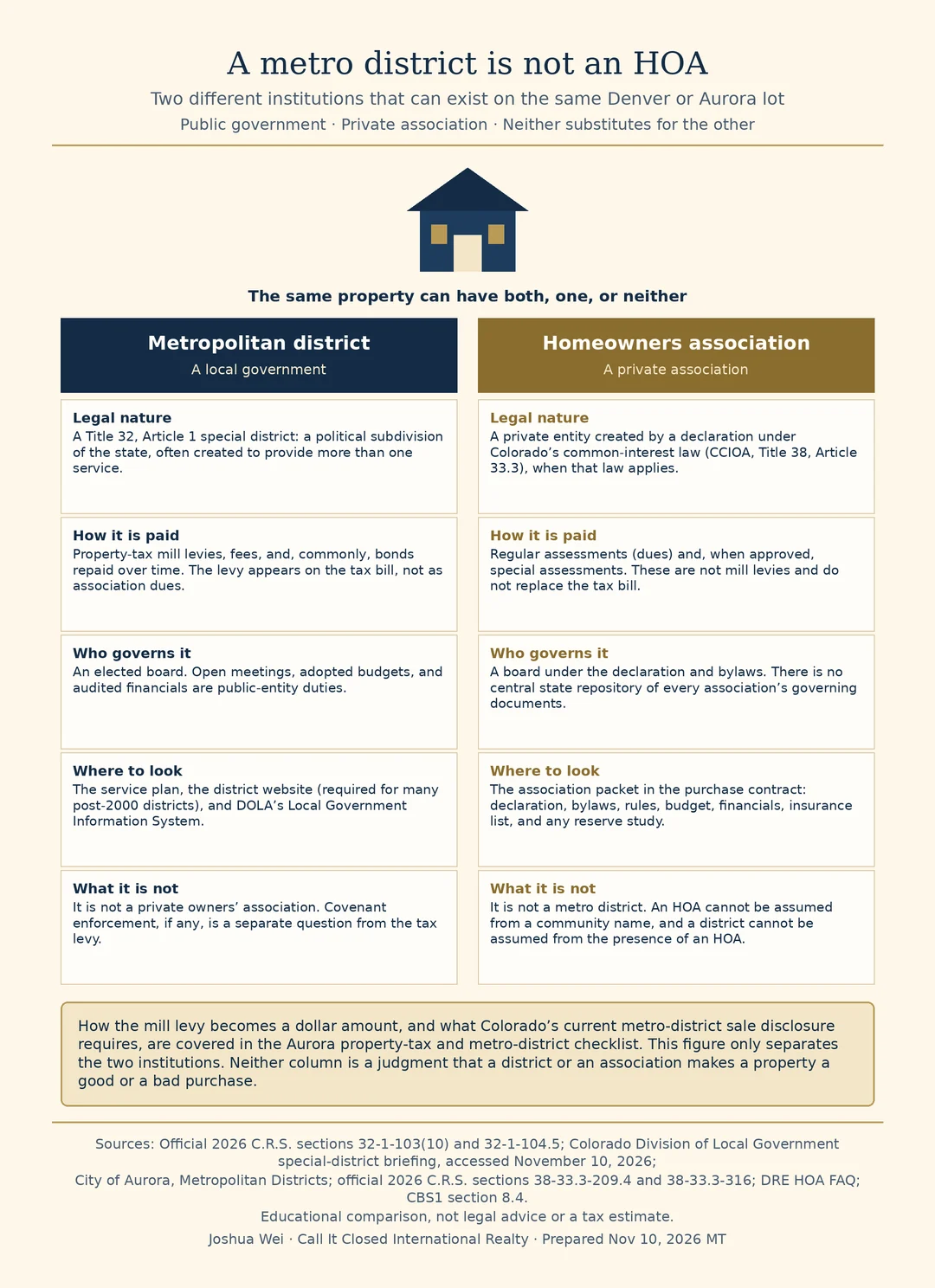
Comparison diagram on a cream background. A small navy house sits above the line “The same property can have both, one, or neither.” Two columns follow: Metropolitan district, a local government, covering legal nature under Title 32, tax and bond funding, an elected board and public records, and DOLA’s Local Government Information System; and Homeowners association, a private association, covering a declaration under CCIOA, dues and special assessments, a board under the declaration, and the contract packet, with no central state repository. A note directs readers to the published property-tax checklist for mill-levy math and the current sale disclosure. Prepared November 10, 2026 MT.
Sources: Official 2026 Colorado Revised Statutes sections 32-1-103(10) and 32-1-104.5 (OLLS CRS PDF) (opens in a new tab); Official 2026 Colorado Revised Statutes sections 38-33.3-209.4 and 38-33.3-316 (OLLS CRS PDF) (opens in a new tab); Colorado Division of Local Government, Special Districts brief review (opens in a new tab); City of Aurora, Metropolitan Districts (opens in a new tab); Colorado Division of Real Estate, HOA FAQ (opens in a new tab)
Cream background, a simple navy house icon, and two equal columns with a navy header for the metro district and a gold header for the HOA, each with five labeled rows, plus a cream callout pointing to the existing tax-and-disclosure article.
The diagram above places the two institutions side by side on the same lot. It is a comparison of legal nature, funding, governance, and records, not a judgment that a district or an association makes a property a good or a bad purchase.
What is a metropolitan district?
The official 2026 Colorado Revised Statutes, retrieved November 10, 2026, define a metropolitan district in Colorado Revised Statutes section 32-1-103 (10) (opens in a new tab) as follows: ""Metropolitan district" means a special district that provides for the inhabitants thereof any two or more of the following services:" The statute then lists fire protection, mosquito control, parks and recreation, safety protection, sanitation, solid waste disposal facilities or collection and transportation of solid waste, street improvement, television relay and translation, transportation, and water. The Colorado Division of Local Government, in Special Districts in Colorado: A Brief Review for Residents and Prospective Homeowners, focuses on districts organized under Title 32, Article 1. Those districts, the briefing says, provide services such as ambulance, fire protection, water, sanitary sewer, health, and park and recreation services. Metropolitan districts, it adds, are common among residential communities and may provide multiple services, including those provided by single-purpose districts, as well as street improvement, mosquito control, television relay and translation, transportation, and traffic-related safety protection.
Title 32, Article 1 special districts are local governments, or political subdivisions of the state. The Division describes them as a third level of government, with the federal and state governments as the other two, and with counties, municipalities, and school districts among the other local governments. Residents of municipalities, not only people in unincorporated areas, may be in special districts.
The City of Aurora’s metropolitan-districts page, accessed November 10, 2026, describes metro districts as independent units of government granted authority through the state, formed to provide certain services within their boundaries. Aurora says they have the authority to issue tax-exempt bonds to finance infrastructure construction and to impose property taxes as a mechanism to repay the bonds. It identifies the Colorado Department of Local Affairs as the agency that regulates metro-district activities, and it says an elected board governs a metro district, adhering to requirements for transparency, accountability, and fiscal responsibility. A district is also regulated by its service plan, which Aurora calls the governing document that outlines the district’s purpose, powers, responsibilities, and financial details.
Those official descriptions are the starting point. A district is not, by existing, proof of a bad purchase. Public infrastructure has costs, and Colorado communities have often used districts to place those costs on the development they serve rather than on the existing city or county tax base. The buyer’s task is to identify the district, read what it is authorized and currently doing, and put the resulting obligation in the same budget as every other cost of owning the property.
What is an HOA, and why is it a different kind of body?
A homeowners association, when Colorado’s Common Interest Ownership Act applies, is a private entity created by a declaration and governed by that declaration, bylaws, and rules, as set out in article 33.3 of title 38 (opens in a new tab) of the official 2026 Colorado Revised Statutes. Colorado Revised Statutes section 38-33.3-316 (1)(a) (opens in a new tab), retrieved November 10, 2026, states: "The association, if such association is incorporated or organized as a limited liability company, has a statutory lien on a unit for any assessment levied against that unit or fines imposed against its unit owner." The Commission’s residential contract also discusses association assessments and liens. This is a statute and form summary, not an opinion about any association’s lien rights; ask a Colorado real estate attorney if you have a question about a particular lien. An HOA is not a Title 32 special district, and its dues are not a mill levy.
The Colorado Division of Real Estate’s HOA Frequently Asked Questions, accessed November 10, 2026, is the practical state guidance for association documents. It identifies annual-disclosure materials such as budgets, assessments, financial statements with reserve amounts, insurance information, governing documents, and meeting minutes. It also explains that there is no central repository of every association’s governing documents. Prospective buyers should work through their broker and the seller to request the packet.
That packet is a contract obligation when section 7 of the residential contract applies. I described what to look for in it, including reserves, insurance, and lender project review, in a companion condo due-diligence note. The important contrast here is simpler: you will not find a complete HOA file by searching a tax bill, and you will not find a district’s bond authorization by reading only the association’s rules.
Covenant enforcement can blur the picture, because some districts also have a role in design review or covenant enforcement, and some associations manage amenities that residents assume are “the district’s.” Ask which entity is responsible for a given rule, fee, or facility, and ask for the document that says so. A community name on a monument sign does not answer the question.
How is each one paid for?
Special districts, the Division of Local Government explains, have various financial powers, including the powers to tax and to assess fees for services, and to issue bonds to pay for community improvements. Bonds place the district in legal indebtedness. Generally, that debt can be issued only as the result of an election. The briefing describes general-obligation bonds secured by the authority to levy property taxes, limited-tax general-obligation bonds with a cap on the mill levy pledged to repayment, and revenue bonds backed by a specific revenue source rather than by taxes. The repayment period, it says, is often twenty years, but terms vary.
The property-tax levy is the rate applied to the assessed value of property in the district. It generates revenue to pay for services, to pay debt service, or both. Mill levies may fluctuate depending on the voter authorization specific to each district. Under Colorado’s TABOR amendment, Article X, Section 20 of the state constitution, mill levy increases generally require voter authorization. The Division also notes a development risk that matters in new communities: metro districts are often established by developers to finance infrastructure for a new subdivision, and if development does not occur as planned, the tax base may be insufficient to meet scheduled bond payments at the established mill levy. Depending on the bonds and the voter authorization, the district might then increase the mill levy.
That is why a current levy, an authorized maximum, and outstanding debt are different facts. I walked through those distinctions, and through a clearly labeled hypothetical levy calculation, in the property-tax checklist. Do not multiply a mill levy by a purchase price and call the result your tax. Do not add a district amount a second time if it is already in a verified total bill.
HOA funding is different in kind. Regular assessments pay for the association’s budgeted operations and, if the budget says so, reserve contributions. Special assessments, the Division of Real Estate’s FAQ explains, are generally less frequent and tied to a particular purpose. They do not appear as mills on the treasurer’s tax bill. They can still be a material obligation, and they can coincide with a district tax on the same property. A useful ownership budget lists both, labeled separately, and does not treat a low dues figure as proof that the tax bill is low, or the reverse.
Who governs each one, and where are the records?
Special districts must hold open meetings, notice those meetings, and keep minutes and other records that are open for public inspection. They must hold elections for their boards, adopt annual budgets, and submit annual financial audits. The Division of Local Government says regular special-district elections occur each May of odd-numbered years, and that eligible electors are generally people registered to vote in Colorado who either live in the district or own property in it. Residents can attend board meetings, attend a required annual meeting in a residential metropolitan district, review filings, and, if they are eligible, self-nominate for the board.
Many of the documents are public by design. Contact information, websites, service plans, budgets, and election information are available through DOLA’s Local Government Information System. Audited financial statements are available from the Office of the State Auditor. Under the official 2026 text of Colorado Revised Statutes section 32-1-104.5 (3) (opens in a new tab), a metropolitan district organized after January 1, 2000, generally must establish and maintain an official public website, with timing rules in that subsection, unless the district is in inactive status or does not have the power to impose an ad valorem property tax. The required contents include, among other items, a plain-language explanation of what the district is, the public improvements and services it provides, the amount of debt it can incur, what revenue may be used to repay that debt, the maximum mill levy it may assess to repay that debt, meeting information, and current budget and financial information. The Division of Local Government briefing summarizes the same website duty. Unless waived, districts created after July 1, 2000, must also file an annual report, including construction status and any default or inability to pay obligations, as the briefing describes.
An HOA’s records are not government filings, so you will not find them in a state database. Before you close, you get them from the seller, the association, or its manager, usually through the contract’s Association Documents process. Once you own the home, Colorado’s Common Interest Ownership Act gives you rights as an owner. The law says all regular and special meetings of the HOA board must be open to all members, and the association must keep minutes and financial records that owners can ask to see. Those rules are different from the open-meeting rules for public bodies like a metro district, and they come with their own exceptions, such as closed sessions for certain legal or personnel matters.
Aurora adds a local layer for districts formed there. The city says it has required new metro districts to adhere to its Model Service Plan since 2004, and that the model includes a maximum property-tax mill levy, a maximum mill-levy imposition term, and a limitation on privately placed debt. Those are features of Aurora’s model for districts it has approved under that framework. They are not a substitute for reading the particular district’s approved service plan and amendments, and they are not a statewide cap. I am not assigning a maximum mill or a payoff year to any Aurora or Denver property.
What should a buyer actually pull, and in what order?
Start with the parcel, not the community brand. Confirm the address, the county, and the parcel identifier, as the property-tax checklist describes. Then identify every taxing entity on the treasurer’s records and the certificate of taxes due, which the purchase contract’s sections 8.4 and 8.5 process is designed to surface. Section 8.4 of the current residential contract, CBS1, retrieved November 10, 2026 from the Division of Real Estate contracts and forms page (opens in a new tab), prints this warning in capital letters: "ACTIONS BY A SPECIAL TAXING OR METROPOLITAN DISTRICT PURSUANT TO ITS AUTHORITY TO ISSUE DEBT, IMPOSE MILL LEVIES, AND IMPOSE FEES, RATES, TOLLS, PENALTIES, OR OTHER CHARGES MAY INCREASE COSTS TO RESIDENTS LIVING IN THE SPECIAL TAXING OR METROPOLITAN DISTRICT. SPECIAL TAXING AND METROPOLITAN DISTRICTS MAY BE SUBJECT TO GENERAL OBLIGATION INDEBTEDNESS THAT IS PAID BY REVENUES PRODUCED FROM ANNUAL TAX LEVIES ON THE TAXABLE PROPERTY WITHIN SUCH DISTRICTS. PROPERTY OWNERS IN SUCH DISTRICTS MAY BE PLACED AT RISK FOR INCREASED MILL LEVIES AND TAX TO SUPPORT THE SERVICING OF SUCH DEBT WHERE CIRCUMSTANCES ARISE RESULTING IN THE INABILITY OF SUCH A DISTRICT TO DISCHARGE SUCH INDEBTEDNESS WITHOUT SUCH AN INCREASE IN MILL LEVIES. BUYERS SHOULD INVESTIGATE THE SPECIAL TAXING OR METROPOLITAN DISTRICTS IN WHICH THE PROPERTY IS LOCATED BY CONTACTING THE COUNTY TREASURER, BY REVIEWING THE CERTIFICATE OF TAXES DUE FOR THE PROPERTY AND BY OBTAINING FURTHER INFORMATION FROM THE BOARD OF COUNTY COMMISSIONERS, THE COUNTY CLERK AND RECORDER, OR THE COUNTY ASSESSOR." The same section then provides a blank: "The official website for the Metropolitan District, if any, is:___."
For each metro district you identify, use LGIS, the district website, the service plan, the latest budget, the latest audit or financial statements, and, where it exists, the annual report. The Division of Local Government publishes a list of questions a prospective homeowner may ask about outstanding general-obligation debt, mill-levy caps on limited-tax bonds, whether the developer holds the bonds, yearly debt service, build-out, and the ratio of debt to assessed value, among others. Those questions are a research agenda, not a scoring system I can run from this article. “Debt greater than 50% of assessed valuation,” the briefing says, “may be considered a ‘red flag’ to financial analysts, although the district’s specific circumstances must be evaluated in each case.” I am repeating that caution from the briefing, accessed November 10, 2026, not applying the ratio to any district.
For the association, if there is one, use the contract packet: declaration, bylaws, rules, budget, financials, insurance list, minutes, and any reserve study. For the tax bill as a whole, including school and other levies that are neither the metro district nor the HOA, return to the property-tax checklist and to the assessor and treasurer. Lender escrow estimates still need those inputs, as the Consumer Financial Protection Bureau’s escrow guidance, already cited in that checklist, explains.
Colorado has also required certain sale disclosures about special districts and metropolitan districts. The Division of Local Government’s briefing summarizes several of them, including contract language about special taxing districts and a metro-district disclosure for residential property in districts organized since 2000. The metro-district sale-disclosure statute was amended in 2025. The current scope, timing, and dollar-estimate requirements are discussed, with the official statute and the signed act, in the property-tax checklist. Use that later explanation, not an older paraphrase, when you ask whether the right disclosure has been provided for your sale. This article does not determine compliance or a remedy.
What this distinction does not settle
It does not tell you whether a particular district’s levy is high or low relative to the services it funds. It does not tell you whether an HOA is well run. It does not forecast a future mill levy, a future dues increase, or a bond payoff date. Two winters of listing data, or a single attached-home median, will not answer those questions either. The records will, or they will show you what is still unknown.
If you are comparing homes in Denver, Aurora, or elsewhere along the Front Range, compare like with like: the same parcel identifiers, the same tax-year bills, the same identified districts, and the same association packets. A cheaper-looking payment may simply be missing a district or an assessment. I can help you organize that comparison. The assessor, the treasurer, the district, the association, the lender, and qualified legal or tax advisers have to answer for their own pieces.
Frequently asked questions
Is a metro district the same as an HOA?
No. The Division of Local Government describes Title 32 special districts, including metropolitan districts, as local governments. An HOA is a private association. One is funded primarily through taxes, fees, and often bonds; the other through assessments. A property can have both.
How do I find out whether a Denver or Aurora home is in a metro district?
Start with the parcel’s tax records and the certificate of taxes due, and use the investigation path printed in section 8.4 of the residential contract: the county treasurer, the certificate, and the county commissioners, clerk, or assessor. Then look up the district in DOLA’s Local Government Information System and on the district’s website.
Do metro district taxes replace HOA dues?
No. They are different obligations. A district levy appears on the property-tax bill. Association assessments are charged under the declaration. Budget for both when both exist, and do not count the same charge twice.
Does Aurora cap every metro district’s mill levy?
Aurora says that new metro districts have been required to adhere to its Model Service Plan since 2004, and that the model includes a maximum mill levy, a maximum imposition term, and a limitation on privately placed debt. That is not a substitute for the particular district’s approved plan, and it is not a statement about every district in the metro area.
Where do I find HOA documents if there is no central registry?
The Division of Real Estate’s FAQ says there is no central repository of every association’s governing documents. Request them through the seller and the association, using the contract’s Association Documents process when it applies.
Related notes
- Buying a Denver or Aurora condo: read the building before you price the unit
- Who oversees Colorado HOAs? What the state HOA Center can and can't do for Denver and Aurora owners and buyers
Sources and method
The statutory definition of a metropolitan district and the official-website requirement are from the official 2026 Colorado Revised Statutes, Colorado Revised Statutes sections 32-1-103 (10) and 32-1-104.5 (opens in a new tab), downloaded November 10, 2026 from the Office of Legislative Legal Services host linked at the 2026 CRS titles index (opens in a new tab). The special-district description, financing, governance, research questions, and public-records path are from the Colorado Division of Local Government’s Special Districts in Colorado: A Brief Review for Residents and Prospective Homeowners (opens in a new tab), accessed November 10, 2026. Aurora’s description of metro districts, service plans, and the Model Service Plan in place since 2004 is from the City of Aurora, Metropolitan Districts (opens in a new tab) page, accessed the same day. Association status, annual disclosures, and the statutory assessment lien are from Colorado Revised Statutes sections 38-33.3-209.4 and 38-33.3-316 (opens in a new tab) and from the Colorado Division of Real Estate’s HOA Frequently Asked Questions (opens in a new tab), accessed November 10, 2026. The contract warning and tax-certificate process are from CBS1, the Contract to Buy and Sell Real Estate (Residential), Mandatory Use Date January 1, 2026, sections 8.4 and 8.5. Current metro-district sale-disclosure requirements are not restated here; they are sourced in the already published property-tax checklist from the signed HB25-1219 act and the official 2026 text of Colorado Revised Statutes section 38-35.7-110. No district count, no share of new-home sales, and no parcel tax estimate is used in this article, because those figures were not independently verified from a current official table for this article.
This note is general education from a Colorado real estate broker with Call It Closed International Realty. It is not legal advice, tax advice, or an estimate of your bill. If you are comparing properties, I will help you separate the district, the association, and the rest of the tax bill, and I will send the remaining questions to the offices that can answer them.
Disclaimer
This article is general information only. It is not legal, tax, lending, insurance, appraisal, inspection, or financial advice, and it is not a substitute for advice about your situation. Joshua Wei is a Colorado real estate broker, not an attorney. Reading this article does not create a client relationship, an agency relationship, or an attorney-client relationship with Joshua Wei or with Call It Closed International Realty.
Laws, program rules, interest rates, insurance terms, tax figures, and other details change. Examples in this article are hypothetical illustrations unless a source is named for a specific, dated figure. Information in this article is believed accurate as of November 19, 2026 and is not guaranteed. No result is promised, and you should not rely on this article as the last word for your situation.
Before you act, confirm the point with the official source linked or cited in this article, and talk with a licensed professional who can apply the rule to your facts. That may be a licensed attorney, a tax professional, a lender, an insurance agent, a home inspector, or another licensed professional, depending on the question. Links to third-party websites and publications are provided for reference only. They are not an endorsement, and their content can change.
If you already have a brokerage relationship with another broker, this is not a solicitation.
Joshua Wei, Associate Broker, Call It Closed International Realty, Colorado license FA.100108558. Equal Housing Opportunity.