October 26, 2026 · Denver · Aurora · HOA · Owning · Buying
Who oversees Colorado HOAs? What the state HOA Center can and can't do for Denver and Aurora owners and buyers
Colorado has an HOA Information and Resource Center, but it doesn't regulate associations. What the Division of Real Estate says about HOA oversight, complaints, registration, fines, interest, records, and governing documents for buyers.
The short answer
In brief: It is easy to assume a state agency polices HOAs. The Colorado Division of Real Estate's HOA FAQ says there is no regulatory oversight of HOAs or community association managers in Colorado, and disputes are civil matters. The state's HOA Information & Resource Center is a resource for owners to understand their basic rights and duties, not an enforcer.
It is easy to assume a state agency polices HOAs. The Division of Real Estate's HOA FAQ (opens in a new tab) says otherwise: "there is no regulatory oversight of HOAs or Community Association Managers in the State of Colorado. Any dispute between homeowners or homeowners and an HOA is considered a civil matter."
The state's HOA Information & Resource Center "serves as a resource for consumers to understand their basic rights and duties under the Colorado Common Interest Ownership Act," according to its About page (opens in a new tab).
I am a licensed Colorado real estate broker with Call It Closed International Realty. I am not an attorney. This is not legal advice.
Disclaimer. This article is general information only. It is not legal, tax, lending, insurance, appraisal, inspection, or financial advice, and reading it does not create a client, agency, or attorney-client relationship. Laws, rates, programs, and figures change. Confirm the official source, and talk with a licensed attorney, tax professional, lender, insurance agent, or inspector before you act. Joshua Wei is a Colorado real estate broker, not an attorney. He is an Associate Broker with Call It Closed International Realty, license FA.100108558. Equal Housing Opportunity.
 Full size (opens in a new tab)
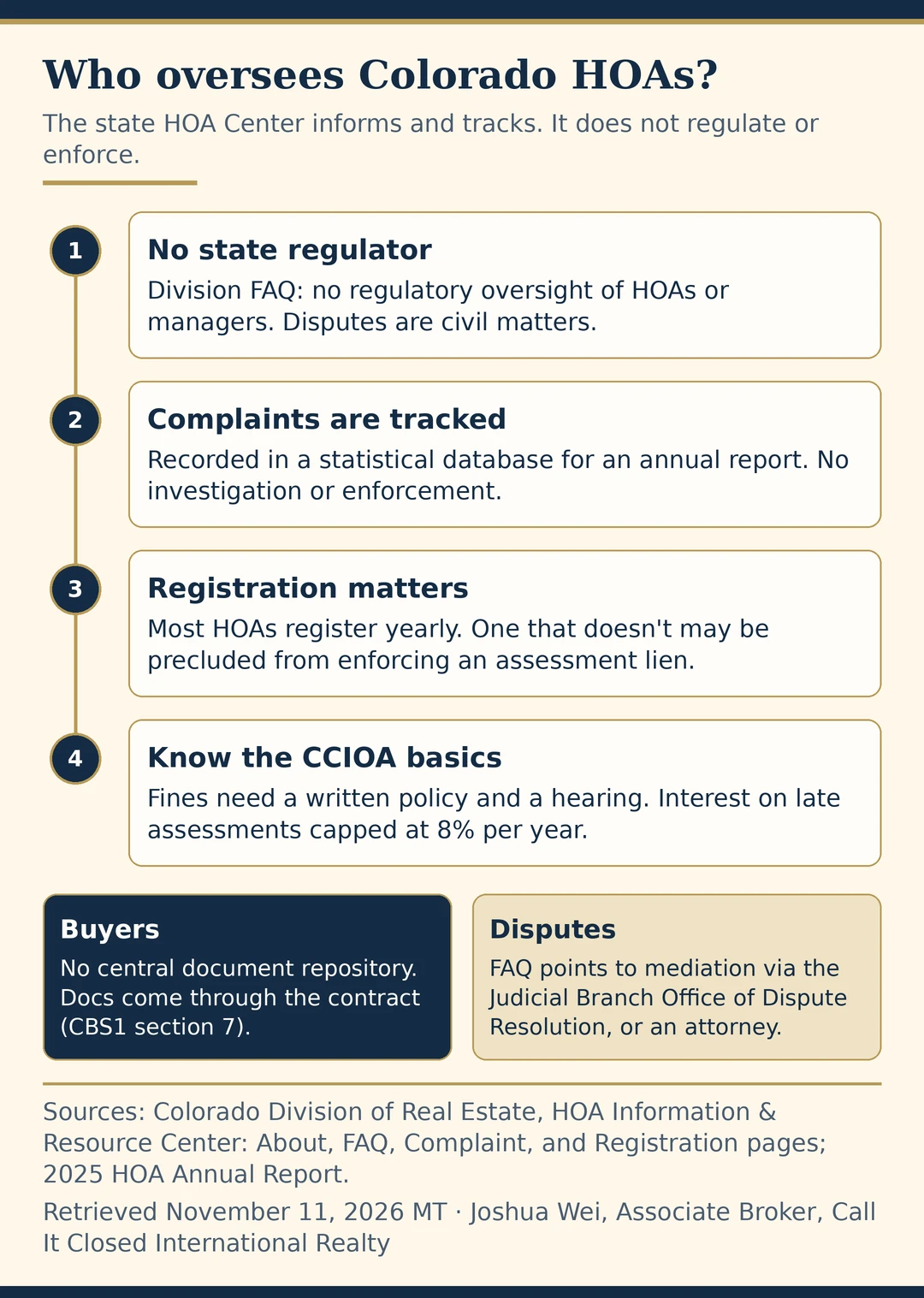
A vertical flow diagram, cream background with navy type and gold accents, titled Who oversees Colorado HOAs, with the subtitle the state HOA Center informs and tracks but does not regulate or enforce. Four numbered steps: 1, no state regulator, the Division FAQ says there is no regulatory oversight of HOAs or managers and disputes are civil matters; 2, complaints are tracked in a statistical database for an annual report, with no investigation or enforcement; 3, registration matters, most HOAs register yearly and one that doesn't may be precluded from enforcing an assessment lien; 4, know the CCIOA basics, fines need a written policy and a hearing, and interest on late assessments is capped at 8 percent per year. Two lower cards: buyers, there is no central document repository and documents come through the contract, CBS1 section 7; and disputes, the FAQ points to mediation through the Judicial Branch Office of Dispute Resolution, or an attorney. Sources: Colorado Division of Real Estate. Retrieved November 11, 2026 MT.
Sources: DRE HOA FAQ (opens in a new tab); DRE HOA complaint page (opens in a new tab)
Cream background, navy text, gold rules. Four numbered steps on a gold spine, two side-by-side cards, and a 28px source footer.
The diagram above summarizes what the HOA Center does and the rules it points owners to, as described on the Division of Real Estate's pages.
What does the HOA Center actually do?
The About page lists its work, including that it "Gathers, analyzes, and reports information through complaints and HOA registrations."
On complaints, the complaint page (opens in a new tab) is direct: "The HOA Information and Resource Center and the Division of Real Estate do not have any investigative or enforcement capabilities to address your HOA complaint. We record your issues and matters of concern into a statistical database, which is later compiled into an annual report."
For disputes, the FAQ points to mediation: "The Colorado Judicial Branch's Office of Dispute Resolution offers affordable access to qualified mediators."
Where the HOA Center comes from
The 2025 Annual Report (opens in a new tab) explains that the HOA Center "was created in 2010" and "is housed within the Colorado Division of Real Estate." It says the Center "collects and compiles information about Common Interest Communities" from "its registration mandate, as well as from general inquiries and complaints received from the public," and is "responsible for providing information and resources to unit owners," as well as boards, declarants, and other interested parties.
The Center's term was renewed in 2025. The report says SB25-184 "extends the HOA Center for a period of five (5) years and shall be repealed September 1, 2030, unless the Colorado General Assembly acts before that date." It adds: "No substantive changes were made to the HOA Center," and "the authority and directives of the HOA Center remain unchanged."
What the numbers show
The annual report gives the Center's 2025 workload:
- During 2025, the Center "received a total of three-thousand seven-hundred and ninety-one (3,791) total inquiries."
- "In 2025, the HOA Center received complaints from three-hundred sixty-four (364) individuals ." That "is an increase of sixty-four (64) from 2024."
- The report estimates "the total number of estimated Coloradans living in an HOA at the end of 2025 was approximately two-million seven-hundred fifty-four thousand onehundred and seventy-five (2,754,175)," calculated by "multiplying the number of units by the average number of persons per household."
How many HOAs are there?
The HOA Center's 2025 Annual Report (opens in a new tab) says 8,405 HOAs were registered as Active at the beginning of 2025, and 8,615 by the end of the year.
Does registration matter?
The registration page (opens in a new tab) says: "most associations located in the State of Colorado are required to register annually with the Colorado Division of Real Estate. An association that fails to register timely, renew, or pay the required fee may be precluded from enforcing a lien for assessments."
The statute is Colorado Revised Statutes section 38-33.3-401 (opens in a new tab). Subsection (1) says: "Every unit owners' association shall register annually with the director of the division of real estate, in the form and manner specified by the director." The registration page's phrase "most associations" and the statute's "Every unit owners' association" read differently; the annual report also tracks associations "Claiming CCIOA Exemptions." Whether a specific association must register is a question for the Division or an attorney.
Subsection (3) sets the consequence: "A registration is valid for one year. The right of an association that fails to register, or whose annual registration has expired, to impose or enforce a lien for assessments under section 38-33.3-316 or to pursue an action or employ an enforcement mechanism otherwise available to it under section 38-33.3-123 is suspended until the association is validly registered pursuant to this section." It adds: "An association's registration in compliance with this section revives a previously suspended right without penalty to the association."
Registration includes "The number of units in the association" and the name of the association's "management company, managing agent, or designated agent." A buyer can use that information to confirm who manages the community.
What does the Division's FAQ say about owner rules?
The FAQ summarizes several Common Interest Ownership Act provisions:
- Fines need a written policy. "Section 38-33.3-209.5(2) states that an association may not fine any unit owner for an alleged violation unless the association has adopted, and follows, a written policy governing the imposition of fines." It must guarantee "notice of the alleged violation and an opportunity to be heard before an impartial decision-maker."
- Interest cap. "Section 38-33.3-315 of the Colorado Common Interest Ownership Act states that interest on delinquent assessments is capped at 8% per year." The statute itself says: "Any pastdue common expense assessment or installment of a common expense assessment bears interest at the rate established by the association in an amount not to exceed eight percent per year."
- Liens. "The statutory lien exists on any unit for any assessment levied against that unit or fines imposed against its unit owner."
- Time limit on some enforcement. Under section 38-33.3-123(2), as the FAQ describes it, an action to enforce a building restriction must be "commenced within one year from the date from which the person commencing the action knew or in the exercise of reasonable diligence should have known of the violation."
- Which document wins. A statute that overrides the documents "will likely begin with language such as 'Notwithstanding any provision in the declaration, bylaws, or other documents to the contrary.'"
Where do buyers get the HOA documents?
The FAQ says: "There is no central repository of HOA governing documents in Colorado." A prospective buyer "will have to ask your real estate broker to ask the listing agent if the seller would be able and willing to provide you with copies of the current governing documents. However, you are not entitled to them until you have signed the Contract to Buy and Sell Real Estate (see section 7)."
CBS1 section 7 sets the association document deadlines. Contract quotations here are from the 2026 CBS1 PDF (opens in a new tab). Under section 7.2, "Seller is obligated to provide to Buyer the Association Documents (defined below), at Seller's expense, on or before Association Documents Deadline." Section 7.3 lists them, including:
- "All Association declarations, articles of incorporation, bylaws, articles of organization, operating agreements, rules and regulations, party wall agreements and the Association's responsible governance policies adopted under section 38-33.3-209.5, C.R.S."
- Minutes of "the annual owners' or members' meeting" and "any executive boards' or managers' meetings."
- A "List of all Association insurance policies," which "must include the company names, policy limits, policy deductibles, additional named insureds and expiration dates of the policies listed."
- "A list by unit type of the Association's assessments, including both regular and special assessments."
- Financial documents, including "the Association's operating budget for the current fiscal year," "the results of the Association's most recent available financial audit or review," and the "reserve study, if any."
Section 7.4 gives the buyer "the Right to Terminate under section 24.1., on or before Association Documents Termination Deadline, based on any unsatisfactory provision in any of the Association Documents, in Buyer's sole subjective discretion." If the documents arrive late, the buyer may terminate by notice received "on or before ten days after Buyer's receipt of the Association Documents." And: "If Buyer does not receive the Association Documents, or if Buyer's Notice to Terminate would otherwise be required to be received by Seller after Closing Date, Buyer's Notice to Terminate must be received by Seller on or before Closing." If no notice is received in time, "Buyer accepts the provisions of the Association Documents as satisfactory and Buyer waives any Right to Terminate under this provision."
What policies must an HOA have?
The Division's FAQ refers to fine policies, and the statute behind them is broader. Under Colorado Revised Statutes section 38-33.3-209.5(1) (opens in a new tab), "To promote responsible governance, associations shall: (a) Maintain accurate and complete accounting records." Associations must also adopt "policies, procedures, and rules and regulations concerning," among other things:
- "Collection of unpaid assessments"
- "Handling of conflicts of interest involving board members"
- "Conduct of meetings"
- "Enforcement of covenants and rules, including notice and hearing procedures and the schedule of fines"
- "Inspection and copying of association records by unit owners"
- "Investment of reserve funds"
- "Procedures for addressing disputes arising between the association and unit owners"
On delinquencies, section 38-33.3-209.5(1.7)(a)(I) says an association shall "First contact the unit owner to alert the unit owner of the delinquency before taking action" and "shall maintain a record of any contact."
These are the policies that CBS1 section 7.3.1 calls "the Association's responsible governance policies adopted under section 38-33.3-209.5, C.R.S." They arrive with the Association Documents, so a buyer can read them before the termination deadline.
What records must an HOA keep?
Section 38-33.3-317(1) lists records the association "must maintain," which "shall be deemed to be the sole records of the association for purposes of document retention and production to owners." The list includes "Detailed records of receipts and expenditures affecting the operation and administration of the association," "Records of claims for construction defects and amounts received pursuant to settlement of those claims," "Minutes of all meetings of its unit owners and executive board," and "Financial statements as described in section 7-136-106, C.R.S., for the past three years and tax returns of the association for the past seven years, to the extent available."
For buyers, one item stands out: "A list of the current amounts of all unique and extraordinary fees, assessments, and expenses that are chargeable by the association in connection with the purchase or sale of a unit."
HOA collections and foreclosure: a 2025 change
The annual report summarizes HB25-1043. It says an HOA's collection policy under section 38-33.3-209.5 "must be updated to include three (3) provisions," among them "An advisement that a unit owner may request a copy of the ledger" that "the HOA must provide within seven (7) business days," and an advisement that "a foreclosure action could result in the sale of the unit at auction causing the owner to lose some or all of the owners' equity in the unit." The report also says: "At least thirty (30) days prior to initiating a foreclosure action, an association must provide a delinquent owner with the three (3) advisement provisions listed above in both written and electronic form." These are the report's summaries; the bill text controls, and a specific collection matter is a question for a Colorado attorney.
An invented example
This example is invented; it is not a real community.
A buyer is under contract on an Aurora townhome. The minutes in the Association Documents mention a dispute over fines with several owners.
- The buyer reads the responsible governance policies listed in section 7.3.1 to see the fine policy that section 38-33.3-209.5(2) requires.
- The buyer checks the HOA's registration status with the Division.
- The buyer reads the insurance list and the budget for deductibles and reserves.
- The buyer understands that the HOA Center records complaints but "do not have any investigative or enforcement capabilities," so any dispute would be a civil matter.
- Before the Association Documents Termination Deadline, the buyer decides whether to continue and asks an attorney about anything unclear.
Buyer checklist for an HOA purchase
- Calendar the Association Documents Deadline and Termination Deadline.
- Confirm every item listed in CBS1 section 7.3 arrived.
- Read the fine, collection, and records policies.
- Check the HOA's registration with the Division.
- Read the insurance list and reserve study.
- Know that the HOA Center records complaints; it does not enforce.
What a specific document means is a question for a Colorado attorney who handles HOA matters.
Related: Aurora property tax and metro district buyer checklist (opens in a new tab).
Frequently asked questions
Can I file a complaint against an unregistered HOA?
The complaint page says: "you may submit a complaint against an association, even if it is not a registered association."
Are anonymous complaints accepted?
"The Division does accept anonymous complaints."
Does the HOA Center give legal advice?
No. The complaint page suggests "speaking with a licensed Colorado attorney" for civil options.
What if my HOA ignores a records request?
The FAQ points owners to "Section 38-33.3-317," which "defines what records must be kept by the association, for the purposes of retention and production to unit owners." A specific records dispute is a question for a Colorado attorney.
Can an unregistered HOA collect assessments?
Under Colorado Revised Statutes section 38-33.3-401(3), the association's right "to impose or enforce a lien for assessments" is "suspended until the association is validly registered." Ask an attorney how this applies to a specific association.
Must an HOA contact me before acting on a late payment?
Under Colorado Revised Statutes section 38-33.3-209.5(1.7)(a)(I), an association shall "First contact the unit owner to alert the unit owner of the delinquency before taking action" and "shall maintain a record of any contact."
How far back do HOA financial records go?
Section 38-33.3-317(1)(g) lists "Financial statements as described in section 7-136-106, C.R.S., for the past three years and tax returns of the association for the past seven years, to the extent available."
Will I see the HOA's insurance before I buy?
CBS1 section 7.3.3 includes a "List of all Association insurance policies" in the Association Documents, with "the company names, policy limits, policy deductibles, additional named insureds and expiration dates of the policies listed." See shopping homeowners insurance before your deadline.
Is the HOA Center going away?
The 2025 Annual Report says SB25-184 extends the Center "for a period of five (5) years" and that it "shall be repealed September 1, 2030, unless the Colorado General Assembly acts before that date."
Does the HOA Center mediate disputes?
No. The FAQ says the state "has no authority to intervene in any association member's conflict with their association." It points to the Judicial Branch's Office of Dispute Resolution for mediation.
Can I use AI to write my complaint?
The complaint page asks that if you do, you "explain in your complaint narrative the extent to which AI was used in the generation of your complaint."
Related notes
- What a Colorado HOA can't prohibit: flags, signs, xeriscape, EV chargers, heat pumps, and more for Denver and Aurora owners
- A metro district is not an HOA: how Denver and Aurora buyers can tell them apart
- Buying a Denver or Aurora condo: read the building before you price the unit
Sources and method
Official sources, retrieved November 11, 2026, America/Denver (Colorado Division of Real Estate, HOA Information & Resource Center):
- About the HOA Center (opens in a new tab)
- HOA Frequently Asked Questions (opens in a new tab)
- File an HOA Complaint (opens in a new tab)
- HOA Registration Services (opens in a new tab)
- 2025 HOA Annual Report (opens in a new tab)
- Added November 13, 2026: further sections of the 2025 Annual Report (executive summary, legislative review, inquiries, complaints, population); Colorado Revised Statutes sections 38-33.3-209.5, 38-33.3-315, 38-33.3-317, and 38-33.3-401 (opens in a new tab) (2026 Colorado Revised Statutes, Title 38); and CBS1 2026 PDF (opens in a new tab) sections 7.2–7.4
Quotations are verbatim. Statute descriptions are as summarized by the Division's FAQ.
This note is general education from a Colorado real estate broker with Call It Closed International Realty. If you're buying in an HOA community in Denver or Aurora, I can help you request and organize the association documents on your contract timeline.
Disclaimer
This article is general information only. It is not legal, tax, lending, insurance, appraisal, inspection, or financial advice, and it is not a substitute for advice about your situation. Joshua Wei is a Colorado real estate broker, not an attorney. Reading this article does not create a client relationship, an agency relationship, or an attorney-client relationship with Joshua Wei or with Call It Closed International Realty.
Laws, program rules, interest rates, insurance terms, tax figures, and other details change. Examples in this article are hypothetical illustrations unless a source is named for a specific, dated figure. Information in this article is believed accurate as of November 13, 2026 and is not guaranteed. No result is promised, and you should not rely on this article as the last word for your situation.
Before you act, confirm the point with the official source linked or cited in this article, and talk with a licensed professional who can apply the rule to your facts. That may be a licensed attorney, a tax professional, a lender, an insurance agent, a home inspector, or another licensed professional, depending on the question. Links to third-party websites and publications are provided for reference only. They are not an endorsement, and their content can change.
If you already have a brokerage relationship with another broker, this is not a solicitation.
Joshua Wei, Associate Broker, Call It Closed International Realty, Colorado license FA.100108558. Equal Housing Opportunity.