September 15, 2026 · Colorado · Water · Homeowners · HOA · Denver · Aurora
Rain barrels in Colorado: what the law allows at a Denver or Aurora home
Rain barrels are legal at most Colorado homes, within limits. What C.R.S. 37-96.5-103 allows, how the 110-gallon cap works for houses and townhomes, what an HOA can and can't do, and why the water stays outdoors.
The short answer
In brief: Colorado law, Colorado Revised Statutes section 37-96.5-103, allows rooftop rainwater collection at a home if no more than two rain barrels with a combined capacity of 110 gallons or less are used, the water comes from the roof of a single-family home or a multifamily residence with four or fewer units, and it is used for outdoor purposes such as irrigation.
Colorado Revised Statutes section 37-96.5-103 (opens in a new tab) allows rooftop collection if:
- "No more than two rain barrels with a combined storage capacity of one hundred ten gallons or less are utilized"
- the water comes from the rooftop of a building used primarily as a single-family home or "a multi-family residence with four or fewer units"
- it's "used for outdoor purposes including irrigation of lawns and gardens"
- it's "used on the residential property on which the precipitation is collected"
And: "A person shall not use precipitation collected under this article for drinking water or indoor household purposes."
I am a licensed Colorado real estate broker with Call It Closed International Realty. I am not an attorney.
Disclaimer. This article is general information only. It is not legal, tax, lending, insurance, appraisal, inspection, or financial advice, and reading it does not create a client, agency, or attorney-client relationship. Laws, rates, programs, and figures change. Confirm the official source, and talk with a licensed attorney, tax professional, lender, insurance agent, or inspector before you act. Joshua Wei is a Colorado real estate broker, not an attorney. He is an Associate Broker with Call It Closed International Realty, license FA.100108558. Equal Housing Opportunity.
 Full size (opens in a new tab)
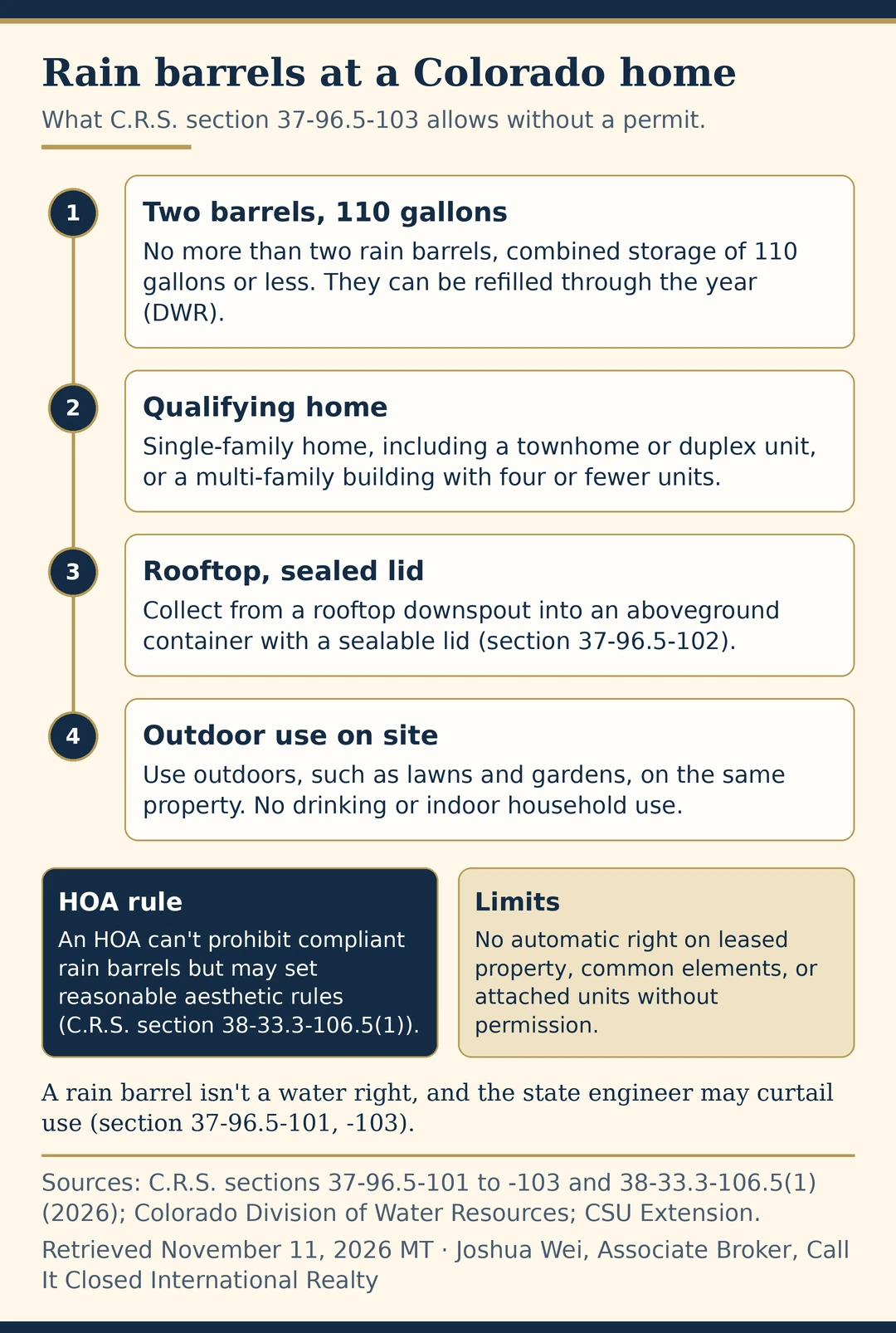
A vertical flow diagram, cream background with navy type and gold accents, titled Rain barrels at a Colorado home. Subtitle: What Colorado Revised Statutes section 37-96.5-103 allows without a permit. 4 numbered steps: 1, Two barrels, 110 gallons: No more than two rain barrels, combined storage of 110 gallons or less. They can be refilled through the year (DWR); 2, Qualifying home: Single-family home, including a townhome or duplex unit, or a multi-family building with four or fewer units; 3, Rooftop, sealed lid: Collect from a rooftop downspout into an aboveground container with a sealable lid (section 37-96.5-102); 4, Outdoor use on site: Use outdoors, such as lawns and gardens, on the same property. No drinking or indoor household use. Two cards: HOA rule: An HOA can't prohibit compliant rain barrels but may set reasonable aesthetic rules (Colorado Revised Statutes section 38-33.3-106.5(1)); and Limits: No automatic right on leased property, common elements, or attached units without permission. A note says: A rain barrel isn't a water right, and the state engineer may curtail use (section 37-96.5-101, -103). Sources: Colorado Revised Statutes sections 37-96.5-101 to -103 and 38-33.3-106.5(1) (2026); Colorado Division of Water Resources; CSU Extension. Retrieved November 11, 2026 MT. Joshua Wei, Associate Broker, Call It Closed International Realty.
Sources: C.R.S. title 37 (opens in a new tab); DWR rainwater page (opens in a new tab)
Cream background, navy text, gold rules. Numbered navy circles on a gold spine with white step cards, two branch cards (navy and tan), a note, and a source footer.
The figure above sums up the four conditions, the indoor-use ban, and the HOA rule.
Why the limit is so small
The statute starts from Colorado water law. Section 37-96.5-101(1) says water "is considered the property of the public, is dedicated to the use of the people, is subject to the doctrine of prior appropriation, and must be administered in accordance with the priority system." Subsection (2) says "nothing in this article is intended to infringe upon or impair the doctrine of prior appropriation."
CSU Extension explains what that means for a homeowner: "In order to safeguard senior holders of Colorado water rights, diverting and storing water is allowed only during times when all water rights in the basin are satisfied. It is impractical, however, for homeowners to know at all times whether water rights are satisfied." The rain barrel law is a narrow exception. CSU adds that before House Bill 16-1005, "rainwater collection was not permitted except under specific circumstances." The law took effect August 10, 2016.
What counts as a rain barrel?
The statute defines a "Rain barrel" as "a storage container with a sealable lid" that is "Located aboveground outside of a residential home" and "Used for collecting precipitation from a downspout of a rooftop."
So a buried cistern doesn't count, because the container must be "Located aboveground." A tank that collects from a patio or driveway doesn't count either, because the water must come "from a downspout of a rooftop." DWR adds that water "must be collected in rain barrels (up to 110 gallon total capacity) with sealable lids."
On standing water, Colorado State University Extension's rainwater collection page (opens in a new tab) says "Mosquitos breed in standing water, so it is important to make sure they cannot access the standing water in your rain barrels." Its suggestions: "the rain barrel should be completely emptied every month (or less)," and "If you plan to be away from the home for more than a week, you should disconnect your rain barrel from the downspout."
Water quality
CSU Extension says the roof matters. It says "the infrequency of rainfall results in accumulation of bird droppings, dust and other impurities on rooftops between rain events." It reports that "Heavy metals such as cadmium, copper, lead, zinc, and chromium have been detected in rainwater collected from rooftops." Its suggested fix: "The best strategy is to filter and screen out contaminants before they enter the storage container." It describes "first-flush" diverters, which keep the first several gallons of runoff out of the barrel. It also says "Roof washing is not needed for water used solely for irrigation purposes."
The legislature asked the state health department to weigh in. Under C.R.S. 25-1.5-210 (opens in a new tab), the department, "to the extent practicable within existing resources, shall develop best practices for" "Nonpotable usage of the collected precipitation" and "Disease and pest vector control."
Do I need a permit?
The Division of Water Resources' rainwater page (opens in a new tab) says "No permit or other approval is required for capture and use of precipitation in rain barrels with a combined storage capacity of 110 gallons in accordance with Section 37-96.5-103, C.R.S."
It also says "You can fill and refill two rain barrels with a combined storage capacity up to 110 gallons throughout the year."
How much water is that?
CSU Extension gives a rough answer. "Each time you collect the maximum 110 gallons of water allowed in rain barrels, you can adequately irrigate approximately 180 square feet (a bit smaller than a 15 foot by 15 foot area) of vegetable garden or lawn area." It adds that "a typical rain barrel user can only expect the rain barrels to completely fill about 10-15 times during the growing season," so "supplemental irrigation will still be necessary." A buyer shouldn't count rain barrels as a substitute for a sprinkler system or a water bill.
What outdoor uses count?
The two official sources word this differently. DWR says "Though the rainwater can legally be used for a variety of outdoor uses (car washing, livestock watering, hot tub filling, irrigation, etc.) rainwater users should evaluate the quality of the collected rainwater to ensure it is appropriate for the proposed outdoor use." CSU Extension's FAQ is narrower on animals. It says "rainwater collected in rain barrels as allowed by HB16-1005 cannot be used for animal watering." The statute's text says "outdoor purposes including irrigation of lawns and gardens." If you plan anything beyond watering plants, ask DWR, since the state engineer administers the law.
CSU Extension also answers a related question: "Can I send downspout water onto my garden? Yes. This situation is acceptable as long as rainwater is directed from the rooftop to the garden." Its fact sheet says ordinary downspout water reaching landscaped areas "is not regarded as rainwater harvesting." And flushing toilets is out: barrels under HB16-1005 "cannot be used for flushing toilets."
Does it apply to townhomes and duplexes?
DWR says "Each home in a row of homes joined by common side walls, such as duplexes, triplexes, or townhomes, is considered a single family residence." The statute's definition matches: a residence "that is part of a row of residences joined by common sidewalls."
The four-unit limit matters for small apartment buildings. A fourplex qualifies under section 37-96.5-103(1)(b). A five-unit building doesn't.
Can my HOA say no?
Under Colorado Revised Statutes section 38-33.3-106.5(1)(j) (opens in a new tab), an association "shall not prohibit" "The use of a rain barrel, as defined in section 37-96.5-102 (1), C.R.S., to collect precipitation from a residential rooftop in accordance with section 37-96.5-103, C.R.S."
The statute's protection doesn't extend to placing or connecting a barrel on property that is:
- "Leased, except with permission of the lessor"
- "A common element or a limited common element"
- "Maintained by the unit owners' association"
- "Attached to one or more other units, except with permission of the owners of the other units"
And "A common interest community may impose reasonable aesthetic requirements that govern the placement or external appearance of a rain barrel." CSU Extension gives examples of what that can look like: "an HOA may require that rain barrels be placed in backyards and/or be a certain color that blends into the outdoor landscape."
For condo owners, the exclusions can matter more than the protection. If the downspouts on a condo building are common elements, the statute doesn't confer a right to connect a barrel to "A common element or a limited common element." Read the declaration to see what your unit includes.
What about homes on wells?
DWR describes a separate path for properties on residential wells. It says certain homes with, or that could qualify for, a residential well "may be eligible to collect more than 110 gallons of precipitation," but "before you begin to collect precipitation in connection with an exempt or small capacity well permit, you need to obtain a rooftop precipitation collection permit." DWR also says collection under the well path "is not allowed" if the home is served by a water system "(such as a water tap from a municipal provider or a shared well) that supplies more than three single family dwellings."
DWR cites the statutes for this path: "Sections 37-92-602(1)(g) and 37-90-105(1)(f), C.R.S., [established by Senate Bill 09-080]." On that path, "There is no limit to the amount of water you can collect, so long as you are collecting the water from the roof of a building that is used primarily as your residence." The water may be used for "Those residential uses that are allowed on the exempt or small capacity well permit, which may include both indoor and outdoor uses, depending on the well permit." The application is form GWS-78, and "If your well has not been registered, you will also need to Register an Existing Well before applying."
CSU Extension notes the two laws can work together: residents with exempt wells "may be able to collect 110 gallons of water under HB16-1005 and collect rainwater for additional uses under SB09-080, so long as they can meet the restrictions described for the two laws." For a buyer looking at acreage with a well, the well permit's terms decide how much more is possible.
What else does the statute say?
The statute includes two more provisions. "The general assembly further declares that the use of a rain barrel does not constitute a water right." And "The state engineer may curtail rain barrel usage" under the water rights statute. CSU Extension describes when: "if a water right holder can prove that those rain barrels have impacted their ability to receive the water that they are entitled to by virtue of their water right."
Section 37-96.5-105 required the state engineer to report to the legislature, by March 1, 2019, and March 1, 2022, "on whether the allowance of small-scale residential precipitation collection pursuant to this article has caused any discernible injury to downstream water rights." This note didn't review those reports.
Other rainwater rules on DWR's page
Two more items on DWR's page come up for owners and builders.
- Green roofs. "Landscaping that is planted on roofs (green roofs) is allowable as long as the landscaping intercepts only precipitation that falls directly onto the landscaping. The landscaping may not intercept and consume concentrated flow and may not store water below the root zone."
- Developer pilot projects. DWR says "House Bill 09-1129, as amended by House Bill 15-1016, allows for Pilot Projects for the Beneficial Use of Captured Precipitation in New Real Estate Developments." CSU Extension says "Individual landowners are not eligible for these pilot projects." DWR notes the authorizing section, 37-60-115(6), "is scheduled for repeal on July 1, 2026." If a new-build community markets rainwater harvesting, ask the builder which program it relies on.
Three hypotheticals
These are invented, to show how the conditions apply.
A townhome in an HOA. An owner of an end-unit townhome wants one barrel at the back downspout. DWR treats each townhome as a single-family residence, so the house qualifies. If the downspout and wall are the owner's to maintain, the HOA generally can't ban the barrel but can set reasonable rules on color and placement. Because a townhome shares walls with other units, the statute's protection also may not apply to property attached to other units unless the owners of those units give permission, so the owner may want that permission in writing. If the association maintains the exterior, the protection doesn't reach that property, and the owner needs the association's approval. A Colorado real estate attorney can say how these rules apply to a specific townhome.
A fourplex investor. An investor buys a fourplex and wants to give each tenant a barrel. The law allows "No more than two rain barrels with a combined storage capacity of one hundred ten gallons or less" for qualifying collection, and a fourplex is a building with four or fewer units. CSU Extension says "A maximum of two (2) rain barrels can be used at each household," which reads as per household. The statute itself ties the limit to collection "from the rooftop of a building." The investor should ask DWR how the limit applies to a shared roof before buying eight barrels.
Rural acreage with a well. A buyer looks at a house on a few acres east of Aurora, served only by its own exempt well. The buyer could use two barrels under the 2016 law without a permit. For more, the buyer would apply for a rooftop precipitation collection permit, and the uses would follow the well permit.
Before you set up barrels
- Confirm the building has four or fewer units.
- Use no more than two barrels, 110 gallons combined, with sealable lids.
- Connect only to roof downspouts.
- Use the water outdoors on the same property.
- If there's an HOA, read its rules and check who maintains the walls and downspouts.
- If you rent, get the owner's permission.
Related: Flood map and drainage checklist (opens in a new tab).
Frequently asked questions
Are rain barrels legal in Colorado?
Colorado Revised Statutes section 37-96.5-103 allows "No more than two rain barrels with a combined storage capacity of one hundred ten gallons or less" at qualifying homes, for outdoor use on the same property.
Can I drink rain barrel water?
The statute bars drinking water and indoor household use. CSU Extension says "Untreated rainwater collected from roofs is not safe to drink."
Can I water my garden with it?
The statute names "irrigation of lawns and gardens."
Can my HOA ban rain barrels?
Colorado Revised Statutes section 38-33.3-106.5(1) says an association "shall not prohibit" compliant rain barrels, and "may impose reasonable aesthetic requirements." Common elements and attached units are excluded from the protection.
I rent. Can I add one?
The HOA statute excludes property that is "Leased, except with permission of the lessor."
Can I collect runoff from my patio or driveway?
Not under the rain barrel law. CSU Extension says harvesting in general "involves the collection of rainfall runoff from rooftops, concrete patios, driveways and other impervious surfaces," but the statute's barrel must be "Used for collecting precipitation from a downspout of a rooftop."
Does the barrel need a lid?
Yes. The statute defines a rain barrel as "a storage container with a sealable lid." CSU Extension says barrels "are required to have a tight-fitting lid and/or mesh covering that allows water in but excludes mosquitos and plant debris."
Can I water my houseplants with it?
No. The statute bars "indoor household purposes," and CSU Extension says the 2016 law "permits rainwater collection specifically for outdoor uses."
Can I fill a hot tub or water my chickens?
DWR's page lists "livestock watering" and "hot tub filling" among outdoor uses. CSU Extension says rain barrel water under the 2016 law "cannot be used for animal watering." Ask DWR before relying on either.
Can I use a bigger tank if I have a well?
Possibly, with a DWR rooftop precipitation collection permit tied to an exempt or small-capacity residential well.
Does a rain barrel give me a water right?
The statute says rain barrel use "does not constitute a water right."
Related notes
- Buying a home in Aurora? The new turf ban, Stage 1 watering rules, lawn permits, and grass-replacement rebates
- What a Colorado HOA can't prohibit: flags, signs, xeriscape, EV chargers, heat pumps, and more for Denver and Aurora owners
- Outside the floodplain is not the whole answer: an Aurora homebuyer's water-risk checklist
Sources and method
Official sources, retrieved November 11 and 13, 2026, America/Denver:
- C.R.S. title 37 (2026) (opens in a new tab): sections 37-96.5-101 to 37-96.5-105
- C.R.S. title 38 (2026) (opens in a new tab): section 38-33.3-106.5(1)(j)
- C.R.S. title 25 (2026) (opens in a new tab): section 25-1.5-210
- Colorado Division of Water Resources, Rainwater, Storm Water & Graywater (opens in a new tab)
- Colorado State University Extension, Rainwater Collection in Colorado (opens in a new tab)
Graywater rules and local plumbing codes are separate and aren't covered here. Sections 37-92-602(1)(g) and 37-90-105(1)(f) are described as DWR states them; their text wasn't separately reviewed. The hypotheticals are invented.
This note is general education from a Colorado real estate broker with Call It Closed International Realty. For a water rights question, talk with a Colorado water attorney or DWR. I'm glad to help you read an HOA's rules before you buy.
Disclaimer
This article is general information only. It is not legal, tax, lending, insurance, appraisal, inspection, or financial advice, and it is not a substitute for advice about your situation. Joshua Wei is a Colorado real estate broker, not an attorney. Reading this article does not create a client relationship, an agency relationship, or an attorney-client relationship with Joshua Wei or with Call It Closed International Realty.
Laws, program rules, interest rates, insurance terms, tax figures, and other details change. Examples in this article are hypothetical illustrations unless a source is named for a specific, dated figure. Information in this article is believed accurate as of November 19, 2026 and is not guaranteed. No result is promised, and you should not rely on this article as the last word for your situation.
Before you act, confirm the point with the official source linked or cited in this article, and talk with a licensed professional who can apply the rule to your facts. That may be a licensed attorney, a tax professional, a lender, an insurance agent, a home inspector, or another licensed professional, depending on the question. Links to third-party websites and publications are provided for reference only. They are not an endorsement, and their content can change.
If you already have a brokerage relationship with another broker, this is not a solicitation.
Joshua Wei, Associate Broker, Call It Closed International Realty, Colorado license FA.100108558. Equal Housing Opportunity.