October 13, 2026 · Denver · Aurora · Selling · Buying
Selling and need a few more weeks? Colorado's seller rent-back agreement for Denver and Aurora, explained
Colorado's Post-Closing Occupancy Agreement (PCO70) lets a seller stay after closing for up to 60 days. What the Commission form says about rent, deposits, repairs, insurance, utilities, and failure to vacate, and how CBS1 section 17 handles possession.
The short answer
In brief: If a Denver or Aurora seller needs to stay briefly after closing, Colorado has a Commission form for it: the Post-Closing Occupancy Agreement, PCO70, also titled Seller Rent-Back Agreement. The form says it is only for short-term residential occupancy not to exceed 60 days; a residential lease must be used for a longer term. It covers rent, deposit and upkeep.
If you are selling a Denver or Aurora home and need to stay a short time after closing, Colorado has a Commission form for that: the Post-Closing Occupancy Agreement (PCO70), also titled "(Seller Rent-Back Agreement)." It is on the Division of Real Estate's contracts and forms page (opens in a new tab).
The form's opening note sets the limit: "This form is to be used only for short-term residential occupancy for a term not to exceed 60 days. A residential lease must be used for a term longer than 60 days."
The current version lists "Adoption Date: August 5, 2025" and "Mandatory Use Date: January 1, 2026." The Commission has adopted an updated PCO70 (opens in a new tab) (adopted August 4, 2026) that is mandatory for use on and after January 1, 2027; it is posted on the same page.
I am a licensed Colorado real estate broker with Call It Closed International Realty. I am not an attorney or tax advisor. This is not legal or tax advice.
Disclaimer. This article is general information only. It is not legal, tax, lending, insurance, appraisal, inspection, or financial advice, and reading it does not create a client, agency, or attorney-client relationship. Laws, rates, programs, and figures change. Confirm the official source, and talk with a licensed attorney, tax professional, lender, insurance agent, or inspector before you act. Joshua Wei is a Colorado real estate broker, not an attorney. He is an Associate Broker with Call It Closed International Realty, license FA.100108558. Equal Housing Opportunity.
 Full size (opens in a new tab)
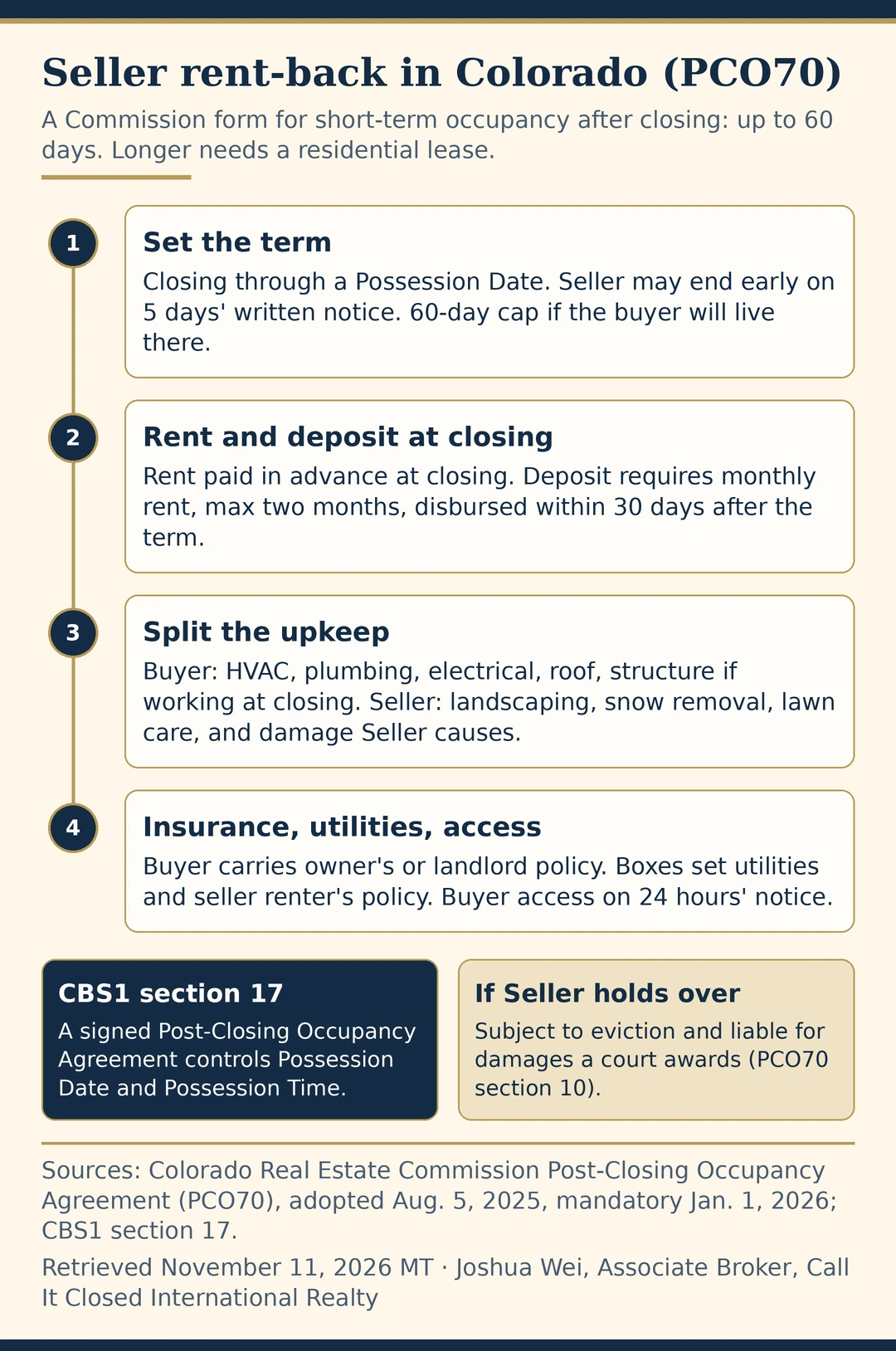
A vertical flow diagram, cream background with navy type and gold accents, titled Seller rent-back in Colorado, PCO70, with the subtitle a Commission form for short-term occupancy after closing of up to 60 days, and longer needs a residential lease. Four numbered steps: 1, set the term from closing through a Possession Date, where the seller may end early on 5 days' written notice and there is a 60-day cap if the buyer will live there; 2, rent and deposit at closing, with rent paid in advance at closing and a deposit that requires monthly rent, is capped at two months, and is disbursed within 30 days after the term; 3, split the upkeep, where the buyer handles HVAC, plumbing, electrical, roof and structure if they were working at closing, and the seller handles landscaping, snow removal, lawn care, and damage the seller causes; 4, insurance, utilities and access, where the buyer carries an owner's or landlord policy, boxes set utilities and a seller renter's policy, and the buyer gets access on 24 hours' notice. Two lower cards: CBS1 section 17, under which a signed Post-Closing Occupancy Agreement controls Possession Date and Possession Time; and if Seller holds over, the seller is subject to eviction and liable for damages a court awards under PCO70 section 10. Sources: Colorado Real Estate Commission forms. Retrieved November 11, 2026 MT.
Sources: PCO70 (DRE) (opens in a new tab); DRE contracts and forms (opens in a new tab)
Cream background, navy text, gold rules. Four numbered steps on a gold spine, two side-by-side cards, and a 28px source footer.
The diagram above lays out who handles what during a rent-back under PCO70. It summarizes the Commission form.
How does possession work in the purchase contract?
Section 17 of the Commission's residential contract (CBS1, 2026 form (opens in a new tab)) says: "Possession of the Property and Inclusions will be delivered to Buyer on Possession Date at Possession Time, subject to the Leases as set forth in section 10.6.1.1. If the parties have executed a Post-Closing Occupancy Agreement, such agreement will control Possession Date and Possession Time."
If a seller holds over without one, section 17 says the seller "will be subject to eviction and will be additionally liable to Buyer" for a per-day amount filled in on the contract. The amount runs "from Possession Date and Possession Time until possession is delivered," and "Additionally, Buyer may pursue a claim against Seller for any of Buyer's actual additional damages incurred by Buyer in excess of such amount."
The rent-back changes the order of events. CBS1 section 18.4 gives the buyer "the right to walk through the Property prior to Closing to verify that the physical condition of the Property and Inclusions complies with this Contract." With a rent-back, that walk-through happens while the seller's belongings are still in the home, and the buyer takes the keys after the term ends.
What does PCO70 say about the term?
Section 3 of PCO70 (opens in a new tab) says: "Seller may retain possession of the Property from date of Closing through __ (Possession Date)." It also says "Seller may cause an earlier termination upon 5 days written notice to Buyer."
The form ties the term to the buyer's own plans: "Buyer and Seller acknowledge that if Buyer intends to occupy the Property as Buyer's principal residence, the Term may not exceed 60 days after Closing." Buyers with a loan should ask the lender how a rent-back fits the loan's occupancy terms.
The seller's use is limited: "Seller agrees to use the Property for Seller's occupancy and personal residence only." Section 3 adds: "Seller's rights and obligations may not be transferred or assigned in whole or in part, voluntarily or involuntarily."
Section 2 ties the form to the purchase contract: "All terms of the Contract are incorporated herein by reference. In the event of any conflict between this Agreement and the Contract, this Agreement controls subject to subsequent amendments to the Contract or this Agreement."
How does a rent-back fit the buyer's loan?
The form's 60-day limit for an owner-occupant matches a 60-day window in two federal loan guides.
- Fannie Mae. Selling Guide B2-1.1-01, Occupancy Types (opens in a new tab), says: "A principal residence is a property that the borrower occupies and uses as their primary residence within 60 days after execution of the applicable security instrument. The borrower must continue to occupy the property for at least one year after the date of occupancy, unless otherwise permitted by the Selling Guide or the applicable security instrument."
- FHA. HUD's Single Family Housing Policy Handbook 4000.1 (PDF (opens in a new tab)) says: "At least one Borrower must occupy the Property within 60 Days of signing the security instrument and intend to continue occupancy for at least one year." The PDF carries a "Last Revised: 08/14/2019" footer, and HUD also publishes the handbook online, so confirm the current text with your lender. The PDF itself says: "Refer to the online version of SF Handbook 4000.1 for specific sections' effective dates."
The PCO70 term runs from Closing; the loan guides count from signing or execution of the security instrument. A buyer with a VA, USDA, jumbo, or other loan should ask the lender for that program's own rule.
Who pays rent, and what about a deposit?
Section 8: "Rent for the Term is $ , payable to Buyer, in advance, at Closing and delivery of deed." The parties check whether unearned rent "Will" or "Will Not" be prorated and refunded if the seller leaves early.
Section 16 covers the deposit: "In order to collect a security deposit, Landlord must collect a monthly rent payment." The deposit is "not to exceed the amount of two monthly rent payments," and "The parties agree that the security deposit will be disbursed within 30 days after the Term in accordance with Colorado law." The 2027 version of section 16 drops the monthly-rent requirement and the two-month cap; it keeps the 30-day disbursement language.
A 2026 change to state law addresses the same point. Colorado Revised Statutes section 38-12-102.5(1) (opens in a new tab) says that, except as described in subsection (2), "a landlord shall not require a tenant to submit a security deposit in an amount that exceeds the amount of two monthly rent payments under the rental agreement." Subsection (2) says: "On and after January 1, 2027, subsection (1) of this section does not apply if the landlord and tenant have executed a post-closing occupancy agreement pursuant to a purchase contract whereby the landlord purchased the residence from the tenant." Before 2027, the two-month cap still appears in the form in use.
The return timing comes from section 38-12-103(1)(a): "A landlord shall, within thirty days after the termination of a lease or surrender of a premises, whichever occurs last, return to the tenant the full security deposit deposited with the landlord by the tenant, unless the lease agreement specifies a longer period of time, but not to exceed sixty days." The same subsection says a landlord "shall not retain the security deposit to cover normal wear and tear or for any damage or defective condition that preexisted the tenancy."
Section 7 of PCO70 links the deposit to damage: "Buyer may apply Seller's security deposit towards the cost of any such repair or replacement in accordance with Colorado law."
Who handles repairs and damage?
The form splits it.
- Buyer (the new owner). Section 4 says the buyer will, "at Buyer's sole expense, maintain, repair and replace the heating and cooling systems including ventilation and ducts, plumbing, electrical wiring, roof and structural components of the Property," among other items, "if such items were functioning or working properly on the date of Closing."
- Seller (the occupant). Section 4 also says "Seller will maintain the Property as Seller previously maintained the Property to include, but not limited to, landscaping, snow removal and lawn care." Under section 5, "Seller is responsible for any misuse, waste, neglect or damage to the Property or personal property on the Property caused by Seller or Seller's family or invitees after Closing."
The seller's upkeep duty has a carve-out. The full sentence in section 4 begins: "Unless the services are provided by a third party, e.g., owners' association, Seller will maintain the Property as Seller previously maintained the Property." Section 4 also says: "Seller will provide timely notice to Buyer of any improvement requiring maintenance or repair."
Section 5 sets the standard for the seller's care: "During the Term, Seller, at Seller's sole expense, will keep the improvements and any personal property on the Property owned by Buyer in the same condition and repair as of the date of Closing, normal wear and tear excepted." It also says: "Seller is not responsible for any damage if not caused by Seller or Seller's family or invitees."
Section 7 covers restoration. The buyer "has the right, but not the obligation, to restore the Property and any items of personal property owned by Buyer to the same condition of repair and cleanliness as existed at the date of Closing, excluding normal wear and tear," and if the seller is responsible under section 4 or section 5, "Seller will pay Buyer, in addition to the Rent, the costs of such repair or replacement."
What about insurance, utilities, and access?
- Insurance. Section 14: "Buyer agrees to maintain and pay the cost of an Owner's Property Insurance Policy (which may be in the form of a Landlord's policy) from Closing." Section 13 has boxes for whether the seller "Will" or "Will Not" carry a "Renter's Policy." Ask your insurance agent about coverage during the term.
- Utilities. Sections 11 and 12 have boxes for who pays water and sewer, and electric and gas, during the term. "Any other utility or service used by Seller during the Term will be paid for by Seller."
- Access. Section 6: "Upon not less than 24 hours prior notice to Seller, Buyer will have access to the Property at all reasonable times." In an emergency, "Buyer may enter the Property without notice to Seller."
Rules during the term
- Laws and HOA rules. Section 9: "During the Term, Seller agrees to abide by all federal, state and local laws as well as any applicable Owners' Association rules and regulations." It also bars storing or using hazardous materials "other than those materials customarily used or stored for a residential home."
- Indemnity. Section 15 (2026 form): "Seller and Buyer agree to indemnify, defend, and hold harmless the other party from and against any claims due to any injury, loss, claim or damage to any person or property, including reasonable attorney's fees, caused by the other party, or such party's family, licensees, or invitees that is not paid by such party's insurance, if any."
- Attorney fees. Section 17: "in the event of any arbitration or litigation relating to this Agreement, prior to or after the Term, the arbitrator or court must award to the prevailing party all reasonable costs and expenses, including attorney fees, legal fees and expenses."
What if the seller doesn't leave on time?
Section 10: "Should Seller not timely surrender possession of the Property to Buyer, Seller will be subject to eviction as well as liable to Buyer for payment of any other damages awarded by a Court of competent jurisdiction."
Colorado's for-cause eviction law has its own scope rules. Under Colorado Revised Statutes section 38-12-1302(1)(e) (opens in a new tab), part 13 does not apply to "A residential tenant who has not been a tenant of a residential premises for at least twelve months." How that, and the rest of the eviction statutes, apply to a seller who stays past a rent-back term is a legal question for a Colorado real estate attorney.
The form's header also carries a warning: "THIS FORM HAS IMPORTANT LEGAL CONSEQUENCES AND THE PARTIES SHOULD CONSULT LEGAL AND TAX OR OTHER COUNSEL BEFORE SIGNING."
What changes in the 2027 form?
The 2027 PCO70 is mandatory for use on and after January 1, 2027. Differences in the text include:
- Deposit. Section 16 now reads: "Seller agrees that a security deposit in the amount of $__, payable to Buyer, will be paid at Closing and held by Buyer." The monthly-rent condition and the two-month cap are gone.
- Supersedes clause. Section 2 adds: "This Agreement supersedes and replaces any previous Agreement."
- Indemnity wording. Section 15 says the parties "agree to indemnify, defend, and hold harmless one another" for claims "caused by either party."
- Early termination. Section 3 says "upon 5-day written notice to Buyer."
The 60-day note and the principal-residence sentence read the same in both versions.
An invented example
This example is invented to show how the sections fit; it is not a real transaction.
A seller in Aurora is buying a new-build home that will not be ready for three weeks. The buyer of the seller's current home has an FHA loan and plans to move in. The parties sign PCO70 for a 21-day term.
- Term. 21 days is within the form's 60-day limit for an owner-occupant, and within the FHA handbook's 60-day window from signing.
- Rent and deposit. Rent is paid at closing under section 8. The deposit, under the 2026 form, cannot exceed two monthly rent payments and must be disbursed within 30 days after the term.
- Upkeep. The HOA handles snow removal, so the section 4 carve-out applies; the seller still mows.
- Early exit. The new build finishes early, and the seller gives 5 days' written notice under section 3. Whether unused rent comes back depends on the section 8 box.
- Walk-through. The buyer walks through before closing under CBS1 section 18.4, then again when the seller hands over the keys.
Rent-back checklist
- Ask the buyer's lender whether the loan allows it and for how long.
- Check which version of PCO70 applies on the date it is signed.
- Fill in rent, deposit, utilities, and the renter's policy box.
- Have both parties' insurance agents confirm coverage during the term.
- Agree on how the keys, garage openers, and codes are handed over at the end.
Related: Denver home prices and seller concessions (opens in a new tab).
Frequently asked questions
Can a seller stay longer than 60 days?
PCO70 says "A residential lease must be used for a term longer than 60 days." Ask a Colorado real estate attorney about a longer arrangement.
Does the seller have to pay rent?
Section 8 has a blank for rent. Under the 2026 form, section 16 says a security deposit requires a monthly rent payment; the 2027 form removes that condition. The amount is negotiated.
Can the seller leave early?
Yes, "upon 5 days written notice to Buyer," per section 3.
Who fixes the furnace if it breaks during the rent-back?
Under section 4, the buyer, if it was "functioning or working properly on the date of Closing." Damage the seller causes is on the seller under section 5.
What is the largest deposit a buyer can ask for?
Under the 2026 PCO70, "not to exceed the amount of two monthly rent payments." From January 1, 2027, C.R.S. 38-12-102.5(2) excludes post-closing occupancy agreements from the statutory two-month cap, and the 2027 form drops the cap.
Can the seller let a friend stay instead?
Section 3 says "Seller's rights and obligations may not be transferred or assigned in whole or in part, voluntarily or involuntarily," and the seller agrees to use the property "for Seller's occupancy and personal residence only."
Is the rent-back agreement binding if the sale doesn't close?
Section 2 says: "This Agreement is conditional upon Closing. If Closing does not occur, this Agreement is null and void."
Can a buyer rent the home back to a seller for longer as an investment?
PCO70 says "A residential lease must be used for a term longer than 60 days." Lease questions are for a Colorado real estate attorney.
Related notes
- Buying a Denver or Aurora home with a tenant in it: leases, Colorado's for-cause eviction law, and move-in timing
- What if the furnace dies or a pipe bursts before closing? Colorado's contract rules for damage and the final walk-through
- Colorado purchase contract deadlines, in plain English
Sources and method
Official sources, retrieved November 11, 2026, America/Denver: Colorado Real Estate Commission Post-Closing Occupancy Agreement (PCO70) (opens in a new tab) (adopted August 5, 2025; mandatory January 1, 2026), the 2027 PCO70 (opens in a new tab) (adopted August 4, 2026; mandatory January 1, 2027), and Contract to Buy and Sell Real Estate (Residential) (CBS1), section 17 (2026 form PDF (opens in a new tab)), both from the Division of Real Estate contracts and forms page (opens in a new tab). Added November 13, 2026: CBS1 sections 17 and 18.4; Colorado Revised Statutes sections 38-12-102.5, 38-12-103, and 38-12-1302 (Title 38 (opens in a new tab)); Fannie Mae Selling Guide B2-1.1-01 (opens in a new tab); and HUD Handbook 4000.1 (PDF (opens in a new tab)). Quotations are verbatim. No rent or deposit amounts are suggested.
This note is general education from a Colorado real estate broker with Call It Closed International Realty. If you are selling in Denver or Aurora and timing is tight, I can help you think through a rent-back before you negotiate it.
Disclaimer
This article is general information only. It is not legal, tax, lending, insurance, appraisal, inspection, or financial advice, and it is not a substitute for advice about your situation. Joshua Wei is a Colorado real estate broker, not an attorney. Reading this article does not create a client relationship, an agency relationship, or an attorney-client relationship with Joshua Wei or with Call It Closed International Realty.
Laws, program rules, interest rates, insurance terms, tax figures, and other details change. Examples in this article are hypothetical illustrations unless a source is named for a specific, dated figure. Information in this article is believed accurate as of November 13, 2026 and is not guaranteed. No result is promised, and you should not rely on this article as the last word for your situation.
Before you act, confirm the point with the official source linked or cited in this article, and talk with a licensed professional who can apply the rule to your facts. That may be a licensed attorney, a tax professional, a lender, an insurance agent, a home inspector, or another licensed professional, depending on the question. Links to third-party websites and publications are provided for reference only. They are not an endorsement, and their content can change.
If you already have a brokerage relationship with another broker, this is not a solicitation.
Joshua Wei, Associate Broker, Call It Closed International Realty, Colorado license FA.100108558. Equal Housing Opportunity.