November 2, 2026 · Denver · Aurora · Buying · Selling · Rentals
Buying a Denver or Aurora home with a tenant in it: leases, Colorado's for-cause eviction law, and move-in timing
If you buy a rented home, the lease may come with it. What the Colorado contract says about leases and security deposits, and what C.R.S. 38-12-1303 requires before a landlord can end a tenancy, including when the buyer plans to move in.
The short answer
In brief: When a rented Denver or Aurora home sells, the tenant doesn't simply leave because the deed changed hands. Colorado's for-cause eviction law, C.R.S. 38-12-1303(1), says a landlord shall not serve a notice to terminate tenancy or proceed with an eviction unless there is cause. The existing lease and the statute's grounds shape a buyer's move-in timing.
When a rented home sells, the tenant doesn't simply leave because the deed changed hands. Colorado's for-cause eviction law, C.R.S. 38-12-1303(1) (opens in a new tab), says: "A landlord shall not serve a notice to terminate tenancy or a demand for possession or otherwise proceed with an action for unlawful detainer pursuant to article 40 of title 13 unless there is cause for the eviction."
The statute's no-fault grounds for a landlord selling and for a new owner moving in both run "at the end of the term of the rental agreement," with written notice periods set out in C.R.S. 38-12-1303(3). How they apply to a particular home and lease is a question for a Colorado landlord-tenant attorney.
I am a licensed Colorado real estate broker with Call It Closed International Realty. I am not an attorney. This is not legal advice.
Disclaimer. This article is general information only. It is not legal, tax, lending, insurance, appraisal, inspection, or financial advice, and reading it does not create a client, agency, or attorney-client relationship. Laws, rates, programs, and figures change. Confirm the official source, and talk with a licensed attorney, tax professional, lender, insurance agent, or inspector before you act. Joshua Wei is a Colorado real estate broker, not an attorney. He is an Associate Broker with Call It Closed International Realty, license FA.100108558. Equal Housing Opportunity.
 Full size (opens in a new tab)
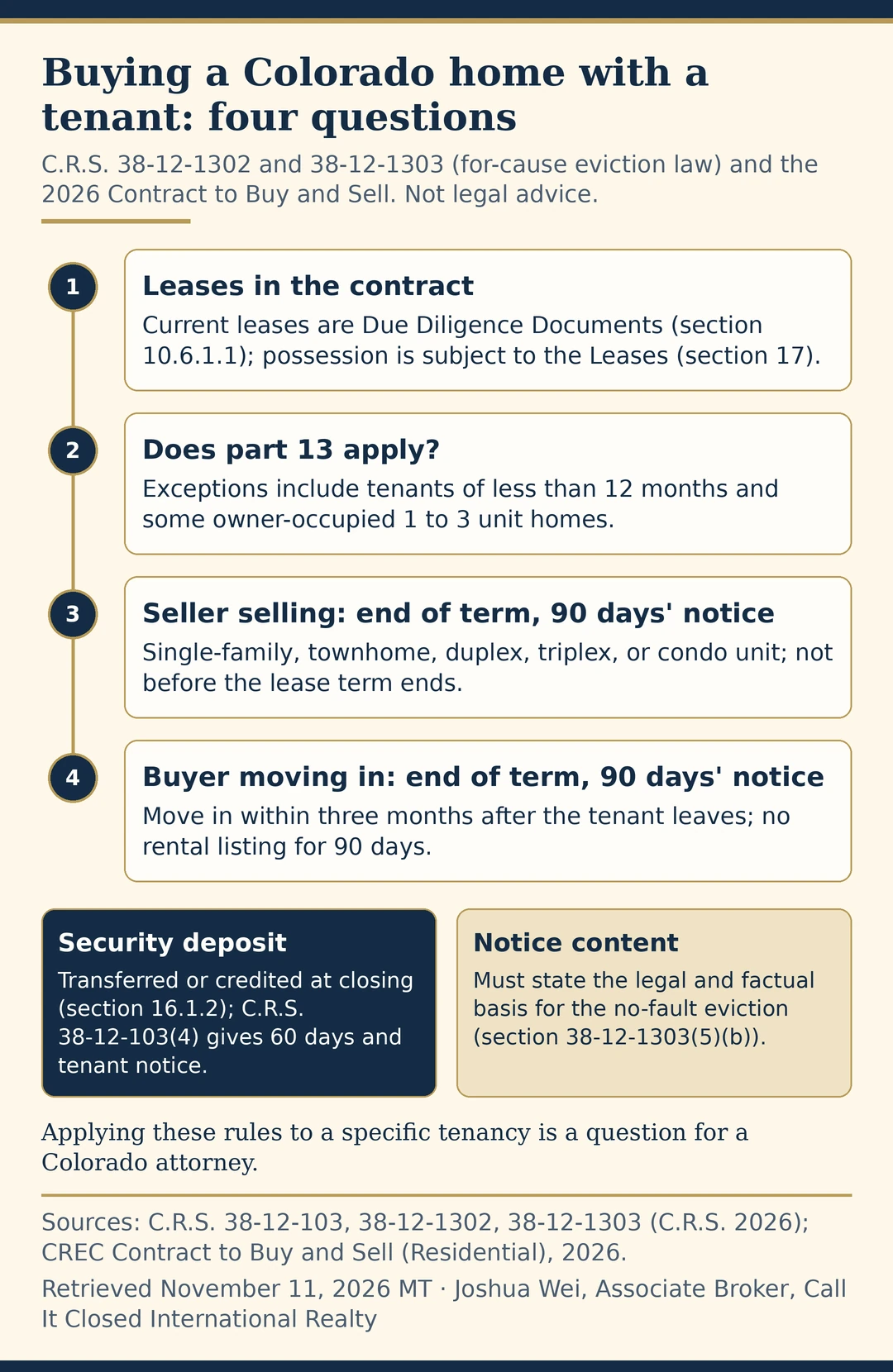
A vertical flow diagram, cream background with navy type and gold accents, titled Buying a Colorado home with a tenant: four questions. Subtitle: C.R.S. 38-12-1302 and 38-12-1303 (for-cause eviction law) and the 2026 Contract to Buy and Sell. Not legal advice. 4 numbered steps: 1, Leases in the contract: Current leases are Due Diligence Documents (section 10.6.1.1); possession is subject to the Leases (section 17); 2, Does part 13 apply?: Exceptions include tenants of less than 12 months and some owner-occupied 1 to 3 unit homes; 3, Seller selling: end of term, 90 days' notice: Single-family, townhome, duplex, triplex, or condo unit; not before the lease term ends; 4, Buyer moving in: end of term, 90 days' notice: Move in within three months after the tenant leaves; no rental listing for 90 days. Two cards: Security deposit: Transferred or credited at closing (section 16.1.2); C.R.S. 38-12-103(4) gives 60 days and tenant notice; and Notice content: Must state the legal and factual basis for the no-fault eviction (section 38-12-1303(5)(b)). A note says: Applying these rules to a specific tenancy is a question for a Colorado attorney. Sources: C.R.S. 38-12-103, 38-12-1302, 38-12-1303 (C.R.S. 2026); CREC Contract to Buy and Sell (Residential), 2026. Retrieved November 11, 2026 MT. Joshua Wei, Associate Broker, Call It Closed International Realty.
Sources: Colorado Revised Statutes 2026, Title 38 (opens in a new tab); CREC Contract to Buy and Sell Real Estate (Residential), 2026 (opens in a new tab)
Cream background, navy text, gold rules. Numbered navy circles on a gold spine with white step cards, two branch cards (navy and tan), a note, and a source footer.
The flow above follows the contract and statute sections cited in this article.
What does the purchase contract say about leases?
In the Commission's residential Contract to Buy and Sell Real Estate (opens in a new tab), the seller delivers, as a Due Diligence Document, "All current leases, including any amendments or other occupancy agreements, pertaining to the Property." Section 17 says possession is delivered "subject to the Leases as set forth in section 10.6.1.1."
Section 10.6.1.1 has a blank where the parties list which agreements continue: "Those leases or other occupancy agreements pertaining to the Property that survive Closing are as follows (Leases)." Read that blank closely; it defines which "Leases" the rest of the contract refers to.
Under section 10.6.2, the buyer "has the right to review and object based on the Due Diligence Documents." If the documents "are not supplied to Buyer or are unsatisfactory, in Buyer's sole subjective discretion," the buyer may send a Notice to Terminate or a Due Diligence Documents Objection by the deadline. Section 10.6.2.4 adds an automatic extension: if a document is late, the buyer "has until the earlier of Closing or ten days after receipt by Buyer to review and object to such Due Diligence Document."
Section 12.5 says the seller "must assign to Buyer all Leases at Closing that will continue after Closing and Buyer must assume Seller’s obligations under such Leases." At closing, under section 16.1.2, the seller "will transfer or credit to Buyer the security deposits for all Leases assigned to Buyer, or any remainder after lawful deductions, and notify all tenants in writing of such transfer and of the transferee’s name and address."
Does the for-cause law apply to this home?
C.R.S. 38-12-1302 (opens in a new tab) lists exceptions. Two that come up in sales:
- A tenant "who has not been a tenant of a residential premises for at least twelve months."
- Certain owner-occupied homes: when "the owner or master tenant lives in and maintains the residential premises as the owner's or master tenant's primary residence," for a single-family home (with or without an ADU), a duplex, or a triplex.
The full list in section 38-12-1302(1) has six exceptions. Besides the two above, part 13 does not apply to "A short-term rental property," certain mobile home spaces, "A residential premises that is leased to a tenant pursuant to an employer-provided housing agreement," or "A residential tenant who is not known to the landlord to be a tenant of the residential premises." The owner-occupied exception also covers an owner who "lives in a property that is adjacent to the residential premises and that the owner maintains as the owner's primary residence," and it requires that the property "Is not a multifamily property of four or more dwelling units."
The statute defines "Primary residence" in section 38-12-1301(7) as "the address that is listed on a tenant's or landlord's Colorado driver's license, identification card, or voter registration; used for purposes of a tenant's or landlord's payment of state or federal taxes; or used for the purpose of public school registration." And "Family member" points to section 8-13.3-503(11), so the family-move-in ground uses that definition.
Whether an exception fits a particular situation is a question for a Colorado attorney.
What counts as "cause"?
Section 38-12-1303(2) says "cause exists only as described in the following sections," and lists the grounds by cross-reference to the unlawful detainer statute, section 13-40-104. They include "nonpayment of rent," "a substantial violation," "a material violation of the lease or rental agreement," "a repeat violation after receipt of proper notice of a violation," the no-fault grounds in subsection (3), and conduct "that creates a nuisance or disturbance that interferes with the quiet enjoyment of the landlord or other tenants at the property." The list also includes "Section 13-40-104 (1)(f) for possession after a legal sale." What that cross-reference covers is a question for an attorney. The ground for a landlord who plans to sell sits in the no-fault list in (3)(d), described below.
The no-fault list in (3) has six grounds: demolition or conversion, substantial repairs or renovations, landlord or family move-in, withdrawal from the rental market to sell, a tenant's refusal to sign a new lease with reasonable terms, and a history of late rent payments.
What if the seller wants the tenant out before closing?
Section 38-12-1303(3)(d) (opens in a new tab) allows a no-fault eviction when the landlord "plans to sell a residential premises that is a single-family home, a townhome, a duplex, a triplex, or an individual condominium unit." It must happen "at the end of the term of the rental agreement," and the landlord must allow "at least ninety days after receiving the written notice." The statute adds: "Nothing in this subsection (3)(d) may be construed to allow a landlord to initiate a no-fault eviction or otherwise terminate a rental agreement without cause before the end of the term of the rental agreement."
The notice has content rules. Under (3)(d)(I)(B), the landlord must provide "proper service of a written notice of the landlord's intent to withdraw the residential premises from the rental market and sell the residential premises, which notice includes the date on which the tenant will be required to vacate." During the 90 days, "the tenant may remain in possession of the residential premises under the same terms of the tenant's existing rental agreement." Under (3)(d)(I)(C), the landlord must not "list the residential premises for a long-term or short-term rental for at least ninety days after the date on which the tenant is required to vacate," with an exception if the landlord shows the home "was listed for sale on a multiple-listing service after the tenant was required to vacate."
"Proper service" means service that "complies with section 13-40-108," under section 38-12-1301(8). "Written notice" means notice that "Complies with section 13-40-106" and "Is provided to a tenant by a landlord or by a landlord's agent," under section 38-12-1301(15).
For a buyer, the practical point is timing. A sale-based notice can only run to the end of the lease term, with at least 90 days' notice. If the lease runs past your planned closing, the tenant may still be there when you close.
This matters for your loan, too. Loans for a home you will live in usually require you to move in within a set time after closing. For example, FHA's rules say at least one borrower must move in within 60 days of signing the loan documents and plan to live there for at least a year. If a tenant's lease runs well past that, and Colorado law does not let you end the lease early to move in, you may not be able to meet that requirement. Tell your lender about the lease and its end date before you apply, so the loan is set up correctly.
What if I plan to move in after closing?
Section 38-12-1303(3)(c) (opens in a new tab) allows a no-fault eviction "for the landlord's own use and occupancy as a residence," at the end of the rental agreement's term, if, among other conditions:
- "the landlord or the landlord's family member moves into the residential premises within three months after the tenant vacates"
- the landlord gives "proper service of a written notice of the no-fault eviction at least ninety days before the date by which the tenant must vacate" (45 days for certain active-duty military landlords)
- "The landlord does not list the residential premises for a long-term or short-term rental for at least ninety days after the date the tenant is required to vacate."
The full list in (3)(c)(I) has one more condition: "No substantially equivalent unit is vacant and available to house the landlord or the landlord's family member in the same building." Under (3)(c)(III), if the landlord or family member "is a person with a disability, the landlord may extend for a reasonable time" the three-month move-in period "to allow for changes to be made to the residential premises."
The notice "must include a statement of the legal and factual basis for the landlord's no-fault eviction," under section 38-12-1303(5)(b). Subsection (5)(a) says a landlord "may proceed with a no-fault eviction of a tenant by filing an action under article 40 of title 13 only if the landlord provides proper service of a written notice of the no-fault eviction and the tenant fails to vacate on or before the deadline stated in the notice."
Once you close, you are the landlord under the assigned lease. The move-in ground is for "the landlord's own use and occupancy as a residence," so it is the buyer, after closing, who would give that notice if the conditions are met.
What if the rules aren't followed?
Two sections set consequences. Section 38-12-1304: "If a landlord proceeds with an eviction of a tenant of a residential premises in violation of this part 13, and the tenant loses possession of the dwelling unit without a court order, the tenant may seek relief as described in section 38-12-510." Section 38-12-1306: "If a landlord fails to comply with this part 13, a tenant may assert the landlord's failure as an affirmative defense for a tenant to an eviction proceeding." It continues: "If a tenant asserts such an affirmative defense, and the landlord cannot demonstrate by a preponderance of the evidence that the landlord has complied with this part 13, the court shall dismiss the eviction proceeding." Owner-occupancy requirements in a loan are a question for the lender.
What about the security deposit?
Besides the contract language, C.R.S. 38-12-103(4) (opens in a new tab) says that when a landlord's interest ends "by sale," whoever holds the deposit must, "within sixty days," transfer it "to the landlord's successor in interest and notify the tenant by mail of such transfer and of the transferee's name and address," or return it as the statute provides.
Subsection (5) says that after doing so, the person who held the deposit "shall be relieved of further liability." Subsection (6) says the new owner who receives the funds "shall be deemed to have all of the rights and obligations of a landlord holding the funds as a security deposit." That means the deposit rules follow the deposit to the buyer.
An invented example
This example is invented; it is not a real property or lease.
A buyer goes under contract on a Denver duplex. One side is vacant; the other has a tenant who has been there three years, with a lease ending June 30. The buyer wants to live in the vacant side and keep the tenant. The seller lists the lease in the section 10.6.1.1 blank, and the buyer reviews it as a Due Diligence Document. At closing the lease is assigned under section 12.5, and the security deposit is credited under section 16.1.2. The seller sends the tenant written notice of the transfer. Because the buyer will live in one unit of a duplex, she asks her attorney whether the owner-occupied exception in section 38-12-1302(1)(b) applies to the other unit and what notice rules she must follow if she later wants the tenant's side for a family member.
A checklist for buyers
- Get every lease early, including amendments and side agreements, as section 10.6.1.1 Due Diligence Documents.
- Fill in the surviving-leases blank so it is clear which leases continue after closing.
- Check the lease end date against your closing and move-in plans.
- Confirm the tenant's start date; the 12-month exception turns on it.
- Ask for the deposit amount and records, and confirm the section 16.1.2 credit on your closing statement.
- Ask about any notice the seller has already served, and get a copy.
- Talk to a Colorado landlord-tenant attorney before relying on any no-fault ground.
Who to ask
- The lease: CBS1 makes current leases a Due Diligence Document, delivered by the seller.
- Whether and when a tenant can be asked to leave: a Colorado landlord-tenant attorney.
- Rate locks and occupancy terms: the lender.
Related: Aurora property tax and metro district buyer checklist (opens in a new tab).
Frequently asked questions
Can a lease clause waive the for-cause law?
Part 13 includes section 38-12-1305, "No waiver of requirements by agreement." How it applies to a lease clause is a question for a Colorado attorney.
Does selling the home end the lease?
The sale ground in section 38-12-1303(3)(d) runs "at the end of the term of the rental agreement," with at least 90 days' notice.
What does section 38-12-1305 say?
"A provision of a rental agreement or other agreement that purports to authorize or effectuate a waiver or modification of any provision of this part 13 is void and unenforceable."
Can a landlord evict to renovate?
Subsection (3)(b) allows a no-fault eviction for "substantial repairs or renovations," with 90 days' notice and other conditions. It does not apply if the repairs are "Required in order for the landlord to satisfy all required remedial action" for a breach of the warranty of habitability, or are "Initiated by the landlord in retaliation against the tenant."
What counts as a late payment under the late-rent ground?
Subsection (3)(f)(II) says a payment "qualifies as late if it is submitted more than ten calendar days after the day it is due according to the rental agreement and the landlord provides the tenant with proper service of a written notice under section 13-40-104 (1)(d)." Under (3)(f)(III), the ground "does not apply if the rent payment is submitted within the cure period."
What if the tenant won't sign a renewal?
Subsection (3)(e) allows a no-fault eviction "If a tenant refuses to sign a new rental agreement with reasonable terms," with at least 90 days to vacate after the refusal and written notice. What terms are "reasonable" for a particular lease is a question for a Colorado landlord-tenant attorney.
What if the tenant agrees to leave early?
The sources here don't address early move-out agreements. That is a question for a Colorado landlord-tenant attorney.
Does this apply to short-term rentals?
Section 38-12-1302(1)(a) says part 13 does not apply to "A short-term rental property."
What if the tenant pays late repeatedly?
Section 38-12-1303(3)(f) covers a tenant who pays late "more than two times during the period of the rental agreement," with notice and conditions.
Who gets the rent for the month of closing?
The contract (section 16.1.2) prorates rents based on a box the parties check: "Rents Actually Received" or "Accrued."
Related notes
- Selling and need a few more weeks? Colorado's seller rent-back agreement for Denver and Aurora, explained
- Buying a home you might rent out? Denver's rental license and Aurora's rental rules, explained
- Thinking of Airbnb income? Denver and Aurora short-term rental rules for buyers, explained
Sources and method
Official sources, retrieved November 11, 2026, America/Denver:
- Colorado Revised Statutes 2026, Title 38 (opens in a new tab): sections 38-12-103(4), 38-12-1302, 38-12-1303, 38-12-1305
- Colorado Real Estate Commission, Contract to Buy and Sell Real Estate (Residential), for use on and after January 1, 2026 (opens in a new tab): sections 10.6.1.1, 12.5, 16.1.2, 17
Added November 13, 2026: further subsections of C.R.S. 38-12-103 and 38-12-1301 through 38-12-1306 (Title 38 (opens in a new tab)), and CBS1 sections 10.6.1.1 and 10.6.2.
Quotations are verbatim. This article doesn't cover local rental licensing, relocation assistance, or the eviction court process.
This note is general education from a Colorado real estate broker with Call It Closed International Realty. If you're looking at a tenant-occupied home in Denver or Aurora, I can help you get the lease documents early and build a realistic possession timeline to review with your attorney.
Added November 19, 2026, after an expert review, and checked that day: HUD, Single Family Housing Policy Handbook 4000.1 (occupancy requirement) (opens in a new tab).
Disclaimer
This article is general information only. It is not legal, tax, lending, insurance, appraisal, inspection, or financial advice, and it is not a substitute for advice about your situation. Joshua Wei is a Colorado real estate broker, not an attorney. Reading this article does not create a client relationship, an agency relationship, or an attorney-client relationship with Joshua Wei or with Call It Closed International Realty.
Laws, program rules, interest rates, insurance terms, tax figures, and other details change. Examples in this article are hypothetical illustrations unless a source is named for a specific, dated figure. Information in this article is believed accurate as of November 19, 2026 and is not guaranteed. No result is promised, and you should not rely on this article as the last word for your situation.
Before you act, confirm the point with the official source linked or cited in this article, and talk with a licensed professional who can apply the rule to your facts. That may be a licensed attorney, a tax professional, a lender, an insurance agent, a home inspector, or another licensed professional, depending on the question. Links to third-party websites and publications are provided for reference only. They are not an endorsement, and their content can change.
If you already have a brokerage relationship with another broker, this is not a solicitation.
Joshua Wei, Associate Broker, Call It Closed International Realty, Colorado license FA.100108558. Equal Housing Opportunity.