September 28, 2026 · Denver · Aurora · Buying · Selling
Colorado's senior and disabled-veteran property tax exemptions: what Denver and Aurora buyers and sellers should know before a move
Colorado exempts 50% of the first $200,000 of actual value for qualifying seniors and veterans with a disability. What the Division of Property Taxation says about the 10-year rule, the 2025–2026 senior classification for movers, deadlines, and why a seller's exemption does not follow the house to a buyer.
The short answer
In brief: Colorado's senior and disabled-veteran property tax exemption exempts 50 percent of the first $200,000 of actual value of a qualifying applicant's primary residence. The senior version is for owners 65 or older who have owned and occupied the home for at least 10 consecutive years. This guide covers what Denver and Aurora buyers and sellers should know before a move.
Colorado has a property tax exemption that can matter a great deal to longtime homeowners, and it is easy to lose track of when a house changes hands. The Colorado Division of Property Taxation, part of the Department of Local Affairs, summarizes it on its official Senior Citizen and Veterans with a Disability Property Tax Exemption (opens in a new tab) page, retrieved November 11, 2026: "For those that qualify and apply 50 percent of the first $200,000 of actual value of the qualified applicant's primary residence is exempted."
The Division states the exemption as a share of actual value, not as a dollar amount of tax. For the effect on a specific parcel's bill, ask the county assessor.
The Division's pages describe the exemption as applying to a qualifying applicant's primary residence, and the senior version as requiring ten consecutive years of ownership and occupancy. Colorado created a temporary "senior primary residence classification," and the state's own page says that classification is available "in 2025 and 2026 for qualifying senior citizens who received the senior exemption in 2020 or later, but are no longer eligible for that program." In 2026 the legislature ended it: SB 26-116 (opens in a new tab) (2026 Colo. Sess. Laws, ch. 307) amended Colorado Revised Statutes section 39-1-104.6 so the classification applies only to property tax years before January 1, 2027, with applications accepted through July 15, 2026.
I am a licensed Colorado real estate broker with Call It Closed International Realty. I am not a tax advisor, an assessor, or an attorney. Your county assessor decides eligibility, and a tax advisor can tell you what it means for your taxes.
Disclaimer. This article is general information only. It is not legal, tax, lending, insurance, appraisal, inspection, or financial advice, and reading it does not create a client, agency, or attorney-client relationship. Laws, rates, programs, and figures change. Confirm the official source, and talk with a licensed attorney, tax professional, lender, insurance agent, or inspector before you act. Joshua Wei is a Colorado real estate broker, not an attorney. He is an Associate Broker with Call It Closed International Realty, license FA.100108558. Equal Housing Opportunity.
 Full size (opens in a new tab)
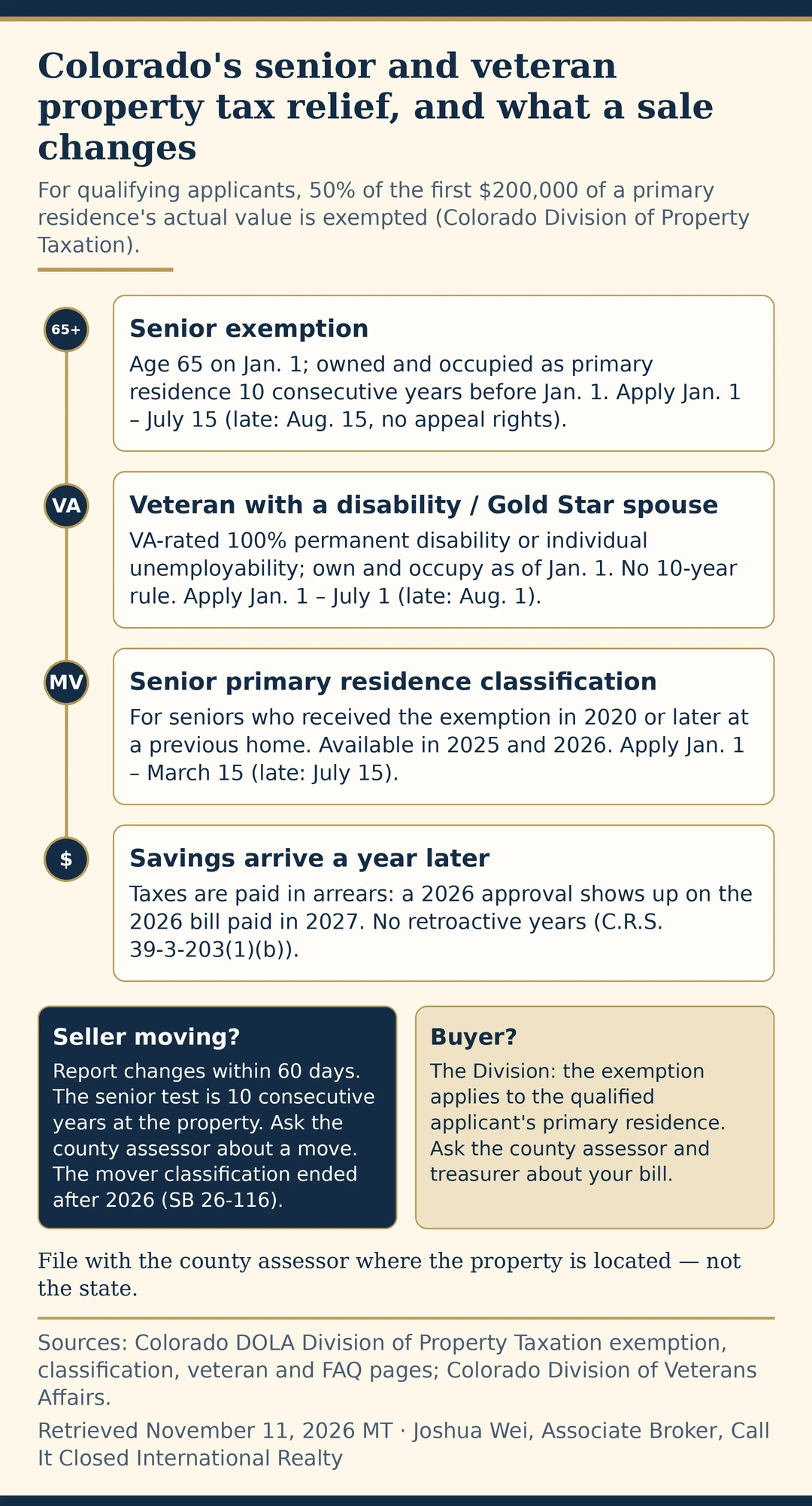
A vertical diagram, cream background with navy type and gold accents, titled Colorado's senior and veteran property tax relief, and what a sale changes. It notes that for qualifying applicants, 50 percent of the first $200,000 of a primary residence's actual value is exempted, per the Colorado Division of Property Taxation. Four cards: the senior exemption, requiring age 65 on January 1 and 10 consecutive years of ownership and occupancy as a primary residence, with applications January 1 to July 15 and a late deadline of August 15 without appeal rights; the veteran with a disability and Gold Star spouse exemptions, requiring a VA-rated 100 percent permanent disability or individual unemployability and ownership and occupancy as of January 1, with no 10-year rule and applications January 1 to July 1, late deadline August 1; the senior primary residence classification for seniors who received the exemption in 2020 or later at a previous home, available in 2025 and 2026, applications January 1 to March 15, late deadline July 15; and a card explaining that taxes are paid in arrears so a 2026 approval appears on the 2026 bill paid in 2027, with no retroactive years under C.R.S. 39-3-203(1)(b). Two lower cards: for a seller moving, report changes within 60 days, the senior test is 10 consecutive years at the property, so ask the county assessor about a move, and the mover classification ended after 2026 under SB 26-116; for a buyer, the Division says the exemption applies to the qualified applicant's primary residence, and questions about the bill go to the county assessor and treasurer. A note says to file with the county assessor where the property is located, not the state. Sources: Colorado Division of Property Taxation pages and Colorado Division of Veterans Affairs. Retrieved November 11, 2026 MT.
Sources: Colorado Division of Property Taxation, exemption and classification overview (opens in a new tab); DPT, Senior Property Tax Exemption (opens in a new tab); DPT, Senior Primary Residence Classification (opens in a new tab); DPT, Veteran with a Disability and Gold Star Exemptions (opens in a new tab); DPT, Frequently Asked Questions (opens in a new tab)
Cream background, navy text, gold rules. Four tagged program cards on a gold spine, two side-by-side seller and buyer cards, a filing note, and a 28px source footer.
The diagram above lays out the three programs the Division describes, with each one's basic test and application window, and shows what changes when a house is sold. It is a summary of official pages, not an eligibility determination.
Who qualifies for the senior exemption?
The Division's Senior Property Tax Exemption (opens in a new tab) page states: "Colorado offers a property tax exemption for seniors 65+ who have owned and occupied their primary residence for at least 10 consecutive years prior to Jan. 1 of the application year. The program exempts up to 50% of the first $200,000 of actual value of the home from taxation."
It lists the requirements this way:
- "The applicant is at least 65 years old on January 1 of the year in which they apply."
- "The applicant or their spouse is the property owner of record and has owned the property for at least 10 consecutive years prior to January 1."
- "The applicant occupies the property as their primary residence, and has done so for at least 10 consecutive years prior to January 1."
- "Or, the applicant is a surviving spouse of a senior citizen who previously qualified and has not remarried (they may be eligible to apply using the long form application)."
For the 2026 tax year, the Division's overview translates that into dates: "An applicant for the senior exemption must have been born on or before January 1, 1961 and owned and occupied their home as their primary residence continuously since January 1, 2016 (or earlier)."
Its frequently asked questions (opens in a new tab) page adds a detail that surprises couples: "only the applicant must meet the age requirement." It also says a home held in an estate-planning trust or LLC may still qualify, and that seniors in that situation "must use the 'Long Form Application for Seniors.'"
What the statute says
The Division's pages track the statute. C.R.S. 39-3-203(1) (opens in a new tab) exempts "fifty percent of the first two hundred thousand dollars of actual value of residential real property that as of the assessment date is owner-occupied and is used as the primary residence of the owner-occupier" if "The owner-occupier is sixty-five years of age or older as of the assessment date and has owned and occupied such residential real property as his or her primary residence for the ten years preceding the assessment date." The program rests on the state constitution. Section 39-3-201 says "Section 3.5 of article X of the state constitution, which was approved by the registered electors of the state at the 2000 general election and amended by the registered electors of the state at the 2006 general election, provides property tax exemptions for a qualifying senior" and for a qualifying veteran with a disability.
For the senior exemption, the same statute set the exempt amount at fifty percent of zero dollars for the tax years 2003 through 2005 and 2009 through 2011. That meant no senior exemption in those years. The legislature could change the amount again. Confirm the current year with the county assessor before you count on the savings.
Section 39-3-202(2)(a) defines "owner-occupier" to include a person who "Is not an owner of record of the residential real property that he or she occupies as his or her primary residence, only because the property has been purchased by or transferred to a trust, a corporate partnership, or any other legal entity solely for estate planning purposes and is the maker of the trust or a principal of the corporate partnership or other legal entity." That's the statutory basis for the Division's trust and LLC answer.
Who qualifies for the veteran-with-a-disability and Gold Star exemptions?
The Division's Veteran with a Disability and Gold Star Exemptions (opens in a new tab) page lists the veteran requirements, including that the veteran "Served active duty in U.S. armed forces," "Was honorably discharged," and "Has established a service-connected disability that has been rated by the United States Department of Veterans Affairs as a one hundred percent permanent disability through disability retirement benefits or has been granted individual unemployability status." The applicant or spouse must be the owner of record, and the applicant must occupy the property as a primary residence, "as of January 1 in the year they apply."
There is no ten-year rule for veterans. The Division's overview says: "There is no age requirement for veterans, but you must have the required VA approved disability rating." The same page describes eligibility for the 2026 tax year as having "owned and occupied their home as their primary residence as of January 1, 2026 (or earlier)."
For Gold Star spouses, the page lists "A Spouse of a United States armed service member who died in the line of duty or a veteran whose death resulted from a service-related injury or disease," and that "The Spouse has been awarded Gold Star Status through the federal Department of Veterans Affairs," along with the same ownership and occupancy requirements.
The Colorado Division of Veterans Affairs' property tax exemption page (opens in a new tab) gives the same benefit amount and names the documentation commonly requested, such as a "VA Benefit Summary Letter," and it says plainly: "Only your County Assessor can process your exemption."
The Division's test refers to ownership and occupancy "as of January 1, 2026 (or earlier)" for the 2026 tax year. How a specific closing date affects an application is a question for the county assessor.
When are the deadlines, and when does the savings show up?
The Division lists different windows for each program:
- Senior exemption: "Each year's application period begins on January 1 and ends July 15." Applications returned between July 15 and the "late deadline (August 15) will not receive appeal rights if the application is denied by the county assessor."
- Veteran with a disability and Gold Star: "Each year's application period begins on January 1 and ends July 1," with a late deadline of August 1 that likewise carries no appeal rights.
- A change for veterans in 2027: Under C.R.S. 39-3-205(1)(b) (opens in a new tab), the version in effect until January 1, 2027, says the veteran application and proof of status are due "no later than July 1." The version effective January 1, 2027, says "no later than July 15." The Division's page reflects the current July 1 date. For the 2027 tax year, confirm the date with the county assessor.
- Senior primary residence classification: "Each year's application period begins on January 1 and ends March 15," with a late deadline of July 15. 2026 was the last year; applications closed July 15, 2026 under SB 26-116.
Applications go to the county, not the state. The Division says: "Applications for these exemption programs must be submitted to the county assessor in the county where the property is located." In Denver that is the Denver Assessor. Aurora parcels can sit in Arapahoe, Adams, or Douglas County, so check the county shown on the parcel's tax bill.
The savings arrive a year later. The FAQ explains: "In Colorado, property taxes are paid a year in arrears." Its example: "If you apply for and are approved for a tax exemption during the 2026 tax year, then you would receive the reduction in your taxes in early 2027 when you receive your 2026 property tax bill from the county treasurer's office."
And missing a year cannot be fixed later. The FAQ says: "No, under 39-3-203(1)(b) C.R.S applicants may not receive an exemption for years before they were eligible or before they applied to the program after they reached eligibility."
I'm a senior thinking about selling. What happens to my exemption?
What the Division says about movers. The Division describes the senior exemption as requiring an applicant to own and occupy the property "for at least 10 consecutive years prior to January 1." The Division created a separate, temporary program for seniors who move. Its Senior Primary Residence Classification (opens in a new tab) page states: "A property tax classification is available in 2025 and 2026 for qualifying senior citizens who received the senior exemption in 2020 or later, but are no longer eligible for that program." The overview adds that "The classification offers similar tax relief benefits as the senior exemption program."
To be eligible, the page says, the applicant or spouse "must own and occupy their home as their primary residence as of January 1st in the year they are applying," and "must have received the senior exemption at a previous home in the year 2020 or later and are not currently able to receive the senior exemption."
The page says the classification is available "in 2025 and 2026 for qualifying senior citizens who received the senior exemption in 2020 or later, but are no longer eligible for that program." SB 26-116 (opens in a new tab) amended Colorado Revised Statutes section 39-1-104.6 so the classification applies only to property tax years before January 1, 2027. For questions about a specific move, ask the county assessor.
Changes must be reported. The FAQ says that "if there are changes to your ownership, occupancy, primary residency or changes to who resides at your home as a primary resident, you must reapply with an updated application to your county assessor's office within 60 days of the change."
Some disruptions don't break the ten years. The FAQ lists exceptions for a prior home "seized through an eminent domain proceeding," a prior home "destroyed due to a natural disaster," and an owner "confined to a hospital, nursing home, or assisted living facility" who would return home if possible, with conditions on who occupies the home meanwhile.
What the statute says about reporting. Under C.R.S. 39-3-205(2)(b) (opens in a new tab), the application must state that the applicant "has a legal obligation to inform the assessor within sixty days of any change in the ownership or occupancy of residential real property for which an exemption has been applied for or allowed that would prevent an exemption from being allowed for the property." If that doesn't happen, section 39-3-205(3)(b) says the applicant must pay "an amount equal to the amount of property taxes not paid as a result of the exemption being improperly allowed plus interest," calculated "from the date on which the change in the ownership or occupancy occurred." Under section 39-3-205(3)(c), that amount "shall be deemed part of the lien of general taxes imposed on the person" required to pay. A seller moving out should tell the assessor within 60 days.
The application itself is signed under oath. Section 39-3-205(2)(a)(VI) requires "An affirmation, in a form prescribed by the administrator, that the applicant believes, under penalty of perjury in the second degree," that the information is correct.
One exemption per person or couple. The FAQ says the law allows "a person or a married couple to have one exemption in total," and warns that "Attempts to apply for multiple exemptions will result in the loss of all exemptions allowed under this program for that year." The statute says the same in two places. Section 39-3-203(5) says "two individuals who are legally married, but who own more than one piece of residential real property, shall be deemed to occupy the same primary residence and may claim no more than one exemption." And section 39-3-203(4) says "No more than one exemption per property tax year shall be allowed for a single dwelling unit of residential real property, regardless of how many owner-occupiers use the dwelling unit as their primary residence or whether one or more owner-occupiers qualify for exemptions under both subsections (1) and (1.5)." A household with a qualifying senior and a qualifying veteran gets one exemption, not two.
I'm buying a home from a longtime owner. Why does this matter to me?
The exemption applies to "the qualified applicant's primary residence," in the Division's words. The program pages don't describe what a buyer's bill will be after a sale. Questions to bring to licensed or official sources:
- County assessor and treasurer: whether the parcel currently carries an exemption, and whether you qualify yourself under the January 1 tests and application windows above.
- Your lender: which year's tax figure is used in your payment estimate.
- The title or closing company: how property taxes are prorated at closing under your contract.
What the statute says about a sale during the year. C.R.S. 39-3-203(2) (opens in a new tab) addresses it directly: "if ownership of residential real property that qualified for an exemption as of the assessment date changes after the assessment date, an exemption shall be allowed only if an owner-occupier whose status as an owner-occupier qualified the property for the exemption has filed an exemption application by the deadline for filing exemption applications." The assessment date is January 1. So the exemption for a sale year turns on whether the seller qualified on January 1 and filed on time. How that year's tax is split between buyer and seller is a contract and closing question. Ask the closing company how the proration figure was calculated and whether it reflects the exemption.
For the next year, the exemption is tied to the new owner. If you'll qualify yourself, for example as a veteran with the required rating who owns and occupies the home on January 1, you file your own application.
Condos, duplexes and multi-unit homes. Under section 39-3-203(3), an owner who lives in "a dwelling unit in a common interest community" or "owns residential real property consisting of multiple-dwelling units and occupies one of the dwelling units as his or her primary residence, shall be allowed an exemption only with respect to the dwelling unit that the individual occupies." An owner who lives in one half of a duplex and rents the other half gets the exemption only on the half they live in.
Are there other relief programs?
The Division's FAQ points to programs it does not run, and directs questions to the agencies that do:
- Property Tax/Rent/Heat Rebate, administered by the Colorado Department of Revenue. The FAQ says it is available to "eligible full-year Colorado residents who are 65 years of age or older, surviving spouses who are 58 years of age or older, or persons with disabilities."
- Property tax deferral. The FAQ states: "Colorado residents who are 65 years of age or older and persons called into active military service may defer the payment of property taxes on their residences. Applications are available from and should be submitted to the county treasurer in the county where the property is located between January 1 and April 1." For how deferral and repayment work, including at a sale, ask the county treasurer. The statute is specific. Under C.R.S. 39-3.5-110(1)(b) (opens in a new tab), deferred taxes and interest become payable when "The property on which the taxes were deferred is sold or becomes subject to a contract of sale, or title to the property is transferred to someone other than the taxpayer who claimed the tax deferral." Under section 39-3.5-111(1)(b), they are "due and payable ninety days after the circumstance occurs." A seller with deferred taxes should ask the county treasurer for a payoff figure before closing.
- Property tax work-off programs, which a taxing entity "may establish" for residents who are 60 or older, first responders with a permanent occupational disability, or persons with disabilities.
Related: Aurora property tax and metro district checklist (opens in a new tab).
Two hypotheticals
These are invented, to show how the rules fit together.
A longtime owner sells in June. A 72-year-old has owned and lived in her Aurora house since 2005 and has the senior exemption. She sells in June 2026 and moves to a condo. Under section 39-3-203(2), the 2026 exemption on the old house is allowed if she qualified on January 1 and filed on time. She must tell the assessor within 60 days of the change under section 39-3-205(2)(b). The temporary classification for movers ended after 2026, so she shouldn't count on relief at the condo for 2027 under that program.
A veteran buys in March. A veteran with a 100 percent permanent VA rating closes on a Denver house in March 2026. The veteran test looks at ownership and occupancy "as of January 1," and he didn't own this house on January 1, 2026. He asks the Denver Assessor about the 2027 application window.
A seller's and buyer's checklist
- Seller: check whether the parcel carries a senior or veteran exemption or a tax deferral.
- Seller: plan to notify the assessor within 60 days of moving or selling.
- Seller with a deferral: ask the county treasurer for a payoff figure before closing.
- Buyer: ask the lender which year's tax figure is in the payment estimate, and whether it reflects the seller's exemption.
- Buyer who may qualify: note the January 1 test and the application deadline for your program.
Frequently asked questions
Does the exemption transfer to the buyer when I sell?
No program page describes a transfer to a buyer. The Division describes the exemption as applying to "the qualified applicant's primary residence." Ask the county assessor whether you qualify.
My spouse is under 65. Can I still apply?
The Division's FAQ says "only the applicant must meet the age requirement."
Do I have to reapply every year?
The FAQ says no, unless ownership, occupancy, primary residency, or who lives there changes, in which case you must reapply "within 60 days of the change."
I just bought my home. Is there a waiting period for veterans?
The Division lists no ten-year requirement for veterans; the test is ownership and occupancy as of January 1 of the application year plus the required VA rating.
Can I get the exemption for past years I missed?
Not according to the Division's FAQ, citing Colorado Revised Statutes section 39-3-203(1)(b).
Can a married couple get two exemptions on two homes?
No. Section 39-3-203(5) says a married couple who own more than one home "may claim no more than one exemption."
Do I have to repay deferred property taxes when I sell?
Yes. Under section 39-3.5-110(1)(b) and section 39-3.5-111(1)(b), deferred taxes and interest are due 90 days after the property is sold or put under a contract of sale.
Where do I file?
With "the county assessor in the county where the property is located," per the Division.
Related notes
- Buying in Aurora? Check the parcel’s tax story before trusting the payment.
- Colorado beneficiary deeds: what a transfer-on-death deed does, and doesn't do, for a Denver or Aurora home
- A metro district is not an HOA: how Denver and Aurora buyers can tell them apart
Sources and method
Official sources, retrieved November 11 and 13, 2026, America/Denver: C.R.S. title 39 (2026) (opens in a new tab) sections 39-3-201 to 39-3-205, 39-3.5-110 and 39-3.5-111; SB 26-116, 2026 Colo. Sess. Laws ch. 307 (opens in a new tab) (approved June 2, 2026; amends C.R.S. 39-1-104.6(2)(a) and (3)(a)); Colorado Department of Local Affairs, Division of Property Taxation pages for the exemption and classification overview (opens in a new tab), the Senior Property Tax Exemption (opens in a new tab), the Senior Primary Residence Classification (opens in a new tab), the Veteran with a Disability and Gold Star Exemptions (opens in a new tab), and the Frequently Asked Questions (opens in a new tab); and the Colorado Division of Veterans Affairs property tax exemption (opens in a new tab) page. Quotations are verbatim. The $100,000 figure is arithmetic on the Division's "50 percent of the first $200,000." No tax-dollar savings, mill levies, or neighborhood figures are stated. The Colorado State Treasurer's deferral page was not reachable from the research environment (HTTP 403); deferral facts are quoted from the Division's FAQ.
This note is general education from a Colorado real estate broker with Call It Closed International Realty. If you are a longtime Denver or Aurora owner thinking about a move, I can help you plan the sale and purchase timeline, and I will point you to your county assessor and a tax advisor for the eligibility questions.
Disclaimer
This article is general information only. It is not legal, tax, lending, insurance, appraisal, inspection, or financial advice, and it is not a substitute for advice about your situation. Joshua Wei is a Colorado real estate broker, not an attorney. Reading this article does not create a client relationship, an agency relationship, or an attorney-client relationship with Joshua Wei or with Call It Closed International Realty.
Laws, program rules, interest rates, insurance terms, tax figures, and other details change. Examples in this article are hypothetical illustrations unless a source is named for a specific, dated figure. Information in this article is believed accurate as of November 19, 2026 and is not guaranteed. No result is promised, and you should not rely on this article as the last word for your situation.
Before you act, confirm the point with the official source linked or cited in this article, and talk with a licensed professional who can apply the rule to your facts. That may be a licensed attorney, a tax professional, a lender, an insurance agent, a home inspector, or another licensed professional, depending on the question. Links to third-party websites and publications are provided for reference only. They are not an endorsement, and their content can change.
If you already have a brokerage relationship with another broker, this is not a solicitation.
Joshua Wei, Associate Broker, Call It Closed International Realty, Colorado license FA.100108558. Equal Housing Opportunity.