November 5, 2026 · Denver · Aurora · Closing · Buying · Selling
The TD-1000 and Colorado's documentary fee: two closing items Denver and Aurora buyers ask about
Every Colorado deed recording comes with a Real Property Transfer Declaration (TD-1000) and, in most sales, a small state documentary fee. What the statutes and the form say, why the assessor wants it, and why your mailing address on it matters.
The short answer
In brief: Two small Colorado closing items are tied to recording the deed. Under C.R.S. 39-14-102(1)(a), a conveyance document presented for recording must be accompanied by a declaration, the TD-1000, completed and signed by either the grantor or the grantee. C.R.S. 39-13-102(2)(b) separately sets the state documentary fee at a statutory rate based on consideration.
When a deed is recorded at a Colorado closing, two small items are tied to recording it:
- The TD-1000. C.R.S. 39-14-102(1)(a) (opens in a new tab) says "any conveyance document presented for recordation shall be accompanied by a declaration prescribed by the property tax administrator," and "Said declaration shall be completed and signed by either the grantor or the grantee."
- The state documentary fee. C.R.S. 39-13-102(2)(b) (opens in a new tab) sets it "at the rate of one cent for each one hundred dollars, or major fraction thereof," of the consideration when that exceeds $500.
This article covers what the statutes and the form say about each.
I am a licensed Colorado real estate broker with Call It Closed International Realty. I am not an attorney or tax advisor.
Disclaimer. This article is general information only. It is not legal, tax, lending, insurance, appraisal, inspection, or financial advice, and reading it does not create a client, agency, or attorney-client relationship. Laws, rates, programs, and figures change. Confirm the official source, and talk with a licensed attorney, tax professional, lender, insurance agent, or inspector before you act. Joshua Wei is a Colorado real estate broker, not an attorney. He is an Associate Broker with Call It Closed International Realty, license FA.100108558. Equal Housing Opportunity.
 Full size (opens in a new tab)
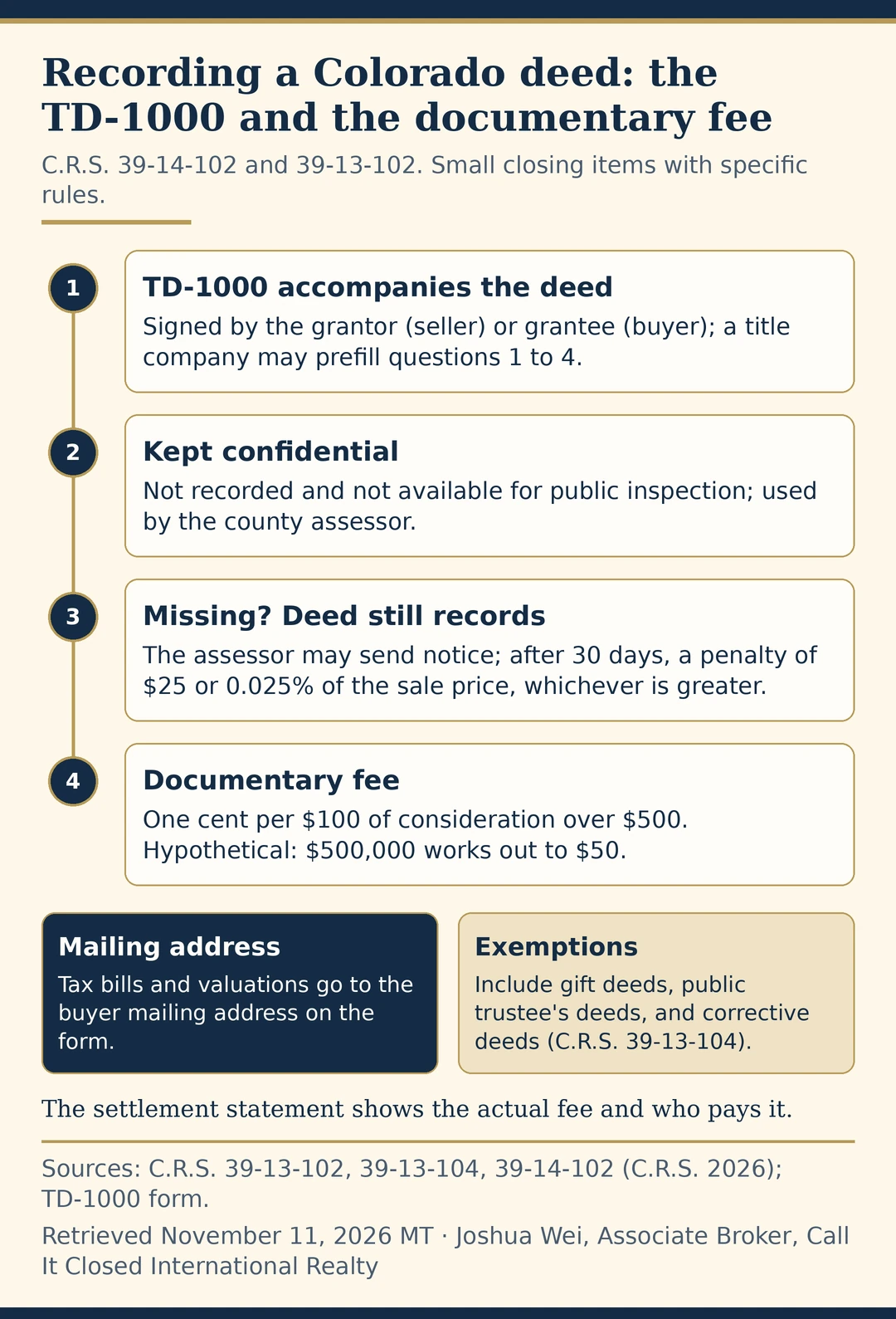
A vertical flow diagram, cream background with navy type and gold accents, titled Recording a Colorado deed: the TD-1000 and the documentary fee. Subtitle: C.R.S. 39-14-102 and 39-13-102. Small closing items with specific rules. 4 numbered steps: 1, TD-1000 accompanies the deed: Signed by the grantor (seller) or grantee (buyer); a title company may prefill questions 1 to 4; 2, Kept confidential: Not recorded and not available for public inspection; used by the county assessor; 3, Missing? Deed still records: The assessor may send notice; after 30 days, a penalty of $25 or 0.025% of the sale price, whichever is greater; 4, Documentary fee: One cent per $100 of consideration over $500. Hypothetical: $500,000 works out to $50. Two cards: Mailing address: Tax bills and valuations go to the buyer mailing address on the form; and Exemptions: Include gift deeds, public trustee's deeds, and corrective deeds (C.R.S. 39-13-104). A note says: The settlement statement shows the actual fee and who pays it. Sources: C.R.S. 39-13-102, 39-13-104, 39-14-102 (C.R.S. 2026); TD-1000 form. Retrieved November 11, 2026 MT. Joshua Wei, Associate Broker, Call It Closed International Realty.
Sources: Colorado Revised Statutes 2026, Title 39 (opens in a new tab); Real Property Transfer Declaration (TD-1000) (opens in a new tab)
Cream background, navy text, gold rules. Numbered navy circles on a gold spine with white step cards, two branch cards (navy and tan), a note, and a source footer.
The diagram above shows where each item comes from and what happens if the TD-1000 is missing.
What is the TD-1000 for?
The TD-1000 form (opens in a new tab) explains: "This form provides essential market information to the county assessor to ensure accurate, fair and uniform assessments for all property. This document is not recorded, is kept confidential, and is not available for public inspection."
It asks about the sale price, personal property included, financing, and items such as "Seller concessions" and "Seller assisted down payments."
Why the assessor wants sales data
The documentary fee article opens with a legislative declaration. C.R.S. 39-13-101(1) (opens in a new tab) says one of the factors the assessor considers in determining actual value is "comparison with other properties of known or recognized value." Subsection (2) says that comparison "may be best effected if there is available to the assessor a continuing record of the consideration paid or to be paid by purchasers of real property."
For the TD-1000, C.R.S. 39-14-102(4) says: "Each county assessor shall maintain a data bank consisting of information which has been derived from the declarations filed pursuant to the provisions of this article." That information "shall be used to properly adjust sales for sales ratio analysis," and also to determine the actual value of the property transferred and of other real property, among other purposes the assessor considers appropriate.
What the form asks, question by question
The current TD-1000 (opens in a new tab) has 18 numbered questions. For a Denver or Aurora home purchase, these are the ones to read before signing:
- Question 1: "Physical Address and/or legal description of the real property sold: Please do not use P.O. Box numbers."
- Question 2: "Type of property purchased," with boxes including "Single Family Residential," "Townhome," "Condominium," and "Multi-Unit Residential."
- Questions 3 to 5: the "Date of closing," the "Total Sale Price: include all real and personal property," the "Date of contract," and the "Contracted price (if different from final sale price)."
- Personal property: the form says it "may include, but is not limited to: machinery or equipment, vehicles, exceptional appliances, electronic devices, furniture, or anything that would not typically transfer with the real property." It adds: "If no personal property is listed, the entire purchase price will be assumed to be for the real property."
- Trades and partial interests: "Did the total sale price include a trade or exchange of additional real or personal property?" and "Was 100% interest in the real property purchased?"
- Related parties: "Is this a transaction between related parties or acquaintances?" The form explains that this covers people related by blood or marriage, business affiliates, and people who knew each other before the transaction.
- Question 9, type of sale: "Builder (new construction)," "Private (For Sale By Owner)," a public sale with broker representation, or "Other."
- Question 10, condition: from "New" and "Excellent" through "Poor" and "Salvage."
- Questions 11 to 14, financing: the type of financing, the "Total amount financed," the terms, and whether there were "Seller assisted down payments," "Seller concessions," or "Special terms or financing."
- Question 15: "Was an independent appraisal obtained in conjunction with this transaction?"
Questions 16 to 18 apply to properties "OTHER THAN Residential," which the form defines as "single family detached, townhomes, apartments and condominiums."
The form ends with a free-text line: "Please include any additional information concerning the transaction and price paid that you feel is important." On contact details it says: "Contact information is kept confidential, for County Assessor and Treasurer use only, to contact buyer with questions regarding this form, property valuation, or property tax information."
Who fills it out?
The form says: "Questions 1, 2, 3, and 4 may be completed (prefilled) by a third party, such as a title company or closing agent, familiar with details of the transaction. The signatory should confirm accuracy before signing." Questions about a prefilled answer go to the title company or closing agent.
Why does the buyer's mailing address matter?
The form says: "Future correspondence (tax bills, property valuations, etc.) regarding this property should be mailed to" the address the buyer provides. Questions about mailing addresses on county records go to the county assessor.
Who can see the TD-1000?
C.R.S. 39-14-102(1)(c) says: "The county clerk and recorder shall not record or file any declaration made pursuant to the provisions of this section." The clerk enters "the date of recordation and reception number of the conveyance document" on it and sends it to the assessor. The assessor "shall make any declaration made pursuant to the provisions of this section available for inspection by any taxpayer who was the grantee specified in the conveyance document which such declaration accompanied or who filed such declaration," and by the person conducting the valuation for assessment study and the property tax administrator, with their employees.
The form also cites C.R.S. 39-5-121.5 (opens in a new tab). Under that section, at a taxpayer's written request, "the assessor shall, within seven working days after receipt of said request, make available to the taxpayer or agent the data used by the assessor in determining the actual value of any property owned by such taxpayer." That data includes data "derived from the declarations filed pursuant to the provisions of article 14 of this title and confidential data, provided that such confidential data shall be presented in such a manner that the source cannot be identified." The assessor notifies the requester of "the estimated cost of providing such information," which is paid before the data is provided.
What if the TD-1000 isn't filed?
Under C.R.S. 39-14-102(1)(b)(II) (opens in a new tab), the assessor sends notice, and "If the grantee fails to provide such declaration within thirty days after the date the notice was mailed, the county assessor may impose upon such grantee a penalty of twenty-five dollars" or a percentage-based penalty tied to the sale price, "whichever amount is greater." The form restates this: "a penalty of $25.00 or 0.025% (0.00025) of the sale price, whichever is greater."
The penalty can repeat. The statute says: "In each subsequent year in which the grantee fails to file the declaration, the assessor may impose said specified penalty unless the real property has been subsequently conveyed." Under subsection (1)(b)(III), unpaid penalties "shall be certified to the county treasurer by January 1 of each year and shall be included in the statement sent to the grantee pursuant to section 39-10-103 for property taxes levied against the real property."
How is the documentary fee figured?
Under C.R.S. 39-13-102(2) (opens in a new tab), no fee is due when the total consideration "is five hundred dollars or less." Above that, it's one cent per $100 "or major fraction thereof." Subsection (1) says the fee is paid "by every person offering for recording in the office of the county clerk and recorder any deed."
The consideration is broad. Subsection (2)(b) measures it as "the total consideration paid by the purchaser, inclusive of the amount of any lien or encumbrance against the real property granted or conveyed and all charges and expenses required to be paid for the making of such grant or conveyance."
Which price counts for a home
For residential property, C.R.S. 39-13-102(5)(a) (opens in a new tab) says the consideration "is the amount listed on the grant or conveyance document; except that, if there is no consideration amount listed on the grant or conveyance document or the amount listed is five hundred dollars or less, and there is a related declaration filed in accordance with section 39-14-102, then the amount of consideration paid is the total sales price listed on the declaration." Under (5)(d), the property "will be regarded as residential unless the deed or other instrument includes a conspicuous statement or notation that the property is not to be regarded as residential."
For commercial or industrial property, (5)(b) treats the total sales price as paid for the real property "unless evidence of the separate consideration paid for personal property is submitted as shown on the purchaser's use tax return as filed with the department of revenue or unless evidence of such separate consideration is shown on the declaration."
Where the fee shows up and where it goes
Subsection (1) says the documentary fee "shall be in addition to any other fee fixed by law for the recording of such deed or instrument in writing." Subsection (3) says: "All documentary fees shall be payable to and collected by the county clerk and recorder." Under C.R.S. 39-13-103, the clerk marks the document with the words "State Documentary Fee," the amount paid and the date paid, before it is recorded. That notation is on the recorded deed.
A 2026 addition, subsection (6)(a), lets a county "designate a portion of the money collected from the documentary fee, other than the portion that is used to offset administrative costs related to recording and maintaining real property deeds and instruments, to be transferred to the county government or a housing authority" for affordable housing that meets the listed conditions. The source note says it took effect August 12, 2026 (HB 26-1202).
Not the same as a local transfer tax
The Commission's 2026 contract (opens in a new tab) has separate blanks for other items. Section 15.4 says: "Any Local Transfer Tax must be paid at Closing by" the party checked. Section 15.6 covers "Any private transfer fees and other fees due to a transfer of the Property." The state documentary fee in C.R.S. 39-13-102 is a separate, statutory fee. Section 15.1 says: "Buyer and Seller must pay, in Good Funds, their respective closing costs and all other items required to be paid at Closing, except as otherwise provided herein."
Hypothetical, for illustration only: on a $500,000 sale price, $500,000 ÷ $100 × $0.01 = $50. Your settlement statement shows the actual amount and who pays it.
Are some deeds exempt?
C.R.S. 39-13-104(1) (opens in a new tab) lists exemptions, including "Any deed granting or conveying title to real property in consequence of a gift of such property," "Any public trustee's deed executed pursuant to the provisions of section 38-38-501, C.R.S.," and "Any instrument which confirms or corrects a deed previously recorded."
The full list in 39-13-104(1) also includes deeds where a government is grantor or grantee (with an affidavit of consideration), "Any treasurer's deed," "Any sheriff's deed," "Any document given to secure payment of an indebtedness," "Any decree or order of a court of record determining or vesting title," "Any document necessary to transfer title to property as a result of the death of an owner thereof," and "Any rights-of-way and easements." Subsection (2) says: "Exemption from payment of the documentary fee imposed in this article must be claimed at the time a deed or instrument is offered for recording."
An invented example
This example is invented; the people, prices and property are not real.
A buyer closes on an Aurora townhome for a total sale price of $425,000. The deed lists $425,000 as consideration. At the rate of one cent per $100, the documentary fee is $425,000 ÷ $100 × $0.01 = $42.50. The settlement statement shows who was charged.
The closing agent prefilled questions 1 to 4 of the TD-1000. Before signing, the buyer checks that question 2 says "Townhome," that the sale price matches the settlement statement, that the seller concession is marked, and that the mailing address is her new address. Had the declaration been missing and not provided within thirty days of the assessor's notice, the penalty under the statute would be the greater of $25 or 0.025% of the sale price, which here is $425,000 × 0.00025 = $106.25.
A closing-day checklist
- Read the prefilled answers on questions 1 to 4 and confirm them, as the form asks.
- Match the sale price on the TD-1000 to the contract price and settlement statement.
- List personal property that "materially impacts the total sale price," if any.
- Mark concessions and seller-assisted down payments if they are part of the deal.
- Give a mailing address where you will receive tax bills and valuation notices.
- Find the documentary fee on the settlement statement, and the "State Documentary Fee" notation on the recorded deed.
- Ask the closing agent about any blank for a local transfer tax or private transfer fee in CBS1 sections 15.4 and 15.6.
Related: Denver home prices and seller concessions post (opens in a new tab).
Related: Aurora property tax and metro district buyer checklist (opens in a new tab).
Frequently asked questions
Is the TD-1000 public?
The form says it "is not recorded, is kept confidential, and is not available for public inspection." The statute allows the assessor to make it available to certain people, including the grantee.
Does the clerk refuse to record a deed without it?
Under C.R.S. 39-14-102(1)(b)(I), the clerk "shall promptly record the conveyance document and shall notify the county assessor" that the declaration was missing.
Does the TD-1000 give notice of anything?
C.R.S. 39-14-102(2) says no declaration "shall be deemed to provide constructive notice."
Do I list furniture I'm buying with the house?
The form asks you to "List any personal property included in the transaction that materially impacts the total sale price."
Who signs the TD-1000?
The form says: "This declaration must be completed and signed by either the grantor (seller) or grantee (buyer)." It has signature lines for both.
Can I correct a mistake after closing?
Neither the form nor the statute sections quoted here describe a correction process. Ask the county assessor's office.
Who pays the documentary fee?
The statute imposes it on the person "offering for recording." The settlement statement shows how it was charged in a particular closing.
What if a property spans two counties?
C.R.S. 39-13-102(4) has each county clerk collect a share based on "the consideration fairly attributable to the part of such property located in his county." It adds: "The allocation of the total consideration between counties is to be made by the person offering such deed or instrument in writing for recording."
Is the fee due on a refinance?
C.R.S. 39-13-104(1)(j) exempts "Any document given to secure payment of an indebtedness," such as a deed of trust.
Related notes
- Closing costs in Denver and Aurora: what is set by law, what is negotiated, and what to read on the forms
- Special warranty, general warranty, or quitclaim? Colorado deed types for Denver and Aurora buyers, explained
- Colorado beneficiary deeds: what a transfer-on-death deed does, and doesn't do, for a Denver or Aurora home
Sources and method
Official sources, retrieved November 11, 2026, America/Denver:
- Colorado Revised Statutes 2026, Title 39 (opens in a new tab): sections 39-13-102, 39-13-104, 39-14-102
- Real Property Transfer Declaration (TD-1000), as posted by the Colorado Division of Real Estate (opens in a new tab)
Added November 13, 2026: further passages of C.R.S. Title 39 (2026) (opens in a new tab) sections 39-5-121.5, 39-13-101, 39-13-102(1)–(6), 39-13-103, 39-13-104(1)–(2) and 39-14-102(1)(b)–(4); the full TD-1000 form (opens in a new tab); and CBS1 sections 15.1, 15.4 and 15.6 (2026 contract PDF (opens in a new tab)).
Quotations are verbatim. The $425,000 example is invented. The $500,000 figure is a hypothetical, not a market price.
This note is general education from a Colorado real estate broker with Call It Closed International Realty. If you're closing in Denver or Aurora, I can walk you through your settlement statement line by line before closing day.
Disclaimer
This article is general information only. It is not legal, tax, lending, insurance, appraisal, inspection, or financial advice, and it is not a substitute for advice about your situation. Joshua Wei is a Colorado real estate broker, not an attorney. Reading this article does not create a client relationship, an agency relationship, or an attorney-client relationship with Joshua Wei or with Call It Closed International Realty.
Laws, program rules, interest rates, insurance terms, tax figures, and other details change. Examples in this article are hypothetical illustrations unless a source is named for a specific, dated figure. Information in this article is believed accurate as of November 13, 2026 and is not guaranteed. No result is promised, and you should not rely on this article as the last word for your situation.
Before you act, confirm the point with the official source linked or cited in this article, and talk with a licensed professional who can apply the rule to your facts. That may be a licensed attorney, a tax professional, a lender, an insurance agent, a home inspector, or another licensed professional, depending on the question. Links to third-party websites and publications are provided for reference only. They are not an endorsement, and their content can change.
If you already have a brokerage relationship with another broker, this is not a solicitation.
Joshua Wei, Associate Broker, Call It Closed International Realty, Colorado license FA.100108558. Equal Housing Opportunity.