September 6, 2026 · Colorado · HOA · Buying · Selling · Title · New Construction
Transfer fees on Colorado homes: HOA fees, community enhancement fees, and the 2011 ban on private transfer fee covenants
Some Front Range homes carry fees payable at sale. What C.R.S. 38-35-127 says about private transfer fee covenants recorded on or after May 23, 2011, which fees it excludes (HOA, government, and certain nonprofit community fees), and how buyers can find an HOA's sale-related fees under C.R.S. 38-33.3-317.
The short answer
In brief: Colorado Revised Statutes section 38-35-127 says a transfer fee covenant impairs the transferability and marketability of title and is an unreasonable restraint on alienation. For covenants recorded on or after May 23, 2011, the statute says they shall not, upon conveyance, be binding on or enforceable against the property. HOA fees and community enhancement fees are treated differently.
Colorado Revised Statutes section 38-35-127(1)(b) (opens in a new tab) says a transfer fee covenant "violates this public policy by impairing the transferability and marketability of title to affected residential real property and constitutes an unreasonable restraint on alienation."
For covenants recorded on or after May 23, 2011, section 38-35-127(3)(a) says they "shall not, upon conveyance, be binding on or enforceable against the affected real property."
The statute lists fees it excludes as an "excluded provision," including fees paid to an HOA, to a governmental or quasi-governmental entity, or to certain nonprofits that benefit the community. How a specific fee is classified is a question for a Colorado real estate attorney.
I am a licensed Colorado real estate broker with Call It Closed International Realty. I am not an attorney.
Disclaimer. This article is general information only. It is not legal, tax, lending, insurance, appraisal, inspection, or financial advice, and reading it does not create a client, agency, or attorney-client relationship. Laws, rates, programs, and figures change. Confirm the official source, and talk with a licensed attorney, tax professional, lender, insurance agent, or inspector before you act. Joshua Wei is a Colorado real estate broker, not an attorney. He is an Associate Broker with Call It Closed International Realty, license FA.100108558. Equal Housing Opportunity.
 Full size (opens in a new tab)
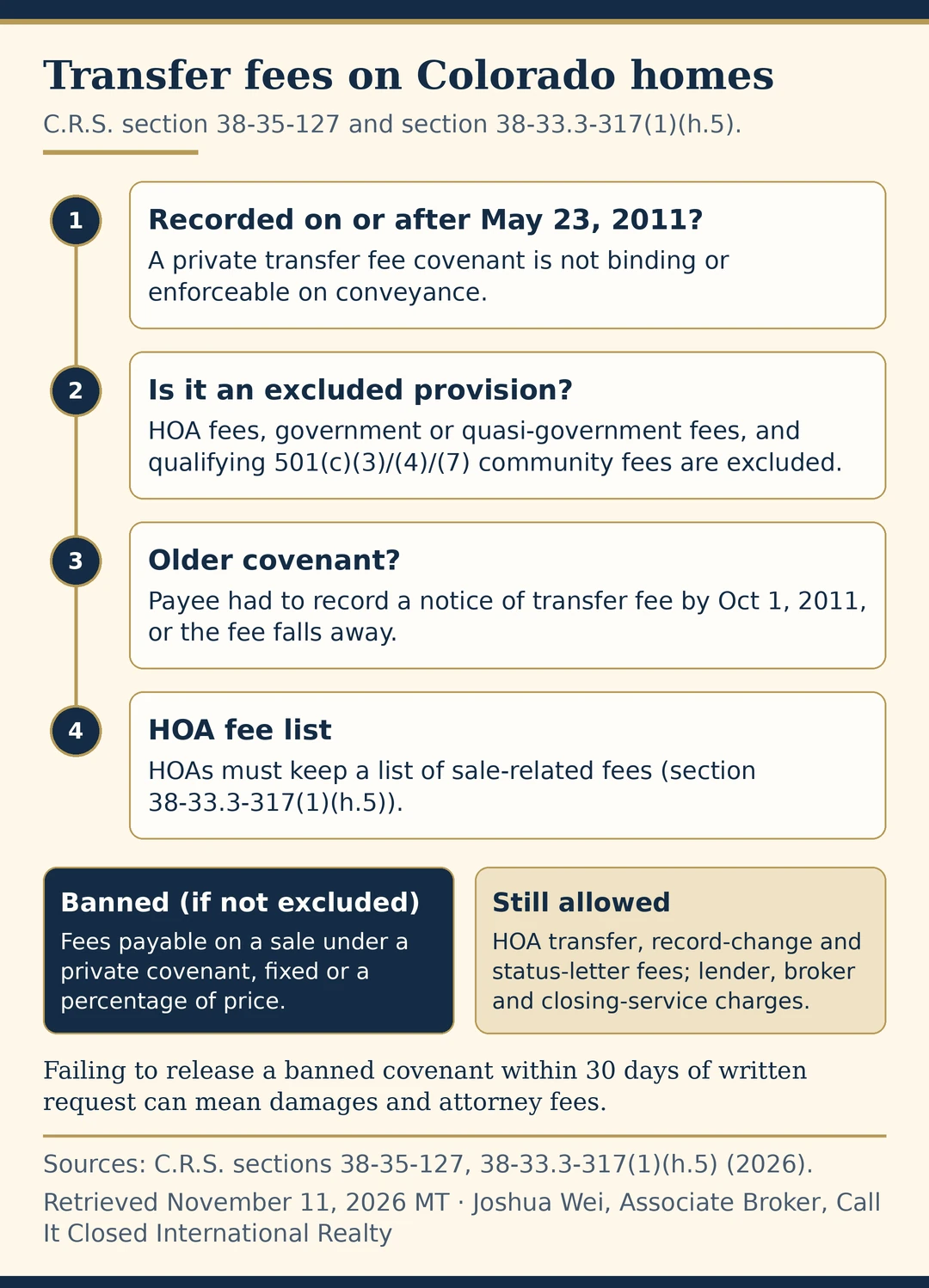
A vertical flow diagram, cream background with navy type and gold accents, titled Transfer fees on Colorado homes. Subtitle: Colorado Revised Statutes section 38-35-127 and section 38-33.3-317(1)(h.5). 4 numbered steps: 1, Recorded on or after May 23, 2011?: A private transfer fee covenant is not binding or enforceable on conveyance; 2, Is it an excluded provision?: HOA fees, government or quasi-government fees, and qualifying 501(c)(3)/(4)/(7) community fees are excluded; 3, Older covenant?: Payee had to record a notice of transfer fee by Oct 1, 2011, or the fee falls away; 4, HOA fee list: HOAs must keep a list of sale-related fees (section 38-33.3-317(1)(h.5)). Two cards: Banned (if not excluded): Fees payable on a sale under a private covenant, fixed or a percentage of price; and Still allowed: HOA transfer, record-change and status-letter fees; lender, broker and closing-service charges. A note says: Failing to release a banned covenant within 30 days of written request can mean damages and attorney fees. Sources: Colorado Revised Statutes sections 38-35-127, 38-33.3-317(1)(h.5) (2026). Retrieved November 11, 2026 MT. Joshua Wei, Associate Broker, Call It Closed International Realty.
Sources: C.R.S. title 38 (2026) (opens in a new tab)
Cream background, navy text, gold rules. Numbered navy circles on a gold spine with white step cards, two branch cards (navy and tan), a note, and a source footer.
The figure above sorts sale-related fees into the ones the statute bans and the ones it excludes.
Why Colorado banned them
A private transfer fee covenant is a recorded promise that each future sale pays someone a fee, either a fixed amount or a percentage of the price. The General Assembly's finding in section 38-35-127(1)(a) is that "The public policy of this state favors the transferability and marketability of interests in residential real property free from unreasonable restraints on alienation and covenants or servitudes that do not touch and concern the residential real property."
The finding in (1)(b) applies "regardless of the duration of the transfer fee covenant or the amount of the transfer fee set forth in the transfer fee covenant." A small fee or a short one isn't saved by being small or short.
The statute came from SB 11-234, effective May 23, 2011. That's why the date keeps coming up.
What counts as a transfer fee?
Under section 38-35-127(2)(g), a transfer fee is a fee required by a transfer fee covenant that's payable on a sale or for the right to make or accept one. It counts "regardless of whether the fee or charge is a fixed amount or is determined as a percentage of the value of the residential real property, the purchase price, or any other form of consideration given for the conveyance."
Three other definitions shape how far the statute reaches:
- Transfer fee covenant, (2)(h). It means "a provision in a document, whether recorded or not and however denominated, that requires or purports to require the payment of a transfer fee, or part of a transfer fee, to a payee." Calling it a "community fee" or a "reinvestment fee" doesn't change what it is. What matters is whether it fits an excluded provision.
- Conveyance, (2)(a). It means "the sale, gift, conveyance, assignment, inheritance, or other transfer of an ownership interest in residential real property located in this state" where homes are built or construction has started. Gifts and inheritances count, not only sales.
- Payee, (2)(c). The person or organization "specified in the transfer fee covenant to which a transfer fee is to be paid," including successors and assigns.
Which fees are excluded from the ban?
The "excluded provision" list in section 38-35-127(2)(b) includes:
- HOA fees. Amounts "payable to or collected by an association of unit owners, homeowners, property owners, condominium owners, or similar mandatory membership organization"
- Government fees. Amounts payable to or imposed by a governmental authority or quasi-governmental entity, to the extent permitted by law
- Nonprofit community fees. Amounts payable to an organization under section 501(c)(3), 501(c)(4), or 501(c)(7) of the Internal Revenue Code "for the purpose of benefiting the community in which the affected real property is located"
- Transaction costs. Lender charges, broker compensation, and one-time fees to a closing agent, title company, or management company "for services rendered in connection with the conveyance"
- Lease charges. Rent and other amounts "payable by a lessee to a lessor under a lease," including a landlord's fee for consenting to an assignment or sublease
- Environmental remediation. Amounts required by "a recorded covenant or servitude that imposes limitations on the use of residential real property pursuant to an environmental remediation project"
- One-time payments. Amounts that, "once paid, shall not bind any successor in title" and that "shall in no event be payable by a grantee upon the conveyance of residential real property upon which there are residential improvements"
Two details in the list are easy to miss. The HOA exclusion in (2)(b)(IV) applies "regardless of whether the document is recorded before, on, or after May 23, 2011," and it covers cooperatives, mobile home, time share and common interest community associations. The nonprofit exclusion in (2)(b)(V) lists the kinds of community purposes it covers: "cultural, educational, charitable, affordable housing, preservation of open space, recreational, transportation, environmental, conservation, or similar activities."
Subsection (9) adds a caution in the other direction. The section "shall not be construed to imply that any transfer fee covenant or excluded provision is valid or enforceable solely as the result of the enactment of this section." Falling in an excluded category doesn't by itself make a fee enforceable. Its validity still depends on the documents and other law.
What about older covenants recorded before May 23, 2011?
For those, the payee had to record a "notice of transfer fee" by October 1, 2011, "as a condition of payment of the transfer fee," under section 38-35-127(4)(a). The notice had to include the amount or percentage and cost examples for homes priced at $250,000, $500,000, and $750,000.
Under (4)(b), the notice also had to:
- be titled "notice of transfer fee" in "at least fourteen-point boldface" type
- "Specify the date or circumstances under which the transfer fee payment requirement expires, if any"
- "Describe the general purpose for which the moneys from the transfer fee will be used"
- give the payee's name and mailing address, with the payee's acknowledged signature
- identify the owner and the legal description of the burdened property
- "Specify the method of releasing any lien recorded against the residential real property pursuant to the transfer fee covenant" If the payee didn't comply, section 38-35-127(5) says the seller "may proceed with the conveyance" and "All conveyances thereafter shall be free and clear of any such transfer fee and transfer fee covenant." The seller in that situation "shall be deemed to have acted in good faith and shall not be subject to any obligations under the transfer fee covenant."
Getting a written statement of the fee
Where a valid notice was recorded, the owner can ask the payee what's owed. Under section 38-35-127(6)(a), on a written request delivered personally or by certified mail to the address in the notice, "the payee shall furnish to the owner or the owner's designee a written statement specifying the amount of the transfer fee payable."
If the payee "fails to provide such statement within thirty days," the owner can record an affidavit and convey "without payment of the transfer fee," and the conveyance "shall not be subject to the transfer fee and transfer fee covenant." Under (6)(b)(I), the affidavit is executed "under penalty of perjury" and recorded "prior to, simultaneously with, or within forty-five days after" the deed. Once recorded, it is prima facie evidence that the request was sent and the payee didn't answer in thirty days.
An exception for older nonprofit payees
Subsection (8) says subsections (4), (5) and (6) "shall not apply to a nonprofit organization formed prior to May 23, 2011," that is a 501(c)(3), (c)(4) or (c)(7) organization, or organized under the listed Colorado nonprofit statutes, "and that is a payee under a transfer fee covenant recorded prior to May 23, 2011." For those payees, the notice deadline and the thirty-day statement procedure don't apply. A title company or attorney would need to look at the specific covenant.
What if someone recorded a banned covenant anyway?
A person who records one on or after May 23, 2011, and doesn't release it within thirty days after a written request, is liable for actual damages, "including the amount of any transfer fee paid by a party to the conveyance," plus reasonable attorney fees.
Under section 38-35-127(3)(b), the clock starts when a "written request for the release is sent to the last-known address of the payee as specified in the transfer fee covenant personally or by certified mail, first-class postage prepaid, return receipt requested." The fee award covers "All reasonable actual attorney fees, expenses, and costs" in an action to recover a transfer fee paid, to quiet title, or to show cause why the covenant or lien "should not be declared invalid." Lenders holding a deed of trust on the property can recover too.
Subsection (3)(a) also reaches liens. A lien recorded on or after May 23, 2011, "to the extent that it purports to secure the payment of a transfer fee," isn't binding on the property or on "any subsequent owner, purchaser, or holder of any mortgage, deed of trust, or other security interest."
The federal mortgage rule
A separate federal rule makes these covenants a financing problem as well. The Federal Housing Finance Agency's rule at 12 CFR part 1228 (opens in a new tab) restricts the purchase of, and taking security interests in, mortgages on properties encumbered by certain private transfer fee covenants, and related securities.
Section 1228.2 says: "The regulated entities shall not purchase, invest or otherwise deal in any mortgages on properties encumbered by private transfer fee covenants, securities backed by such mortgages, or securities backed by the income stream from such covenants, unless such covenants are excepted transfer fee covenants." It also says "The Federal Home Loan Banks shall not accept such mortgages or securities as collateral," with the same exception.
Under section 1228.3(a), the rule applies to covenants "created on or after February 8, 2011," with a narrow exception for some settlement or government-approved agreements. An "excepted transfer fee covenant" in section 1228.1 includes one that "Requires payment of a private transfer fee to a covered association and limits the use of such transfer fees exclusively to purposes which provide a direct benefit to the real property encumbered." The federal definition of a private transfer fee also leaves out fees "That defray actual costs of the transfer of the property, including transfer of membership in the relevant covered association."
Section 1228.4 says the rule "does not affect state restrictions or requirements with respect to private transfer fee covenants, such as with respect to validity, enforceability, disclosures, or duration." Colorado's statute and the federal rule both apply, and their definitions aren't the same. Whether a particular loan program will accept a property with a recorded fee covenant is a question for the lender.
What fee list must an HOA keep?
Associations must keep, under section 38-33.3-317(1)(h.5) (opens in a new tab), "A list of the current amounts of all unique and extraordinary fees, assessments, and expenses that are chargeable by the association in connection with the purchase or sale of a unit and are not paid for through assessments, including transfer fees, record change fees, and the charge for a status letter or statement of assessments due."
Under section 38-33.3-317(2)(a), association records "must be available for examination and copying by a unit owner or the owner's authorized agent." The association may require "a written request, describing with reasonable particularity the records sought, at least ten days prior to inspection," and it "may not condition the production of records upon the statement of a proper purpose."
Recorded fee covenants show up in title records; the title company can answer questions about them.
Where the fees show up in a Colorado purchase
The Commission's Contract to Buy and Sell Real Estate (Residential) (opens in a new tab) touches sale-related fees in three places.
- Association documents, section 7.3.5. The seller's financial documents include a list of the fees and charges "(regardless of name or title of such fees or charges)" that the manager or association "will charge in connection with the Closing," including the status letter fee, "any rush or update fee," and "any record change fee or ownership record transfer fees (Record Change Fee)." Item (5) is a "list of all assessments required to be paid in advance, reserves or working capital due at Closing."
- Status letter fees, section 15.3. "Any fee incident to the issuance of Association's Status Letter must be paid by Seller." Checkboxes decide who pays the Record Change Fee, reserves or working capital, and "Any other fee listed in the Status Letter as required to be paid at Closing."
- Title, sections 8.1 and 8.2. The buyer gets a Title Commitment and "has the right to review and object to the Abstract of Title or Title Commitment and any of the Title Documents" by the Record Title Objection Deadline. A recorded fee covenant would be found and objected to here.
Working capital or reserve contributions due to an association at closing are amounts "payable to or collected by an association," so they fall within the HOA exclusion in section 38-35-127(2)(b)(IV). The contract's checkboxes, not the statute, decide who pays them.
A hypothetical
Here's an invented example. A seller in an Aurora subdivision gets a title commitment listing two items. One is a covenant recorded in 2014 by the original developer's affiliate, requiring 1% of every sale price to be paid to that company. The other is the HOA declaration, which requires a working capital contribution to the association at each sale.
Read against the statute, the developer-affiliate fee looks like a transfer fee covenant recorded after May 23, 2011. Under section 38-35-127(3)(a) it "shall not, upon conveyance, be binding on or enforceable against the affected real property." The seller's attorney might send the written release request described in (3)(b). The HOA's working capital contribution is an amount payable to an association, which is an excluded provision. Who pays it is set by the section 15.3.3 checkbox in the contract.
The facts are made up. A real document needs a Colorado real estate attorney and the title company to read it.
Checklists
Buyers:
- Read the title commitment's exceptions for any covenant that charges a fee on sale.
- Compare the section 7.3.5 fee list with the status letter so nothing new appears at closing.
- Ask your lender early if a fee covenant shows up.
Sellers:
- Request the status letter at least fourteen days before closing, as section 15.3 requires.
- If an old pre-2011 covenant appears, have the title company check for a recorded notice of transfer fee.
- Keep copies of any written release request and how it was sent.
Frequently asked questions
Are private transfer fees legal in Colorado?
Section 38-35-127(3)(a) says covenants recorded on or after May 23, 2011 "shall not, upon conveyance, be binding on or enforceable against the affected real property," subject to the excluded provisions.
Can my HOA charge a transfer fee?
Amounts "payable to or collected by an association" are an excluded provision, and section 38-33.3-317(1)(h.5) requires a list of current sale-related fees.
What's a community enhancement fee?
That name isn't in the statute. Fees payable to a qualifying 501(c)(3), (4), or (7) organization "for the purpose of benefiting the community" are an excluded provision. A specific recorded document is a question for a Colorado real estate attorney.
Who pays these fees, buyer or seller?
The purchase contract has fee allocation provisions. How they apply to a specific fee is a question for a Colorado real estate attorney.
How do I spot a recorded fee covenant?
Recorded covenants appear in title records; the title company can identify them.
Does a transfer fee apply when a home is inherited?
The definition of "conveyance" in section 38-35-127(2)(a) includes an "inheritance." The same rules on enforceability apply.
Can a lender refuse a loan because of a fee covenant?
The FHFA rule at 12 CFR 1228.2 restricts its regulated entities from dealing in mortgages on properties with non-excepted private transfer fee covenants created on or after February 8, 2011. Ask the lender how it applies to a specific property.
Does a metro district fee count?
Fees payable to a governmental or quasi-governmental entity are excluded from the ban, to the extent permitted by law. Whether a particular metro district charge fits that exclusion is for a Colorado real estate attorney.
Related notes
- Who oversees Colorado HOAs? What the state HOA Center can and can't do for Denver and Aurora owners and buyers
- Closing costs in Denver and Aurora: what is set by law, what is negotiated, and what to read on the forms
- A metro district is not an HOA: how Denver and Aurora buyers can tell them apart
Sources and method
Official sources, retrieved November 11 and 13, 2026, America/Denver:
- C.R.S. title 38 (2026) (opens in a new tab): sections 38-35-127 (all subsections), 38-33.3-317(1)(h.5), (2)(a) and (8)
- 12 CFR part 1228, eCFR (opens in a new tab): sections 1228.1 to 1228.4
- Colorado Real Estate Commission, Contract to Buy and Sell Real Estate (Residential), for use on and after January 1, 2026 (opens in a new tab): sections 7.3.5, 8.1, 8.2, 15.3
Section 38-33.3-317(8) says the (1)(h.5) list requirement doesn't apply to associations that include time-share units. Case law and specific community documents weren't reviewed. The hypothetical is invented.
This note is general education from a Colorado real estate broker with Call It Closed International Realty. For a specific fee or covenant, talk with a Colorado real estate attorney and your title company.
Disclaimer
This article is general information only. It is not legal, tax, lending, insurance, appraisal, inspection, or financial advice, and it is not a substitute for advice about your situation. Joshua Wei is a Colorado real estate broker, not an attorney. Reading this article does not create a client relationship, an agency relationship, or an attorney-client relationship with Joshua Wei or with Call It Closed International Realty.
Laws, program rules, interest rates, insurance terms, tax figures, and other details change. Examples in this article are hypothetical illustrations unless a source is named for a specific, dated figure. Information in this article is believed accurate as of November 13, 2026 and is not guaranteed. No result is promised, and you should not rely on this article as the last word for your situation.
Before you act, confirm the point with the official source linked or cited in this article, and talk with a licensed professional who can apply the rule to your facts. That may be a licensed attorney, a tax professional, a lender, an insurance agent, a home inspector, or another licensed professional, depending on the question. Links to third-party websites and publications are provided for reference only. They are not an endorsement, and their content can change.
If you already have a brokerage relationship with another broker, this is not a solicitation.
Joshua Wei, Associate Broker, Call It Closed International Realty, Colorado license FA.100108558. Equal Housing Opportunity.