October 7, 2026 · Denver · Aurora · Buying · Insurance
Wildfire risk for Denver-area homebuyers: the state risk map, the new wildfire resiliency code, and insurance questions to ask
Wildfire isn't only a mountain issue. How Front Range buyers can check the Colorado Wildfire Risk Viewer, what the 2025 Colorado Wildfire Resiliency Code covers, what the Division of Insurance says insurers look at, and what Colorado's FAIR Plan is.
The short answer
In brief: Wildfire risk on the Front Range isn't limited to the mountains; the legislature found the 2021 Marshall fire "resulted in the loss of over one thousand homes and commercial properties." Before a purchase contract's insurance and inspection deadlines, buyers can check the free Colorado State Forest Service Wildfire Risk Viewer and the 2025 Colorado Wildfire Resiliency Code map, and ask insurers specific questions.
Wildfire risk on the Front Range isn't limited to the mountains. When the legislature created the state's FAIR Plan, it found in C.R.S. 10-4-1802 (opens in a new tab) that "the 2021 Marshall fire resulted in the loss of over one thousand homes and commercial properties." This guide walks through the free state tools and the insurance questions worth asking before your contract's insurance and inspection deadlines.
Before you commit to a home, three free checks help:
- The state's risk map. The Colorado State Forest Service's Wildfire Risk Viewer, described on the state's climate site (opens in a new tab), lets you "determine the potential wildfire intensity within a general vicinity of the location you define."
- The wildfire code map. The Division of Fire Prevention and Control says the 2025 Colorado Wildfire Resiliency Code (opens in a new tab) was "established on 1 July, 2025 through 8 CCR 1507-39." It applies within the wildland-urban interface areas the code designates.
- An early insurance quote. The Division of Insurance's homeowners page links its Colorado Property & Insurance Wildfire Preparedness Guide (opens in a new tab), which says "Homeowners insurance typically covers property losses caused by wildfire and coverage continues to be available in most wildfire prone areas," but that "cost and ability to obtain insurance will vary based on company policies."
I am a licensed Colorado real estate broker with Call It Closed International Realty. I am not an insurance agent, wildfire mitigation specialist, or code official.
Disclaimer. This article is general information only. It is not legal, tax, lending, insurance, appraisal, inspection, or financial advice, and reading it does not create a client, agency, or attorney-client relationship. Laws, rates, programs, and figures change. Confirm the official source, and talk with a licensed attorney, tax professional, lender, insurance agent, or inspector before you act. Joshua Wei is a Colorado real estate broker, not an attorney. He is an Associate Broker with Call It Closed International Realty, license FA.100108558. Equal Housing Opportunity.
 Full size (opens in a new tab)
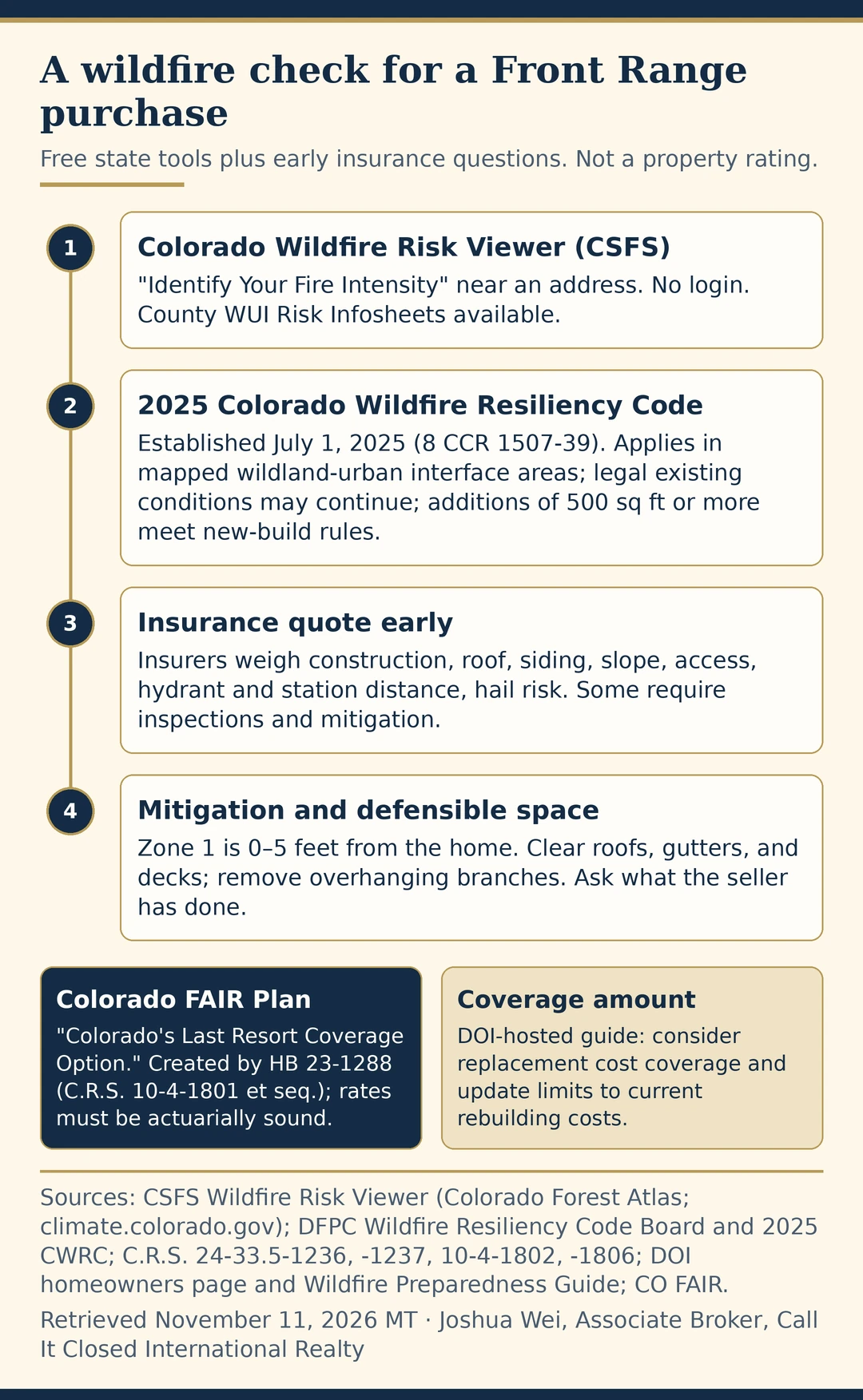
A vertical flow diagram, cream background with navy type and gold accents, titled A wildfire check for a Front Range purchase, with the subtitle free state tools plus early insurance questions, not a property rating. Four numbered steps: 1, the Colorado Wildfire Risk Viewer from the Colorado State Forest Service, with its Identify Your Fire Intensity tool near an address, no login, and county WUI Risk Infosheets; 2, the 2025 Colorado Wildfire Resiliency Code, established July 1, 2025 through 8 CCR 1507-39, which applies in mapped wildland-urban interface areas, lets legal existing conditions continue, and requires additions of 500 square feet or more to meet new-build rules; 3, get an insurance quote early, since insurers weigh construction, roof, siding, slope, access, hydrant and fire station distance, and hail risk, and some require inspections and mitigation; 4, mitigation and defensible space, where zone 1 is 0 to 5 feet from the home, clear roofs, gutters, and decks, remove overhanging branches, and ask what the seller has done. Two lower cards: the Colorado FAIR Plan, Colorado's last resort coverage option, created by HB 23-1288 under C.R.S. 10-4-1801 and following, with rates that must be actuarially sound; and coverage amount, where the Division of Insurance-hosted guide suggests considering replacement cost coverage and updating limits to current rebuilding costs. Sources: Colorado State Forest Service, Division of Fire Prevention and Control, Colorado Revised Statutes, Division of Insurance, and CO FAIR. Retrieved November 11, 2026 MT.
Sources: Colorado Wildfire Risk Public Viewer (opens in a new tab); DFPC Wildfire Resiliency Code Board (opens in a new tab); Colorado Property & Insurance Wildfire Preparedness Guide (DOI-hosted) (opens in a new tab)
Cream background, navy text, gold rules. Four numbered steps on a gold spine, two side-by-side cards, and a 28px source footer.
The diagram above lays out a wildfire check for a Front Range purchase: the state risk viewer, the resiliency code map, insurance questions, and the FAIR Plan as a last resort. It summarizes official sources and does not rate any property.
How do I look up wildfire risk for an address?
The Colorado Forest Atlas help page, Overview of Wildfire Risk Viewer (opens in a new tab), says the application "does not require registration or a login." Its featured tool, "Identify Your Fire Intensity," "allows users to identify potential wildfire intensity near their home, or any other point of interest on the map, and provides a link to additional resources for users wanting to know how to reduce their risk."
The state climate site adds that you can "select a county to download the selected county's WUI Risk Infosheet." The viewer shows risk for a general vicinity. It is not an inspection and does not decide insurance eligibility.
What is the Colorado Wildfire Resiliency Code?
Senate Bill 23-166 created the Wildfire Resiliency Code Board. Its mission, per C.R.S. 24-33.5-1236 (opens in a new tab), includes "hardening structures and reducing fire risk in the defensible space surrounding structures in the wildland-urban interface in Colorado."
Under C.R.S. 24-33.5-1237(2)(a), "An adopting governing body shall adopt a code that meets or exceeds the minimum standards set forth in the codes within nine months of the board adopting the codes." An adopting governing body is one "that has jurisdiction in an area within the wildland-urban interface and has the authority to adopt building codes or fire codes."
The 2025 code's Section 101.2 says it applies to "the construction, alteration, movement, repair, maintenance and use of any building, structure or premises that contain occupiable and/or habitable space," within the designated wildland-urban interface areas. On existing buildings, the code says: "Buildings or conditions in existence at the time of the adoption of this code are allowed to have their use or occupancy continued, if such condition, use or occupancy was legal at the time of the adoption of this code, provided that such continued use does not constitute a distinct danger to life or property."
Section 101.5 matters if you plan a big addition. When work "increases the footprint of the existing structure by 500 square feet or greater, the addition or alteration conforms to that required for a new building or structure."
DFPC publishes a "State Map for the Application of the 2025 Colorado Wildfire Resiliency Code" on its code adoption resources page (opens in a new tab). If a home you are considering is in a mapped area, ask the local building department how the code affects remodels, roofs, decks, and fences.
What do insurers look at?
The Division of Insurance-hosted guide lists "additional insurance considerations," including:
- "The type of construction, materials, and features on your home, including the roofing, windows and siding as well as slope and emergency vehicle access."
- "Distance to a fire hydrant and a fire station, whether your neighborhood is protected by full-time and/or part-time firefighters, and any factors that affect the time it would take to extinguish a fire in your area."
- "Insurers consider many individual and geographical risk factors beyond wildfire that affect premiums and insurability, such as hail proneness and unique construction."
It also says: "Many insurance companies require customers to be active participants in reducing their wildfire risk by implementing steps to protect their property. In addition, some insurers require on-site inspections and will notify policyholders of necessary mitigation to reduce risk to their home and keep it insurable."
On coverage amounts, it advises: "Consider replacement cost coverage that provides additional protection and update policy limits to rebuild or repair your home for what it would cost in the current building market."
The Division of Insurance's homeowners insurance page (opens in a new tab) explains that insurers must provide a summary of coverage, quoting Bulletin B-5.15: "The summary disclosure forms must contain an explanation of major coverages and exclusions as well as general factors considered in cancellation, nonrenewal and increases in premium."
The purchase contract has a Property Insurance Termination Deadline. CBS section 10.5 (opens in a new tab) reads: "Buyer has the Right to Terminate under section 24.1. on or before Property Insurance Termination Deadline, based on, in Buyer's sole subjective discretion, any unsatisfactory provision of the availability, terms and conditions and premium for property insurance (Property Insurance) on the Property." Coverage and quote questions are for a licensed insurance agent; when proof of insurance is needed is a question for your lender.
What does Colorado's 2026 wildfire-model law require of insurers?
A newer statute gives buyers more to ask for. C.R.S. 10-4-124 (opens in a new tab), added by HB 25-1182 and effective July 1, 2026, covers insurers that use a "wildfire risk model," defined as a tool "used by an insurer in whole or in part, to measure or assess the wildfire risk associated with a residential property or community for purposes of rating, classifying, or pricing."
Mitigation has to count. Under section 10-4-124(3), an insurer using such a model must make sure "Property-specific mitigation actions such as establishing defensible space, incorporating building hardening measures, or receiving certification from an entity with expertise in mitigation of properties against wildfire" and "Community-level mitigation activities or designations, including forest treatment and other fuel reduction activities," are "either incorporated in" the model "or are otherwise demonstrably included in the insurer's underwriting and pricing." If not, section 10-4-124(4) says "the insurer shall provide discounts to policyholders who can demonstrate" those actions. The statute's definition of a property-specific action points to the Insurance Institute for Business and Home Safety's Wildfire Prepared Home designation, or a program like it, "by a similar mitigation program that includes a verification and certification process."
Discounts must be posted. Under section 10-4-124(5), "An insurer shall post on its public website readily accessible information on the premium discounts, incentives, or other premium adjustments that are available," along with "the process for appealing a wildfire risk score."
You get your score. Under section 10-4-124(6), an insurer that uses a wildfire score to underwrite or price must give "an annual written notice to each policyholder or applicant upon application for property insurance of the applicable mitigation discounts, the wildfire risk score, and any other wildfire risk classification." The notice must include "A written explanation of why the policyholder or applicant received the assigned score or classification that identifies the primary features of the property that influenced the assignment of the score." It must also explain "that insurers may use different models and have different risk score ranges that could result in different risk scores from other insurers."
Timing for applicants. Under section 10-4-124(7)(a), the score goes to applicants "no later than fifteen days after the submission of the applicant's completed application to the insurer." That's a date to compare with your Property Insurance Termination Deadline.
Appeals. Under section 10-4-124(8), a policyholder or applicant who thinks the score or discount "is inaccurate and provides evidence of the property-specific or community-level mitigation action may appeal the score directly to the insurer." The insurer must acknowledge the appeal "within ten calendar days" and respond "within thirty calendar days after receiving the appeal." Subsection (9) says the section also applies to the FAIR Plan.
What is the Colorado FAIR Plan?
CO FAIR (opens in a new tab) describes itself as "Colorado's Last Resort Coverage Option" and says: "It should be considered a last resort after exploring all traditional insurance options."
The statute behind it, C.R.S. 10-4-1802(2), says the plan is one that "Complements the private market by requiring consumers to purchase coverage through the private market when possible." Under C.R.S. 10-4-1806(2), rates must "Not be excessive, inadequate, or unfairly discriminatory" and must "Be actuarially sound so that revenue generated from premiums is adequate to pay for expected losses, expenses, and taxes."
The FAIR Plan has limits of its own. Under C.R.S. 10-4-1807(2) (opens in a new tab), its plan of operation must provide for "Coverage limits not to exceed seven hundred fifty thousand dollars for property," and for "reasonable underwriting standards to determine the eligibility of a risk, including mitigation requirements and property inspections." So a FAIR Plan policy can also come with mitigation conditions, and its property limit is capped by statute. Under section 10-4-124(9), the 2026 wildfire-score rules apply to the FAIR Plan too.
If a standard insurer won't write a policy, a licensed independent insurance agent can explain the options, including the FAIR Plan.
What can owners do to reduce risk?
The DOI-hosted guide, citing Colorado State Forest Service material, describes defensible-space zones. Zone 1, "0-5 FEET FROM THE HOME," is "The area nearest the home. This zone requires the most vigilant work in order to reduce or eliminate ember ignition and direct flame contact with your home." Its annual checklist includes "Clear roof, deck and gutters of pine needles and other debris" and "Remove branches that overhang the roof and chimney."
For what mitigation has been done, ask the seller; for which steps an insurer credits, ask the insurer or a licensed agent.
Related: Flood map and drainage guide (opens in a new tab).
A buyer's wildfire checklist, keyed to the contract
- Before you write the offer: look up the address on the Wildfire Risk Viewer and the DFPC code map.
- Right after acceptance: apply for homeowners quotes. Ask each insurer for the wildfire risk score and the mitigation discounts it posts under section 10-4-124.
- Before the inspection deadline: ask the seller what mitigation has been done (defensible space, roof, vents, deck), and whether any insurer required mitigation. Ask for a Wildfire Prepared Home or similar certificate if one exists.
- Before the Property Insurance Termination Deadline: compare quotes, including replacement cost coverage, and decide whether the availability, terms and premium work for you.
- After closing: keep mitigation records, since they're the evidence for a discount or a score appeal.
A hypothetical
This example is invented. A buyer under contract on a house at the edge of open space in southeast Aurora applies for a policy on day two. Within 15 days, the insurer sends a wildfire score with a written explanation that cites the wood deck and the vegetation within five feet of the house. The seller says the deck has not been treated. The buyer gets a second quote from another insurer, whose notice explains that insurers may use different models. With both quotes in hand before the Property Insurance Termination Deadline, the buyer decides under section 10.5 whether to proceed, and asks the seller to clear the zone-one vegetation as part of inspection resolution.
Frequently asked questions
Is Denver in the wildland-urban interface?
Check the state code map and risk viewer for the specific address. This article does not classify any neighborhood.
Will the new code make me retrofit my house?
The code lets legal existing conditions continue, but it says "Provisions of this code that specifically apply to existing conditions are retroactive." Ask your local building department.
Can an insurer require mitigation?
The DOI-hosted guide says some insurers "will notify policyholders of necessary mitigation to reduce risk to their home and keep it insurable."
When should I shop for insurance?
The contract's Property Insurance Termination Deadline (CBS section 10.5) is one date to know. How that right works on your contract is a question for your broker or a Colorado real estate attorney, and coverage questions are for a licensed insurance agent.
What is replacement cost coverage?
The guide describes it as coverage that helps "rebuild or repair your home for what it would cost in the current building market." Ask an insurance professional about your policy.
Can I see my wildfire risk score?
Under C.R.S. 10-4-124(6) and (7), an insurer that uses a wildfire score must give it to an applicant "no later than fifteen days after the submission of the applicant's completed application," with a written explanation.
Is there a coverage cap on a FAIR Plan policy?
Yes. C.R.S. 10-4-1807(2)(b) says the plan must provide for "Coverage limits not to exceed seven hundred fifty thousand dollars for property." If the cost to rebuild your home is higher, ask a licensed insurance agent what that means for you, and ask your lender what coverage amount it requires.
Do mitigation records matter after I buy?
Under C.R.S. 10-4-124(7)(d), after a completed mitigation action, you can ask the insurer for a revised score, and it must respond "no later than thirty days after the submission" of that request.
Can I appeal a wildfire score?
Yes, with evidence of mitigation, under section 10-4-124(8). The insurer must respond "within thirty calendar days after receiving the appeal."
Is the FAIR Plan cheaper?
CO FAIR calls itself a last resort, and the statute says its rates must be "actuarially sound." For a comparison on a specific home, ask a licensed insurance agent.
Related notes
- Shop homeowners insurance before your deadline: Colorado's insurability right and the Division of Insurance's buyer guide for Denver and Aurora
- Outside the floodplain is not the whole answer: an Aurora homebuyer's water-risk checklist
- Sewer scopes and roof inspections in Denver and Aurora: what they catch that a general inspection can miss
Sources and method
Official sources, retrieved November 11 and 13, 2026, America/Denver: Colorado Real Estate Commission Contract to Buy and Sell Real Estate (Residential), CBS1 section 10.5 (opens in a new tab) from the DRE forms page (opens in a new tab); Colorado Revised Statutes 2026, Title 10 (opens in a new tab) (sections 10-4-124, 10-4-1802, 10-4-1806, 10-4-1807) and Title 24 (opens in a new tab) (sections 24-33.5-1236, 24-33.5-1237); Division of Fire Prevention and Control Wildfire Resiliency Code Board (opens in a new tab), 2025 Colorado Wildfire Resiliency Code (opens in a new tab) (sections 101.2, 101.5), and code adoption resources (opens in a new tab); Colorado State Forest Service Wildfire Risk Viewer via the state climate site (opens in a new tab) and Colorado Forest Atlas help (opens in a new tab); Colorado Division of Insurance homeowners insurance page (opens in a new tab) and the Colorado Property & Insurance Wildfire Preparedness Guide (opens in a new tab) it links (the guide is hosted by the Division, carries industry and REALTOR® partner material, and is marked "Updated as of January 4, 2024"); and CO FAIR (opens in a new tab). Quotations are verbatim. No property-level risk rating, premium, or loss statistic is stated beyond the legislature's own Marshall fire finding. The hypothetical is invented.
This note is general education from a Colorado real estate broker with Call It Closed International Realty. If you are buying on the Front Range, I can help you fit the risk map, code, and insurance checks inside your contract dates.
Disclaimer
This article is general information only. It is not legal, tax, lending, insurance, appraisal, inspection, or financial advice, and it is not a substitute for advice about your situation. Joshua Wei is a Colorado real estate broker, not an attorney. Reading this article does not create a client relationship, an agency relationship, or an attorney-client relationship with Joshua Wei or with Call It Closed International Realty.
Laws, program rules, interest rates, insurance terms, tax figures, and other details change. Examples in this article are hypothetical illustrations unless a source is named for a specific, dated figure. Information in this article is believed accurate as of November 13, 2026 and is not guaranteed. No result is promised, and you should not rely on this article as the last word for your situation.
Before you act, confirm the point with the official source linked or cited in this article, and talk with a licensed professional who can apply the rule to your facts. That may be a licensed attorney, a tax professional, a lender, an insurance agent, a home inspector, or another licensed professional, depending on the question. Links to third-party websites and publications are provided for reference only. They are not an endorsement, and their content can change.
If you already have a brokerage relationship with another broker, this is not a solicitation.
Joshua Wei, Associate Broker, Call It Closed International Realty, Colorado license FA.100108558. Equal Housing Opportunity.