October 25, 2026 · Denver · Aurora · Buying · Insurance
Shop homeowners insurance before your deadline: Colorado's insurability right and the Division of Insurance's buyer guide for Denver and Aurora
Colorado's residential contract gives buyers a Property Insurance Termination Deadline. How to use it, and what the Colorado Division of Insurance's buyer guide and HOA insurance toolkit say about coverage limits, policy forms, deductibles, and condo master policies.
The short answer
In brief: Section 10.5 of Colorado's residential purchase contract gives the buyer a right to terminate, on or before the Property Insurance Termination Deadline, based on any unsatisfactory availability, terms, conditions or premium for property insurance, in the buyer's sole subjective discretion. That makes shopping homeowners insurance early part of the contract timeline. The Division of Insurance publishes a buyer guide.
Section 10.5 of Colorado's residential contract (CBS1) says: "Buyer has the Right to Terminate under section 24.1. on or before Property Insurance Termination Deadline, based on, in Buyer's sole subjective discretion, any unsatisfactory provision of the availability, terms and conditions and premium for property insurance (Property Insurance) on the Property."
Contract quotations here are from the 2026 CBS1 PDF (opens in a new tab). The Colorado Division of Insurance's homeowners insurance buyer guide (opens in a new tab) says: "It is a good idea to get at least three quotes."
I am a licensed Colorado real estate broker with Call It Closed International Realty. I am not an insurance agent or attorney. This is not insurance or legal advice.
Disclaimer. This article is general information only. It is not legal, tax, lending, insurance, appraisal, inspection, or financial advice, and reading it does not create a client, agency, or attorney-client relationship. Laws, rates, programs, and figures change. Confirm the official source, and talk with a licensed attorney, tax professional, lender, insurance agent, or inspector before you act. Joshua Wei is a Colorado real estate broker, not an attorney. He is an Associate Broker with Call It Closed International Realty, license FA.100108558. Equal Housing Opportunity.
 Full size (opens in a new tab)
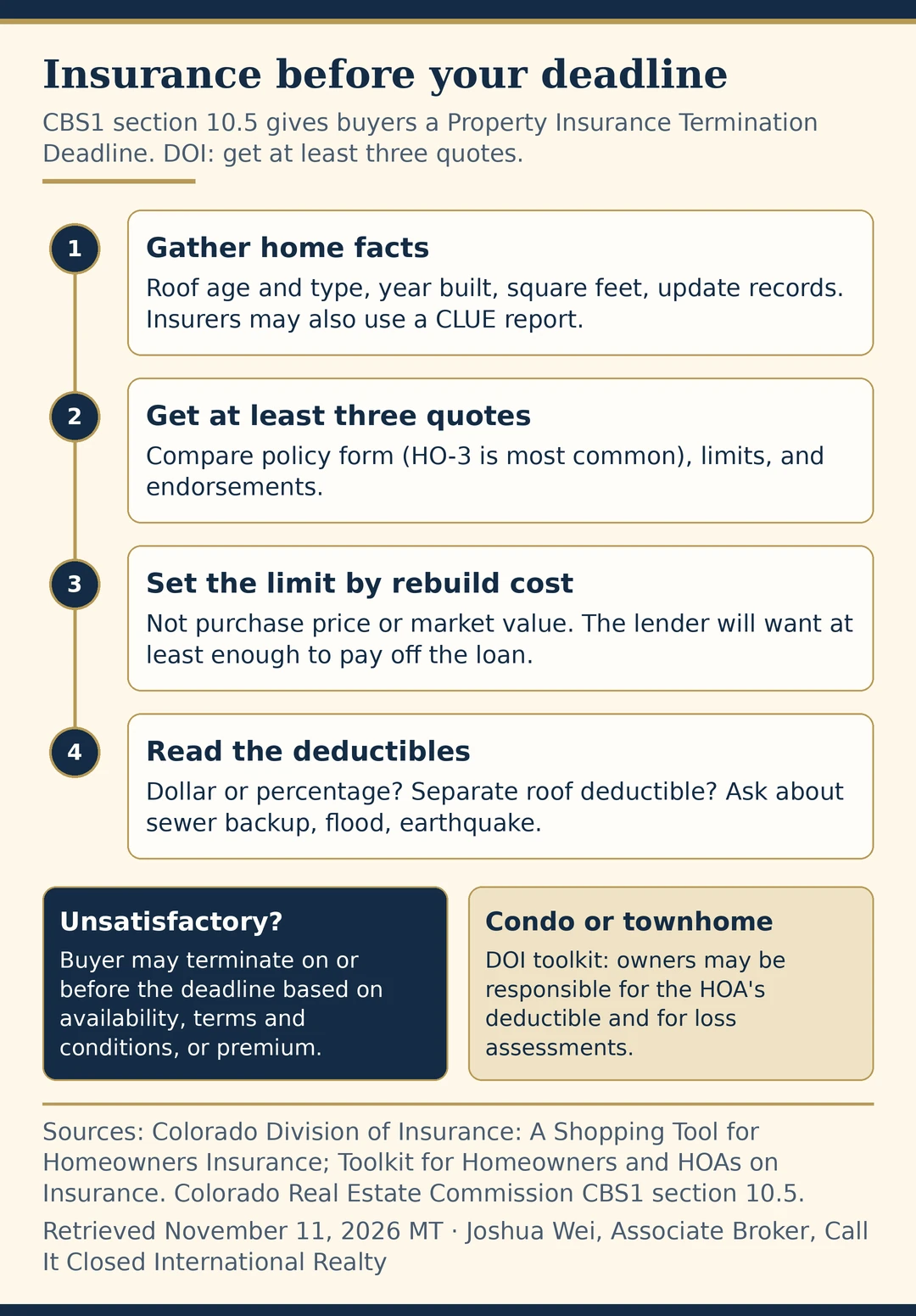
A vertical flow diagram, cream background with navy type and gold accents, titled Insurance before your deadline, with the subtitle CBS1 section 10.5 gives buyers a Property Insurance Termination Deadline, and the Division of Insurance suggests at least three quotes. Four numbered steps: 1, gather home facts such as roof age and type, year built, square feet, and update records, and note that insurers may also use a CLUE report; 2, get at least three quotes, comparing policy form, where HO-3 is most common, limits, and endorsements; 3, set the limit by rebuild cost, not purchase price or market value, since the lender will want at least enough to pay off the loan; 4, read the deductibles, whether dollar or percentage, whether there is a separate roof deductible, and ask about sewer backup, flood, and earthquake. Two lower cards: unsatisfactory, where the buyer may terminate on or before the deadline based on availability, terms and conditions, or premium; and condo or townhome, where the Division of Insurance toolkit says owners may be responsible for the HOA's deductible and for loss assessments. Sources: Colorado Division of Insurance and Colorado Real Estate Commission. Retrieved November 11, 2026 MT.
Sources: DOI buyer guide (PDF) (opens in a new tab); DOI HOA toolkit (opens in a new tab)
Cream background, navy text, gold rules. Four numbered steps on a gold spine, two side-by-side cards, and a 28px source footer.
The diagram above pairs the contract deadline with the shopping steps in the Division of Insurance guide.
How does the deadline work?
Section 10.5 is a termination right, not a promise that coverage will be available. Termination under section 24.1 "is effective upon the other party's receipt of a written notice to terminate (Notice to Terminate), provided such written notice was received on or before the applicable deadline specified in this Contract." If no notice arrives in time, the buyer "accepts the specified matter, document or condition as satisfactory and waives the Right to Terminate under such provision." And: "Any Notice to Terminate delivered after the applicable deadline specified in the Contract is ineffective and does not terminate this Contract."
Section 20 adds: "Time is of the essence for all dates and deadlines in this Contract. This means that all dates and deadlines are strict and absolute." In practice, that means requesting quotes soon after the contract is signed, so you have written terms and a premium in hand before the deadline.
How much coverage?
The guide says: "You should choose a coverage limit that is based on the estimated cost to rebuild your home - not its purchase price or current market value. Your mortgage lender will want you to have at least enough insurance to pay off your loan."
It warns: "Insuring your home for less than the cost to rebuild it means you may have to pay thousands of dollars out of pocket to rebuild your home if it is destroyed."
The guide says each quote carries its own number: "If you get more than one quote, you will also get more than one estimate of the cost to rebuild. Although not a guarantee, current estimates can help you avoid being underinsured."
What Colorado law requires insurers to provide
Colorado's homeowner's insurance statute, Colorado Revised Statutes section 10-4-110.8 (opens in a new tab), sets several requirements for replacement-cost policies on a "Dwelling." Note the definition first: "Dwelling" means "a single-family home, other than a mobile home, condominium, or manufactured home, that is used as a primary residence by the owner of the dwelling."
- A reconstruction estimate. Under section 10-4-110.8(9.5)(a), at application and renewal of a replacement-cost policy "issued or renewed on and after January 1, 2025, the insurer shall: (I) Provide the applicant or policyholder with an estimate of the cost necessary to reconstruct the covered structure." The insurer must also disclose "How the estimate was calculated" and "Provide copies of any generated estimates from any software or tools or services used by the insurer to establish the reconstruction costs."
- Extended replacement cost and law and ordinance. Under section 10-4-110.8(6)(a)(I), the insurer "shall make available to an applicant the opportunity to obtain extended replacementcost coverage and law and ordinance coverage." At a minimum, it "shall offer law and ordinance coverage in an amount of insurance equal to twenty percent of the limit of the insurance for the dwelling and extended replacement-cost coverage in an amount of insurance that is at least fifty percent of the limit of the insurance for the dwelling."
- Additional living expense (ALE). Under section 10-4-110.8(6)(b), "All homeowner's insurance replacement-cost policies for a dwelling must include additional living expense coverage. This coverage must be available for a period of at least twelve months and is subject to other policy provisions. Insurers shall offer policyholders the opportunity to purchase a total of twenty-four months of ALE coverage."
- Copies of the policy. Under section 10-4-110.8(10)(a), a carrier "shall make available to a policyholder an electronic or paper copy of the policyholder's insurance policy, including the declaration page and any" "endorsements, within three business days after a request from the policyholder."
- Inquiries. Under section 10-4-110.8(1), "An insurer may not cancel or fail to renew coverage of an insured solely because the insured inquires about coverage for homeowner's insurance and the inquiry is not related to an actual claim to the property insured."
The Division's toolkit puts the ALE point this way: "Many policies offer only 12 months, but State law requires that the companies offer you 24 months of coverage." How these rules apply to a particular policy is a question for the insurer or a licensed agent.
Replacement cost or actual cash value?
The guide explains the difference. "Replacement Cost Value (RCV) - The cost to rebuild your home or repair damages using materials of a like kind and quality. This is different from your home's market value, which includes the price of land and depends on the real estate market." For actual cash value, it says: "ACV coverage pays you for your loss, but often does not pay enough to fully replace or repair the damage to your home."
It lists the levels for the home "in order of the least to the most coverage": actual cash value, functional replacement cost, replacement cost, extended replacement cost, and guaranteed replacement cost. Two warnings stand out:
- On replacement cost: "Many policies pay only the home's ACV until you begin or complete repairs or reconstruction."
- On guaranteed replacement cost: "Ask if there is a cap on the coverage. Very few insurers offer this coverage."
The guide's example of the functional version is "replacing damaged plaster walls with (less expensive) drywall." For older Denver homes with plaster, that difference is worth asking about.
What will insurers ask?
The guide lists questions about the home, including "Approximate age of roof," roof type, the year built, and square feet. It adds: "Insurers also may use outside sources to get other information about you, such as a credit based insurance score or a CLUE (Comprehensive Loss Underwriting Exchange) report."
The Division's HOA and homeowners toolkit (opens in a new tab) suggests owners "Maintain and keep records for updates like roofing, heating/cooling systems, electrical, and plumbing."
The guide's worksheet also asks about "Home Systems: Plumbing Electrical Heating Air conditioning Septic system Well Sump pump," with the approximate age of each, and about "Distance to the fire department" and "Distance to fire hydrant or other water source." It adds a tip: "Your home appraisal or real estate listing may have some of this information." The seller's property disclosure and your inspection report can help fill in roof and system ages.
The toolkit says that if an insurer uses a consumer report, "they must disclose and provide contact information for that consumer reporting company," and lists "Verisk and LexisNexis." It also notes: "Colorado law allows one free credit report annually."
Which policy form, and what about deductibles?
The guide describes common forms. The HO-3 special form "is the most common type of homeowners insurance coverage." It "covers your home for its replacement cost value and your personal property for its actual cash value."
On deductibles, the guide says: "Deductibles can be a dollar amount or a percentage." Its comparison worksheet asks "Percentage deductible?" and "Separate deductible for roof?"
Its list of separate or optional coverages includes "Sewer, drain, sump pump backup," "Flood insurance," and "Earthquake insurance."
Questions the guide suggests asking
The guide has a list of questions for an agent or company. A few that fit a purchase:
- "Can you help me estimate what it would cost to repair or rebuild my home if it were damaged or destroyed?"
- "Will the coverage limits for my home or personal property automatically increase over time with inflation?"
- "How does this policy cover my roof? Are there any limits of coverage for my roof?"
- "Is there just one deductible in this policy or is there more than one deductible?"
- "Am I eligible for coverage with the insurance company if" "The home I am buying had damage and a claim filed by a previous owner?"
- "Is there anything I can repair or improve in my home to lower my premium?"
The toolkit's homeowner FAQ adds coverages to consider, including "Extended replacement cost at 50% of Dwelling Coverage, if concerned about coverage in the event of a total loss," "Ordinance & Law coverage at 20% of Dwelling Coverage if home is older and your city/locality has updated building code requirements," and "Water Backup Coverage," which "covers damages caused by the backup of sewers or drains, or overflows from a sump pump."
Buying a condo or townhome?
The toolkit says: "An HOA's master policy provides coverage for common areas and the building's structure, including the roof, exterior walls, and possibly fixtures within units depending on the policy type (e.g., 'all-in' or 'bare walls-in')."
It also warns: "Homeowners may be responsible for the HOA's deductible and any overages outside of the HOA's master policy limits." And: "Loss assessments occur when the HOA levies additional charges on homeowners to cover costs not fully insured by the master policy, such as deductibles or significant damages."
For a condo or townhome, the statute's "Dwelling" definition excludes condominiums, so the reconstruction-estimate and ALE rules above may not apply the same way. Ask your agent what applies to an HO-6 or similar policy, and read the HOA's master policy with the Association Documents.
What if something happens before closing?
Your policy covers you once it is in force. Before closing, the contract allocates risk. Section 18.1 covers damage "by fire, other perils or causes of loss prior to Closing," and section 18.2 covers a system that fails before "Closing or possession, whichever is earlier." See damage before closing and the final walk-through. When your policy should start is a question for your agent and lender.
An invented example
This example is invented; it is not a real property or quote.
A buyer is under contract on a 1950s Aurora ranch with a ten-year-old roof. The Property Insurance Termination Deadline is twelve days out.
- On day one, the buyer gathers the roof age, square footage, and system ages from the listing and seller's disclosure.
- The buyer requests three quotes, as the guide suggests, and asks each for its reconstruction estimate and how it was calculated.
- One quote has a separate, higher roof deductible. Another pays the roof at actual cash value. The buyer compares them on the guide's worksheet.
- The buyer asks about extended replacement cost, law and ordinance coverage, and 24 months of ALE.
- Before the deadline, the buyer decides whether the terms are acceptable. If not, a written Notice to Terminate must be received on time.
A quote is not the same as coverage. Before your deadline, ask each insurer in writing whether the quote depends on an inspection, a claims-history report, or other review, and whether it will issue the policy on those terms for your closing date. If an insurer cannot commit before your deadline, talk with your broker about asking the seller for a written extension of the deadline before it passes. Your lender will also need proof of insurance before closing.
Real premiums and terms depend on the insurer; get them in writing.
After you buy the policy
The guide's advice once you have chosen: "Read the policy and ask your agent about anything you don't understand. Keep your policy in a safe place and know the name of your insurance company." It points to the declarations page as the place "to check that you've received the coverage you wanted." The toolkit adds: "It's also advisable to review your insurance policy regularly to ensure it still meets your needs and that you understand the coverages you are or are not paying for."
Checklist before the insurance deadline
- Find the Property Insurance Termination Deadline in section 3 of your contract.
- Gather roof age, home systems, square footage, and year built.
- Get at least three quotes.
- Ask for each reconstruction estimate and how it was calculated.
- Compare dwelling limits, RCV or ACV, deductibles, and roof terms.
- Ask about extended replacement cost, law and ordinance, ALE, and water backup.
- For a condo or townhome, read the HOA master policy and ask about loss assessment coverage.
- Decide before the deadline, and deliver any Notice to Terminate in writing.
- A quote is not the same as coverage. Before your deadline, ask each insurer in writing whether the quote depends on an inspection, a claims-history report, or other review, and whether it will issue the policy on those terms for your closing date. If an insurer cannot commit before your deadline, talk with your broker about asking the seller for a written extension of the deadline before it passes. Your lender will also need proof of insurance before closing.
Related: Flood map, drainage, and insurance guide for Denver and Aurora buyers (opens in a new tab).
Frequently asked questions
When is the Property Insurance Termination Deadline?
It's a date filled in under section 3 of your contract. The deadline is negotiated, so it varies by contract.
Is "full coverage" a real term?
The toolkit says: "This term should be avoided. What may be interpreted as 'full coverage' for one consumer may not meet the needs of another."
Should I insure for the purchase price?
The guide says to base the limit on "the estimated cost to rebuild your home - not its purchase price or current market value."
Does a higher deductible lower my premium?
The toolkit suggests asking: "Will increasing my deductible lower my premiums? But it's also important to know what deductible can you afford when you have a claim?"
What if I can't get acceptable insurance?
Section 10.5 lets the buyer terminate on or before the deadline based on unsatisfactory availability, terms, or premium. Questions about a specific contract are for a Colorado real estate attorney; coverage questions are for a licensed insurance agent.
Do I have to accept actual cash value on the roof?
That depends on the policy you choose. The guide suggests asking: "How does this policy cover my roof? Are there any limits of coverage for my roof?" Compare roof terms across quotes.
Can I get a copy of the policy before I decide?
After you buy, Colorado law requires a carrier to provide a copy "within three business days after a request from the policyholder." Before you buy, ask the agent for the policy form and endorsements with the quote.
Does asking questions hurt my insurability?
Under Colorado Revised Statutes section 10-4-110.8(1), an insurer "may not cancel or fail to renew coverage of an insured solely because the insured inquires about coverage for homeowner's insurance and the inquiry is not related to an actual claim to the property insured."
What is law and ordinance coverage?
The guide defines "Ordinance or Law Coverage" as "A type of coverage that pays the extra cost to rebuild your home to meet new or updated building codes or ordinances that did not exist when your home was first built. It is also called building code upgrade coverage."
Do I need flood insurance?
The guide lists "Flood insurance" among the separate coverages to ask about. For flood maps and insurance questions, see the flood guide linked above.
Related notes
- Wildfire risk for Denver-area homebuyers: the state risk map, the new wildfire resiliency code, and insurance questions to ask
- Colorado purchase contract deadlines, in plain English
- Outside the floodplain is not the whole answer: an Aurora homebuyer's water-risk checklist
Sources and method
Official sources, retrieved November 11, 2026, America/Denver:
- Colorado Division of Insurance (DORA): A Shopping Tool for Homeowners Insurance (opens in a new tab), an NAIC guide republished by the Division, with the PDF modified December 2025, and the Toolkit for Homeowners and HOAs on Insurance (opens in a new tab)
- Colorado Real Estate Commission CBS1 section 10.5 (DRE contracts and forms (opens in a new tab))
- Added November 13, 2026: CBS1 2026 PDF (opens in a new tab) sections 10.5, 18, 20, and 24.1; Colorado Revised Statutes section 10-4-110.8 (opens in a new tab) (2026 Colorado Revised Statutes, Title 10); and further passages of the Division's buyer guide (opens in a new tab) and toolkit (opens in a new tab)
Quotations are verbatim.
This note is general education from a Colorado real estate broker with Call It Closed International Realty. When you're under contract, I can help you track the insurance deadline. Coverage choices are for you and a licensed insurance professional.
Disclaimer
This article is general information only. It is not legal, tax, lending, insurance, appraisal, inspection, or financial advice, and it is not a substitute for advice about your situation. Joshua Wei is a Colorado real estate broker, not an attorney. Reading this article does not create a client relationship, an agency relationship, or an attorney-client relationship with Joshua Wei or with Call It Closed International Realty.
Laws, program rules, interest rates, insurance terms, tax figures, and other details change. Examples in this article are hypothetical illustrations unless a source is named for a specific, dated figure. Information in this article is believed accurate as of November 19, 2026 and is not guaranteed. No result is promised, and you should not rely on this article as the last word for your situation.
Before you act, confirm the point with the official source linked or cited in this article, and talk with a licensed professional who can apply the rule to your facts. That may be a licensed attorney, a tax professional, a lender, an insurance agent, a home inspector, or another licensed professional, depending on the question. Links to third-party websites and publications are provided for reference only. They are not an endorsement, and their content can change.
If you already have a brokerage relationship with another broker, this is not a solicitation.
Joshua Wei, Associate Broker, Call It Closed International Realty, Colorado license FA.100108558. Equal Housing Opportunity.