November 3, 2026 · Denver · Aurora · Buying · Foreclosure · Investing
Buying at a foreclosure auction in Denver or Arapahoe County: how public trustee sales work and what can go wrong
Colorado foreclosure auctions are run by county public trustees. What Denver's and Arapahoe County's public trustees say about bidding, payment, liens, and warranties, and what the statute says about when title actually vests.
The short answer
In brief: In Colorado, a foreclosure handled through the public trustee ends in an auction held by the county public trustee. The Denver Public Trustee says its auctions are held online Thursdays at 10 a.m.; Arapahoe County's, which cover part of Aurora, are in person Wednesdays at 10 a.m. Arapahoe's page says the trustee issues no express or implied warranty and bidders must do their own due diligence.
In Colorado, a foreclosure handled through the public trustee ends in an auction held by the county public trustee. Denver's are online. The Denver Public Trustee (opens in a new tab) says its auctions "are held online Thursdays at 10 a.m." Arapahoe County's, which include part of Aurora, are in person, "at 10:00 a.m. Wednesdays (except for weeks that include a county holiday)," according to the Arapahoe County Public Trustee (opens in a new tab).
Arapahoe's page says: "The Public Trustee issues NO express or implied warranty on the properties offered for sale. It is the responsibility of the person bidding to do their own due diligence prior to bidding." The same page says "Execution of the Certificate of Purchase does not transfer title."
I am a licensed Colorado real estate broker with Call It Closed International Realty. I am not an attorney. This is not legal advice.
Disclaimer. This article is general information only. It is not legal, tax, lending, insurance, appraisal, inspection, or financial advice, and reading it does not create a client, agency, or attorney-client relationship. Laws, rates, programs, and figures change. Confirm the official source, and talk with a licensed attorney, tax professional, lender, insurance agent, or inspector before you act. Joshua Wei is a Colorado real estate broker, not an attorney. He is an Associate Broker with Call It Closed International Realty, license FA.100108558. Equal Housing Opportunity.
 Full size (opens in a new tab)
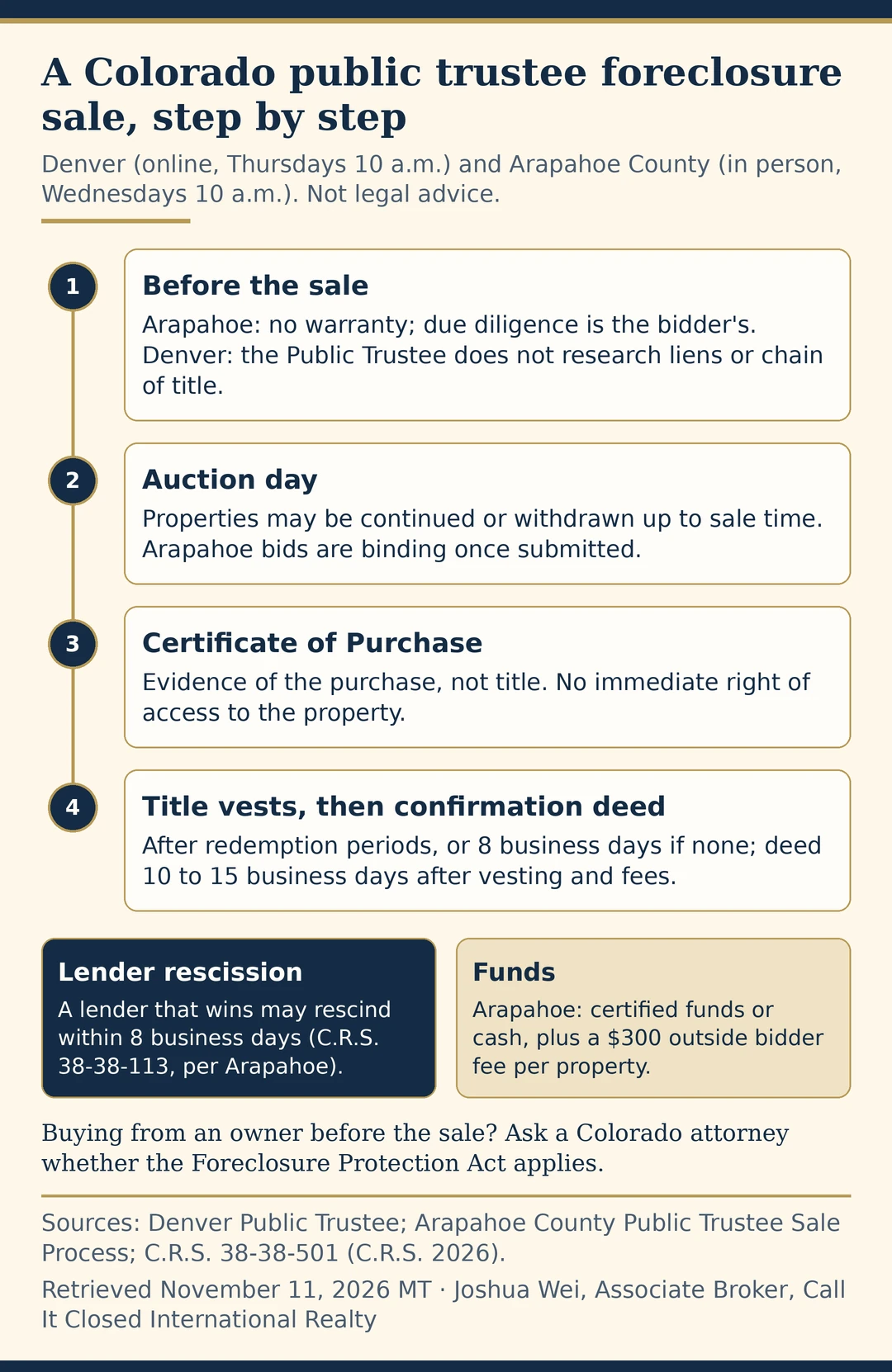
A vertical flow diagram, cream background with navy type and gold accents, titled A Colorado public trustee foreclosure sale, step by step. Subtitle: Denver (online, Thursdays 10 a.m.) and Arapahoe County (in person, Wednesdays 10 a.m.). Not legal advice. 4 numbered steps: 1, Before the sale: Arapahoe: no warranty; due diligence is the bidder's. Denver: the Public Trustee does not research liens or chain of title; 2, Auction day: Properties may be continued or withdrawn up to sale time. Arapahoe bids are binding once submitted; 3, Certificate of Purchase: Evidence of the purchase, not title. No immediate right of access to the property; 4, Title vests, then confirmation deed: After redemption periods, or 8 business days if none; deed 10 to 15 business days after vesting and fees. Two cards: Lender rescission: A lender that wins may rescind within 8 business days (C.R.S. 38-38-113, per Arapahoe); and Funds: Arapahoe: certified funds or cash, plus a $300 outside bidder fee per property. A note says: Buying from an owner before the sale? Ask a Colorado attorney whether the Foreclosure Protection Act applies. Sources: Denver Public Trustee; Arapahoe County Public Trustee Sale Process; C.R.S. 38-38-501 (C.R.S. 2026). Retrieved November 11, 2026 MT. Joshua Wei, Associate Broker, Call It Closed International Realty.
Sources: Denver Public Trustee and Foreclosures (opens in a new tab); Arapahoe County Public Trustee, Sale Process (opens in a new tab); C.R.S. 2026 Title 38 (opens in a new tab)
Cream background, navy text, gold rules. Numbered navy circles on a gold spine with white step cards, two branch cards (navy and tan), a note, and a source footer.
The timeline above runs from the pre-sale list to the confirmation deed.
What does the public trustee do?
Denver's page says the Clerk and Recorder's Public Trustee unit "holds property titles in trust when a borrower uses that property as collateral for a loan." It says the office's "two primary responsibilities are to administer foreclosures according to law, selling homes at auction when necessary, and execute the release of deeds of trust to remove mortgage liens from a property."
It also lists limits. The Public Trustee can "Explain the foreclosure process to homeowners," "Provide a list of outside resources for homeowners," and "Provide foreclosure cure information to homeowners." It cannot "Provide legal advice to homeowners," "Administer debt mitigation agreements," or "Administer appeals." Arapahoe's page says the same about advice: "The Public Trustee, including any of his or her employees, cannot give legal advice. Please consult with an attorney if you have any questions about your rights."
How do you bid?
Denver: "Bidders must register and deposit funds online to participate in the Denver Public Trustee auctions." Denver's page links to the auction site's policies and deadlines.
Arapahoe: "Bidders must personally attend the sale." The page also says: "Bidders must set their starting bids at least $1.00 over the Lender's Bid. Once submitted, your bid is binding and may not be withdrawn, even if you are the only outside bidder on the property." Payment: "Bidders must bring certified funds in the form of cashier's checks payable to the Arapahoe County Public Trustee, or cash to the sale. MONEY ORDERS ARE NOT ACCEPTED." Outside bidders also "are required to pay a $300.00 fee in addition to the full amount of their winning bid."
Arapahoe's page sets more rules for the room:
- Timing. "Doors open at 9:45 a.m." The sale is in the East Hearing Room of the County Administration Building at 5334 South Prince St. in Littleton.
- The lists. "The Pre-sale list is posted to the website after 3:00 p.m. two business days before the Wednesday sale date. An updated list is posted after 4:00 p.m. the day before the sale."
- Proof of funds. Bidders must "be prepared to show proof of funds to the Public Trustee deputy prior to being permitted to bid."
- Bid sheets. "Bidders must complete a separate bid sheet for every property on which they plan to bid."
- Order and increments. "Properties are sold in chronological order of foreclosure date." And: "Each subsequent bid must be in increments of at least $500.00."
- Conduct. "Talking or visiting is not allowed during the sale, and will be strictly enforced." The page lists statutes that disruptions "may violate," including "C.R.S. section 6-4-106 (bid-rigging)."
- Payment details. "One cashier's check may not be used to purchase two separate properties." Cash must be "counted by the Arapahoe County Treasurer; therefore, the sale of that property will be moved to the end of the list."
What the lender does before the sale
Arapahoe says: "Lenders (holders of evidence of debt) must submit their bids by 12:00 pm, two business days prior to the sale." Lenders "may submit amendments to their bids until 12:00 pm the day before the sale." And: "The lender does not need to provide funds to the Public Trustee if it is the high bidder and there is a deficiency remaining on the property." The lender's bid is the floor an outside bidder has to beat.
Can the owner stop the sale?
Denver's page describes a cure: "Absent a renegotiation of the loan between the lender and borrower, the borrower may stop the foreclosure process by" curing the default. The steps it lists:
- "An Intent to Cure form must be filled out, signed and turned in to the Public Trustee." It adds: "There is no filing fee."
- "Homeowners must file at least 15 days before the current auction date of their property in order to be guaranteed timely receipt of payment figures."
- "The foreclosing lender's attorney is required to supply cure figures to the Public Trustee within ten business days but no later than seven days prior to the sale at auction."
- "All cure payments must be in the form of a wire transfer, certified check, cashier's check or teller's check."
After a cure, "The Public Trustee will place your file on hold (this process stops the foreclosure from advancing)." For a bidder, the takeaway is that a property on the pre-sale list can drop off before the auction.
Will the property still be for sale on auction day?
Arapahoe warns that "properties may be continued or withdrawn right up to the time of the sale on Wednesday." Denver says: "Some properties will be continued (postponed) week to week because of bankruptcy, a pending cure or other reason."
What about other liens?
Denver's Public Trustee says: "The Public Trustee does not research chain of title or whether a given property has liens against it. You may use a title company or search through the public records (not all liens may be found this way)."
A foreclosure sale does not always clear every lien. If the loan being foreclosed is not the first loan on the property, the liens recorded ahead of it may stay with the property after the sale. Federal tax liens have their own rules. An IRS lien that is ahead of the loan being foreclosed may stay with the property. If the sale does wipe out an IRS lien, federal law says the United States may still redeem the property within 120 days after the sale, or within the redemption period under state law if that is longer. Before you bid, ask a title company and a Colorado real estate attorney which liens would remain after the sale and who could still redeem.
When do I actually own it?
Arapahoe explains: "Execution of the Certificate of Purchase does not transfer title and the highest bidder (grantee named in the Certificate of Purchase) does not have immediate right of access to the property."
C.R.S. 38-38-501(1) (opens in a new tab) says title vests "Upon the expiration of all redemption periods allowed to all lienors entitled to redeem under part 3 of this article or, if there are no redemption periods, upon the close of the officer's business day eight business days after the sale." Arapahoe's page says it "is strongly recommended that bidders review C.R.S. section 38-38-302," the lienor-redemption statute, before bidding.
The certificate of purchase
Under C.R.S. 38-38-401(1) (opens in a new tab), "No later than five business days after the sale, the officer shall execute and record" a certificate of purchase. Among other items, it states "The sum paid for the property," "The name and address of the purchaser," and "A statement that the purchaser or assignee of the certificate of purchase shall be entitled to a confirmation deed at the expiration of all redemption periods provided under part 3 of this article unless a redemption is made." Arapahoe calls it "simply evidence of the investment made."
Junior lienors can redeem
Denver's page says: "Redemptions take place only after a property has been sold at a foreclosure auction and is primarily a mechanism for junior lien holders." Under section 38-38-302(1)(d), a junior lienor must have, "within eight business days after the sale, filed a notice with the officer of the lienor's intent to redeem." Arapahoe says that if a valid Intent to Redeem is filed, "the holder of the Certificate of Purchase will be contacted by the Public Trustee for a signed and notarized Redemption Statement that complies with C.R.S. section 38-38-302."
Denver adds that the Redemption Statement "must be filed with the Public Trustee along with all receipts or backup by the end of business on the 13th business day after the sale. If not timely filed, the Public Trustee will calculate the amount necessary to redeem with interest only." It describes the per diem period as running "through the 19th business day (the end of the first redemption period)." If a lienor redeems, the winning bidder is paid the redemption amount instead of getting the property. Ask an attorney how that works for a specific sale.
Overbids
If you bid more than the lender, section 38-38-111(1) (opens in a new tab) says: "An overbid shall be first applied to any deficiency as indicated in the holder's bid, and then paid to the officer to be held in escrow until the end of all redemption periods." After that, remaining funds go to junior lienors who filed to redeem, and then "any remaining overbid shall be paid to the borrower." Denver's page carries the notice the statute requires: owners whose home sells for more than is owed "may have excess funds due to you."
The lender can also undo its own winning bid. Arapahoe says the lender "may rescind the sale any time within eight (8) business days after the sale," citing Colorado Revised Statutes section 38-38-113.
Buying before the auction?
If you're buying directly from an owner facing foreclosure, Colorado's Foreclosure Protection Act may apply. The Commission's forms page (opens in a new tab) lists a separate "Contract to Buy and Sell Real Estate (Residential) (Colorado Foreclosure Protection Act)." Whether the Act applies to a particular purchase is a question for a Colorado real estate attorney.
Related: Aurora property tax and metro district buyer checklist (opens in a new tab).
Frequently asked questions
Can I inspect the home before bidding?
Arapahoe's page says the Public Trustee offers no warranty and that bidders are responsible for "their own due diligence." Neither page describes interior access before the sale.
Can I evict the occupants after I win?
Arapahoe says the highest bidder "cannot evict someone from the property prior to title vesting." The process after vesting is a question for a Colorado real estate attorney.
When can I get the keys?
Denver's FAQ says: "Please consult a real estate attorney to determine when it is legal to enter a home purchased at auction through the Public Trustee. The Public Trustee does not have the keys to any properties."
Can the sale be undone after I win?
Arapahoe says: "The Public Trustee cannot set aside a sale after announcing that the property is struck and sold." It adds that a request by a non-lender to set aside a sale, or by a lender after the eight-business-day window, "is outside the jurisdiction of the Public Trustee and must be handled in a court of law." The lender's own rescission right within eight business days is separate, as noted above.
How long until I get a deed?
C.R.S. 38-38-501(1) says the officer records a confirmation deed "No earlier than ten business days nor later than fifteen business days after both the title vests and the officer has received all statutory fees and costs."
Why is the lender's bid higher than the loan balance?
Denver says it "may include late fees, unpaid interest, attorney fees, and Public Trustee fees."
Can I finance an auction purchase?
Arapahoe says bidders "must also have the full amount of their winning bid plus the $300 outside bidder fee at the sale." Financing questions are for a lender.
What if the winning bidder doesn't pay?
Arapahoe says: "If the highest bidder fails to honor their bid, then the next highest bidder who tenders the full amount of their bid shall be deemed the successful bidder."
Can an HOA redeem?
Yes, as a lienor. Denver's page says a homeowner association redeeming must provide an Intent to Redeem form, a "certified copy of the Declaration of Covenants," a "$100 redemption fee," and "A signed and notarized statement confirming that the amount claimed as the portion of the lien used to redeem does not include an amount equal to the first 6 months of dues that would have been due immediately prior to the acceleration of the loan."
Where can a homeowner facing foreclosure get help?
Denver's page lists the Colorado Foreclosure Hotline at 1-877-601-HOPE and says: "The Colorado Foreclosure Hotline offers free advice to homeowners to navigate the foreclosure process." It also says: "The Denver Public Trustee cannot offer assistance or legal advice to homeowners or to lenders."
What about property taxes?
The Public Trustee pages quoted here don't cover taxes. The county treasurer and a title company are the sources for a specific property.
An invented example
This example is invented; it is not a real property or sale.
A bidder sees an Aurora house in Arapahoe County on the pre-sale list posted Monday afternoon for Wednesday's sale. She pays a title company for a search of recorded liens, since the Public Trustee does not research liens. She checks the updated list Tuesday evening; the property is still on it. On Wednesday she arrives before 9:45 a.m. with cashier's checks covering her maximum bid plus the $300 fee, and fills out a bid sheet. The lender's bid is $310,000. She bids $310,001, another bidder raises, and she wins at $321,501. Within five business days the Public Trustee records the Certificate of Purchase. She cannot enter or evict before title vests. A junior lienor files an Intent to Redeem within eight business days, so the redemption process now decides whether she ends up with the house or with the redemption amount. She calls her attorney.
A bidder's checklist
- Read the trustee's current page for the county; procedures and fees change.
- Order your own title work; the Public Trustee "does not research chain of title."
- Watch the pre-sale and updated lists, since properties can be continued, cured or withdrawn.
- Bring certified funds for the full bid plus fees (Arapahoe), or register and deposit online (Denver).
- Review C.R.S. 38-38-302 on lienor redemption, as Arapahoe recommends.
- Plan for the wait between the sale, the Certificate of Purchase, title vesting and the confirmation deed.
- Talk to a Colorado real estate attorney about occupants, access and redemption risk.
Related notes
- Reading your title commitment: what Denver and Aurora buyers should check before the title objection deadline
- Recent renovation? Mechanics' liens when you buy or sell a Colorado home
- Special warranty, general warranty, or quitclaim? Colorado deed types for Denver and Aurora buyers, explained
Sources and method
Official sources, retrieved November 11, 2026, America/Denver:
- Denver Clerk and Recorder, Public Trustee and Foreclosures (opens in a new tab)
- Arapahoe County Public Trustee, Sale Process (opens in a new tab)
- C.R.S. 38-38-501, Colorado Revised Statutes 2026, Title 38 (opens in a new tab)
- Colorado Division of Real Estate, contracts and forms page (opens in a new tab)
Added November 13, 2026: further passages of the Denver Public Trustee page (opens in a new tab) (role, cure process, redemption, FAQ) and the Arapahoe County sale process page (opens in a new tab) (sale rules, lender bids, after the sale), and C.R.S. 38-38-111, 38-38-302 and 38-38-401 (Title 38 (opens in a new tab)). The dollar figures in the example are invented.
Quotations are verbatim. Procedures, fees, and deposits change, so check the public trustee's current page before any sale. No foreclosure counts or prices are stated.
This note is general education from a Colorado real estate broker with Call It Closed International Realty. If you're weighing a distressed property against a regular listing in Denver or Aurora, I can help you compare the two, starting with the title work and inspection access a normal purchase gives you.
Added November 19, 2026, after an expert review, and checked that day: 26 U.S.C. 7425, Discharge of liens (Cornell Legal Information Institute) (opens in a new tab).
Disclaimer
This article is general information only. It is not legal, tax, lending, insurance, appraisal, inspection, or financial advice, and it is not a substitute for advice about your situation. Joshua Wei is a Colorado real estate broker, not an attorney. Reading this article does not create a client relationship, an agency relationship, or an attorney-client relationship with Joshua Wei or with Call It Closed International Realty.
Laws, program rules, interest rates, insurance terms, tax figures, and other details change. Examples in this article are hypothetical illustrations unless a source is named for a specific, dated figure. Information in this article is believed accurate as of November 19, 2026 and is not guaranteed. No result is promised, and you should not rely on this article as the last word for your situation.
Before you act, confirm the point with the official source linked or cited in this article, and talk with a licensed professional who can apply the rule to your facts. That may be a licensed attorney, a tax professional, a lender, an insurance agent, a home inspector, or another licensed professional, depending on the question. Links to third-party websites and publications are provided for reference only. They are not an endorsement, and their content can change.
If you already have a brokerage relationship with another broker, this is not a solicitation.
Joshua Wei, Associate Broker, Call It Closed International Realty, Colorado license FA.100108558. Equal Housing Opportunity.