September 11, 2026 · Denver · Aurora · Homeownership · Zoning
Planning a fence in Denver or Aurora? Height limits, permits, setbacks, and the property line
Fence rules differ between Denver and Aurora. Denver's 4-foot front and 6-foot back limits and when a permit is needed; Aurora's 42-inch front-yard cap, sidewalk setbacks and no-permit rule for most fences; and why an ILC isn't the document to rely on for a fence line.
The short answer
In brief: Denver's fences and walls page says that, except in industrial areas, the maximum fence height is four feet in the front yard and six feet in the backyard, and all fences over four feet tall need a zoning permit. Aurora's Unified Development Ordinance caps residential front-yard fences at 42 inches. Setbacks and the property line are separate checks.
- Denver: the city's fences and walls page (opens in a new tab) says "Except for industrial areas, the maximum fence height allowed is four feet in the front yard and six feet in the backyard." It also says "All fences over four feet tall need a zoning permit."
- Aurora: Table 4.7-4 of the Unified Development Ordinance, section 146-4.7.9 (opens in a new tab) caps residential front-yard fences at "Maximum 42 inches." Side and rear fences are capped at "Maximum six feet; except fences along arterial or collector streets may be up to eight feet." Aurora's neighborhood zoning codes page (opens in a new tab) says "A fence permit is not required for new or replacement fences," but the fence must still meet the city's standards.
Denver's page says fences "should not be constructed on a neighboring property." Where a specific property line runs is a question for a professional land surveyor.
I am a licensed Colorado real estate broker with Call It Closed International Realty. I am not an attorney or a surveyor.
Disclaimer. This article is general information only. It is not legal, tax, lending, insurance, appraisal, inspection, or financial advice, and reading it does not create a client, agency, or attorney-client relationship. Laws, rates, programs, and figures change. Confirm the official source, and talk with a licensed attorney, tax professional, lender, insurance agent, or inspector before you act. Joshua Wei is a Colorado real estate broker, not an attorney. He is an Associate Broker with Call It Closed International Realty, license FA.100108558. Equal Housing Opportunity.
 Full size (opens in a new tab)
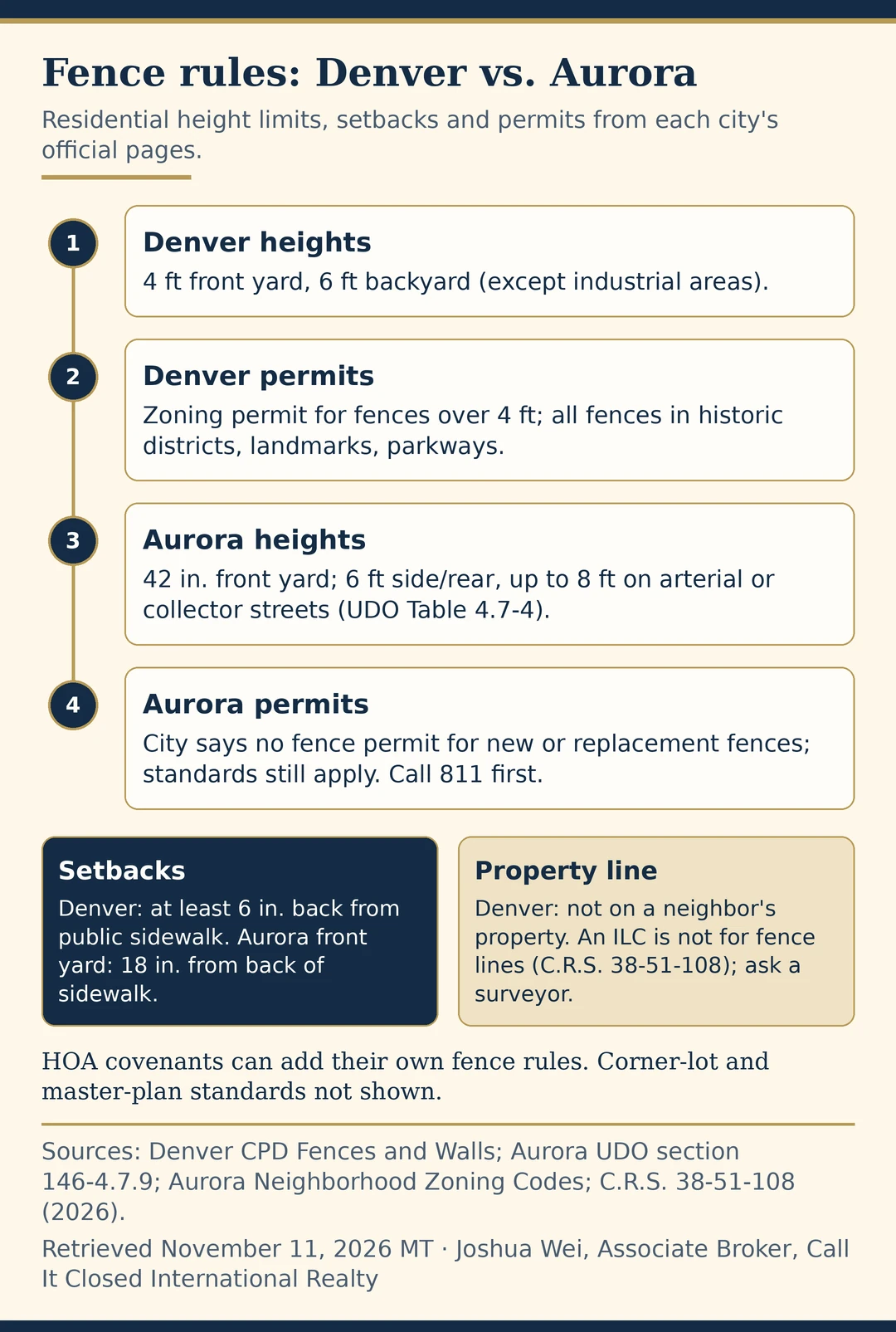
A vertical flow diagram, cream background with navy type and gold accents, titled Fence rules: Denver vs. Aurora. Subtitle: Residential height limits, setbacks and permits from each city's official pages. 4 numbered steps: 1, Denver heights: 4 ft front yard, 6 ft backyard (except industrial areas); 2, Denver permits: Zoning permit for fences over 4 ft; all fences in historic districts, landmarks, parkways; 3, Aurora heights: 42 in. front yard; 6 ft side/rear, up to 8 ft on arterial or collector streets (UDO Table 4.7-4); 4, Aurora permits: City says no fence permit for new or replacement fences; standards still apply. Call 811 first. Two cards: Setbacks: Denver: at least 6 in. back from public sidewalk. Aurora front yard: 18 in. from back of sidewalk; and Property line: Denver: not on a neighbor's property. An ILC is not for fence lines (C.R.S. 38-51-108); ask a surveyor. A note says: HOA covenants can add their own fence rules. Corner-lot and master-plan standards not shown. Sources: Denver CPD Fences and Walls; Aurora UDO section 146-4.7.9; Aurora Neighborhood Zoning Codes; C.R.S. 38-51-108 (2026). Retrieved November 11, 2026 MT. Joshua Wei, Associate Broker, Call It Closed International Realty.
Sources: Denver Fences and Walls (opens in a new tab); Aurora UDO 146-4.7.9 (opens in a new tab)
Cream background, navy text, gold rules. Numbered navy circles on a gold spine with white step cards, two branch cards (navy and tan), a note, and a source footer.
The figure above compares the two cities' height limits, setbacks and permit rules side by side.
Denver: where can the fence go?
Denver's page says:
- "Fences should not be constructed on a neighboring property or in the public right-of-way. The public right-of-way includes streets, alleys, sidewalks, and tree lawn areas."
- "All fences and walls must be at least 6 inches back from the public sidewalk, regardless of where the property line is located."
The front-yard limit is measured from the "primary street-facing façade." Fences in front of that wall must be four feet or shorter.
Denver's page defines the term: "Primary street-facing façade refers to the building wall that faces the primary street. In many cases, this is the wall where the building's front door is located." It adds: "Fences behind this point can be up to six feet in height."
For industrial areas, the page says "the maximum height allowed is 7 feet within the setback and 10 feet outside of the setback." It also says "Taller heights may be allowed in certain situations," and points to Section 10.5.5 of the Denver Zoning Code for over-height fences and walls.
Denver: when do I need a permit?
Denver says fences under four feet "do not require a permit, unless the site has landmark or historic status." Fences over four feet need a zoning permit. "All walls, including retaining walls, over 12 inches high need a zoning permit."
Fences and walls "in a historic district, an individually designated landmark, or located along a designated parkway require a permit" at any height.
What the Zoning Code adds
The page summarizes Denver Zoning Code section 10.5.5 (opens in a new tab). The code measures the front-yard line more precisely: "The maximum height of a fence or wall when forward of at least 75% of the total width of the Primary Street-facing Façades of all Primary Structures shall be 4 feet."
Over-height fences have a set path. Under section 10.5.5.1.C, the Zoning Administrator "may grant a permit for fences and walls that exceed the maximum height" by "no more than 2 feet," if criteria are met. They include that "The fence or wall is necessary to provide security, privacy, or protection from traffic impacts such as noise or lights," and that it "shall not adversely affect traffic safety, appropriate use of adjacent property, or established trees." Requests to go more than two feet over "shall be processed under Section 12.4.7, Variances."
Materials are listed in section 10.5.5.1.E: "Wood; Composite materials; Brick; Masonry; Metal/iron bars (ornamental fence); Textured or aggregate concrete; Chain link or wire mesh." The code prohibits "scrap metal doors, tires, car doors, or other salvaged or discarded materials." Existing fences of prohibited materials "may not be maintained" and "shall be immediately reconstructed of approved materials or removed."
At corners, section 10.5.5.1.A says "Any landscaping, fence, wall, or screening within a sight triangle shall be approved by the Department of Transportation and Infrastructure ('DOTI')."
Zoning permit versus building permit
Denver separates the two. A zoning permit is about height and location. A building permit is about construction. The page says: "Post-hole dug fences only need a building permit if they are taller than eight feet, but all other fence and wall types require building permits if they are over four feet tall." It adds that "Masonry walls and retaining walls over six feet in height require commercial engineering plan review and a building permit."
So a six-foot wood fence set in post holes in a Denver backyard needs a zoning permit, because it's over four feet. Under the page's wording, it doesn't need a building permit, because post-hole fences only need one above eight feet. A six-foot masonry wall in the same spot is not a post-hole fence. It falls under "all other fence and wall types," so it needs a building permit as well.
What Denver asks for with an application
Permits go through Denver's e-permits system. The page says a site plan should show:
- "Labels and dimensions of all zone lot lines (e.g., primary, side, rear)"
- "The distance of the proposed fence/wall from all zone lot lines"
- "Labels for adjacent streets and alleys"
- "All existing structures already on the property"
- "Proposed fence/wall location and height"
- "Proposed fence/wall materials"
Elevations are needed if the plan includes "A mix of materials, such as a fence on top of a retaining wall etc." or "An over-height fence or wall." The page also notes that "If your property is in a floodplain or if you are digging within two feet of the sewer line, a sewer use and drainage permit (SUDP) may be required."
Aurora: setbacks and materials
Aurora's UDO table sets a front-yard fence setback of "18 inches minimum from back of sidewalk, unless larger setback required by another provision of this UDO." For side and rear yards it lists "Four feet minimum from back of sidewalk, if replacing an existing fence," and "Where existing homes that share a rear yard fence, the fence may be located on the lot line." The UDO also lists prohibited fence types and materials; Aurora's zoning staff can answer questions about a specific design.
Corner lots
Corner lots have their own rows in Table 4.7-4. The height is "Maximum 42 inches," and "A fence that meets the front yard requirements may wrap a corner and shall be set back a minimum of 18 inches from back of sidewalk." For side yards along the street, "New side yard fences shall be set back a minimum of 10 feet from the back of sidewalk adjacent to the street, but in no case less than 15 feet from the street flowline. A replacement for an existing fence shall be set back a minimum of 4 feet from the back of sidewalk."
The general standards add a sight-triangle rule in section 146-4.7.9.C.2: "Corner lot fences shall have a 45 degree angle if located within the 30 foot sight triangle." And under C.1, "no fence, wall, or hedge shall be located in a location that the City determines will create a traffic hazard."
Fire hydrants
Section 146-4.7.9.C.3 says "No person shall place or keep any post, fence, wall, retaining wall, tree, shrub, hedge, or any other structure or planting within five feet of a fire hydrant or Fire Department connection." A variation needs "written approval from the Fire/Life Safety representative within the Building Division."
Front-yard design
Aurora allows some solid elements in a front yard. Under section 146-4.7.9.L.2, "An open-style fence on a solid base is permitted in the front yard, provided the base does not exceed 18 inches in height." Only "stucco and masonry materials are allowed" for that base, and "A wood base is not allowed." The section also says "Open style picket fences that are at least 50 percent opaque are permitted in front yard."
Materials Aurora allows and bans
Section 146-4.7.9.D lists acceptable materials, including "Brick, stone, and decorative concrete masonry unit (CMU) fences," "Wrought iron style and metal picket fences," "Closed style wood or stockade fencing," "Chain link with or without weather resistant color coating," and "Composite wood." It says wood or stockade fencing "shall have a top rail."
The prohibited list in section 146-4.7.9.E includes "Electrically charged fences," with an exception for battery-operated alarmed fences, and "Fences constructed of chicken wire, corrugated metal, fabric materials, fiberboard, garage door panels, plywood, snow fencing, agricultural, rope, and miscellaneous materials not commonly associated with residential fences." In Residential districts, picket fences "less than six feet six inches in height shall have the top of pickets sawed or rounded to provide a blunt end."
Construction and gates
Section 146-4.7.9.R sets construction standards. Two are practical for homeowners:
- "All fence posts for fences over 42 inches in height shall be set in circular concrete bases a minimum of two feet deep and one-foot diameter."
- "The finished side of the fence shall face the public right-of-way or private streets or alleys, as applicable."
The gate standards in section 146-4.7.9.S say "All gates shall have hardware to secure the gate in a closed position," and that a gate along a sidewalk "shall not open into the public sidewalk area except when a person is entering or exiting the gated area."
Retaining walls in Aurora
Under section 146-4.7.9.T.2, residential retaining walls are capped at "Maximum 48 inch height adjacent to rear lot lines" and "Maximum 30 inch height adjacent to side lot lines." The section adds that "Any wall exceeding 30 inches in height requires a pedestrian railing or barrier," and "Terraced retaining walls are not permitted within the side yards of single-family detached homes."
Master plans and HOAs
Under section 146-4.7.9.B.3, development must also follow "any additional fence and wall standards applicable to the development in any approved Master Plan that includes the property." For subdivisions where the rear of lots faces a street, section 146-4.7.9.C.4 says "a homeowners' association, Title 32 District, or other approved quasi-public entity shall maintain a fence or wall." A homeowner may not be the one who controls that kind of perimeter fence. Ask the HOA or metro district who owns and maintains a fence along the back of a lot.
Aurora's zoning codes page adds: "Before installing a fence, contact Colorado 811 or 1.800.922.1987 to locate buried utility services."
That step is a state requirement, not just a tip. Under C.R.S. 9-1.5-103(3)(a)(II) (opens in a new tab), "a person shall not make or begin excavation without first notifying the notification association," with listed exceptions. Under (3)(b), notice "shall be given at least two business days prior thereto not including the day of actual notice." The statute's definition of "Excavation" in 9-1.5-102 lists "augering," "trenching" and "postholing" among the covered operations. It excludes "Routine maintenance on existing planted landscapes." Whether a specific project falls under an exception is a question for Colorado 811.
How do I know where my property line is?
C.R.S. 38-51-108, in the 2026 Colorado Revised Statutes, Title 38 (opens in a new tab), says an improvement location certificate's certification "is not to be relied upon for the establishment of fence, building, or other future improvement lines." Which survey fits a project is a question for a professional land surveyor.
HOA covenants can have their own fence rules; the association can say what applies to a specific lot.
Two hypotheticals
These are invented, to show how the rules stack.
A Denver backyard fence. An owner wants a six-foot cedar fence along the rear lot line, set in post holes, behind the house. Denver's height rule allows up to six feet behind the primary street-facing façade. Because it's over four feet, it needs a zoning permit. As a post-hole fence under eight feet, Denver's page says it doesn't need a building permit. The owner notifies Colorado 811 at least two business days before digging, and confirms where the lot line is before the posts go in.
An Aurora corner lot. An owner wants privacy along the side street of a corner lot. A new side-yard fence must be set back "a minimum of 10 feet from the back of sidewalk adjacent to the street, but in no case less than 15 feet from the street flowline," and the 30-foot sight triangle applies near the corner. Height along the side and rear is up to six feet, except along arterial or collector streets. The owner also checks the HOA's covenants and any master plan standards.
A checklist before you build or buy
- Find your zone lot lines and the primary street-facing façade (Denver) or front, side and rear yards (Aurora).
- Check the height limit for each segment, and whether the lot is a corner lot.
- Confirm permit needs: zoning and possibly building permits in Denver; Aurora says no fence permit, but the standards still apply.
- Check historic, landmark or parkway status in Denver.
- Read HOA covenants and ask who owns any perimeter fence.
- Notify Colorado 811 before digging.
- If you're buying, ask the seller whether permits were pulled for a tall fence or retaining wall. Our permit history guide explains where to look.
Frequently asked questions
How tall can a backyard fence be in Denver?
Six feet, outside industrial areas, per Denver's page.
Do I need a permit for a 6-foot fence in Denver?
Denver says "All fences over four feet tall need a zoning permit."
How tall can a front-yard fence be in Aurora?
42 inches, under UDO Table 4.7-4.
Do I need a fence permit in Aurora?
Aurora says a fence permit isn't required for new or replacement fences, but the fence must meet city standards.
Can my fence sit right on the sidewalk?
Denver requires at least 6 inches back from the public sidewalk. For Aurora front yards, UDO Table 4.7-4 says "18 inches minimum from back of sidewalk, unless larger setback required by another provision of this UDO."
Do I need a building permit for a Denver fence?
Denver's page says "Post-hole dug fences only need a building permit if they are taller than eight feet, but all other fence and wall types require building permits if they are over four feet tall."
Can I put a fence near a fire hydrant in Aurora?
Not within five feet, under UDO section 146-4.7.9.C.3, unless the Building Division's Fire/Life Safety representative approves in writing.
How tall can a retaining wall be in an Aurora backyard?
Section 146-4.7.9.T.2 sets "Maximum 48 inch height adjacent to rear lot lines" and 30 inches next to side lot lines.
Do I have to call 811 before putting in fence posts?
C.R.S. 9-1.5-103(3) requires notice to the notification association at least two business days before excavation, with exceptions.
Can I use my ILC to place a fence?
C.R.S. 38-51-108 says an ILC "is not to be relied upon for the establishment of fence, building, or other future improvement lines."
Related notes
- Checking permit history before you buy in Denver or Aurora: where to look and what unpermitted work can mean
- ILC or survey? What Denver and Aurora buyers should know about Improvement Location Certificates
- What a Colorado HOA can't prohibit: flags, signs, xeriscape, EV chargers, heat pumps, and more for Denver and Aurora owners
Sources and method
Official sources, retrieved November 11 and 13, 2026, America/Denver. The Aurora code site blocks automated requests; its text was read through a web fetch on November 13:
- City and County of Denver, Fences and Walls (opens in a new tab)
- Aurora Unified Development Ordinance section 146-4.7.9 (opens in a new tab): Table 4.7-4 and subsections B, C, D, E, L, R, S, T
- Denver Zoning Code, Article 10 (opens in a new tab): section 10.5.5 (republished February 25, 2025)
- City of Aurora, Neighborhood Zoning Codes (opens in a new tab)
- Colorado Revised Statutes 2026, Title 38 (opens in a new tab), C.R.S. 38-51-108
- Colorado Revised Statutes 2026, Title 9 (opens in a new tab), C.R.S. 9-1.5-103(3)
Quotations are verbatim. Denver's screening rules in section 10.5.7, retaining wall standards and specific master-plan standards aren't covered here, so check them with the city. The hypotheticals are invented.
This note is general education from a Colorado real estate broker with Call It Closed International Realty. If you're buying a Denver or Aurora home with fence plans, I'll help you check the survey options and HOA rules before you close.
Disclaimer
This article is general information only. It is not legal, tax, lending, insurance, appraisal, inspection, or financial advice, and it is not a substitute for advice about your situation. Joshua Wei is a Colorado real estate broker, not an attorney. Reading this article does not create a client relationship, an agency relationship, or an attorney-client relationship with Joshua Wei or with Call It Closed International Realty.
Laws, program rules, interest rates, insurance terms, tax figures, and other details change. Examples in this article are hypothetical illustrations unless a source is named for a specific, dated figure. Information in this article is believed accurate as of November 13, 2026 and is not guaranteed. No result is promised, and you should not rely on this article as the last word for your situation.
Before you act, confirm the point with the official source linked or cited in this article, and talk with a licensed professional who can apply the rule to your facts. That may be a licensed attorney, a tax professional, a lender, an insurance agent, a home inspector, or another licensed professional, depending on the question. Links to third-party websites and publications are provided for reference only. They are not an endorsement, and their content can change.
If you already have a brokerage relationship with another broker, this is not a solicitation.
Joshua Wei, Associate Broker, Call It Closed International Realty, Colorado license FA.100108558. Equal Housing Opportunity.