October 12, 2026 · Denver · Aurora · Buying · Selling
ILC or survey? What Denver and Aurora buyers should know about Improvement Location Certificates
An Improvement Location Certificate (ILC) is not a land survey. What Colorado Revised Statutes section 38-51-108 says an ILC is and isn't, how section 9 of Colorado's residential contract handles a New ILC or New Survey, and how it connects to owner's extended title coverage.
The short answer
In brief: Colorado's purchase contract lets the parties require a New Improvement Location Certificate (ILC) or a New Survey, and state law treats them differently. Under Colorado Revised Statutes section 38-51-108, an ILC is not a land survey plat or improvement survey plat, and its certification says it is not to be relied on to establish fence, building or other future improvement lines.
In a Colorado home purchase, the contract lets the parties require a "New Improvement Location Certificate (New ILC)" or a "New Survey." State law distinguishes the two.
Under Colorado Revised Statutes section 38-51-108 (opens in a new tab), an ILC "shall not be designated as or construed as being a land survey plat or improvement survey plat." The surveyor's required certification states that it "is not to be relied upon for the establishment of fence, building, or other future improvement lines."
Which document fits a specific purchase or project is a question for a professional land surveyor and the title company.
I am a licensed Colorado real estate broker with Call It Closed International Realty. I am not an attorney or a land surveyor. This is not legal advice.
Disclaimer. This article is general information only. It is not legal, tax, lending, insurance, appraisal, inspection, or financial advice, and reading it does not create a client, agency, or attorney-client relationship. Laws, rates, programs, and figures change. Confirm the official source, and talk with a licensed attorney, tax professional, lender, insurance agent, or inspector before you act. Joshua Wei is a Colorado real estate broker, not an attorney. He is an Associate Broker with Call It Closed International Realty, license FA.100108558. Equal Housing Opportunity.
 Full size (opens in a new tab)
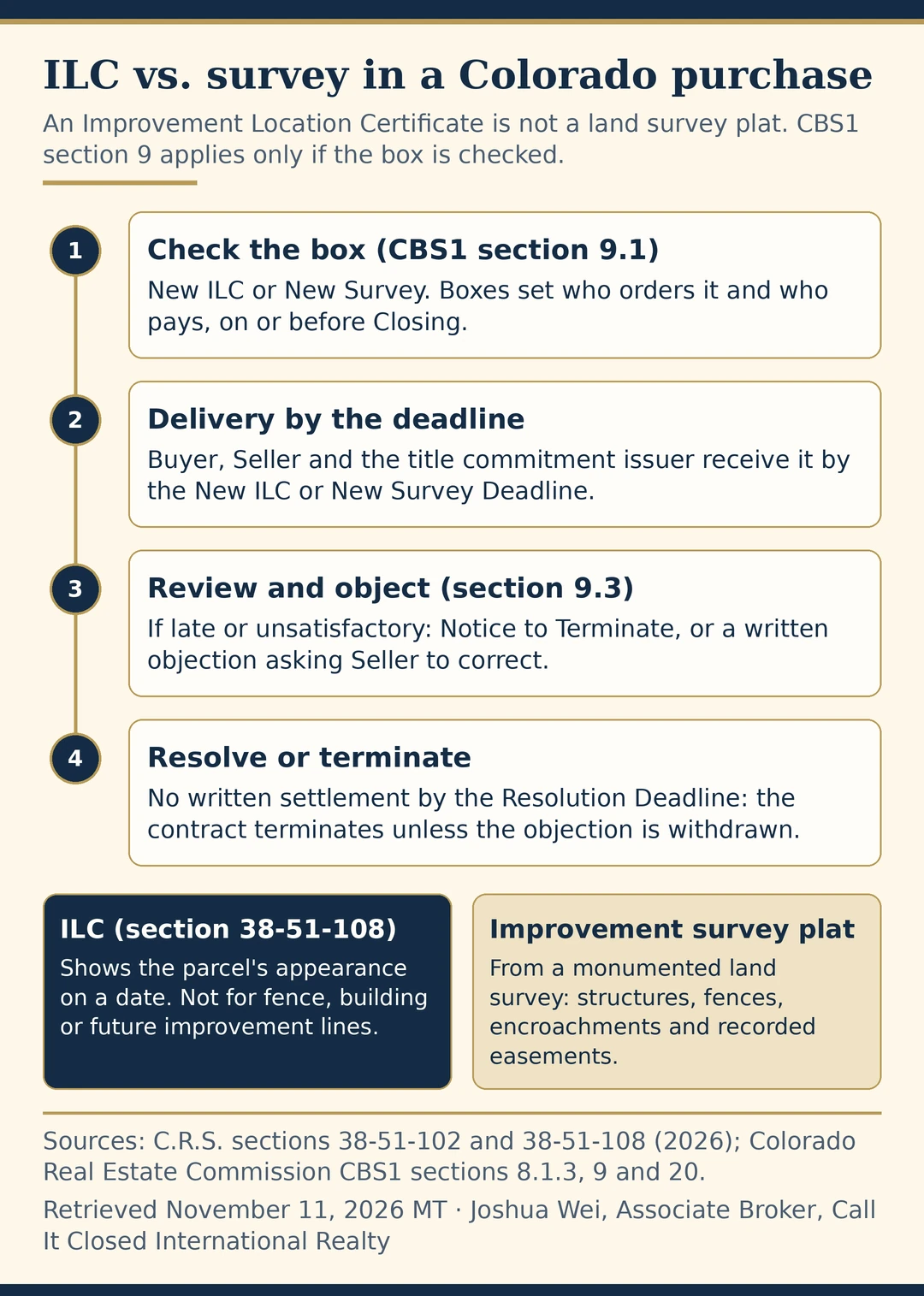
A vertical flow diagram, cream background with navy type and gold accents, titled ILC vs. survey in a Colorado purchase, with the subtitle an Improvement Location Certificate is not a land survey plat, and CBS1 section 9 applies only if the box is checked. Four numbered steps: 1, check the box under CBS1 section 9.1 for a New ILC or New Survey, with boxes setting who orders it and who pays, on or before Closing; 2, delivery by the deadline, when Buyer, Seller and the title commitment issuer receive it by the New ILC or New Survey Deadline; 3, review and object under section 9.3, so that if it is late or unsatisfactory the buyer can send a Notice to Terminate or a written objection asking Seller to correct; 4, resolve or terminate, since with no written settlement by the Resolution Deadline the contract terminates unless the objection is withdrawn. Two lower cards: ILC under section 38-51-108, which shows the parcel's appearance on a date and is not for fence, building or future improvement lines; and improvement survey plat, from a monumented land survey, showing structures, fences, encroachments and recorded easements. Sources: Colorado Revised Statutes and the Colorado Real Estate Commission residential contract. Retrieved November 11, 2026 MT.
Sources: C.R.S. Title 38 (2026) (opens in a new tab); DRE contracts and forms (opens in a new tab)
Cream background, navy text, gold rules. Four numbered steps on a gold spine, two side-by-side cards, and a 28px source footer.
The diagram above compares an ILC with an improvement survey plat and shows the contract steps in section 9. It summarizes the statute and the Commission contract.
What is an ILC?
Colorado Revised Statutes section 38-51-102(8) (opens in a new tab) defines it: "Improvement location certificate" means "a representation of the boundaries of a parcel of land and the improvements thereon, prepared pursuant to section 38-51-108."
Section 38-51-108(1) says who it is for: "A professional land surveyor may prepare an improvement location certificate for the use of a specific client based upon the professional land surveyor's general knowledge of land boundaries and monuments in a given area whether or not the client is the owner or buyer; except that, if the client is not the owner or buyer, the professional land surveyor shall provide a copy of the certificate to the owner or buyer."
Note the basis named there: the surveyor's "general knowledge of land boundaries and monuments in a given area." The statute does not describe an ILC as a monumented land survey.
The certificate must be "prominently labeled "improvement location certificate"" and include a statement in the statutory form. The first paragraph of that statement reads: "I hereby certify that this improvement location certificate was prepared for .... (individual or firm) ...., that it is not a land survey plat or improvement survey plat, and that it is not to be relied upon for the establishment of fence, building, or other future improvement lines. This certificate is valid only for use by .... (individual or firm) .... and describes the parcel's appearance on .... (date) ...."
Two limits are built into that text. The certificate names who may use it, and it speaks as of one date. Part of that statement certifies "that the improvements on the above described parcel on this date, .... (insert date) ...., except utility connections, are entirely within the boundaries of the parcel, except as shown, that there are no encroachments upon the described premises by improvements on any adjoining premises, except as indicated, and that there is no apparent evidence or sign of any easement crossing or burdening any part of said parcel, except as noted."
The statute also says: "A professional land surveyor shall assume full liability for each improvement location certificate done by such professional land surveyor or under such professional land surveyor's responsible charge."
How is a survey different?
An improvement survey plat is a full survey product. Section 38-51-102(9) (opens in a new tab) defines it as "a land survey plat as defined in subsection (12) of this section resulting from a monumented land survey showing the location of all structures, visible utilities, fences, hedges, or walls situated on the described parcel and within five feet of all boundaries of such parcel, any conflicting boundary evidence or visible encroachments, and all easements, underground utilities, and tunnels for which properly recorded evidence is available from the county clerk and recorder, a title insurance company, or other sources as specified on the improvement survey plat."
A "Monumented land survey" is one "in which monuments are either found or set" to mark the boundaries. Under section 38-51-102(12.3), "Monument" means "the object or physical structure that marks the corner point." The ILC certification, by contrast, says it "describes the parcel's appearance" on a date.
What must a land survey plat show?
Section 38-51-102(12) says a land survey plat "includes all information required by section 38-51-106." Section 38-51-106(1) lists those items. They include:
- "A scale drawing of the boundaries of the land parcel;"
- "All recorded and apparent rights-of-way and easements," with the source named if someone other than the surveyor did that research;
- "All field-measured dimensions necessary to establish the boundaries on the ground";
- "A description of all monuments, both found and set, that mark the boundaries of the property and of all control monuments used in conducting the survey";
- "The signature and seal of the professional land surveyor;" and
- "Any conflicting boundary evidence."
A client can ask that easements be left off. Section 38-51-106(1)(b)(II) says that in that case the plat carries "a statement that such client did not want rights-of-way and easements shown."
Section 38-51-107(1) adds a public-record step for some surveys. A surveyor who accepts a monument while performing a monumented land survey "shall prepare and deposit a plat if such monument is not of record" in the county clerk and recorder's office or the other designated public office. Under section 38-51-107(2), no plat is required "if the monuments accepted or set are within a platted subdivision that was filed in the clerk and recorder's office within the previous twenty years."
ILC and improvement survey plat side by side
| | ILC (section 38-51-108) | Improvement survey plat (section 38-51-102(9)) | |---|---|---| | Statutory basis | "general knowledge of land boundaries and monuments in a given area" | "a monumented land survey" | | Monuments | Not described as found or set | "monuments are either found or set" | | Fences, future improvements | "not to be relied upon for the establishment of fence, building, or other future improvement lines" | Shows "all structures, visible utilities, fences, hedges, or walls" on the parcel and within five feet of its boundaries | | Easements | "no apparent evidence or sign of any easement crossing or burdening any part of said parcel, except as noted" | "all easements, underground utilities, and tunnels for which properly recorded evidence is available" | | Who may use it | "valid only for use by" the named individual or firm | Not limited by that certification |
The table quotes the statute. Which product a lender, a title company, or a planned project calls for is a question for them and for a professional land surveyor.
Who can prepare an ILC or survey?
Section 38-51-102(16) says "Professional land surveyor" means "a person licensed pursuant to part 3 of article 120 of title 12." The licensing board, under section 38-51-102(5), is "the state board of licensure for architects, professional engineers, and professional land surveyors, created in section 12-120-103."
The Division of Professions and Occupations runs the Architects, Engineers and Land Surveyors program page (opens in a new tab), and the state's license lookup (opens in a new tab) lists "Architects, Engineers and Land Surveyors" among its license types. A buyer can use it to confirm a surveyor's license.
The statute protects the label. Section 38-51-109(2) says: "It is unlawful for any person to offer to sell, to sell, or otherwise to receive remuneration for any document, sketch, or diagram which purports to be an improvement location certificate unless such document, sketch, or diagram conforms with the standards, requirements, and terminology of this article." Under section 38-51-110(2), a person "who willfully and knowingly violates this article is guilty of a misdemeanor" and faces "a fine of not less than one hundred fifty dollars or more than one thousand five hundred dollars."
How does the Colorado contract handle it?
Section 9 of the Colorado Real Estate Commission's residential contract (CBS1, 2026 form (opens in a new tab)), from the Division of Real Estate's contracts and forms page (opens in a new tab), applies only "If the box is checked." The checked boxes then set:
- Who orders it. Section 9.1.1 has boxes for "Seller" or "Buyer." It adds: "The New ILC or New Survey may also be a previous ILC or survey that is in the above-required form, certified and updated as of a date after the date of this Contract."
- Who pays. Under section 9.1.2, the cost "will be paid, on or before Closing," by the party checked.
- Who receives it. Under section 9.1.3, "Buyer, Seller, the issuer of the Title Commitment" and anyone named will receive it "on or before New ILC or New Survey Deadline."
- Who it is certified to. Section 9.1.4 says: "The New ILC or New Survey will be certified by the surveyor to all those who are to receive the New ILC or New Survey." That matters because the statutory ILC certification says it "is valid only for use by" the named party.
The checkbox in section 9.1 offers two choices: "(1) New Improvement Location Certificate (New ILC); or, (2) New Survey in the form of ___." If the parties pick a survey, the blank is where the type of survey is written in.
Section 9.2 lets the buyer change course in two ways. First: "Buyer may select a New ILC or New Survey different than initially specified in this Contract if there is no additional cost to Seller or change to the New ILC or New Survey Objection Deadline." Second: "Buyer may, in Buyer's sole subjective discretion, waive a New ILC or New Survey if done prior to Seller incurring any cost for the same."
What if the ILC shows a problem?
Section 9.3 gives the buyer a review right. If the New ILC or New Survey "is not timely received by Buyer or is unsatisfactory to Buyer, in Buyer's sole subjective discretion," the buyer may, by the New ILC or New Survey Objection Deadline, either send a Notice to Terminate or deliver "a written description of any matter that was to be shown or is shown in the New ILC or New Survey that is unsatisfactory and that Buyer requires Seller to correct."
Section 9.3 says those rights apply "notwithstanding section 8.3. or section 13," the contract's off-record title and transfer-of-title sections. How that wording plays out in a dispute is a question for a Colorado real estate attorney.
Under section 9.3.3, if the parties "have not agreed in writing to a settlement thereof on or before New ILC or New Survey Resolution Deadline, this Contract will terminate on expiration of the New ILC or New Survey Resolution Deadline," unless the seller receives the buyer's written withdrawal of the objection first.
CBS1 section 20 says: "Time is of the essence for all dates and deadlines in this Contract." Talk with your broker before a deadline passes, and with an attorney about any boundary dispute.
What about the seller's old surveys?
CBS1 section 8.3 covers off-record title. It says the seller "must deliver to Buyer, on or before Off-Record Title Deadline, true copies of all existing surveys in Seller's possession pertaining to the Property." It then adds: "This Section excludes any New ILC or New Survey governed under section 9 (New ILC, New Survey)."
Section 8.3 also gives the buyer "the right to inspect the Property to investigate if any third party has any right in the Property not shown by public records (e.g., unrecorded easement, boundary line discrepancy or water rights)."
So an existing survey delivered under section 8.3 and a New ILC ordered under section 9 run on separate deadlines.
How does it connect to title insurance?
CBS1 section 8.1.3 covers Owner's Extended Coverage (OEC). If the commitment is to contain OEC, "it will commit to delete or insure over the standard exceptions which relate to: (1) parties in possession, (2) unrecorded easements, (3) survey matters, (4) unrecorded mechanics' liens," along with "(5) gap period (period between the effective date and time of commitment to the date and time the deed is recorded) and (6) unpaid taxes, assessments and unredeemed tax sales prior to the year of Closing."
Section 8.1.3 also carries a caveat: "Regardless of whether the Contract requires OEC, the Title Insurance Commitment may not provide OEC or delete or insure over any or all of the standard exceptions for OEC."
The contract adds: "The Title Insurance Company may require a New Survey or New ILC, defined below, among other requirements for OEC." Ask the title company early what it needs.
An invented example
This example is invented to show how the sections fit; it is not a real property.
A buyer is under contract on a Denver bungalow with a detached garage near the back lot line and a wood fence along one side. The contract checks the New ILC box, the seller orders it, and the buyer pays under section 9.1.2. The buyer also asked for OEC under section 8.1.3.
- The ILC arrives by the New ILC or New Survey Deadline and shows the fence a short distance off the line, marked "except as shown."
- Under section 9.3, the buyer has until the objection deadline to send a Notice to Terminate or a written objection describing what the seller must correct.
- The buyer also plans to replace the fence after closing. The ILC certification says it "is not to be relied upon for the establishment of fence, building, or other future improvement lines," so the buyer asks a professional land surveyor what is needed for that project.
- The buyer asks the title company how the ILC affects the OEC survey exception.
What the fence location means legally is a question for a Colorado real estate attorney.
Buyer checklist
- Decide whether to check section 9.1, and if a survey, what form to write in the blank.
- Ask the title company and lender what they need before the New ILC or New Survey Deadline.
- Confirm the surveyor's license in the state lookup.
- Make sure the certificate is certified to everyone listed in section 9.1.3.
- Compare the ILC with any existing surveys delivered under section 8.3.
- Calendar the New ILC or New Survey Objection and Resolution Deadlines.
Related: Adverse possession and boundary questions for buyers and fence rules in Denver and Aurora.
Related: Flood maps, drainage, and insurance for Denver and Aurora buyers (opens in a new tab).
Frequently asked questions
Can I use an ILC to place a new fence?
The statutory certification says an ILC "is not to be relied upon for the establishment of fence, building, or other future improvement lines." Ask a professional land surveyor what you need.
Is an ILC required in every Colorado purchase?
In CBS1, section 9 applies "If the box is checked." Ask your lender and title company about their own requirements.
Who pays for the ILC?
The contract leaves it to the boxes in section 9.1.2. It is negotiable.
Can the seller's old ILC be reused?
Section 9.1.1 allows "a previous ILC or survey that is in the above-required form, certified and updated as of a date after the date of this Contract."
What does "encroachment" mean on an ILC?
The certification addresses whether improvements are "entirely within the boundaries of the parcel, except as shown," and whether there are "encroachments upon the described premises by improvements on any adjoining premises, except as indicated." Ask the surveyor to explain anything marked.
Can I switch from an ILC to a full survey after signing?
Section 9.2 says the buyer "may select a New ILC or New Survey different than initially specified in this Contract if there is no additional cost to Seller or change to the New ILC or New Survey Objection Deadline."
How do I check that the surveyor is licensed?
Section 38-51-102(16) ties the title to a license under part 3 of article 120 of title 12. The state's license lookup includes "Architects, Engineers and Land Surveyors."
Can I skip the ILC to make my offer stronger?
CBS1 section 9.2 addresses a buyer's waiver. What a waiver would mean for title coverage is a question for the title company or a Colorado real estate attorney.
Related notes
- Reading your title commitment: what Denver and Aurora buyers should check before the title objection deadline
- Special warranty, general warranty, or quitclaim? Colorado deed types for Denver and Aurora buyers, explained
- Colorado purchase contract deadlines, in plain English
Sources and method
Official sources, retrieved November 11, 2026, America/Denver: Colorado Revised Statutes sections 38-51-102 and 38-51-108 (opens in a new tab) (2026 Colorado Revised Statutes, Title 38); and the Colorado Real Estate Commission's Contract to Buy and Sell Real Estate (Residential) (CBS1), sections 8.1.3 and 9 (2026 form PDF (opens in a new tab)), from the Division of Real Estate contracts and forms page (opens in a new tab). Added November 13, 2026: Colorado Revised Statutes sections 38-51-106, 38-51-107, 38-51-109, and 38-51-110 (Title 38 (opens in a new tab)); CBS1 section 8.3; the Division of Professions and Occupations AES program page (opens in a new tab) and license lookup (opens in a new tab). Quotations are verbatim. No surveying costs are estimated.
This note is general education from a Colorado real estate broker with Call It Closed International Realty. If you are writing an offer in Denver or Aurora, I can walk you through the ILC and survey choices in section 9 before you sign.
Disclaimer
This article is general information only. It is not legal, tax, lending, insurance, appraisal, inspection, or financial advice, and it is not a substitute for advice about your situation. Joshua Wei is a Colorado real estate broker, not an attorney. Reading this article does not create a client relationship, an agency relationship, or an attorney-client relationship with Joshua Wei or with Call It Closed International Realty.
Laws, program rules, interest rates, insurance terms, tax figures, and other details change. Examples in this article are hypothetical illustrations unless a source is named for a specific, dated figure. Information in this article is believed accurate as of November 13, 2026 and is not guaranteed. No result is promised, and you should not rely on this article as the last word for your situation.
Before you act, confirm the point with the official source linked or cited in this article, and talk with a licensed professional who can apply the rule to your facts. That may be a licensed attorney, a tax professional, a lender, an insurance agent, a home inspector, or another licensed professional, depending on the question. Links to third-party websites and publications are provided for reference only. They are not an endorsement, and their content can change.
If you already have a brokerage relationship with another broker, this is not a solicitation.
Joshua Wei, Associate Broker, Call It Closed International Realty, Colorado license FA.100108558. Equal Housing Opportunity.