October 1, 2026 · Denver · Aurora · Buying · Selling
Buying an older Denver or Aurora home? Lead paint disclosures and lead water service lines, explained
Federal law requires a lead-based paint disclosure and a 10-day evaluation opportunity on most pre-1978 homes. Denver Water and Aurora Water also publish service-line maps. What the EPA rule, the Colorado contract, and both utilities say, and what a buyer can check before closing.
The short answer
In brief: Older Denver and Aurora homes raise two separate lead questions. For most homes built before 1978, federal rules require a lead-based paint disclosure, records, a pamphlet and a 10-day opportunity for the buyer to inspect before being bound. Lead water service lines are a different question, checked through Denver Water's and Aurora Water's published lookups.
Older Front Range homes can carry two different lead questions, and they are handled in two different ways.
Paint. For most homes built before 1978, federal law requires a specific disclosure before a buyer is bound by a contract. The U.S. Environmental Protection Agency's regulation, 40 CFR Part 745, Subpart F (opens in a new tab), describes its purpose as requiring sellers and landlords of most pre-1978 housing to "disclose to the purchaser or lessee the presence of any known lead-based paint and/or lead-based paint hazards; provide available records and reports; provide the purchaser or lessee with a lead hazard information pamphlet; give purchasers a 10-day opportunity to conduct a risk assessment or inspection; and attach specific disclosure and warning language to the sales or leasing contract before the purchaser or lessee is obligated under a contract to purchase or lease target housing."
Water pipes. The pipe that brings water from the main to the house, called the service line, is a separate issue. Denver Water's Lead Service Lines (opens in a new tab) page states: "The primary source of lead in drinking water is customer-owned lead service lines — the pipe that brings water from the water main in the street to the plumbing in the home." Both Denver Water and Aurora Water publish address-lookup maps.
Each has its own documents and contract dates. What a home inspection covers is a question for your inspector.
I am a licensed Colorado real estate broker with Call It Closed International Realty. I am not an environmental inspector, a risk assessor, a plumber, a physician, or an attorney. For health questions about lead exposure, talk to a medical professional or the Colorado Department of Public Health and Environment.
Disclaimer. This article is general information only. It is not legal, tax, lending, insurance, appraisal, inspection, or financial advice, and reading it does not create a client, agency, or attorney-client relationship. Laws, rates, programs, and figures change. Confirm the official source, and talk with a licensed attorney, tax professional, lender, insurance agent, or inspector before you act. Joshua Wei is a Colorado real estate broker, not an attorney. He is an Associate Broker with Call It Closed International Realty, license FA.100108558. Equal Housing Opportunity.
 Full size (opens in a new tab)
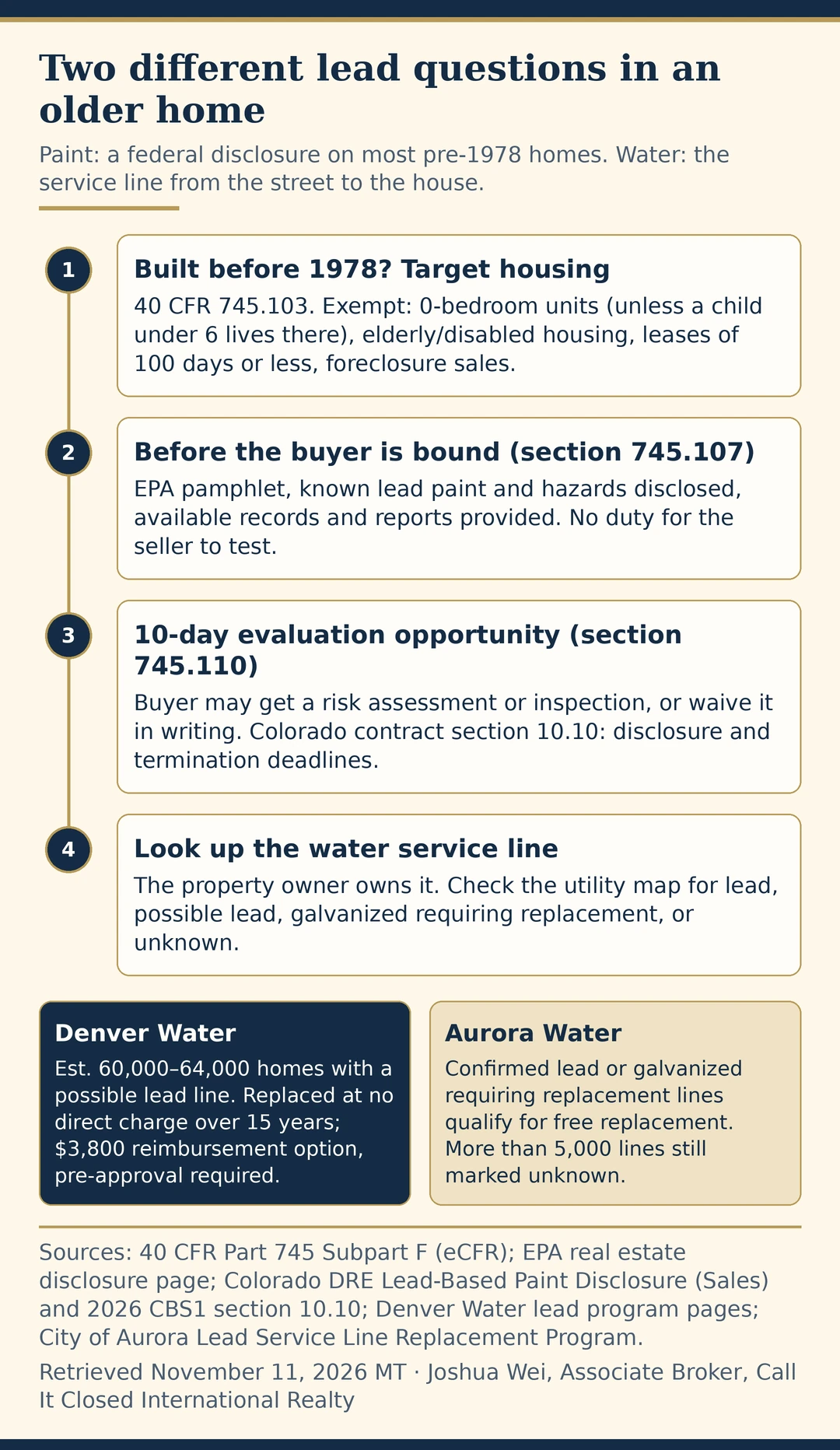
A vertical flow diagram, cream background with navy type and gold accents, titled Two different lead questions in an older home. Subtitle: paint is a federal disclosure on most pre-1978 homes, and water is the service line from the street to the house. Four numbered steps: 1, built before 1978 means target housing under 40 CFR 745.103, with exemptions for zero-bedroom units unless a child under 6 lives there, elderly or disabled housing, leases of 100 days or less, and foreclosure sales; 2, before the buyer is bound under section 745.107, the seller provides the EPA pamphlet, discloses known lead paint and hazards, and provides available records and reports, with no duty to test; 3, a 10-day evaluation opportunity under section 745.110, where the buyer may get a risk assessment or inspection or waive it in writing, and the Colorado contract section 10.10 sets disclosure and termination deadlines; 4, look up the water service line, which the property owner owns, on the utility map for lead, possible lead, galvanized requiring replacement, or unknown. Two lower cards: Denver Water, an estimated 60,000 to 64,000 homes with a possible lead line, replaced at no direct charge over 15 years, with a 3,800 dollar reimbursement option requiring pre-approval; Aurora Water, where confirmed lead or galvanized requiring replacement lines qualify for free replacement and more than 5,000 lines are still marked unknown. Sources: eCFR, EPA, Colorado Division of Real Estate forms, Denver Water, and City of Aurora. Retrieved November 11, 2026 MT.
Sources: eCFR, 40 CFR Part 745 Subpart F (opens in a new tab); EPA, Real Estate Disclosures About Potential Lead Hazards (opens in a new tab); Denver Water, Lead Reduction Program (opens in a new tab); City of Aurora, Lead Service Line Replacement Program (opens in a new tab)
Cream background, navy text, gold rules. Four numbered steps on a gold spine, two side-by-side utility cards, and a 28px source footer.
The diagram above splits the two lead questions: the federal paint disclosure on pre-1978 homes, and the water service line between the street and the house. It summarizes official sources and does not assess any property.
Which homes are covered by the lead paint disclosure rule?
The rule applies to "target housing." The regulation defines it as "any housing constructed prior to 1978, except housing for the elderly or persons with disabilities or any 0-bedroom dwelling (unless any child who is less than 6 years of age resides or is expected to reside in such housing)."
The EPA's Real Estate Disclosures About Potential Lead Hazards (opens in a new tab) page lists exemptions, including "Zero-bedroom units, such as efficiencies, lofts, and dormitories (unless a child under the age of six lives or is expected to live in such housing)," "Leases for 100 days or less," and "Foreclosure sales."
The year the house was built is the first check. The county assessor's parcel record lists a year built, and the seller's records may show more.
What does the seller have to provide?
Under 40 CFR section 745.107 (opens in a new tab), these steps "shall be completed before the purchaser or lessee is obligated under any contract to purchase or lease target housing":
- "The seller or lessor shall provide the purchaser or lessee with an EPA-approved lead hazard information pamphlet," such as "Protect Your Family From Lead in Your Home."
- "The seller or lessor shall disclose to the purchaser or lessee the presence of any known lead-based paint and/or lead-based paint hazards in the target housing being sold or leased."
- "The seller or lessor shall provide the purchaser or lessee with any records or reports available to the seller or lessor pertaining to lead-based paint and/or lead-based paint hazards in the target housing being sold or leased."
The same section adds an important limit: "Nothing in this section implies a positive obligation on the seller or lessor to conduct any evaluation or reduction activities."
In Colorado transactions, the Commission's Lead-Based Paint Disclosure (Sales) form, posted on the Division of Real Estate's contracts and forms page (opens in a new tab), is the attachment that carries this. It opens with the federally required Lead Warning Statement, which begins: "Every purchaser of any interest in residential real property on which a residential dwelling was built prior to 1978 is notified that such property may present exposure to lead from lead-based paint that may place young children at risk of developing lead poisoning." The form also warns: "Penalties for failure to comply with Federal Lead-Based Paint Disclosure Laws include treble (3 times) damages, attorney fees, costs, and a base penalty adjusted for inflation for each violation."
What "available" means. The seller's duty covers records "available to the seller." The regulation's definitions in 40 CFR section 745.103 (opens in a new tab) say: "Available means in the possession of or reasonably obtainable by the seller or lessor at the time of the disclosure." So the definition reaches records the seller can reasonably obtain, not only those already in hand.
What the signed attachment contains. 40 CFR section 745.113(a) (opens in a new tab) says "Each contract to sell target housing shall include an attachment containing the following elements." Besides the Lead Warning Statement, they include "A statement by the seller disclosing the presence of known lead-based paint and/or lead-based paint hazards in the target housing being sold or indicating no knowledge of the presence of lead-based paint and/or lead-based paint hazards," and "A list of any records or reports available to the seller pertaining to lead-based paint and/or lead-based paint hazards in the housing that have been provided to the purchaser. If no such records or reports are available, the seller shall so indicate." The full warning statement in the regulation also says: "Lead poisoning also poses a particular risk to pregnant women."
Keep the paperwork. Under section 745.113(c)(1), "The seller, and any agent, shall retain a copy of the completed attachment required under paragraph (a) of this section for no less than 3 years from the completion date of the sale."
The EPA adds a point about brokers: "Agents are responsible, along with the seller or lessor, for complying with this rule unless the seller or lessor fails to disclose to the agent all information on lead-based paint or lead-based paint hazards."
The regulation sets out the agent's duty in 40 CFR section 745.115(a) (opens in a new tab): "Each agent shall ensure compliance with all requirements of this subpart." The agent must "Inform the seller or lessor of his/her obligations under sections 745.107, 745.110, and 745.113." Under section 745.115(b), an agent who has done that "shall not be liable for the failure to disclose to a purchaser or lessee the presence of lead-based paint and/or lead-based paint hazards known by a seller or lessor but not disclosed to the agent."
The definition of "agent" in section 745.103 has a limit that matters for buyers: "This term does not apply to purchasers or any purchaser's representative who receives all compensation from the purchaser." A buyer's broker paid only by the buyer is outside the regulation's definition of agent.
Penalties. Under 40 CFR section 745.118(c) (opens in a new tab), "Any person who knowingly violates the provisions of this subpart shall be jointly and severally liable to the purchaser or lessee in an amount equal to 3 times the amount of damages incurred by such individual." Section 745.118(d) lets a court award "reasonable attorney fees and any expert witness fees" to a prevailing party in a damages suit. And section 745.119 says the federal rule doesn't relieve anyone "from any responsibility for compliance with State or local laws, ordinances, codes, or regulations governing notice or disclosure of known lead-based paint."
What is the 10-day evaluation opportunity?
40 CFR section 745.110 (opens in a new tab) states: "Before a purchaser is obligated under any contract to purchase target housing, the seller shall permit the purchaser a 10-day period (unless the parties mutually agree, in writing, upon a different period of time) to conduct a risk assessment or inspection for the presence of lead-based paint and/or lead-based paint hazards." It also says "a purchaser may waive the opportunity to conduct the risk assessment or inspection by so indicating in writing."
The Colorado form has the buyer choose. Paragraph 8 asks the buyer to elect to "Obtain a risk assessment or an inspection of the Property for the presence of lead-based paint and/or lead-based paint hazards, within the time limit and under the terms of section 10 of the Contract to Buy and Sell Real Estate," or to "Waive the opportunity to conduct a risk assessment or inspection."
The 2026 Contract to Buy and Sell Real Estate (Residential) has dated deadlines for this. Section 10.10.1 says that, unless exempt, the seller and licensees "must sign and deliver to Buyer a completed Lead-Based Paint Disclosure (Sales) form on or before the Lead-Based Paint Disclosure Deadline." If the buyer does not receive it on time, the buyer "may waive the failure to timely receive the Lead-Based Paint Disclosure, or Buyer may exercise Buyer's Right to Terminate under section 24.1. by Seller's receipt of Buyer's Notice to Terminate on or before the expiration of the Lead-Based Paint Termination Deadline." Section 10.10.2 gives a buyer who elects an assessment or inspection a right to terminate "on or before the expiration of the Lead-Based Paint Termination Deadline," and states: "If Seller does not receive Buyer's Notice to Terminate within such time, Buyer accepts the condition of the Property relative to any Lead-Based Paint as satisfactory."
For what a given evaluation covers and the credentials it requires, ask a certified lead inspector or risk assessor.
What if I plan to renovate a pre-1978 home?
The EPA's Renovation, Repair and Painting Program (opens in a new tab) page says the rule "requires that anyone paid to perform work that disturbs painted surfaces in homes, childcare facilities and preschools built before 1978 be certified." It adds: "In general, the RRP Rule does not apply to homeowners doing RRP projects in their own pre-1978 homes. However, it does apply if you rent all or part of your home, operate a childcare center in your home or if you buy, renovate and sell homes for profit." The EPA "recommends that homeowners hire a lead-safe certified contractor."
For renovation costs and schedules in a pre-1978 home, ask a lead-safe certified contractor.
How do I check a Denver or Aurora water service line?
Who owns it. Denver Water's Laws About Lead and You (opens in a new tab) page states: "The full water service line is owned by the property owner." Its reimbursement page says: "Property owners own the service line from the point of the tap located in the street to the home."
Denver Water. Its Lead Reduction Program (opens in a new tab) page offers an address search and says the map will tell you if a home "is one of the estimated 60,000 to 64,000 homes with a possible lead service line." The service-lines page adds: "In Denver Water's experience, homes built before 1951 are more likely to have lead service lines," and says the program "will replace customer-owned lead service lines with copper lines at no direct charge to the customer. It will take 15 years to replace all of them." Denver Water also describes "a longer construction outlook detailing where lead service line replacements will occur from 2026 to 2031, outlined by neighborhood and year."
For owners who want to move faster, Denver Water's reimbursement page (opens in a new tab) states: "The reimbursement is a one-time payment of $3,800 which is approximately half of the utility's cost for replacement." It also says "An application for reimbursement must be submitted and approved in advance of replacement of the lead service line," and that the property "must not be on Denver Water's schedule for lead service line replacement in the current calendar year or in the next calendar year."
Aurora Water. The City of Aurora's Lead Service Line Replacement Program (opens in a new tab) page offers a service line material map and states: "If Aurora Water confirmed you have a lead or galvanized requiring replacement water service line, the property owner qualifies for a free water service line replacement." It explains that "In Colorado, properties constructed in 1960 or earlier sometimes installed lead or galvanized steel water service lines," and that "Currently, Aurora Water has more than 5,000 service lines marked as unknown."
For a specific Aurora address, start with the map.
Who can answer what. The utility maps show a line's listed material. For what is known about a specific line, ask the seller and the utility. For the line's condition, ask a licensed plumber. Denver Water also offers a free water test kit through its program page. That page also offers to "Request a free replacement water pitcher or filter." When Denver Water finds a lead line during its own construction, its service-lines page says: "we replace that line entirely with copper. To protect residents' health, we provide a filter and this important handout."
Related: Radon testing when buying in Denver or Aurora (opens in a new tab).
A buyer's checklist for an older home
- Check the year built on the county assessor's record. If it's before 1978, the Lead-Based Paint Disclosure (Sales) form applies unless an exemption listed above does.
- Read the seller's statement on the form and the list of records. If records are listed, ask for copies.
- Decide on Paragraph 8: an assessment or inspection, or a written waiver. Note the Lead-Based Paint Termination Deadline in the contract.
- Look up the address on the Denver Water or Aurora Water service line map.
- If the map shows lead, galvanized or unknown, ask the seller what they know and ask the utility about replacement timing.
- If you plan to remodel, plan for EPA RRP certification for any paid contractor.
A hypothetical
This example is invented. A buyer goes under contract on a 1948 Denver bungalow. The seller checks "no knowledge" on the lead paint form and lists no reports. The buyer elects a risk assessment under Paragraph 8, within the contract's deadline. Separately, the Denver Water map shows a possible lead service line. Those are two different tracks. The paint question runs through the federal form and the contract deadlines. The water line question runs through Denver Water's program: its replacement schedule, or the $3,800 reimbursement if the property isn't on the schedule for the current or next year.
Frequently asked questions
Does every older home need a lead-based paint inspection?
No. Federal law requires the seller to disclose what is known and to give the buyer an opportunity to evaluate, which the buyer "may waive ... by so indicating in writing."
My house was built in 1979. Does the paint disclosure apply?
No, not under the federal rule. The rule covers housing "constructed prior to 1978," and EPA says the rule does not apply to "Housing built after 1977." So a home built in 1979 is not target housing. The year matters, so check it. If the assessor record, the permits, and the seller's records disagree, or the build year is not clear, ask your broker or a real estate attorney whether to give the lead-based paint disclosure anyway. EPA says a seller or agent who does not give the required information "may be subject to penalties." Whether old paint is present is a separate question. A certified lead inspector or risk assessor can answer that.
Will a general home inspection find a lead service line?
The Denver Water and Aurora Water maps list a line's material. Whether an inspection covers the service line is a question for your inspector, and a licensed plumber can look at the line.
Who pays to replace a lead service line?
Denver Water says its program replaces customer-owned lead lines "at no direct charge to the customer" on its schedule, with a $3,800 reimbursement option for earlier replacement. Aurora says owners with a confirmed lead or galvanized-requiring-replacement line qualify "for a free water service line replacement."
Does a seller have to disclose a known lead service line?
The Commission's Seller's Property Disclosure (Residential), on the Division of Real Estate forms page (opens in a new tab), states: "If Seller has knowledge of an adverse material fact affecting the Property or occupants, it must be disclosed whether there is a specific item on this SPD or not." Whether a particular fact meets that standard is a question for a real estate attorney.
How long does the seller have to keep the lead paint form?
Under 40 CFR section 745.113(c)(1), "no less than 3 years from the completion date of the sale," for both the seller and any agent.
Where can I get health information about lead?
The Colorado Department of Public Health and Environment and your medical provider. This article does not give health advice.
Related notes
- Buying an older Denver or Aurora home to remodel? Colorado's asbestos inspection rules come first
- Sewer scopes and roof inspections in Denver and Aurora: what they catch that a general inspection can miss
- Buying a Denver or Aurora home? Make radon testing a plan, not a checkbox.
Sources and method
Official sources, retrieved November 11 and 13, 2026, America/Denver: 40 CFR Part 745, Subpart F (opens in a new tab) (sections 745.100, 745.103, 745.107, 745.110, 745.113, 745.115, 745.118, 745.119) on eCFR; EPA Real Estate Disclosures About Potential Lead Hazards (opens in a new tab) and Lead Renovation, Repair and Painting Program (opens in a new tab); Colorado Division of Real Estate forms page (opens in a new tab) (Lead-Based Paint Disclosure (Sales) (opens in a new tab), the 2026 Contract to Buy and Sell Real Estate (Residential) (opens in a new tab), sections 10.10.1–10.10.2, and the Seller's Property Disclosure (Residential) (opens in a new tab)); Denver Water Lead Reduction Program (opens in a new tab), Lead Service Lines (opens in a new tab), Laws About Lead and You (opens in a new tab), and reimbursement (opens in a new tab) pages; and the City of Aurora Lead Service Line Replacement Program (opens in a new tab). Quotations are verbatim. Counts and dollar amounts are the utilities' own published figures. No property-level assessment and no health advice are given. The hypothetical is invented.
This note is general education from a Colorado real estate broker with Call It Closed International Realty. If you are looking at an older home in Denver or Aurora, I can help you line up the disclosure, inspection, and utility checks inside your contract dates.
Disclaimer
This article is general information only. It is not legal, tax, lending, insurance, appraisal, inspection, or financial advice, and it is not a substitute for advice about your situation. Joshua Wei is a Colorado real estate broker, not an attorney. Reading this article does not create a client relationship, an agency relationship, or an attorney-client relationship with Joshua Wei or with Call It Closed International Realty.
Laws, program rules, interest rates, insurance terms, tax figures, and other details change. Examples in this article are hypothetical illustrations unless a source is named for a specific, dated figure. Information in this article is believed accurate as of November 19, 2026 and is not guaranteed. No result is promised, and you should not rely on this article as the last word for your situation.
Before you act, confirm the point with the official source linked or cited in this article, and talk with a licensed professional who can apply the rule to your facts. That may be a licensed attorney, a tax professional, a lender, an insurance agent, a home inspector, or another licensed professional, depending on the question. Links to third-party websites and publications are provided for reference only. They are not an endorsement, and their content can change.
If you already have a brokerage relationship with another broker, this is not a solicitation.
Joshua Wei, Associate Broker, Call It Closed International Realty, Colorado license FA.100108558. Equal Housing Opportunity.