November 4, 2026 · Denver · Aurora · Buying · Renovation · Inspections
Buying an older Denver or Aurora home to remodel? Colorado's asbestos inspection rules come first
Colorado requires a certified asbestos inspection before renovation that disturbs materials above set trigger levels, including in single-family homes. What CDPHE says about the trigger levels, certified inspectors and contractors, notice periods, and demolition.
The short answer
In brief: Colorado's asbestos rules can apply before a remodel or demolition that disturbs building materials. CDPHE says that if the components to be disturbed exceed the trigger levels, they must be inspected for asbestos by a Colorado-certified Asbestos Building Inspector before work starts. For single-family homes, CDPHE publishes specific trigger levels for pipes and other surfaces.
Colorado's asbestos rules can apply before a remodel or demolition that disturbs building materials. The Colorado Department of Public Health and Environment (CDPHE) says: "If the components that will be disturbed exceed the trigger levels, they must be inspected for asbestos by a Colorado-certified Asbestos Building Inspector before starting work."
CDPHE's single-family trigger levels are 50 linear feet on pipes, 32 square feet on other surfaces, or the volume equivalent of a 55-gallon drum. Whether a particular project crosses them is a question for a Colorado-certified Asbestos Building Inspector.
I am a licensed Colorado real estate broker with Call It Closed International Realty. I am not an asbestos inspector, contractor, or attorney.
Disclaimer. This article is general information only. It is not legal, tax, lending, insurance, appraisal, inspection, or financial advice, and reading it does not create a client, agency, or attorney-client relationship. Laws, rates, programs, and figures change. Confirm the official source, and talk with a licensed attorney, tax professional, lender, insurance agent, or inspector before you act. Joshua Wei is a Colorado real estate broker, not an attorney. He is an Associate Broker with Call It Closed International Realty, license FA.100108558. Equal Housing Opportunity.
 Full size (opens in a new tab)
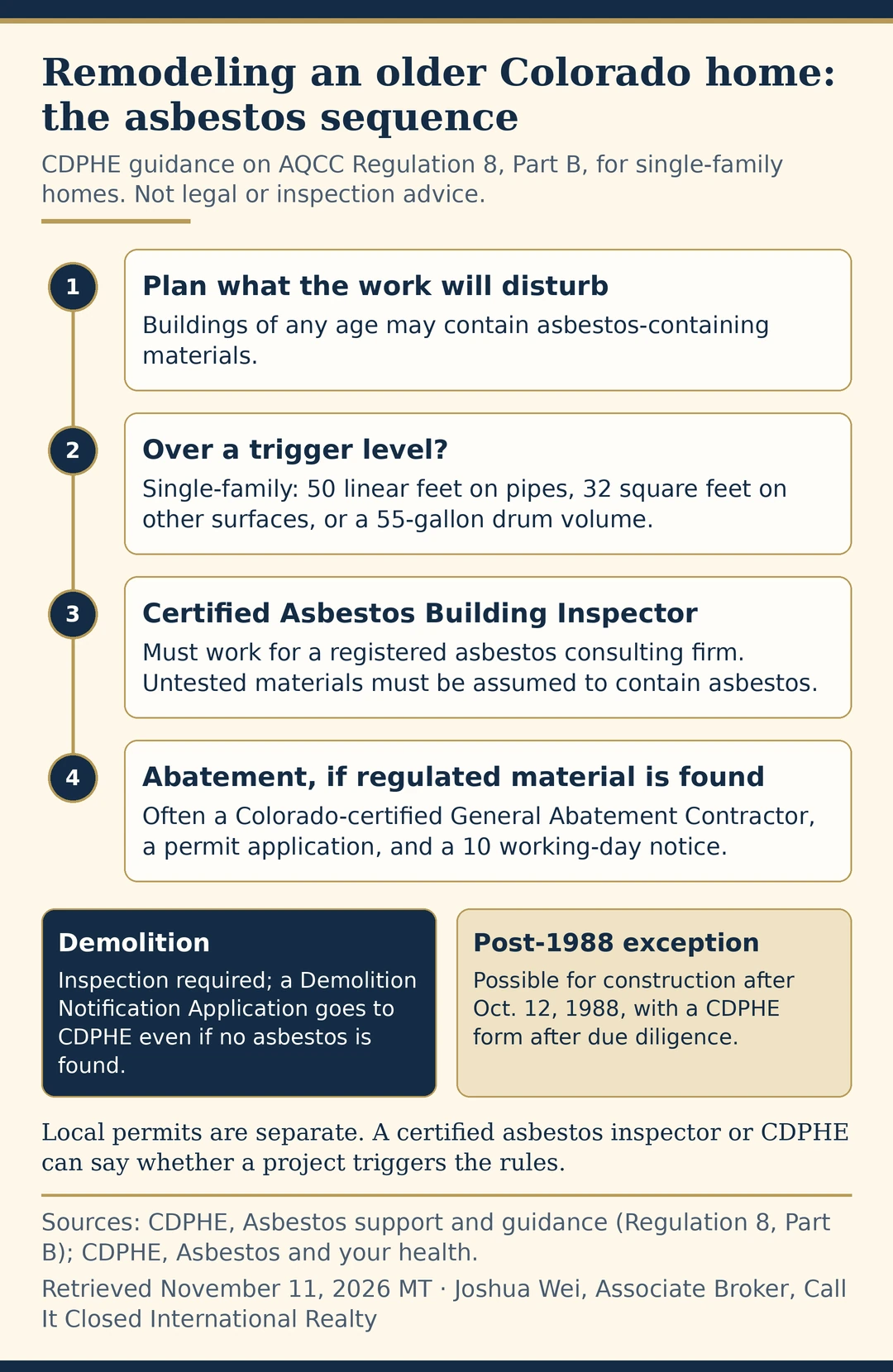
A vertical flow diagram, cream background with navy type and gold accents, titled Remodeling an older Colorado home: the asbestos sequence. Subtitle: CDPHE guidance on AQCC Regulation 8, Part B, for single-family homes. Not legal or inspection advice. 4 numbered steps: 1, Plan what the work will disturb: Buildings of any age may contain asbestos-containing materials; 2, Over a trigger level?: Single-family: 50 linear feet on pipes, 32 square feet on other surfaces, or a 55-gallon drum volume; 3, Certified Asbestos Building Inspector: Must work for a registered asbestos consulting firm. Untested materials must be assumed to contain asbestos; 4, Abatement, if regulated material is found: Often a Colorado-certified General Abatement Contractor, a permit application, and a 10 working-day notice. Two cards: Demolition: Inspection required; a Demolition Notification Application goes to CDPHE even if no asbestos is found; and Post-1988 exception: Possible for construction after Oct. 12, 1988, with a CDPHE form after due diligence. A note says: Local permits are separate. A certified asbestos inspector or CDPHE can say whether a project triggers the rules. Sources: CDPHE, Asbestos support and guidance (Regulation 8, Part B); CDPHE, Asbestos and your health. Retrieved November 11, 2026 MT. Joshua Wei, Associate Broker, Call It Closed International Realty.
Sources: CDPHE, Asbestos support and guidance (opens in a new tab); CDPHE, Asbestos and your health (opens in a new tab)
Cream background, navy text, gold rules. Numbered navy circles on a gold spine with white step cards, two branch cards (navy and tan), a note, and a source footer.
The flow above walks through CDPHE's sequence, from planning a project to permitted abatement.
Why does an older home matter?
CDPHE's asbestos and health page (opens in a new tab) says: "Before the 1990s, asbestos was more widely used in various building materials, including ceiling tiles, floor tiles, roofing shingles, pipes, boilers, water heaters, popcorn ceilings, and textured surfacing materials typically found on walls and ceilings."
Age isn't the whole test. CDPHE's renovation guidance (opens in a new tab) also says: "Buildings of any age may contain asbestos-containing materials."
The health page explains why. "In 1989, the EPA passed a partial ban on the manufacture, import, processing, and distribution of some asbestos-containing products." But: "In 1991, the U.S. Fifth Circuit Court of Appeals vacated much of the so-called Asbestos Ban and Phaseout rule and remanded it to the EPA." It adds: "Many sources incorrectly report that all asbestos-containing products have been banned since then," and "Products manufactured in other countries may also contain asbestos and can be imported into the United States."
Where it can be in a house
The health page lists products that "may contain asbestos." Items a homebuyer may see in a house include "Decorative plaster," "Joint compounds," "Adhesives and mastics," "Floor tile," "Blown-in insulation," "Pipe insulation (corrugated air-cell, block, etc.)," "Boiler insulation," "Roofing shingles," "Spackling compounds," "Caulking/putties," and "Sheet vinyl flooring (linoleum)."
It also says: "The only way to know if a material contains asbestos is to have the material tested by an accredited laboratory. An inspection by a Colorado-certified Asbestos Building Inspector can confirm where asbestos-containing material is located in a home or any other building."
Why disturbance matters
CDPHE says: "Asbestos exposure can occur when asbestos-containing materials are disturbed or damaged, releasing fibers into the air. This may occur during demolition work, building, home maintenance, repair, or remodeling." On health effects: "Asbestos fibers are a known carcinogen that can cause respiratory disease." CDPHE adds that researchers have not determined a safe level of exposure. It also notes that "exposure to asbestos fibers does not cause immediate symptoms. If you are concerned about an exposure, seek the advice of your medical provider."
What are the trigger levels?
From CDPHE's guidance (opens in a new tab), "Single-Family Residential Dwellings trigger levels are":
- "50 linear feet on pipes."
- "32 square feet on other surfaces."
- "Volume equivalent of a 55- gallon drum."
The thresholds are higher for public and commercial buildings: "260 linear feet on pipes. 160 square feet on other surfaces. Volume equivalent of a 55-gallon drum." Which rules apply to work in a condo building's common areas is a question for CDPHE and the HOA.
Who can inspect and remove asbestos?
The inspection must be done by a certified inspector: "The certified Asbestos Building Inspector must work for a registered asbestos consulting firm." CDPHE also says: "Under many circumstances, a Colorado-certified General Abatement Contractor must remove asbestos-containing material that is or may become regulated before it is disturbed by renovation or demolition activities."
Paperwork and timing: "A ten working-day notification period is required before the work can commence."
Renovation, abatement and demolition are different categories
CDPHE's health page defines renovation as "altering in any way one or more components in or on a facility." Its examples "include the replacement or repair of mechanical ventilation systems, pipes, ceilings, walls, flooring (including floor tiles), and insulating materials." It adds: "Operations in which load-supporting structural members are wrecked or removed are demolitions."
The support page defines abatement as "the removal of friable asbestos-containing material or materials that will be rendered friable in amounts greater than the above trigger levels." For that work: "Abatement must be conducted by a Colorado-certified General Abatement Contractor (GAC)." For non-friable material that stays non-friable during removal: "Other contractors may remove non-friable materials if done in accordance with Regulation 8, Part B." In both cases, a notification and permit application and fee go to the division, with the ten-working-day period.
Disposal has its own rule: "All asbestos-containing material waste must be disposed of at an approved asbestos waste disposal site, regardless of the quantity or the necessity for a notice/permit."
What the state fees are
CDPHE's fee table for single-family homes with material above the trigger levels but at or below the public and commercial levels lists: "Single Family Residential Dwelling Notice - $60.00," a "30-day permit - $180.00," a "90-day permit - $300.00," and a "1-year permit - $420.00." Above the higher amounts, the listed fees are a "30-day permit - $400.00," "90-day permit - $800.00," and "1 year permit - $1,200.00." The demolition notice is "$50.00 base fee plus" $5.00 per 1,000 square feet. These are state fees only, not contractor or inspector costs.
There's a limited exception for newer construction: it "may be made if the building, or those portions thereof, were constructed after October 12, 1988" and a specified form is completed after due diligence.
What does the statute say about homeowners?
The rules above come from Colorado Revised Statutes, Title 25, Article 7, Part 5, which CDPHE lists among its resources. The 2026 statutes (Title 25 PDF) (opens in a new tab) contain three provisions that matter for an owner-occupant.
First, Colorado Revised Statutes section 25-7-502(1)(a) defines "Area of public access" and says the term "includes a single-family residential dwelling and any facility that charges the general public a fee for admission, such as any theater or arena." Subsection (1)(c) then provides that "a single family residential dwelling shall not be considered an area of public access for purposes of conducting asbestos abatement if the homeowner who resides in the single family dwelling that is the homeowner's primary residence requests, on a form provided by the division, that the single family dwelling not be considered an area of public access." That matches the "opt-out" form on CDPHE's list.
Second, Colorado Revised Statutes section 25-7-503(1)(a)(IV) says permits "shall be required for asbestos abatement projects in any building, facility, or property, or any portion thereof, having public access; except that the requirements of this subsection (1)(a)(IV) shall not apply to asbestos abatement projects performed by an individual on a single-family residential dwelling that is the individual's primary residence."
Third, Colorado Revised Statutes section 25-7-504(3) says the certification requirements "shall apply to asbestos abatement on a single-family residential dwelling; except that the requirements of this section shall not apply to any individual who performs asbestos abatement on a single-family residential dwelling that is the individual's primary residence."
CDPHE's support page, by contrast, says: "Individuals must possess current Colorado certification to work in any regulated asbestos activity." I am not resolving how the statute's homeowner exceptions and the page's certification statement fit together. A buyer planning to do any of this work personally after moving in should ask CDPHE first. None of these exceptions applies to a house you are buying but do not yet own and live in.
What a building permit application asks
Colorado Revised Statutes section 25-7-509.5(1) says a local government that issues building permits "shall require a property owner applying for either a permit to renovate property or a permit to demolish property to disclose, on the permit application form, whether the property owner knows if the property has been inspected for asbestos." Under subsection (2)(a), a local government need not add the question "until the entity otherwise creates and disseminates updated application forms pursuant to its standard practice." The form language in (2)(b) includes a box for "AN ASBESTOS INSPECTION WAS CONDUCTED ON THE BUILDING MATERIALS THAT WILL BE DISTURBED BY THIS PROJECT ON OR ABOUT" a date, and a box stating "IT WAS DETERMINED THAT AN ASBESTOS INSPECTION IS NOT REQUIRED UNDER STATE LAW."
The statute also defines "Asbestos" in section 25-7-502(2) as "asbestiform varieties of chrysotile, amosite, crocidolite, anthophyllite, tremolite, and actinolite." Lab reports may name one of these minerals.
What about tearing down a house?
CDPHE says: "The building or area of the building to be demolished must be inspected for asbestos by a Colorado-certified asbestos inspector." It adds that a "Demolition Notification Application Form must be submitted to the division, even if no asbestos was found during the inspection, along with payment of a notification fee."
CDPHE also says: "Demolition of a building that has any non-friable asbestos-containing vinyl asbestos tile or tar-impregnated roofing materials in excess of trigger levels must be completed without causing the asbestos-containing materials to become friable." And: "Operations such as crushing or pneumatic jacking of materials containing asbestos are not permitted."
Can I look up past asbestos work on a house?
CDPHE's support page says: "Looking for asbestos documents on a house or other type of building? Locate asbestos documents." It tells users to choose the "CDPHERM AIR Public Asbestos and Lead" search type and suggests searching "using the numerical digits of the address with a wildcard/asterisk symbol," such as "123*Broadway*." It also says: "Use a date range so that the database can efficiently return documents of interest." Errors in the records go to cdphe_apcd_records@state.co.us.
For a buyer, that search can show whether past abatement or demolition paperwork exists for an address. A search that finds nothing does not show that a house is free of asbestos.
How does this fit into a purchase?
CDPHE ties its rules to renovation and demolition, not to the sale itself. Who to ask:
- What a home inspection covers: the home inspector.
- Whether planned work crosses a trigger level, and what abatement involves: a Colorado-certified Asbestos Building Inspector, or CDPHE.
- How existing asbestos reports fit a seller's disclosure: a Colorado real estate attorney.
What the contract and disclosure form say
The Commission's 2026 contract (opens in a new tab) gives the buyer an inspection right in section 10.3: "Unless otherwise provided in this Contract, Buyer, acting in good faith, has the right to have inspections (by one or more third parties, personally or both) of the Property, Leased Items, and Inclusions (Inspection), at Buyer's expense." If the physical condition is "unsatisfactory, in Buyer's sole subjective discretion," the buyer may terminate under section 10.3.1 or deliver "a written description of any unsatisfactory condition that Buyer requires Seller to correct" under section 10.3.2, by the deadlines in the contract.
The Seller's Property Disclosure (2026) (opens in a new tab) asks in section N, "ENVIRONMENTAL CONDITIONS," whether the seller knows of "Hazardous materials on the Property, such as radioactive, toxic or biohazardous materials, asbestos, pesticides, herbicides, wastewater sludge methane, mill tailings, solvents, or petroleum products," "EVER EXISTING on any part of the Property." The same section asks about "Environmental assessments, studies, or reports done involving the physical condition of the Property." If the seller checks "Yes," ask for the report.
An invented example
This example is invented; it is not a real house or project.
A buyer is under contract on a 1962 ranch house in Aurora and plans to open the kitchen wall and replace the floor after closing. The seller's disclosure is blank on asbestos. During the inspection period, the buyer hires a Colorado-certified Asbestos Building Inspector who works for a registered consulting firm. Lab results show asbestos in the sheet vinyl and its mastic, and in the joint compound on the wall to be removed. The planned work would disturb more than 32 square feet. The buyer's inspector explains that abatement, notification and the ten-working-day period would come before the remodel. The buyer uses the results to plan the project's timeline and budget, and decides with her broker whether to send an inspection objection.
A buyer's checklist
- Ask the seller whether any asbestos inspection, abatement or demolition paperwork exists, and read SPD section N.
- Search CDPHE records for the address using the "CDPHERM AIR Public Asbestos and Lead" search type.
- Plan the scope of any remodel before your inspection deadline, so an inspector can test the areas you will disturb.
- Hire certified people: an Asbestos Building Inspector who works for a registered consulting firm, and a certified General Abatement Contractor when required.
- Build in time for the ten-working-day notification period and any local permits.
- Keep the reports with your closing records for future work or a future sale.
Related: Denver and Aurora radon testing guide (opens in a new tab).
Frequently asked questions
Do I need an asbestos inspection to buy a house?
CDPHE's rule is tied to renovation and demolition that disturb materials above trigger levels, not to the sale itself.
Does a newer home need an inspection before remodeling?
CDPHE says "Buildings of any age may contain asbestos-containing materials," and there's a limited post-October 12, 1988 exception that requires a form.
What happens if materials aren't tested?
CDPHE says an inspection is required before work, "or materials need to be assumed to be an asbestos-containing material."
Can I recycle demolition debris?
CDPHE says that during demolition, "the recycling of materials, such as concrete or wood, bonded or contaminated with asbestos-containing material, such as floor tile or mastic, is not permitted."
Where do I find certified professionals?
CDPHE's page links to lists of "Asbestos-certified individuals" and "Certified general abatement contractors."
Is there a homeowner opt-out for single-family homes?
CDPHE's forms list includes a "Single-family residential dwelling area of public access opt-out," and its fee table lists "All Single-Family Residential Dwelling opt outs - $60.00." The statute behind it is Colorado Revised Statutes section 25-7-502(1)(c), quoted in the section on homeowners above. Whether your project qualifies is a question for CDPHE at cdphe.asbestos@state.co.us or 720-507-5136.
Can I get the ten-day wait waived?
The forms list includes a "Request for waiver of the 10-working day notification period," and the page says that "In the case of emergencies, you must request a waiver of the notification period."
Are local permits separate?
CDPHE's demolition checklist includes "Obtain local permits if required."
Related notes
- Buying an older Denver or Aurora home? Lead paint disclosures and lead water service lines, explained
- Checking permit history before you buy in Denver or Aurora: where to look and what unpermitted work can mean
- Buying in a Denver historic district? Landmark review, past unpermitted work, and demolition checks, explained
Sources and method
Official sources, retrieved November 11, 2026, America/Denver:
- CDPHE, Asbestos support and guidance: Renovation, demolition, and certification (opens in a new tab) (summarizing AQCC Regulation 8, Part B)
- CDPHE, Asbestos and your health (opens in a new tab)
Added November 13, 2026: further passages of CDPHE's support page (opens in a new tab) (categories, disposal, fees, records search, forms) and asbestos and your health page (opens in a new tab) (product list, ban history, testing, renovation definition); Colorado Revised Statutes sections 25-7-502, -503(1)(a)(IV), -504(3) and -509.5 (2026 Title 25 PDF (opens in a new tab)); CBS1 section 10.3 (2026 contract PDF (opens in a new tab)); and the Seller's Property Disclosure (2026) (opens in a new tab) section N.
Quotations are verbatim. I quote CDPHE's guidance rather than Regulation 8 itself, so check the regulation and with CDPHE for your project. No contractor or inspector cost estimates are given; the fees listed are CDPHE's state fees.
This note is general education from a Colorado real estate broker with Call It Closed International Realty. If you're shopping older homes in Denver or Aurora with a remodel in mind, I can help you build inspection time and specialist reports into your contract deadlines.
Disclaimer
This article is general information only. It is not legal, tax, lending, insurance, appraisal, inspection, or financial advice, and it is not a substitute for advice about your situation. Joshua Wei is a Colorado real estate broker, not an attorney. Reading this article does not create a client relationship, an agency relationship, or an attorney-client relationship with Joshua Wei or with Call It Closed International Realty.
Laws, program rules, interest rates, insurance terms, tax figures, and other details change. Examples in this article are hypothetical illustrations unless a source is named for a specific, dated figure. Information in this article is believed accurate as of November 13, 2026 and is not guaranteed. No result is promised, and you should not rely on this article as the last word for your situation.
Before you act, confirm the point with the official source linked or cited in this article, and talk with a licensed professional who can apply the rule to your facts. That may be a licensed attorney, a tax professional, a lender, an insurance agent, a home inspector, or another licensed professional, depending on the question. Links to third-party websites and publications are provided for reference only. They are not an endorsement, and their content can change.
If you already have a brokerage relationship with another broker, this is not a solicitation.
Joshua Wei, Associate Broker, Call It Closed International Realty, Colorado license FA.100108558. Equal Housing Opportunity.