October 3, 2026 · Denver · Aurora · Buying · Homeownership
ADUs in Denver and Aurora: what Colorado's 2024 law, Denver's permit rules, and Aurora's pending update say
Buying a home with an ADU, or planning one? What Colorado's accessory dwelling unit law (C.R.S. 29-35-401 to 405) requires, what Denver's permit page says, where Aurora's code update stands, and what HOAs can and cannot restrict, quoted from official sources.
The short answer
In brief: Whether a Denver or Aurora property can add an accessory dwelling unit depends on three layers: Colorado's 2024 ADU law and its exempt parcels, the city's own zoning code and permits, and any HOA documents. The state law defines an ADU as an internal, attached or detached dwelling unit with complete independent living facilities on the same lot.
An accessory dwelling unit (ADU) is a second, smaller home on the same lot as a house. That might be a basement apartment, a garage apartment, or a backyard cottage. Colorado's 2024 ADU law, C.R.S. 29-35-402(2) (opens in a new tab), defines it as "an internal, attached, or detached dwelling unit" that "Provides complete independent living facilities for one or more individuals," is "located on the same lot as a proposed or existing primary residence," and "Includes facilities for living, sleeping, eating, cooking, and sanitation."
For Denver and Aurora buyers and owners, the picture in late 2026 looks like this:
- State law. Under C.R.S. 29-35-403(1), "On or after June 30, 2025, a subject jurisdiction shall allow, subject to an administrative approval process, one accessory dwelling unit as an accessory use to a single-unit detached dwelling in any part of the subject jurisdiction where the jurisdiction allows single-unit detached dwellings."
- Denver. The city's ADU permit page (opens in a new tab) says: "ADUs are allowed in all zone districts that allow new single unit dwellings."
- Aurora. The city's ADU zoning code update page (opens in a new tab) says: "Currently, ADUs are permitted in three zone districts: OA-R1, OA-R2 and OA-RMU." It describes a proposed amendment, with "Draft Adoption: December 2026 to March 2027."
Rules are changing, especially in Aurora. Before you pay for a home because of its ADU, or plan to build one, confirm the current rules for that address with the city.
I am a licensed Colorado real estate broker with Call It Closed International Realty. I am not an attorney, architect, contractor, or zoning official.
Disclaimer. This article is general information only. It is not legal, tax, lending, insurance, appraisal, inspection, or financial advice, and reading it does not create a client, agency, or attorney-client relationship. Laws, rates, programs, and figures change. Confirm the official source, and talk with a licensed attorney, tax professional, lender, insurance agent, or inspector before you act. Joshua Wei is a Colorado real estate broker, not an attorney. He is an Associate Broker with Call It Closed International Realty, license FA.100108558. Equal Housing Opportunity.
 Full size (opens in a new tab)
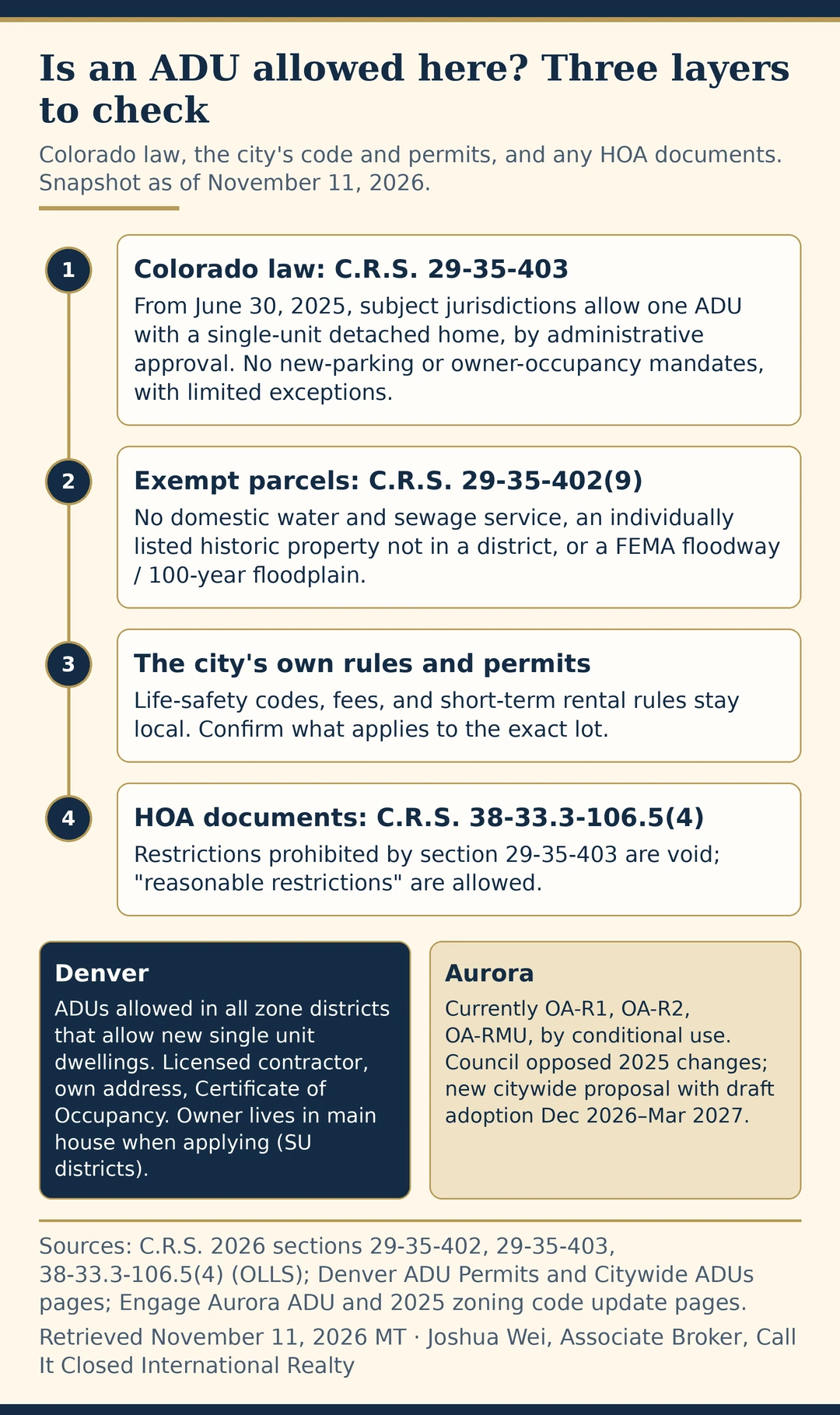
A vertical flow diagram, cream background with navy type and gold accents, titled Is an ADU allowed here? Three layers to check, with the subtitle Colorado law, the city's code and permits, and any HOA documents, snapshot as of November 11, 2026. Four numbered steps: 1, Colorado law C.R.S. 29-35-403, under which from June 30, 2025 subject jurisdictions allow one ADU with a single-unit detached home by administrative approval, without new-parking or owner-occupancy mandates, with limited exceptions; 2, exempt parcels under C.R.S. 29-35-402(9), meaning no domestic water and sewage service, an individually listed historic property not in a district, or a FEMA floodway or 100-year floodplain; 3, the city's own rules and permits, where life-safety codes, fees, and short-term rental rules stay local, so confirm what applies to the exact lot; 4, HOA documents under C.R.S. 38-33.3-106.5(4), where restrictions prohibited by section 29-35-403 are void but reasonable restrictions are allowed. Two lower cards: Denver, where ADUs are allowed in all zone districts that allow new single unit dwellings, with a licensed contractor, their own address, and a Certificate of Occupancy, and the owner living in the main house when applying in single unit districts; and Aurora, where ADUs are currently in OA-R1, OA-R2, and OA-RMU by conditional use, the council opposed 2025 changes, and a new citywide proposal lists draft adoption from December 2026 to March 2027. Sources: Colorado Revised Statutes, City and County of Denver, and Engage Aurora. Retrieved November 11, 2026 MT.
Sources: C.R.S. 2026 Title 29 (PDF) (opens in a new tab); Denver ADU Permits (opens in a new tab); Engage Aurora, ADU zoning code update (opens in a new tab)
Cream background, navy text, gold rules. Four numbered steps on a gold spine, two side-by-side city cards, and a 28px source footer.
The diagram above compares the three layers that decide whether an ADU is allowed: Colorado's 2024 law, Denver's permit rules, and Aurora's current code and pending update. It summarizes official sources as of November 11, 2026.
What does Colorado's ADU law require?
House Bill 24-1152 added Part 4 to Article 35 of Title 29. It applies to a "subject jurisdiction," which C.R.S. 29-35-402(21) (opens in a new tab) defines as "A municipality that both has a population of one thousand or more, as reported by the state demography office, and is within a metropolitan planning organization," or certain parts of counties.
Beyond allowing one ADU, C.R.S. 29-35-403(2) says that on or after June 30, 2025, a subject jurisdiction "shall not":
- "Require the construction of a new off-street parking space in connection with the construction or conversion of an accessory dwelling unit," with limited exceptions.
- "Require an accessory dwelling unit, or any other dwelling on the same lot as an accessory dwelling unit, to be owner-occupied," although it may require an owner to show they live on the parcel when applying "To construct or convert an accessory dwelling unit" or for a short-term rental license or permit.
- "Apply a restrictive design or dimension standard to an accessory dwelling unit."
Local governments keep real powers. Under 29-35-403(3), nothing prevents them from "Applying and enforcing a locally adopted life safety code, including but not limited to, a building, fire, utility, or stormwater code," adopting impact fees, or "Enacting or applying a local law concerning the short-term rental of an accessory dwelling unit or any other dwelling on the same lot as an accessory dwelling unit."
What counts as a "restrictive design or dimension standard"?
The statute defines it. Under C.R.S. 29-35-402 (opens in a new tab), it means a local standard that, among other things:
- "Requires an architectural style, building material, or landscaping that is more restrictive for an accessory dwelling unit than for a single-unit detached dwelling in the same zoning district";
- "Does not allow for accessory dwelling unit sizes between five hundred and seven hundred fifty square feet";
- "Requires side setbacks for an accessory dwelling unit that are larger than the side setbacks required for a primary dwelling unit in the same zoning district";
- "Requires a rear setback for an accessory dwelling unit that is larger than the greater of" the rear setback for other accessory buildings in the district, or "Five feet"; or
- "Is a more restrictive minimum lot size standard for an accessory dwelling unit than for a single-unit detached dwelling in the same zoning district."
So the state law sets a floor, not a full rulebook. A city can still set height, size and placement rules, as long as they don't cross those lines.
What does "administrative approval" mean?
Section 29-35-402 defines an "administrative approval process" as one in which a proposal "is approved, approved with conditions, or denied by local government administrative staff based solely on its compliance with objective standards set forth in local laws," and which "Does not require, and cannot be elevated to require, a public hearing, a recommendation, or a decision by an elected or appointed public body or a hearing officer." There is a limited exception for historic properties in certified local governments. Compare that with Aurora's description, below, of current ADUs as requiring a "conditional use permit with a public hearing."
Incentives for cities
The law also creates a voluntary track. Under section 29-35-404, a local government can be certified as an "accessory dwelling unit supportive jurisdiction" by showing it complies with section 29-35-403 and uses strategies such as "Providing pre-approved plans for the construction of accessory dwelling units" or "Waiving, reducing, or providing financial assistance for accessory dwelling unit-related fees that are incurred by low- and moderate-income households." Section 29-35-405 creates "The accessory dwelling unit fee reduction and encouragement grant program" for certified jurisdictions. Whether Denver or Aurora is certified is a question for the city or the Colorado Department of Local Affairs.
Some lots are exempt. C.R.S. 29-35-402(9) defines an "exempt parcel" to include one "Not served by a domestic water and sewage treatment system," "A historic property that is not within a historic district," or one "In a floodway or in a one hundred year floodplain, as identified by the federal emergency management agency."
What are Denver's ADU rules?
Denver's Citywide ADUs page (opens in a new tab) says the change "allows ADUs on 70% of Denver's land, compared to 36% before this measure passed. The measure went into effect on December 16, 2024."
Denver's ADU permit page lists general rules, including:
- "ADUs must be built by a licensed contractor. Homeowners cannot apply for permits to build an ADU."
- "Only one ADU is allowed per primary dwelling unit."
- "ADUs must have their own address."
- "In single unit zone districts, a property owner must live in the main house when applying for permits to build an ADU on the property. This is not required for when the main house and ADU are being built at the same time."
- "The Denver Zoning Code regulates the height, size, and placement of ADUs."
- "For ADU water service from Denver Water, a new license may be required. Additional fees may apply."
- "A Certificate of Occupancy is required before the ADU can be lived in."
It also says: "All new ADUs need zoning, building, and sewer use and drainage permits (SUDP)."
On renting, the page warns: "Short-term rentals, including short-term rentals of ADUs, are highly regulated in Denver and require licenses."
Where does Aurora stand?
Aurora's situation is in flux, so read this section as a snapshot.
The city's 2025 zoning code update page (opens in a new tab), which proposed changes in response to HB24-1152, carries this note: "At the June 9 regular City Council meeting, the Aurora City Council voted to oppose these proposed changes to the city's zoning code." That page's timeline lists the City Council meeting as June 09 2025.
A newer ADU zoning code update page (opens in a new tab), published in August 2026, says: "The city is proposing an amendment to the Unified Development Ordinance (UDO) related to Accessory Dwelling Units (ADUs)." It lists the major changes as "Expanding ADUs citywide," "Increasing the allowable ADU types to include internal, attached and detached," "Developing high-quality architectural and use standards," and "Moving to administrative approvals for the three types through a building permit."
On current rules, the same page says: "Currently, ADUs are permitted in three zone districts: OA-R1, OA-R2 and OA-RMU." It adds: "The city has permitted detached-only ADUs since 2018," "Permitted within Original Aurora," and "Require conditional use permit with a public hearing (approved by Planning and Zoning Commission)."
If you are buying in Aurora because of an ADU or ADU potential, ask the city's planning staff what applies to that lot today and whether an existing unit was permitted.
Can an HOA stop an ADU?
Colorado's HOA statute addresses this. C.R.S. 38-33.3-106.5(4) (opens in a new tab) says that in a subject jurisdiction or an ADU-supportive jurisdiction, no declaration, bylaw, or rule of an association "may restrict the creation of an accessory dwelling unit as an accessory use to any single-unit detached dwelling in any way that is prohibited by section 29-35-403." Such a provision "is void as a matter of public policy."
There is an exception for "reasonable restrictions," defined as "a substantive condition or requirement that does not unreasonably increase the cost to construct, effectively prohibit the construction of, or extinguish the ability to otherwise construct, an accessory dwelling unit."
Whether a particular HOA rule is reasonable, and how this applies in a city whose own code has not yet been updated, are legal questions. Ask an attorney.
What should a buyer check on a home with an ADU?
- Permits. Denver's page says "A Certificate of Occupancy is required before the ADU can be lived in." For permit history, ask the seller and the city.
- Address and utilities. Denver requires a separate address and says a new Denver Water license may be required.
- Rental plans. Short-term rentals of ADUs require licenses in Denver, and state law leaves short-term rental rules to local governments.
- Exempt parcel. C.R.S. 29-35-402(9) lists floodplain and historic-property exemptions; ask the city whether one applies to the lot.
- HOA documents. Whether a declaration or rule is enforceable under C.R.S. 38-33.3-106.5(4) is a question for an HOA attorney.
- Lender and insurer. How a loan or policy treats the ADU is a question for your lender and a licensed insurance agent.
Related: Flood map and drainage guide (opens in a new tab).
How do lenders and appraisers look at an ADU?
This is lender territory, but Fannie Mae's Selling Guide is public and shows what a conventional lender may ask. Ask your lender which rules apply to your loan.
What counts as an ADU. Fannie Mae's B2-3-04, Special Property Eligibility Considerations (opens in a new tab), says: "Only one ADU is permitted on the parcel of the primary one-unit dwelling. ADUs are not permitted with a two- to four-unit dwelling." It says the ADU "must be subordinate in size to the primary dwelling" and have separate "means of ingress/egress, kitchen, sleeping area, bathing area, and bathroom facilities." And: "it is not considered an ADU if it can only be accessed through the primary dwelling or the area is open to the primary dwelling with no expectation of privacy." On kitchens: "An independent second kitchen by itself does not constitute an ADU."
One unit or two. The same section says: "Whether a property is defined as a one-unit property with an ADU or a two- to four-unit property will be based on the characteristics of the property, which may include, but are not limited to, the existence of separate utility meter(s), a unique postal address, and whether the unit can be legally rented." Denver requires ADUs to "have their own address," so that question can come up.
Zoning. B2-3-04 says: "An ADU should always be considered legal if it is allowed under the current zoning code for the subject property." If an ADU "is not allowed under zoning (where an ADU is not allowed under any circumstance)," the property can still be eligible if, among other conditions, "The lender confirms that the existence will not jeopardize any future property insurance claim that might need to be filed for the property."
Square footage. Fannie Mae's B4-1.3-05 (opens in a new tab) says an ADU's living area "should not be included with the finished above-grade square footage calculation of the primary dwelling" unless it "is contained within or part of the primary dwelling with interior access and above grade." A listing that adds the ADU to the house's square footage may not match the appraisal.
Rental income. Fannie Mae's B3-3.8-02, Rental Income from the Subject Property (opens in a new tab), lists these ADU limits: "Rental income is only allowed from one existing ADU. Purchase or limited cash-out refinance transactions only. The qualifying rental income amount from the ADU is limited to 30% of the total qualifying income." Whether projected ADU rent helps you qualify, and how much, is a question for your lender.
A hypothetical
This example is invented. A buyer is looking at a Denver house with a detached garage apartment that the listing calls an ADU, and plans to rent it to help with the payment. Before the inspection deadline, she asks the seller for the ADU's permits and Certificate of Occupancy, since Denver says one "is required before the ADU can be lived in." She checks whether the unit has its own address. She asks her lender whether the unit meets the lender's ADU definition and whether projected rent can count, given the 30 percent cap in Fannie Mae's guide. She asks Denver's licensing office what license a long-term or short-term rental of the unit would need.
Frequently asked questions
Does state law let me build an ADU anywhere?
No. It applies in subject jurisdictions, to lots where single-unit detached homes are allowed, and not to exempt parcels. Local building, fire, utility, and stormwater codes still apply.
Do I have to live on the property?
C.R.S. 29-35-403(2) says a subject jurisdiction shall not "Require an accessory dwelling unit, or any other dwelling on the same lot as an accessory dwelling unit, to be owner-occupied," with the application exception it describes. Denver's permit page has an owner-residency requirement at application in single unit zone districts. Ask the city about a specific lot.
Can I Airbnb my ADU?
State law preserves local short-term rental rules. Denver says short-term rentals of ADUs "are highly regulated in Denver and require licenses."
Is a basement apartment an ADU?
State law includes "internal" units, if they provide "complete independent living facilities." Whether a specific space is legal depends on permits and local code.
What size can an ADU be?
State law says a jurisdiction cannot refuse to allow sizes "between five hundred and seven hundred fifty square feet" where the law applies. Denver's zoning code sets its own limits; ask Denver zoning about a specific lot.
Can rent from an ADU help me qualify for a mortgage?
Under Fannie Mae's guide, it can count for a purchase or limited cash-out refinance, from "one existing ADU," and "limited to 30% of the total qualifying income." Other loan programs have their own rules; ask your lender.
Can a city require a public hearing for my ADU?
Under C.R.S. 29-35-403(1), a subject jurisdiction must allow one ADU "subject to an administrative approval process," which the statute defines as one that "cannot be elevated to require, a public hearing." How that applies to a specific city is a legal question.
Is Aurora required to follow the state law?
That is a legal question. This article reports what Aurora's own pages say and does not offer an opinion on compliance.
Related notes
- Thinking of Airbnb income? Denver and Aurora short-term rental rules for buyers, explained
- Buying a home you might rent out? Denver's rental license and Aurora's rental rules, explained
- Checking permit history before you buy in Denver or Aurora: where to look and what unpermitted work can mean
Sources and method
Official sources, retrieved November 11 and 13, 2026, America/Denver: Colorado Revised Statutes 2026, Title 29 (opens in a new tab) (sections 29-35-402 to 29-35-405) and Title 38 (opens in a new tab) (section 38-33.3-106.5(4)), Office of Legislative Legal Services; City and County of Denver ADU permit page (opens in a new tab) and Citywide ADUs page (opens in a new tab); City of Aurora ADU zoning code update (opens in a new tab) and 2025 zoning code updates (opens in a new tab) pages on Engage Aurora. Quotations are verbatim. Denver ADU size limits are not restated because the zoning code PDF found was republished February 25, 2025, and the code has been amended since. Lending and appraisal points quote Fannie Mae's Selling Guide sections B2-3-04 (opens in a new tab), B4-1.3-05 (opens in a new tab) and B3-3.8-02 (opens in a new tab); other loan programs may differ, and no insurance claims are made. The hypothetical is invented.
This note is general education from a Colorado real estate broker with Call It Closed International Realty. If you are considering a Denver or Aurora home with an ADU, or one with ADU potential, I can help you build the permit, HOA, and city checks into your contract dates.
Disclaimer
This article is general information only. It is not legal, tax, lending, insurance, appraisal, inspection, or financial advice, and it is not a substitute for advice about your situation. Joshua Wei is a Colorado real estate broker, not an attorney. Reading this article does not create a client relationship, an agency relationship, or an attorney-client relationship with Joshua Wei or with Call It Closed International Realty.
Laws, program rules, interest rates, insurance terms, tax figures, and other details change. Examples in this article are hypothetical illustrations unless a source is named for a specific, dated figure. Information in this article is believed accurate as of November 13, 2026 and is not guaranteed. No result is promised, and you should not rely on this article as the last word for your situation.
Before you act, confirm the point with the official source linked or cited in this article, and talk with a licensed professional who can apply the rule to your facts. That may be a licensed attorney, a tax professional, a lender, an insurance agent, a home inspector, or another licensed professional, depending on the question. Links to third-party websites and publications are provided for reference only. They are not an endorsement, and their content can change.
If you already have a brokerage relationship with another broker, this is not a solicitation.
Joshua Wei, Associate Broker, Call It Closed International Realty, Colorado license FA.100108558. Equal Housing Opportunity.