September 13, 2026 · Denver · Aurora · Buying · Zoning · RV
Can I park my RV or trailer at home in Denver or Aurora? What buyers should check
Planning to keep a camper, trailer, or boat at your next home? What the Denver Zoning Code says about trailer and RV length, location, and screening, and what Aurora's code says about parking surfaces and 24-hour street limits.
The short answer
In brief: If you own an RV, camper, trailer or boat, check the rules before you buy, not after. In many Denver single-unit and two-unit neighborhoods, Denver Zoning Code section 10.9.3.6 bars parking an automobile trailer exceeding 22 feet in length and sets location and screening rules for recreational vehicles. Aurora's code has its own rules.
If you own an RV, camper, trailer, or boat, check the rules before you buy, not after.
- Denver. In many single-unit and two-unit neighborhoods, Denver Zoning Code section 10.9.3.6 (opens in a new tab) bars parking "An automobile trailer exceeding 22 feet in length" and sets location and screening rules. Recreational vehicles up to 33 feet must be parked "behind the Primary Street-facing façade of the primary structure," with setback and screening rules.
- Aurora. The city's neighborhood zoning codes page (opens in a new tab) says "Parking of any type of vehicles, boats, trailers and campers on landscape and/or lawn portion of the yard is prohibited." Aurora City Code section 134-358 (opens in a new tab) limits a recreational vehicle on the street to 24 hours "during any seven-day period."
HOA rules can be stricter than either city's code.
I am a licensed Colorado real estate broker with Call It Closed International Realty. I am not an attorney.
Disclaimer. This article is general information only. It is not legal, tax, lending, insurance, appraisal, inspection, or financial advice, and reading it does not create a client, agency, or attorney-client relationship. Laws, rates, programs, and figures change. Confirm the official source, and talk with a licensed attorney, tax professional, lender, insurance agent, or inspector before you act. Joshua Wei is a Colorado real estate broker, not an attorney. He is an Associate Broker with Call It Closed International Realty, license FA.100108558. Equal Housing Opportunity.
 Full size (opens in a new tab)
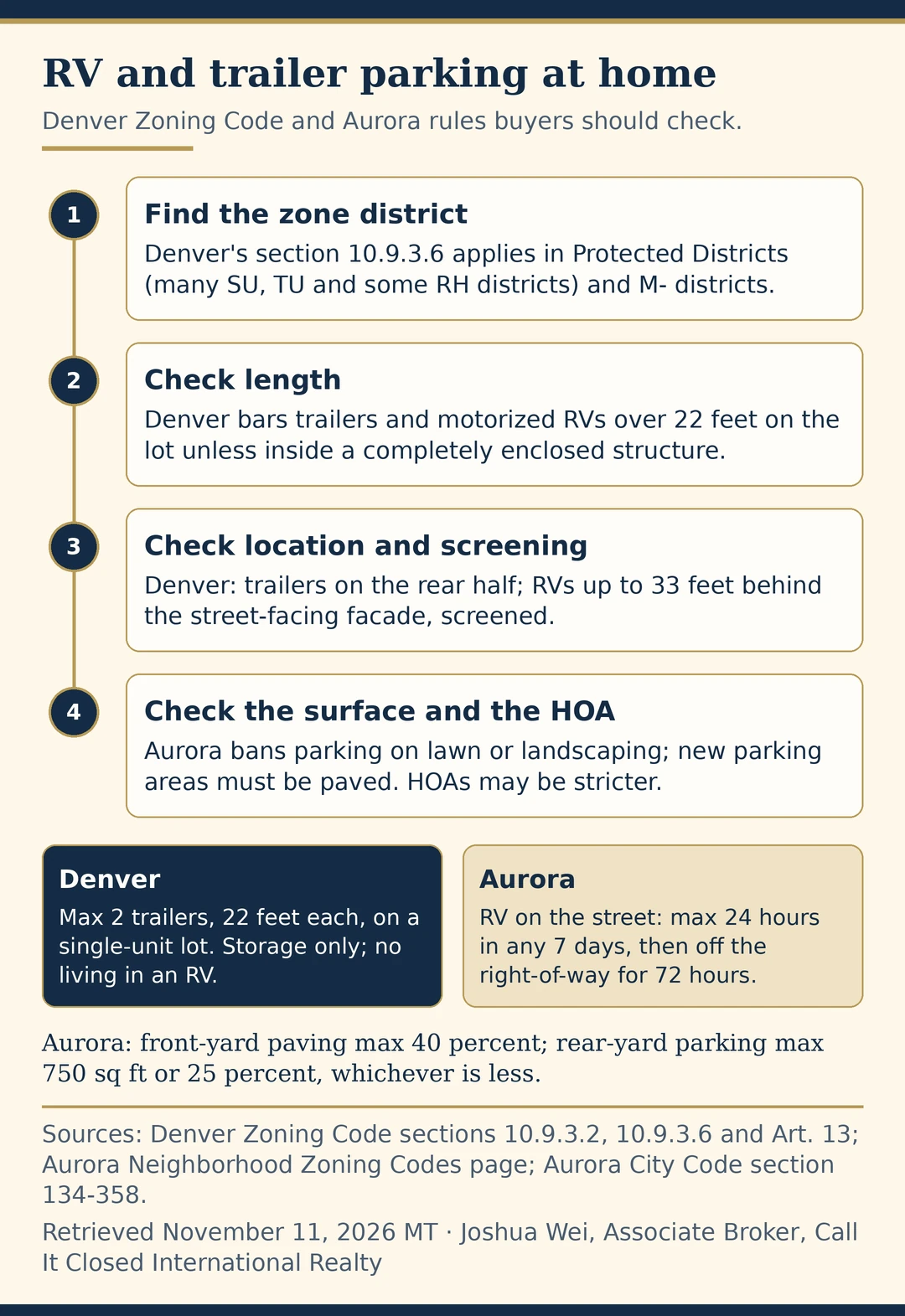
A vertical flow diagram, cream background with navy type and gold accents, titled RV and trailer parking at home. Subtitle: Denver Zoning Code and Aurora rules buyers should check. 4 numbered steps: 1, Find the zone district: Denver's section 10.9.3.6 applies in Protected Districts (many SU, TU and some RH districts) and M- districts; 2, Check length: Denver bars trailers and motorized RVs over 22 feet on the lot unless inside a completely enclosed structure; 3, Check location and screening: Denver: trailers on the rear half; RVs up to 33 feet behind the street-facing facade, screened; 4, Check the surface and the HOA: Aurora bans parking on lawn or landscaping; new parking areas must be paved. HOAs may be stricter. Two cards: Denver: Max 2 trailers, 22 feet each, on a single-unit lot. Storage only; no living in an RV; and Aurora: RV on the street: max 24 hours in any 7 days, then off the right-of-way for 72 hours. A note says: Aurora: front-yard paving max 40 percent; rear-yard parking max 750 sq ft or 25 percent, whichever is less. Sources: Denver Zoning Code sections 10.9.3.2, 10.9.3.6 and Art. 13; Aurora Neighborhood Zoning Codes page; Aurora City Code section 134-358. Retrieved November 11, 2026 MT. Joshua Wei, Associate Broker, Call It Closed International Realty.
Sources: Denver Zoning Code Article 10 (opens in a new tab); Aurora City Code 134-358 (opens in a new tab)
Cream background, navy text, gold rules. Numbered navy circles on a gold spine with white step cards, two branch cards (navy and tan), a note, and a source footer.
The figure above compares the Denver and Aurora rules for RVs and trailers.
Which Denver properties do the RV rules cover?
Section 10.9.3.6 applies "to properties located in a Protected zone district and to residential uses located in the Master Planned (M-) zone districts." Article 13 of the code lists the Protected Districts. They include single-unit districts such as U-SU-C and E-SU-D, two-unit districts such as U-TU-B, and some row house districts. Check the property's zone district on the city's zoning map.
What counts as an RV or a trailer in Denver?
The Article 13 definitions matter here because the rules turn on them.
- Recreational Vehicle: "A vehicular-type, portable structure without permanent foundation for personal household use, which can be towed, hauled or driven and primarily designed as living accommodation for recreational, camping and travel use and including travel trailers, truck campers, camping trailers, and self-propelled motor homes."
- Large Recreational Vehicle: one "that has a gross vehicle weight greater than 10,000 pounds." The code adds that the term "Recreational Vehicle" includes "Large Recreational Vehicle."
- Large-Scale Motor Vehicles and Trailers: "Motor vehicles including trucks, recreational vehicles, buses, boats, and heavy equipment and similar size vehicles which have gross vehicle weights greater than 10,000 pounds. This definition shall not include Recreational Vehicles."
- Detached camper units: "A shell designed to be mounted on a pickup or truck chassis for use as a temporary shelter for travel, recreation and vacation use."
Under these definitions, a boat trailer is a trailer, since the Trailer definition names "boat trailers," unless the rig is heavy enough to fall under the 10,000-pound Large-Scale category. A pop-up camping trailer is an RV, since the RV definition names "camping trailers."
What can't be parked on a Denver lot in those districts?
The code says these "shall not be parked or stored on a zone lot":
- "Large-Scale Motor Vehicles and Trailers"
- "An automobile trailer exceeding 22 feet in length"
- "A bus or motorized recreation vehicle exceeding 22 feet in length"
- "A truck-tractor or semi-trailer"
There's an exception for enclosed storage: "An automobile trailer or Recreational Vehicle of any length may be stored within a completely enclosed structure located so as to comply with all the requirements for the location of structures on the zone lot."
Work vehicles in any residential district
A separate rule, section 10.9.1, reaches further. It covers every residential zone district, not just Protected Districts. On a residential zone lot, it bars parking or storing "Tow trucks," "Large-Scale Motor Vehicles and Trailers," "Stake body trucks," "Cube or box vans," "Backhoes," "Vehicles towing trailers carrying machinery and supplies," and "Other similar specialized vehicles." The exception is narrow. These vehicles may be parked "only to render services to the subject zone lot and only for the duration necessary to render such services." A buyer who drives a box van home from work should read this one first.
Where can a trailer or RV go on the lot?
- Trailers and campers. "Automobile trailers not exceeding 22 feet in length and detached camper units shall be parked or stored only on the rear one-half of the zone lot." If the rear half doesn't abut an alley, they may go on the front half only if they meet setbacks and are screened by a solid fence or wall.
- RVs up to 33 feet. They must be behind the street-facing façade, meet side setback rules, and be screened from the street and neighbors.
- No living in it. They "may be parked only for storage purposes and shall not be used for temporary or permanent residential occupancy."
Denver also limits trailers on a lot with a single-unit dwelling: "Permitted number: 2," "Maximum length: 22 feet," and "Each trailer shall be designed to have and be used for a substantially different purpose."
How many vehicles in total?
Section 10.9.3.1 caps vehicles too. In single-unit, two-unit, row house and manufactured home community districts, a zone lot may have "no more than 1 motor vehicle per licensed driver residing in each dwelling unit plus 1 additional motor vehicle per dwelling unit, to a maximum of 6 motor vehicles per dwelling unit." Under section 10.9.3.3, motorcycles are counted separately: one per licensed motorcycle driver plus one more per unit.
Repairs and project vehicles
Buyers who plan to work on vehicles at home should read section 10.9.3.4 and section 10.9.3.5.
- Engine and transmission repairs on your own vehicles are allowed "from 8:00 a.m. to 9:00 p.m. inside a completely enclosed garage structure," but this excludes "any auto body and fender work, or the painting of motor vehicles."
- "Customary maintenance" outdoors on a driveway is allowed during the same hours. The code lists "washing; polishing; fluid changes; greasing; tire changing; brake repair; muffler replacement; engine tune-up; flushing of radiators."
- Occupants "shall not repair motor vehicles belonging to another person or persons that do not reside in the same dwelling unit."
- An inoperable vehicle must be "stored inside a completely enclosed garage structure," and it's limited to "one such vehicle per dwelling unit."
Renting a neighbor's garage
If your own lot can't hold a vehicle, section 10.9.3.7 offers an option. Vehicles "may be parked or stored in accessory attached or detached garages on Zone Lots not occupied by the owner of such motor vehicle" if the garage is "on a Zone Lot on the same Block as the subject vehicle owner resides" or "on an immediately adjacent Block." The code adds that "named or numbered streets do not destroy adjacency." The garage "Is not to be used for repair of vehicles by the non-resident owner of the vehicle." This doesn't help with outdoor RV parking. It's about garages only.
Parking an RV or trailer on a Denver street
The street is governed by Denver's parking ordinances, not the zoning code. The city's parking ordinances page (opens in a new tab) quotes them.
- Large RVs and attached trailers, section 54-464(b). This covers "A licensed vehicle containing an attached recreational vehicle with a combined overall length exceeding twenty-two (22) feet, a recreational vehicle exceeding twenty-two (22) feet in length, or a trailer attached to a licensed vehicle." The limit is "twenty-four (24) hours during any seven-day period on a public right-of-way."
- Unattached trailers and big trucks, section 54-464(a). For "a trailer not attached to a licensed vehicle," a vehicle over 6,000 pounds empty weight or 22 feet long, or a truck-tractor or semitrailer, the limit is "two (2) hours during any seven-day period."
- Moving it doesn't reset the clock. Under both parts of section 54-464, a vehicle is in violation "if it has not been moved to a location that is at least seven hundred (700) feet away during the seven-day period," and the time limit "includes the cumulative time spent on any public right-of-way."
- Smaller RVs, section 54-465(b). "A recreational vehicle that does not exceed twenty-two (22) feet in length shall be considered in violation of this section if it has not been moved to a location that is at least seven hundred (700) feet away during the seventy-two-hour period of time."
There's an exception in section 54-464 for vehicles "actively engaged in rendering services in the immediate area," and the code adds that "'rendering services' does not include idling or waiting for a business to open."
What does Aurora require?
Aurora's page says "Only 40 percent of the front yard can be a parking or driveway surface." A rear-yard parking surface "cannot exceed 750 square feet or 25 percent of the backyard, whichever is less." It also says "Any new parking area must be surfaced with asphalt, concrete, brick or stone pavers."
Aurora's street rule defines a recreational vehicle to include "motor homes, camper trailers, truck campers, camper vans, watercraft, snowmobiles, and off-highway vehicles." The definition excludes "a truck with a truck bed cap, shell, cover, or topper." A separate definition covers a camper trailer: "any wheeled vehicle, without motive power, which contains living or sleeping quarters and which may occasionally be drawn over the public highways by a motor vehicle and may be licensed as a vehicle." Aurora's list also reaches beyond RVs in the everyday sense. It names "watercraft, snowmobiles, and off-highway vehicles," so a boat left on the street falls under the same 24-hour limit. Moving the RV down the block doesn't reset the clock. The code says "It shall not be a defense to this section that the recreational vehicle has been moved to a different location within the public right-of-way." It "must be removed from the public right-of-way for no less than 72 consecutive hours."
Enforcement is spelled out in section 134-358(b). A police or public works employee may put a citation on the vehicle, and "If cited recreational vehicle has not been removed within 24 hours after being cited for violating this section, a member of the Aurora police department is empowered to have the recreational vehicle towed or removed."
Aurora's yard paving rules in practice
The three paving limits on Aurora's page work together. Parking must be on a paved surface, not lawn or landscape. The front yard can't be more than 40 percent "parking or driveway surface." A rear-yard pad "cannot exceed 750 square feet or 25 percent of the backyard, whichever is less." On a 2,000-square-foot backyard, 25 percent is 500 square feet, so 500 is the cap. Any new pad must be "asphalt, concrete, brick or stone pavers," so a gravel strip for a trailer doesn't qualify.
Three hypotheticals
These are invented, to show how the rules fit together.
A 26-foot travel trailer in a Denver bungalow neighborhood. The buyer's lot is in a U-SU-C district, a Protected District. Two provisions point different ways. Article 13 lists "travel trailers" in the Recreational Vehicle definition, and section 10.9.3.6(B) lets RVs up to 33 feet sit behind the street-facing façade if they meet side setbacks and are screened. But section 10.9.3.6(A) bars "An automobile trailer exceeding 22 feet in length." The code text doesn't say which one controls a 26-foot travel trailer. The buyer should get the zoning team's answer in writing before relying on either reading. Either way, the trailer would need a route behind the house and a screening fence, or a completely enclosed structure, which is allowed for any length. On the street, section 54-464(b) gives it 24 hours in any seven days.
A boat and a utility trailer. A buyer has a 20-foot boat on a trailer and a 12-foot utility trailer. In Denver, section 10.9.3.2 allows two trailers on a single-unit lot, each up to 22 feet, if they serve "a substantially different purpose." Hauling a boat and hauling yard waste are different purposes. In a Protected District, both trailers go on the rear half of the lot, or on the front half only if they meet setbacks and are screened.
A camper van in Aurora. An Aurora buyer has a camper van and plans to park it on the street between trips. Section 134-358 names "camper vans," so the 24-hours-in-seven-days limit applies. After that, it must be off the right-of-way for 72 consecutive hours. The buyer needs a paved spot on the lot, and Aurora's page limits front-yard paving to 40 percent.
What should I check before I buy?
- The zone district, and whether it's a Protected District in Denver
- Lot depth, side yard width, and alley access for a trailer or RV
- Gate width and the paved surface
- HOA covenants on RVs, trailers, and boats
- Whether a garage is tall enough for enclosed storage
- The vehicle's length and gross vehicle weight from its title or spec sheet, since the rules turn on 22 feet, 33 feet and 10,000 pounds
- Whether any work vehicle you bring home falls under Denver's section 10.9.1 list
Frequently asked questions
Can I keep a 30-foot travel trailer in my Denver backyard?
In Protected Districts, the code bars parking or storing an automobile trailer over 22 feet on a zone lot unless it's inside a completely enclosed structure. Article 13 also lists travel trailers as Recreational Vehicles, which may be up to 33 feet with location and screening rules. Ask Denver zoning staff which provision applies to your trailer.
Can I park an RV in my Denver driveway?
In Protected Districts, an RV up to 33 feet must be behind the street-facing façade, meet setbacks, and be screened. The barred list also includes motorized RVs over 22 feet. The two provisions overlap, so ask Denver zoning staff how they apply to a motorized RV between 22 and 33 feet.
Can I live in an RV parked at my house in Denver?
The code says such vehicles "shall not be used for temporary or permanent residential occupancy."
Can I park on the lawn in Aurora?
No. The city says parking vehicles, boats, trailers, and campers on landscape or lawn areas "is prohibited."
How long can an RV sit on an Aurora street?
No more than 24 hours in any seven-day period, and it must then be off the right-of-way for at least 72 consecutive hours.
How long can an RV sit on a Denver street?
Under Denver's parking ordinance, section 54-464(b), an RV over 22 feet long, or a trailer attached to a vehicle, may be parked on public streets for no more than 24 hours in any seven-day period. That time counts every public street, so moving it down the block does not reset the clock. A shorter RV must be moved at least 700 feet every 72 hours under section 54-465(b). Denver Parking Enforcement can answer questions about a specific vehicle.
Can I fix my car in my Denver driveway?
Customary maintenance is allowed outdoors from 8:00 a.m. to 9:00 p.m. under section 10.9.3.4(C). Engine and transmission work must be done inside a completely enclosed garage, and body work and painting aren't allowed.
Do HOAs have their own rules?
They can. Read the declaration and rules before you go under contract.
Related notes
- What a Colorado HOA can't prohibit: flags, signs, xeriscape, EV chargers, heat pumps, and more for Denver and Aurora owners
- Buying a Denver or Aurora condo: read the building before you price the unit
- Buying in Denver? The sidewalk fee, trash fee, and city service liens that come with the house
Sources and method
Official sources, retrieved November 11 and 13, 2026, America/Denver:
- Denver Zoning Code, Article 10 (opens in a new tab): sections 10.9.1, 10.9.3.1 to 10.9.3.6 (republished February 25, 2025)
- Denver Zoning Code, Article 13 (opens in a new tab): definitions of Protected District, Recreational Vehicle, Large-Scale Motor Vehicles and Trailers, Trailer, and Detached Camper Units
- City of Aurora, Neighborhood Zoning Codes (opens in a new tab)
- Aurora City Code section 134-358 (opens in a new tab). The Aurora code site blocks automated requests, so it was read through a web fetch on November 13, 2026.
- City and County of Denver, Parking Ordinances (opens in a new tab): sections 54-464 and 54-465
Aurora's full zoning code wasn't reviewed. The hypotheticals are invented.
This note is general education from a Colorado real estate broker with Call It Closed International Realty. For a specific lot, ask the city's zoning staff.
Disclaimer
This article is general information only. It is not legal, tax, lending, insurance, appraisal, inspection, or financial advice, and it is not a substitute for advice about your situation. Joshua Wei is a Colorado real estate broker, not an attorney. Reading this article does not create a client relationship, an agency relationship, or an attorney-client relationship with Joshua Wei or with Call It Closed International Realty.
Laws, program rules, interest rates, insurance terms, tax figures, and other details change. Examples in this article are hypothetical illustrations unless a source is named for a specific, dated figure. Information in this article is believed accurate as of November 19, 2026 and is not guaranteed. No result is promised, and you should not rely on this article as the last word for your situation.
Before you act, confirm the point with the official source linked or cited in this article, and talk with a licensed professional who can apply the rule to your facts. That may be a licensed attorney, a tax professional, a lender, an insurance agent, a home inspector, or another licensed professional, depending on the question. Links to third-party websites and publications are provided for reference only. They are not an endorsement, and their content can change.
If you already have a brokerage relationship with another broker, this is not a solicitation.
Joshua Wei, Associate Broker, Call It Closed International Realty, Colorado license FA.100108558. Equal Housing Opportunity.